


I teach IGCSE Geography at an international school in Southeast Asia. This was one of my best-selling lessons, but a model lesson lives or dies by its data - so I rebuilt it from scratch for 2026: the model redrawn, the real-country data refreshed, and Stage 5 covered for the countries now shrinking. If you bought the original, the update is free, just re-download.
What’s in it:
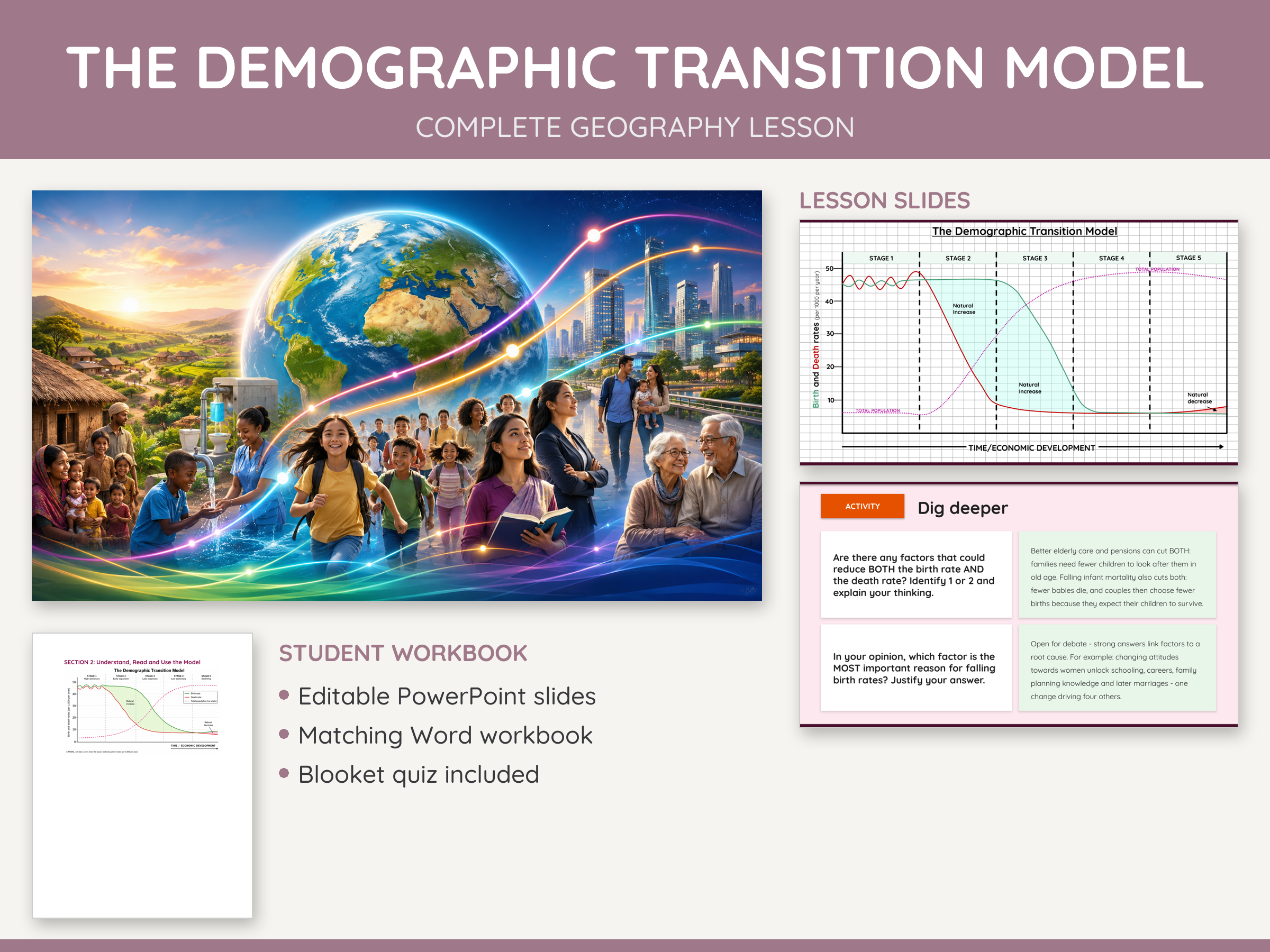
A complete, ready-to-teach lesson on the Demographic Transition Model, built around one big question: why do populations stop growing as countries get richer? You get a full PowerPoint presentation with answers included throughout (a “four countries, four stories” data starter with natural-increase calculations and The Gambia paradox, the five-stage model read line by line, a hinge question that kills the “stage 2 explodes because birth rates rise” misconception, a whiteboard showdown, The Living Graph stage-sorting task, a birth-rate/death-rate card sort, a case-for-and-against evaluation, and a real three-century dataset tested against the model), a Word workbook in four versions (Student-guided and Teacher-guided scaffolding, each in full colour and printer-friendly black and white, plus a ready-to-print PDF), and a 30-question Blooket quiz file for instant retrieval practice. Bonus access to free lesson-support activities and daily games on the Geography Oasis website.
What students learn:
- What the DTM shows and why demographers use it
- How birth rate, death rate and total population move through all five stages
- Why death rates fall first, then birth rates follow as a country develops
- How to calculate natural increase and read real population data
- How to evaluate the model - where it fits real countries and where it does not
- Why Stage 5 matters and some countries are now shrinking
The model is redrawn for 2026 and the real-world data section is refreshed to the latest available figures. Also suitable for AP Human Geography, World Geography, and any population, development or human geography unit at ages 11-16.
Format:
Delivered as fully editable PowerPoint (.pptx) and Word (.docx) files, plus PDF. Diagrams and visuals are not editable.
TEACHING CAMBRIDGE IGCSE GEOGRAPHY (0460)?
I have also rebuilt this whole topic as a complete Population & Migration unit for the 2027 syllabus: 7 modules with lesson slides, student workbooks, full answer keys and bonus interactive website access. Start with the free sample: https://www.tes.com/teaching-resource/resource-13453951
This is one of a growing collection of fully rebuilt 2026 geography lessons; more are on the way in my shop. If you find this useful, a review would mean a lot. It’s how other teachers discover these resources, and it helps me keep creating.
Something went wrong, please try again later.
This resource hasn't been reviewed yet
To ensure quality for our reviews, only customers who have purchased this resource can review it
Report this resourceto let us know if it violates our terms and conditions.
Our customer service team will review your report and will be in touch.
£2.90