


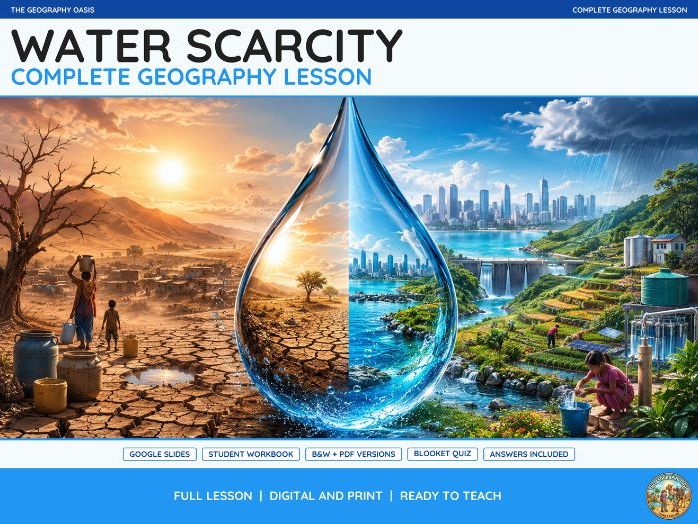
I teach IGCSE Geography at an international school in Southeast Asia. Water Scarcity was one of my best-selling lessons, but the story has moved fast: Cape Town’s close call has been joined by Mexico City and Tehran, and some of the old figures had drifted a long way from today’s data (the UK’s water-use split has literally reversed). So I rebuilt it from scratch, with every statistic re-verified against the latest WHO/UNICEF and UN water reports. If you bought the original, the update is free, just re-download.
What’s in it:
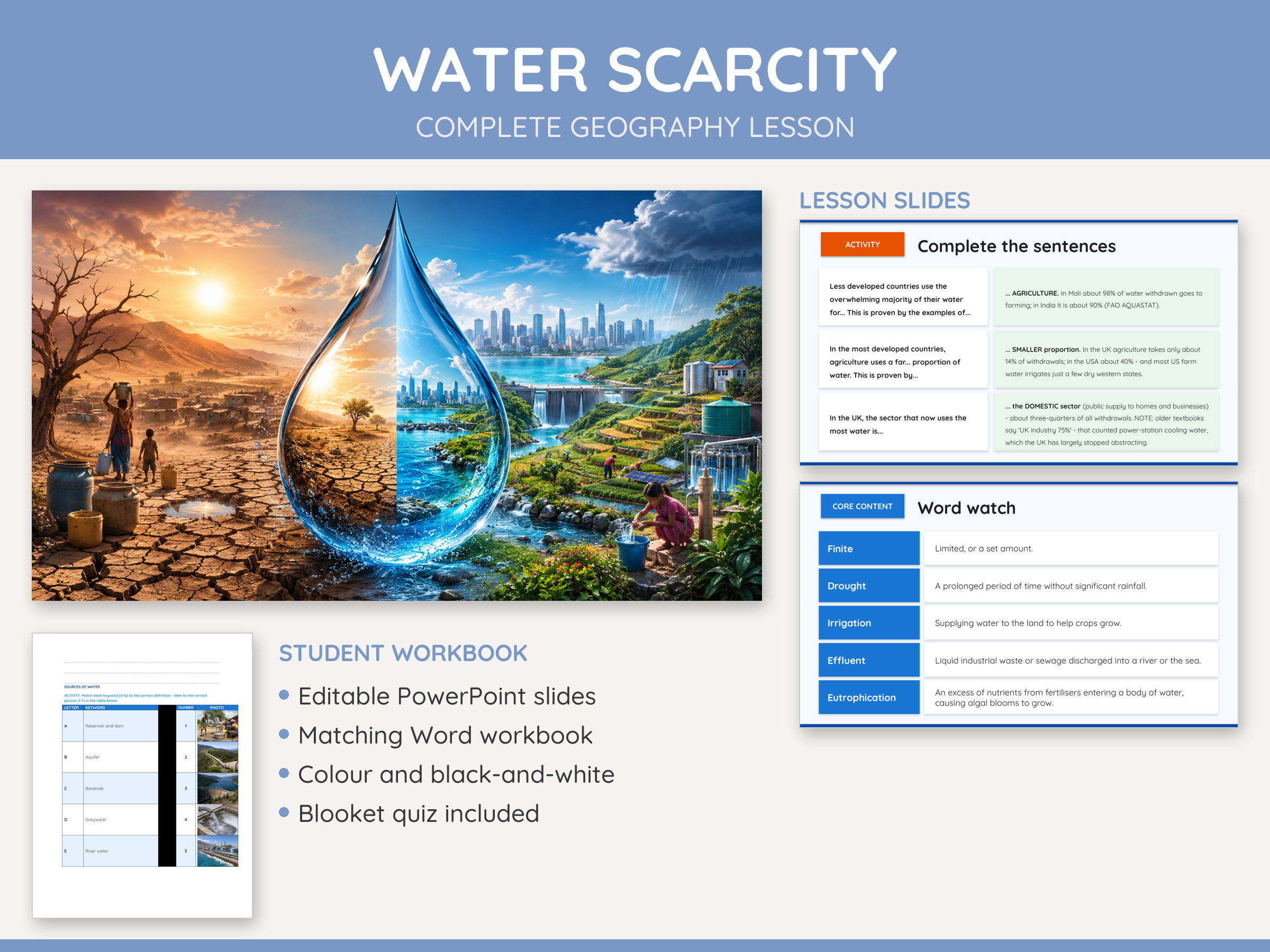
A complete, ready-to-teach lesson answering one big question: if most of the planet is covered in water, why do billions go thirsty? You get a full PowerPoint presentation with answers included throughout (a shade-the-graphs opener on where Earth’s water is, a sources-of-water match, “water diet” pie charts, the physical-versus-economic scarcity distinction with maps and distribution writing, the five causes of increasing scarcity, three close calls from the news, the Singapore Four National Taps and Konso, Ethiopia case studies, a five-minute annotate challenge, a HIC or LIC strategy sort, and a tomorrow’s headline exit ticket), a Word workbook in three versions (Full colour, printer-friendly black and white, ready-to-print PDF), and a 30-question Blooket quiz file for instant retrieval practice. Bonus access to free lesson-support activities and daily games on the Geography Oasis website.
What students learn:
- Where Earth’s water is found and why so little is usable
- The main sources of fresh water, from aquifers to reservoirs
- How countries at different development levels use water differently
- Physical versus economic water scarcity, and their global distributions
- Five reasons water scarcity is getting worse
- How a high-income and a low-income country secure their water supplies
Every figure is re-verified for 2026: about 2.1 billion people (1 in 4) lack safely managed drinking water, and around 4 billion face severe scarcity at least one month a year (WHO/UNICEF 2025; UN 2024). Also suitable for AP Human Geography, World Geography, and any water resources, development or global issues unit at ages 11-16.
Format:
Delivered as fully editable PowerPoint (.pptx) and Word (.docx) files, plus PDF. Diagrams and visuals are not editable.
TEACHING CAMBRIDGE IGCSE GEOGRAPHY (0460)?
I have also rebuilt this whole topic as a complete Development unit for the 2027 syllabus: 5 modules with lesson slides, student workbooks, full answer keys and bonus interactive website access. Start with the free sample: https://www.tes.com/teaching-resource/resource-13453955
This is one of a growing collection of fully rebuilt 2026 geography lessons; more are on the way in my shop. If you find this useful, a review would mean a lot.
It’s how other teachers discover these resources, and it helps me keep creating.
Get this resource as part of a bundle and save up to 21%
A bundle is a package of resources grouped together to teach a particular topic, or a series of lessons, in one place.
Something went wrong, please try again later.
This resource hasn't been reviewed yet
To ensure quality for our reviews, only customers who have purchased this resource can review it
Report this resourceto let us know if it violates our terms and conditions.
Our customer service team will review your report and will be in touch.
£4.40