


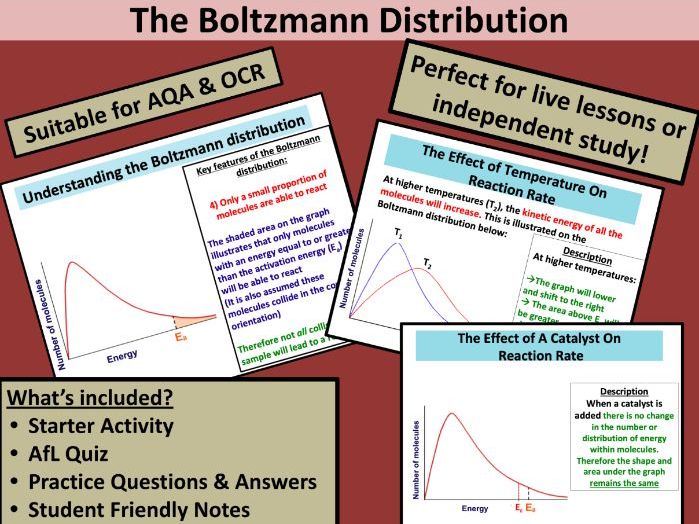
A structured Year 12 KS5 lesson including starter activity and AfL work tasks on The Boltzmann Distribution. Suitable for the AQA & OCR Specification (AS Chemistry)
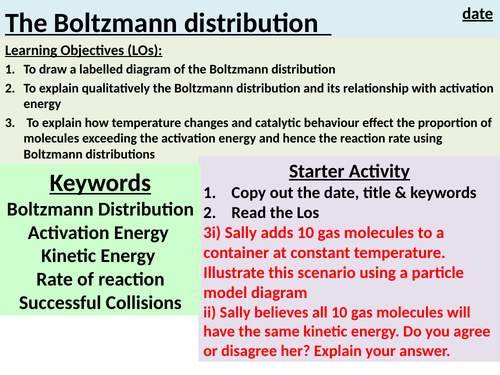
By the end of this lesson KS5 students should be able to:
**1. To draw a labelled diagram of the Boltzmann distribution
**2. To explain qualitatively the Boltzmann distribution and its relationship with activation energy
**3. To explain how temperature changes and catalytic behaviour effect the proportion of molecules exceeding the activation energy and hence the reaction rate using Boltzmann distributions
Declaimer: Please refrain from purchasing this popular resource for an interview lesson or a formal observation. This is because planning your own lessons including using your own lesson PowerPoints is a fundamental skill of a qualified/unqualified teacher that will be reviewed during these scenarios outlined above
Get this resource as part of a bundle and save up to 10%
A bundle is a package of resources grouped together to teach a particular topic, or a series of lessons, in one place.
Bundle
AS Chemistry: Kinetics (OCR)
3 full lesson bundle which covers the chapter: **Kinetics** from the **OCR AS Level Chemistry Specification**. If you teach the AQA specification, please purchase this bundle instead: https://www.tes.com/teaching-resource/as-chemistry-kinetics-aqa-13432577 **Lesson 1: Collision Theory & Rates of Reaction** 1. To explain the effect of concentration (including pressure of gases only) on the rate of reaction in terms of the frequency of collisions 2. To calculate the rate of reaction using the gradients of a concentration-time graph 3. To describe the techniques and procedures used to investigate reaction rates including the measurement of mass, gas volumes and concentration **Lesson 2: Catalysts** 1. To explain the effect of concentration (including pressure of gases only) on the rate of reaction in terms of the frequency of collisions 2. To calculate the rate of reaction using the gradients of a concentration-time graph 3. To describe the techniques and procedures used to investigate reaction rates including the measurement of mass, gas volumes and concentration **Lesson 3: The Boltzmann Distribution** 1. To draw a labelled diagram of the Boltzmann distribution 2. To explain qualitatively the Boltzmann distribution and its relationship with activation energy 3. To explain how temperature changes and catalytic behaviour effect the proportion of molecules exceeding the activation energy and hence the reaction rate using Boltzmann distributions ***Declaimer: Please refrain from purchasing this popular resource for an interview lesson or a formal observation. This is because planning your own lessons including using your own lesson PowerPoints is a fundamental skill of a qualified/unqualified teacher that will be reviewed during these scenarios outlined above***
£19.77
Bundle
AS Chemistry: Kinetics (AQA)
A 2 full lesson bundle which covers the chapter: **Kinetics** from the **AQA AS Level Chemistry Specification.** If you teach the OCR Specification, then please purchase this bundle instead: https://www.tes.com/teaching-resource/resource-12395756 **Lesson 1: Collision Theory & Rates of Reaction** 1. To describe the techniques and procedures used to investigate reaction rates including the measurement of mass and gas volumes 2. To explain the effect of concentration (including pressure of gases only) on the rate of reaction in terms of the frequency of collisions 3. To explain the role of a catalyst in chemical reactions **Lesson 2: The Boltzmann Distribution** 1. To draw a labelled diagram of the Boltzmann distribution 2. To explain qualitatively the Boltzmann distribution and its relationship with activation energy 3. To explain how temperature changes and catalytic behaviour effect the proportion of molecules exceeding the activation energy and hence the reaction rate using Boltzmann distributions **Declaimer: Please refrain from purchasing this popular resource for an interview lesson or a formal observation. This is because planning your own lessons including using your own lesson PowerPoints is a fundamental skill of a qualified/unqualified teacher that will be reviewed during these scenarios outlined above**
£13.47
Something went wrong, please try again later.
This resource hasn't been reviewed yet
To ensure quality for our reviews, only customers who have purchased this resource can review it
Report this resourceto let us know if it violates our terms and conditions.
Our customer service team will review your report and will be in touch.
£6.97