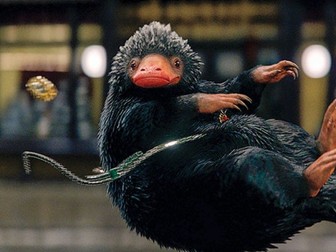
This activity pack includes 21 pages of worksheets in pdf, suited for 4-7 year olds and based on the book Billy and the Beast by Nadia Shireen.
Resources include:
Differentiated predicting worksheets
Differentiated sequencing and retelling
Problem and solution
Write a shopping list
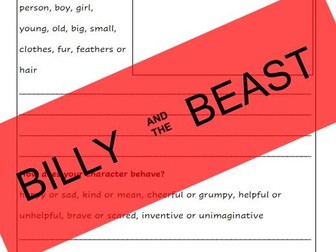
Write a character description
Questions and answers
Inference
Punctuation and grammar 1
Punctuation and grammar 2
Picture word cards match
Read and illustrate
Reading and tracing phrase strips
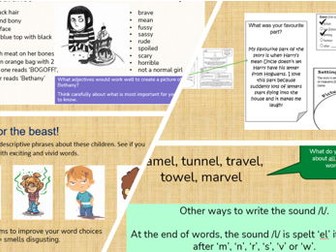
A whole unit of work based on the Fantastic Beasts by J.K. Rowling. The children will design a set of instructions on how to look after a beast of their imagination. The children I have taught at my school SJA have been really engaged in the learning which lasts approximately 2 weeks (10 teaching sessions). All objectives come from the Year 3 English National Curriculum.
Resource includes: Lessson PowerPoint with learning objectives, Grammar Geek (How to use this is below), lesson activities and planning. Some resources are editable to suit your class.
How to use Grammar Geek:
Introduce the session slide, read out each objective. The colours focus on different parts of grammar: vocabulary, structure and application.
Give children 5 minutes to complete as much as they can. Support can be given. We complete ours in silence and adults support children across the class.
After 5 minutes, invite individual children to read the objective and give their answer with explanation e.g. I have put a comma here and full stop at the end because it has two clauses in this sentence.
After children’s responses, show the ‘teacher’ responses and discuss reasons behind each answer.
The aim of Grammar Geek is to increase the children’s knowledge and understanding of grammar whilst engaging them in the unit of work. There are spelling sessions weaved in to encourage this skill in students.
I hope you enjoy, please leave a review once you’ve downloaded the resources.
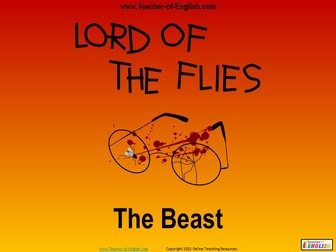
Lord of the Flies – The Beast (Fully Editable PowerPoint Lesson)
Help students explore one of the novel’s most important symbols with this fully editable Lord of the Flies – The Beast lesson. Designed for English Literature, this resource guides learners through Chapter Two, focusing on the boys’ first discussion of the beast, the growing fear on the island as well as the rising tension between Ralph, Jack and Piggy.
Lord of the Flies - The Beast
This classroom-ready lesson includes:
A detailed exploration of the beast and its symbolic significance
Close-reading tasks based on key extracts from Chapter Two
Discussion questions examining whether the beast exists and how fear spreads among the boys
Analysis of character reactions, helping students track Ralph, Jack, Piggy and the littluns
Activities on marginalisation, exploring why Piggy is an outsider and how Ralph’s attitude towards him shifts
Symbolism and imagery tasks, including the meaning of the “snake-thing” and its biblical connotations
Extension questions to push higher-ability students towards interpretive and thematic responses
This resource is ideal for developing:
Understanding of symbolism and fear
Character analysis and group dynamics
Knowledge of key events in Chapter Two
Skills needed for GCSE-style responses
Fully editable and easy to deliver, this lesson saves planning time while helping students build a deeper, more analytical understanding of one of the novel’s central motifs.
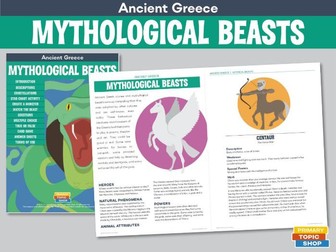
In this lesson, students learn about Greek mythological creatures. Twelve of the main Greek beasts, creatures and monsters are explored in listings, Centaur, Cerberus, Chimera, Cyclops, Harpy, Hydra, Medusa, Minotaur, Pegasus, Phoenix, Satyr and Siren. Each listing features an original illustration, facts and a short myth. The introduction includes interesting facts about ancient Greek mythological beasts including heroes, natural phenomena, animal attributes and powers. There is also a page exploring three constellations named after mythological beasts. Activities include differentiated reading response, create a monster activity, match the beast activity, constellation task cards and a printable memory card game.
Pages: 38 (including 7 answer sheets)
Contents:
12 Illustrated Listings
Research a Beast Activity
Constellation Page
Constellation Task Cards
Star Charts
Create a Monster Activity
Match the Beast Activity
Printable Memory Card Game
Questions / Multiple Choice / True or False (Differentiated Reading Response)
Questions or comments? Contact me at admin@primarytopicshop.co.uk
All text and illustrations are by Christa Galloway, Primary Topic Shop.
Cover lesson for KS3 exploring the stippling drawing technique. The worksheets instructs students to complete the drawings of 3 mini beasts, as well as a practice grid.
A full unit of work covering the entire book.
Features:
character description and analysis
character point of view
letter writing in role
planning and writing a new chapter
planning and writing a book review
discussion of lots of the chapters
weekly spellings (linked to Y3/4 curriculum) and homework
quizzes linked to chapters/teaching points
great for teaching online
This animated Power Point resource presents itself in the format of an Examination straight out of Hogwarts. Students read the descriptions of fantastic creatures such as the Hippogriff, the Basilisk and even the humble Puffskein and then answer questions about the information they have read. Students are required to draw detailed diagrams from the information they have acquired and are asked to compile their own entry to the latest edition of Fantastic Creatures concerning a new breed of werewolf.
Answers and feedback are provided in a humorous manner.
This resource is ideal to use in any exam period as a means of encouraging descriptive and informative writing whilst also inspiring students to read more widely from the pages of J.K.Rowling.
Suitable for Potter fans of all ages.
The Lonely Beast – News Report Script Writing Unit (6 Sessions)
Inclusive English planning supporting communication, confidence and storytelling
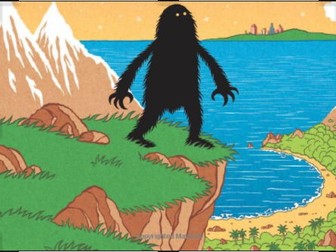
This detailed Scheme of Work is based on The Lonely Beast by Chris Judge — a fun and imaginative story exploring loneliness, friendship and courage. Through sensory storytelling, drama activities and structured discussion, pupils connect with the Beast’s journey before working collaboratively to plan and perform a news report about his experiences.
Designed for learners working across Pre-Formal, Semi-Formal, Formal and Formal+ pathways, this unit provides fully differentiated access to communication, sequencing and functional writing. Visual scaffolds, role-play and symbol-supported planning enable participation at each student’s individual level, with attention to building confidence and expressive language.
What’s included
12 structured sessions delivered over six weeks
Sensory-led reading and literacy application weekly
Pathway-specific instructions for every activity
Clear learning objectives and differentiated success criteria
Drama and role-play opportunities (interviewing the Beast, news desk performance)
Vocabulary development through images, Makaton and Colourful Semantics
Story sequencing using key moments and settings
News report features including key questions (who/what/where/when/why)
Opportunities to record evidence through writing, photos or performance
Embedded assessment links to SOLAR/EHCP outcomes
Curriculum and skill development
Listening and comprehension through shared reading
Building and expressing opinions verbally or through AAC
Developing question-and-answer skills in paired role-play
Structuring ideas for an audience in the form of a news script
Sequencing events and information logically
Using punctuation, nouns and action verbs in simple sentences
Growing confidence in performing and communicating to others
Empathy, social interaction and discussion about friendships
Intended outcomes
By the end of this unit, learners will have:
Engaged with a motivating narrative about difference and belonging
Understood key story events through sequencing and questioning
Planned and contributed to a group or individual news report script
Performed or shared their report using verbal, visual or AAC communication
Demonstrated measurable progress in communication, literacy and independence
This modernised, laugh-out-loud panto is packed with classic audience participation, school-specific humour, and plenty of festive fun. It’s perfect for Christmas performances, staff revues, or end-of-term celebrations.
What’s included:
A full-length, ready-to-perform panto script (4 acts)
16+ speaking parts (easily adaptable for larger or smaller casts)
Suggested music cues and sound effects
Customisable lines – add your school name, local area, and inside jokes for maximum audience laughs.
Features all your favourite characters: Belle, Beast, Gaston, Mrs. Potts (the Dame), Lumière, Cogsworth, LeFou, and more
Why you’ll love it:
Written specifically for staff performances, with plenty of opportunities for improvisation and audience interaction
Includes modern pop culture references and jokes your students (and colleagues) will love.
Easy to stage with minimal props and set design required
Family-friendly, funny, and full of heart
Whether you’re looking to entertain your students, raise funds, or end the term on a high note, this Beauty and the Beast Staff Panto is guaranteed to be a crowd-pleaser!
A simple set of worksheets focussed on The Lonely Beast by Chris Judge that help your child practice their writing skills including captions and speech marks to help them build up to writing a newspaper report.
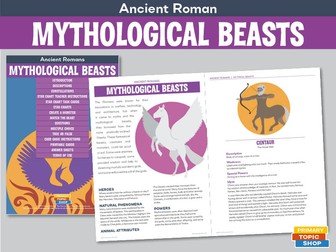
In this lesson, students learn about Roman mythological creatures. Twelve of the main Roman gods are explored in listings, Centaur, Cerberus, Chimera, Cyclops, Faun, Harpy, Hydra, Medusa, Minotaur, Pegasus, Phoenix and Siren. Each listing features an original illustration, facts and a short myth. The introduction includes interesting facts about ancient Roman mythological beasts including the influence of the Greeks, heroes, natural phenomena, animal attributes and powers. There is also a page exploring three constellations named after mythological beasts. This PDF includes information handouts, differentiated reading response, create a monster activity, match the beast activity, constellation task cards and a printable memory card game (24 cards).
Pages: 36 (including 7 answer sheets)
Contents:
12 Illustrated Listings
Constellation Page
Constellation Task Cards
Star Charts
Create a Monster Activity
Match the Beast Activity
Printable Memory Card Game (24 cards)
Questions / Multiple Choice / True or False (Differentiated Reading Response)
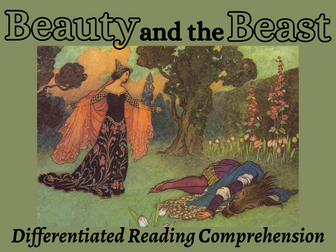
10 versions of differentiated reading comprehension for the traditional tale ‘Beauty and the Beast’, suitable for readers aged 6 to 12 years.
The higher-level text uses more complex vocabulary, includes more details, and employs additional literary devices. It has a larger word count and is 2 A4 pages in length. Three versions of comprehension questions come with this level text:
➊ A classic worksheet with 20 questions that require mid to high-level reading comprehension skills,
➋ A classic worksheet with 15 higher level compound questions.
➌ A multiple-choice SAT-style version with 26 questions that vary in difficulty level, each with 4 answer choices.
The middle-level text has a slightly smaller word count and simpler vocabulary. It spans 2 A4 pages in length and is accompanied by three sets of comprehension questions:
➍ A classic 17 question worksheet
➎ A classic 14 question worksheet
➏ A multiple-choice SAT-style version with 31 questions that vary in difficulty level, each with 4 answer choices.
The lower-level text has been simplified and shortened for easier reading, using decodable words whenever possible, while keeping the key details, main plot points, and essence intact. It spans 2 A4 pages in length and includes three sets of question sheets:
➐ A classic worksheet with 15 questions
➑ A classic worksheet with 8 very easy questions
➒ A TRUE OR FALSE activity with 20 questions
➓ A multiple-choice style version with a sequencing task and 8 easy questions
Answer sheets are provided for all levels of worksheets.
Resources Include a PDF document which can be displayed on an interactive board so that it can be used as a class reader or printed off to be read to the class. The story is in five sections to be read over five days. To promote class discussion and debate, a Powerpoint presentation is also included. It contains five open ended questions for each section of the story.
This Twisted Tale recounts the story of a merchant and the youngest of his three daughters, Booty; so named because of her choice of footwear and her, somewhat challenging, feisty nature.
The merchant becomes indebted to a monstrously hairy bundle of rags after accidentally taking shelter in a bed and breakfast hotel. In an effort to rid himself of the debt, the merchant offers his daughter, Booty, to come and work alongside the monstrous bundle to raise the profile of the hotel. Family honour demands that Booty should agree, but then she discovers that there is more to the bundle of filthy rags than meets the eye. Things change when her father suddenly becomes ill and Booty has to return home to look after him and also defend him from her two greedy sisters. Naturally, there is a happy ending of sorts, but one has to ask if it is the sort of ending you would expect in a tale where everything is supposed to end happily ever after.
Total reading time: 56 mins approximately
(All reading times will vary depending upon the reader.)
Day 1: 11 mins reading time
Day 2: 10.5 mins reading time
Day 3: 10.5 mins reading time
Day 4: 11.5 mins reading time
Day 5: 12.5 mins reading time
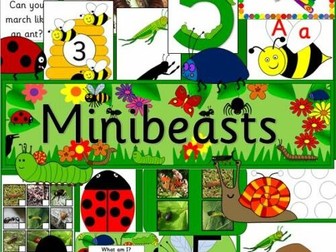
This Minibeasts pack has been created to fit in with the current Early Years curriculum with a range of resources to cover all areas of learning.
Display
Display banner
Display border
Large lettering
Topic words
Photographs
Mathematics
Number line
Number bingo- two bingo games with numbers from 1-5 and 1-10
Counting cards
Measuring- order the different length worms
Butterfly symmetry
Butterfly symmetry matching halves
Ladybird spot counting cards
Cut and match the spotty ladybirds
Spider web counting mats
Butterfly cards
Colour by numbers
Large number cards
Cut and stick number worksheets
Ladybird adding worksheets
Numbered beehives
Five Little Spiders number rhyme pack
Five Wiggly Worms number rhyme pack
One Little Bee number rhyme pack
Literacy
Draw and write mini beast sheets
Decorated writing sheets
Acrostic poem worksheets
An alphabet line on ladybirds
A simple mini beast word mat
Upper and lower case letters on bees
Cut and stick the initial sound butterflies onto the correct nets
Swat the fly game
Personal, Social and Emotional Development
Various posters to display in your mini beast area
Various blank posters for the children to write their own posters for the mini beast area
Photos of different mini beast habitats
Communication and Language
What am I? cards
Various rhymes and songs
A story telling pack for The Very Hungry Caterpillar
Guess the mini beast
Physical development
A target game
Various maze worksheets
Trace the patterns on the mini beasts
Worksheets to trace the different paths the mini beasts make
Move like a mini beast
Preposition posters
Mini beast cutting skills
Lacing pictures
Understanding the World
Mini beast pictures and sorting cards
Posters of mini beasts
A mini beast fan to make
A Power Point to find out and about different mini beasts
Life cycle posters of caterpillars and frogs
Lots of small mini beast photo cards
Vegetable patch detective cards
A photo bingo game
Expressive Arts and Design
Shadow matching cards
Incy Wincy Spider song pack
Mini beast stick puppets
Mini beast face masks
Colouring posters
A collection of craft ideas sheets
Outline pictures of different mini beasts
Colour bugs posters
Ideas sheets for making spiders webs with string
Observational drawing and recording sheets
Complete the pictures
A student-led exploration and analysis of significant moments in Chapter 6 of LOTF.
This lesson uses jigsaw work, enabling students to work in groups to share and discuss their explorations.
The lesson can be adapted for online learning through the use of collaborative breakout rooms in Teams.
I have selected key words, which I think will be unfamiliar to children, from each chapter of the novel to pre-teach before reading the chapter to them. This resource can can be used on the board, printed and displayed or put into a large vocabulary book.
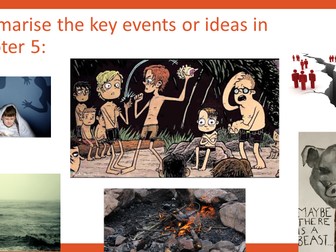
This interesting and highly-stimulating lesson enables students to make important inferences and interpretations regarding ‘the beast’ that is referred to by the boys on the island throughout William Golding’s novel Lord of the Flies. In particular, students form opinions of what the beast may represent, based upon key evidence throughout the text.
The lesson follows a clear, logical, bite-size learning journey, which guides students towards differentiated learning objectives. Over the course of this journey, they become able to:
- Establish, sketch, evidence, and share their initial interpretations of the beast;
- Collaborate with others to form rational and substantiated opinions;
- Read and understand Chapters Six and Seven of the play, with a particular focus upon how Golding utilises the beast to depict other concepts and notions;
- Analyse key quotations which refer to the beast in relation to each of the characters;
- Give appropriate and sustained interpretations and inferences regarding altering views towards Golding’s use of the beast;
-Peer assess each other’s learning attempts.
This resource pack includes:
- A visually engaging whole-lesson PowerPoint presentation;
- Detailed worksheet;
- A scaffolded essay template;
- Links to the extracts of the text needed for the lesson (Chapters Six and Seven in this case);
- A detailed lesson plan, complete with what the teacher and students should aim to achieve at each stage of the lesson.
All images are licensed for commercial use, and are cited on the final slide of the PowerPoint.


 Quick View