AQA GCSE Sociology - Agents of socialisation
A brief PowerPoint presentation exploring some of the mass media's influences of socialisation and society.
This resource is aimed at year 9 GCSE Sociology students.
There are 3 lessons which concentrate on the introduction of secondary agents of socialisation: Education, Media, Work, Religion and Peer groups.
This resource has 5 exam questions with model answers along with homework activities and interactive notebook tasks. There are progress checks with prompt questions in the notes. Additionally there are several clips and interactive based challenges. Links to clips can be found in the notes.
This PowerPoint covers all information required from the WJEC spec on the process and agencies of socialisation. This will equip your students to answer any 10m question: explain how any two agents of socialisation influence.
This is a highly detailed PowerPoint which will save you alot of preparation time. Included inside is useful exam pitstops for your students to practice. I have 18 years experience teaching sociology across AQA and WJEC. My other resources include sample responses linked to this section.
Full teaching resource pack for the OCR A Level (new) specification topic of SOCIALISATION, CULTURE AND IDENTITY. Includes all the resources and activities needed to deliver the entire topic, including a range of assessments. The pack contains:
Teacher booklets
Student booklets
All PPTs
All activities
Assessments
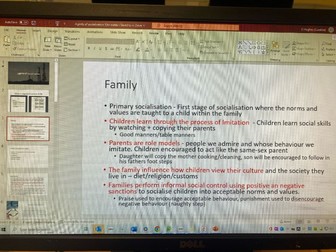
A lesson looking at socialisation, how children learn their norms and vales and the institutions that they learn them from.
complete lesson with retrival practice. AFL checkpoints and exam questions
GCSE Sociology resources including presentation, activity and worksheet. For more materials relating to this resource, please visit the NGfL site, linked below.
This lesson is designed to fill a 90 minute lesson, there is a total of 13 slides. The lesson focuses on discussing feral children, socialisation, agents of secondary socialisation. This is aimed at GCSE sociology eduqas.
Included:
Starter activity- match up the key concepts. Answers provided.
Title page- encouraging students to start thinking about what feral children are.
Explanation of socialisation and the different types.
Introduction to secondary socialisation. Worksheet provided. Students add key details to their worksheets whilst teacher talks through each agent of secondary socialisation.
Introduction to feral children. Short video clips to watch with questions for students to think about. Video links provided on the power point.
Short answer exam question- 4 marks. Encouraging self assessment.
Homework task- instructions on pp. To make a revision resource.
A very detailed powerpoint focusing on socialisation, including both primary and secondary (and all the 6 agents - family, peers, religion, education, workplace, media) combined with sociologists and key concepts. Well worth the investment.
The resource explains gender and socialisation. It explains gender roles and family. It shows socialisation before and after birth, through adolescence, and how gender internalisation of roles occur.The resource explains gender inequality and how women empowerment can be achieved. Prepared for sociology , IGCSE, with focus on family.
This is a resource designed to aid revision for the OCR specification AS and A Level Sociology. You’ll need to photocopy it and blow it up to A3 in order to make it usable for the students.
This is a complete resource package for delivering the content for the BTEC First Unit 4 Social Influences Learning Aim A.
There is a 28 slide Powerpoint and 4 activities.
The resources cover the content, below:-
Topic A.1 Primary and secondary socialisation Primary socialisation:
● agents, e.g. parents, siblings, carers
● influence of agents on speech, beliefs and values. Agents of secondary socialisation and their influence:
● friends and peers
● media, e.g. advertising, social networking, television, celebrity culture, music, newspapers/magazines
● other agents, e.g. early years workers at nursery/playgroup, teachers, youth workers, representatives of religions, work colleagues, social workers.
Topic A.2 Effects of socialisation
● Shaping of gender roles, e.g. expectations for male and female behaviour.
● Shaping of attitudes, e.g. the development of tolerance/prejudice, shaping of moral choices, religious and secular beliefs, attitude to authority.
● Development of social norms and values, e.g. views of right and wrong, manners and behaviour, use of language.
● Influence on lifestyle choices, e.g. entering employment/not entering employment, career choices, use of illegal substances, marriage and long-term relationships, alternative lifestyles, religion, use and choice of medical care and treatment, smoking, alcohol consumption, participation in sport or exercise.
PLEASE LEAVE A REVIEW FOR THIS RESOURCE PACKAGE, THANK YOU
For more free and small charge resource packages, visit my TES shop to find them all one place, with a handy search facility, HSCresources TES shop has free and small charge teaching packages
Join the biggest subject team, Health and Social Care Resources Facebook group. 5,300 sharing ideas, resources, signposting and prop each other out
#hscresources
Topic 2 - Socialisation and Theories of Socialisation. This resources includes the basics of the key concept / process as well as functionalist, Marxist, feminist, interactionist and postmodernist theories of Socialisation.
This resource is for teaching the optional topic Culture and Identity from the exam series provided by AQA A Level Sociology.
Includes:
Lesson PPT’s on sociological theories of Socialisation. Plus any handouts used in conjunction with the lesson.
We provide the Tutor2U Topic companion to work alongside in lessons.
50+ slides on secondary socialisation
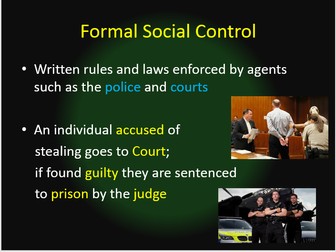
All key words, studies and examples for the agents of socialisation and formal/informal social control
Easy to digest and goes into great detail.
Ideal for GCSE and A level students
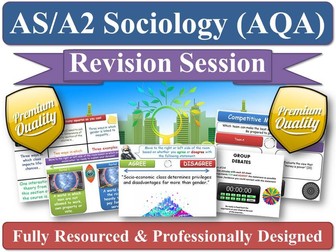
Designed for teachers using the new AQA Sociology specification at KS5. Save significant amounts of money by buying these revision sessions in bundles!
This download contains one of a series of revision sessions that use a variety of mind-mapping, discussion and debate tasks to cover a section of the specification. It includes a fully animated revision session PowerPoint and a set of ‘silent debate’ A3 worksheets.
The topic of this revision session is: ‘The socialisation process and the role of the agencies of socialisation’.
This revision session features:
-A ‘grid of learning’ post-it task (to focus students on the day’s topic and refresh their memories of the basics)
-A 'competitive mind-mapping task (which can be completed on the whiteboard or on A3 paper)
-A silent debate task (with 6 x A3 silent debate worksheets in an editable .doc file) [nb. allowing group conversation, instead of silence, is also an effective approach]
-Debates that ask students to move from one side of the room or the other and verbalise a defence of their position in response to a statement or rubric.
-A concluding ‘One thing I am still uncertain about…’ post-it question.
The revision sessions can be used in a number of ways:
-As revision sessions during a revision period of term-time leading up to exams
-Sandwiched between lessons as they are taught throughout the year as a way of solidifying and assessing learning
This session can be purchased individually or as part of various bundles depending on your needs.
Please note: the cover picture depicts some of the activities that make up this revision session, the wording within those tasks is adapted to the topic specified above and may differ from the wording depicted. Contents and tasks may vary slightly between revision sessions. The cover photo is, however, a fair depiction of the contents of the lesson.
Copyright Adam Godwin (2017) [Godwin86] godwin86@gmail.com
Lesson looks at how schools socialise children using sanctions etc by analysing a documentary, recalls key terms, looks at the functions of school, how schools socialise us into gender and an exam question.
Home Learning - photocopy information from a relevant text book you have for this info.
BUY THE IGCSE PAPER 1 BUNDLE HERE: https://www.tes.com/teaching-resource/cie-sociology-notes-igcse-paper-1-13002933
This comprehensive revision guide covers all of the specification points, with key terms, case study examples and evaluative arguments.
Examples are shown clearly through Past Paper answer keys.
Although directed for the CIE syllabus, this is applicable to the AQA, OCR and WJEC specifications.
Relevant for IGCSE, GCSE, AS and A2.
Content included:
Culture, norms, values, roles, status and beliefs as social constructions; relativity
Conformity and non-conformity; the agencies and processes of social control
The formation and existences of sub-cultures
Diversity and cultural variation in human behaviour and issues related to multiculturalism
Age as an example of social construction
Processes through which children learn social expectations
Main agencies of socialisation and their impact on the individual, including the consequences of inadequate socialisation (feral children)
The nature/nurture debate
Role, age, gender, ethnic group and class as influences on social identity
3 lessons based on introducing socialisation and then 2 lessons to follow with activities around it- leading onto the nature/ nurture debate. The activity sheets and HW is attached. There are video links included to activities to help grasp the students attention!
Supports the New AQA GCSE Sociology.


 Quick View
 Quick View
![GCSE sociology [wjec, eduqas] - Feral children and socialisation](https://l.imgt.es/resource-preview-imgs/fffb29b5-dc20-4c8e-9b4d-fd28c608ca21%2FScreenShot20200916at211957.crop_662x497_119%2C0.preview.png?profile=res-img-med-legacy-v2) Quick View
Quick View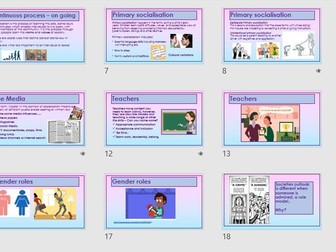 Quick View
 Quick View
 Quick View
 Quick View
 Quick View