Year 9 Lesson – Faith, Food and Fur: Ethics Around Animals
Aims:
Explore ethical issues about how humans use and treat animals, including experimentation, farming, and entertainment
Understand what factory farming and animal testing involve and why they are controversial
Reflect on different perspectives, including religious and secular views on animal rights and stewardship
This lesson includes retrieval practice, case study analysis, comprehension tasks, debates, pros and cons activities, and extended writing to develop critical thinking about the balance between human needs and animal welfare.
All resources are fully planned and ready to teach. School logos have been removed from the PPT.
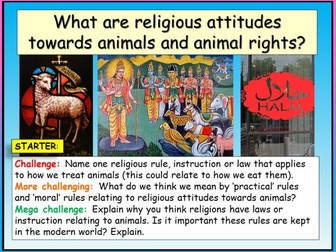
A fully-resourced, detailed and differentiated lesson which serves as an introduction to religious attitudes towards animals. The lesson investigates the attitudes of all six main world religions and students will complete scripture analysis, clip tasks, extended literacy tasks and much more.
This is perfect as part of a KS3/KS4 RE unit and has been created for the EC Publishing Year 9 RE Package.
This lesson is editable, so easy to adapt for your own planning and contains match up tasks, clip tasks, literacy and debate tasks, information sheets and more, as well as an engaging 1 hour PowerPoint. It is well-differentiated with three-level challenges for each task and very easy to follow.
Who are EC Resources?
EC Resources are top TES RE providers and are a group of teachers who work together to create easy to use, high quality and editable lessons and units of work. We have created lessons for The Children’s Commissioner, MACS Charity, Tes, LikeToBe Careers, the Criminal Cases Review Commission (UK Gov) and have also completed PSHE and Citizenship commissions for schools across the UK.
Check out our RE and PSHE Packages here:
Complete KS3 PSHE and RSE
Complete KS4 PSHE and RSE
One Year of KS5 PSHE and RSE
One Year of Citizenship and British Values
Complete Year 7 and 8 RE
Complete Careers and Employability
AQA Citizenship GCSE Mega Pack
Check out the EC Publishing website for full, affordable PSHE, Citizenship and RE Packages for all year groups including the new 2024 Complete PSHE Package. You can contact us at info@ecpublishing.co.uk
Teaching PSHE, RE or Citizenship GCSE next year? Why not join our Citizenship and PSHE teachers Facebook group, with 8000 other teachers, for guidance, advice and resource sharing.
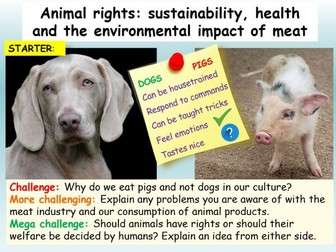
1 hour, fully resourced PSHCE lesson which focuses on animal rights, sustainability, the meat industry and our changing diets. The lesson has been left editable and is filled with engaging, well differentiated and fun activities. It is also useful for RE as an introduction to animal rights, or as a Tutor Time session (over a week).
The pack includes a 1 hour long PowerPoint, differentiated challenge activities, worksheets, clips and literacy focus tasks. These resources have been designed to be engaging, detailed and easy to follow.
You can find many more inexpensive and free PSHE, Citizenship and RE resources at my shop: MORE PSHE RESOURCES
Animal Rights - Complete Scheme of Work
A complete unit covering philosophical, ethical and religious view about animal rights in a 6-8 week term. This package includes 9 lessons (suitable for 45-60 minutes each), a mid-point formative assessment, an end of unit summative assessment and a unit overview document for students. Topics covered include “Uses of Animals”, “Religious Views” and “Zoos & Nature Reserves”, to name a few.
This scheme of work is written in line with NATRE and DfE requirements and covers areas of PSHE/RSHE. It is suitable for experienced teachers of the subject as well as ECTs, non-specialists and cover staff. The assessments can be edited to reflect changes to the learning material and sequence.
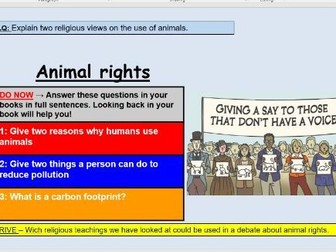
This lesson examines animal rights from both religious and ethical perspectives, encouraging students to explore moral questions surrounding the treatment and value of animals. Designed for the Eduqas GCSE Religious Studies specification (and suitable for other exam boards), it includes a variety of videos, discussion activities, and worksheets to engage learners and develop evaluative thinking.
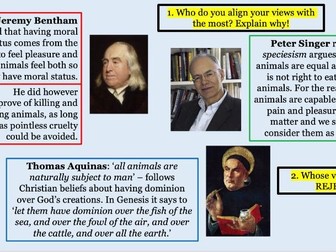
Students consider Christian, Islamic, and Sikh viewpoints alongside ethical theories and thinkers, including Peter Singer, to understand how beliefs shape attitudes toward animal welfare. The lesson also provides optional exam-style questions and AFL practice to strengthen both knowledge and exam skills.
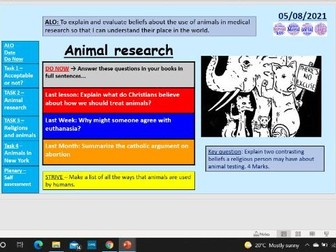
Fifth lesson for GCSE AQA Religion and life (Theme B). This lesson looks at the different ways humans use animals and asks students to consider the ethics of each type. The lessons takes a specific look at the role animals played in the research for a covid vaccine. Relevant video links in slides and works well with AQA textbook. Easy to adapt to other exam boards.
Really good starting point if you are new to the course/some good tasks to add to your lessons if you have taught the course before
This unit explores the issue of animal rights and how religions perceive the status of animals. Do humans have dominion of animals or should we refrain from any exploitation of God’s creation?
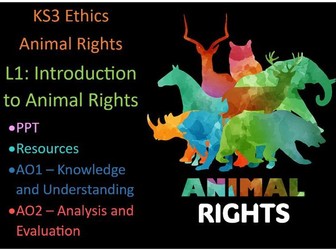
Lesson: Introduction to Animal Rights
This lesson is Lesson 1 in the new ‘Animal Rights’ unit, devised as part of a brand new, relevant and engaging scheme of work for KS3. It is intended as a double (roughly one and a half hours per lesson) however, due to time restrictions and the embedded support in the corresponding Work Pack, could also be taught in a minimal one hour.
This lesson explores the key issues at the heart of the animal rights debate, including the value of life and sentience.
Although part of a unit, this lesson can also be taught as a stand-alone lesson, e.g. for revision. The corresponding Work Packs would also support a home-learned curriculum as the PowerPoints and Packs themselves include differentiation and scaffolding, where required.
The interleaved schemed of work are specifically designed to promote the two skills desired for success at GCSE:
AO1 (Knowledge and Understanding)
AO2 (Analysis and Evaluation)
The resources are specifically created to ensure students are aware of the skill they are demonstrating and how to improve further through modelling.
These new units bring the relevance back to our topics, for example, through thought experiments and reference to current affairs. Students will experience greater engagement and enjoyment in a fair and balanced approach.
Lesson includes:
Homework Slide
Lesson overview
Starter activity
Key words (literacy focus)
Introduction of key information (AO1 - knowledge) and how this is used (AO1 - understanding)
Introduction of a contentious issue or debate (AO2 - analysis) and finalised judgement (AO2 - evaluation)
Plenary
Lesson Sheets:
If you would rather work in exercise books, the Work Pack/lesson sheets are designed so that you can print off relevant pages - it is a resource pack. This would be useful if you have appropriate curriculum time to cover the content of the course. Unfortunately, this is not the case across all schools, and therefore the Work Pack helps by providing time-saving activities, whilst still being able to cover the breadth and depth of the course.
In addition, students who may be limited by literacy issues, e.g. slower writing paces, are not disadvantaged or capped in their progress. Therefore, some classes could use a mixed approach - part Work Pack, part exercise book - and all students will be able to progress through the same volume of content.
Please give feedback: I am always happy to respond to comments - whether positive or constructive - this will help to improve the quality of my resources in the future and, more importantly, the quality of pupils’ RE/RS education in general - which is what we’re all here for!
This is an advanced (CEFR C1, IELTS 7.0) EFL Speaking class about animal rights. Students begin by looking at two photos; one of battery-farmed chickens and one of free-range chickens. Teachers should elicit the differences between the experiences of these chickens. A discussion about ethics and animals follows. Target language (battery farming, activist, sentient, vegan, research, free-range) is introduced using photographs. A gap-fill activity follows to confirm students’ understanding. Students then discuss more questions and the class ends with predictions about the future of animal rights.
Fifth lesson in scheme of work focusing on moral/ethcial dilemmas that are faced by people around the world every day. This scheme of work looks at reasons for and against these dilemmas and what religions may say about this.
This lesson introduces students to the concept of a animal rights and how humans do/should interact with animals in the world. Students understand the role of religions in standing up for the rights of animals.
This is a complete lesson that has been designed with non subject specialists in mind so that it is fairly easy to pick up and teach. Lesson includes differentiated tasks, work sheets, on screen task management board and relevant information.
A resource which is intended to run over 4 lessons: independent study with some introduction and video clips which can be uploaded to your server, and students can access them in their own time using headphones. Great for independent study, differentiation, SMSC, PHSE, Religious Studies and Citizenship, as well as General Studies, this resource stimulates outrage, insight and curiosity. It also includes historical and cultural insights, like the Ecuadorian Government signing in the rights of nature into law.
KS3/2 lesson on animal rights.
Contains: PPT lesson, blank worksheets that support the lesson, completed/answer worksheet, a table with one completed section of the main task and an information sheet with all the information from the lesson on one sheet which can be printed and used in the lesson instead.
Religions included are: Hinduism, Islam, Christianity and Buddhism.
By Juliet Davies - Head of RE @ Kingsbury Science and Maths Specialist College, Warwickshire davies.j2@we-learn.com A thought-provoking slideshow of images of how animals are used followed by an AQA GCSE style exam question.
Year 8/KS3 RE Lesson: Environment and Animal Rights – Why Are They Important in Hinduism?
School logos have been removed from the PPT.
This lesson explores Hindu beliefs about caring for animals and the natural world. Pupils learn that all living things have a soul (atman), the importance of ahimsa (non-violence), and why many Hindus are vegetarian. The lesson also introduces the Chipko movement and the sacred status of cows in India. Activities include guided reading, designing a symbol for respect for animals, a concept collage of Hindu beliefs about nature, and reflection tasks on how these ideas influence daily life.
Learning aims:
Explain why Hindus believe all life is sacred
Describe the principle of ahimsa and its impact on lifestyle choices
Understand the significance of animals like cows in Hinduism
Reflect on how Hindu beliefs encourage respect for the environment
Includes PowerPoint slides, creative tasks, reading activities, and discussion questions ready to teach.
By Juliet Davies, Head of RE, Kingsbury School, Warwickshire
some unpleasant images of vivisection followed by the thought-provoking word 'dominion' and just how much power that affords us. :-(
Two activities contained.
The first is a card sort on the question of “Should human rights have priority over animal rights?” - Students sort the cards onto the table.
Second activity is designed to provide discussion around whether all animals should have the same rights.
Creative and visually engaging learning mat / revision sheet for Philosophy and Ethics: Life Issues (Eduqas) or Religion & Life (AQA): Animal Rights
Please give feedback! I am always happy to respond to comments - whether positive or constructive - this will help to improve the quality of my resources in the future and, more importantly, the quality of pupils’ RE/RS education in general - which is what we’re all here for!