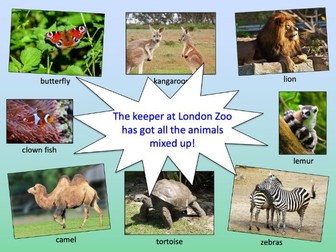
This lesson is part of a wider cross-curricula unit called London Zoo which is designed for KS1 and lower KS2 students (Y2-4).
The animals have escaped at the zoo and the keeper needs your help! The presentation first encourages students to describe the features of animals. It then challenges students to match animals to their names, description and habitat. It includes a variety of animals including fish, birds, mammals, insects and amphibians.
There is a group activity and an individual activity:
Group Activity:
Students match animals to their names, description and habitat (KS1 and KS2 versions).
Individual Activity:
Students match animals to their names, description and habitat on a worksheet. This is differentiated three ways:
Easier – Students match animals to their habitats.
Medium – Students match animals to their description and habitat.
Harder – Students fill in the names of the animals and match them to their description and habitat.
Extension – Students classify animals as fish, birds, mammals, insects or amphibians.
If you like this resource, we would appreciate a review! We will happily send you a free resource in return for a review or useful suggestions/feedback. Contact us at ed@teachitforward.co.uk.
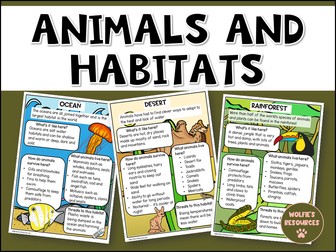
Animals and their habitats for year 2. Are you teaching students about animals, their habitats and how they have adapted to these habitats? Then this is the product for you! Save valuable time with these print and go, no prep activities. Children will love these fun activities, whilst learning at the same time. A 23 slide teaching power point means that no research or planning is required. There are word cards and real life pictures for display and a colouring sheet for early finishers.
Read on for a full list of included activities.
What’s included in this product:
23 slide teaching power point
A colourful matching/bingo/lotto habitats game
Hot or cold habitats cut and stick sorting activity
Wet or dry habitats cut and stick sorting activity
Forest or savanna cut and stick sorting activity
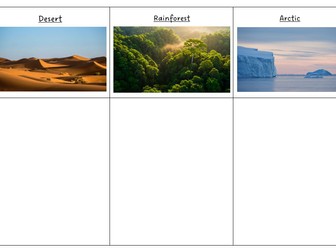
Rainforest or desert cut and stick sorting activity
Who lives here? draw the animals in the habitats x 3
Who lives here? draw the animals in the micro habitats
How lives here? cut and stick activity
Polar bear adaptation writing activity
Choose an animal to draw and research
Choose an animal to draw in natural habitat
Habitats activity sheet
Make a leaflet - 2 x differentiated - Choice of 3 animals - lion, sloth, polar bear
6 colorful habitat information posters
56 word cards for display
16 real life A5 posters for display
Colouring activity for early finishers
A quick, easy, standalone lesson for pupils in key stage one, or working at an equivalent level.
Resources includes a power point and worksheet.
The power point explains different habitats (savannah, arctic, rainforest and desert) before going on to explain the main activity and gives opportunities to discuss pupils answers. The power point also introduces a second activity which could be used for more able pupils.
The main activity asks pupils to sort animals into different habitats.
The second activity presents pupils with “alien” or fake animals and they must think about the features of the animals before again placing them in differing habitats. This allows for great discussion around adaptation and suitability for different habitats.
PowerPoint Explaining Habitats generally then focussing more on UK wild animals such as badgers, foxes, birds, hedgehogs and whether they live in dens, burrows, setts of nests. It includes videos and a sorting activity. All supported with Widgit Symbols
A fully planned and engaging assembly PowerPoint designed to introduce pupils to World Turtle Day and inspire them to care for wildlife and the environment.
This assembly explains what World Turtle Day is and why it is celebrated on 23rd May each year, helping pupils understand that it raises awareness about turtles and tortoises and the challenges they face in the wild.
Pupils will learn fascinating facts about turtles, including that they have lived on Earth for over 200 million years, with over 300 different species living in oceans, rivers and on land. The presentation explores the differences between turtles and tortoises, as well as where they live and what they eat.
The assembly highlights the important role turtles play in keeping ecosystems balanced, such as maintaining healthy oceans and controlling animal populations. It also explores the threats they face, including pollution, habitat loss, climate change and human activity.
A strong conservation message encourages pupils to take action, with practical ways they can help, such as reducing plastic use, protecting habitats and supporting wildlife initiatives. The assembly promotes responsibility and environmental awareness in a clear and engaging way.
Perfect for whole-school assemblies, this resource is suitable for both KS1 and KS2 and requires no additional preparation.
What’s included:
Clear, engaging and age-appropriate slides
Introduction to turtles and their habitats
Fascinating facts and real-world examples
Exploration of environmental challenges
Practical ways pupils can help wildlife
Strong links to science and geography
Ideal for:
World Turtle Day (23rd May)
Animals and habitats topics
Environmental awareness
Science and geography assemblies
Eco schools and sustainability
Mixed age planning for mixed year 1/2 class.
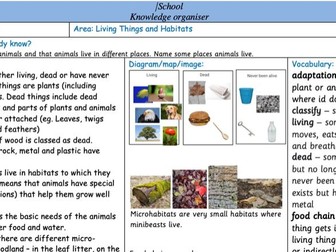
Living things and habitats.
6 lessons
living, not living anymore, never lived
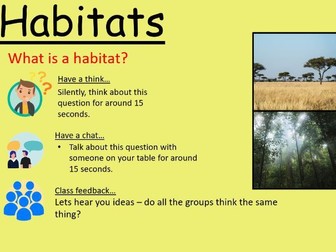
what is a habitat
seaside habitat
camel/polar bear adpatations for their habitat
micro-habitats
food chains
includes: all slides (powerpoint), pre-assessment, recalls, activities and challenges for every lesson and MTP and knowledge organiser and assessment grid.
Some external video links to youtube included in slides.
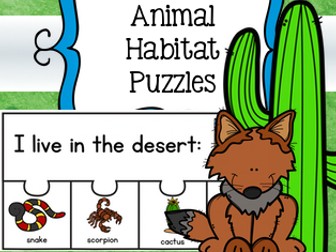
This resource contains 5 different puzzles / habitats. These puzzles are a great way for you to introduce and reflect upon animal habitats in your teaching.
Simply cut out each of the jigsaw pieces and laminate (this will keep them strong and longer lasting and students match the animals/objects to the correct habitat.
Habitats included are:
♦ desert
♦ ocean
♦ arctic
♦ rainforest
♦ pond
Each puzzle comes with 4 animals/nature piece. Each puzzle piece has an image and the name of that image below it.
A fun activity that is a great way to introduce or work on animal habitats.
1. Accordion Booklets:
A. Habitats
1. Assembly Instructions for the Habitats Booklet
2. Completed Facts about each Habitat:
Coral reef, Swamp, Pond, Cave, City/ Urban, Freshwater, Marine
3. Blank versions for students to write their own facts about each Habitat
4. A smaller version of #1, 2, & 3 to fit smaller pieces of construction paper
B. Biomes
1. Assembly Instructions for the Biomes Booklet
2. Completed Facts about each Biome:
Rainforest, Temperate forest, Chaparral, Taiga, Tundra, Alpine,
Savanna, Grassland, Desert
3. Blank versions for students to write their own facts about each Biome
2. Cootie Catchers:
A. Habitats
Coral reef, Swamp, Pond, Cave, City/ Urban, Marine,
Freshwater, Marsh
1. Students identify the habitat from the picture (environment)
2. Students identify the habitat from the picture (animals)
3. Students identify the habitat from the description (definition)
4. A blank cootie catcher for students to create their own questions.
B. Biomes
Rainforest, Tundra, Grassland, Desert, Alpine, Savannah,
Temperate forest, Taiga
1. Students identify the biome from the picture (environment)
2. Students identify the biome from the picture (animals)
3. Students identify the biome from the description (definition)
4. A blank cootie catcher for students to create their own questions.
3. Lapbooks
A. Habitats
1. How to Use and Assembly Instructions for the lapbook
2. Completed facts for each of the following types of habitats:
City, Freshwater, Marine, Arctic, Coral Reef, Swamp, Pond, Cave
B. Biomes
1. How to use and Assembly Instructions for the biomes lapbook
2. Completed facts for each of the following biomes:
Savannah, Grassland, Temperate forest, Taiga,
Tundra, Rainforest, Alpine, Desert
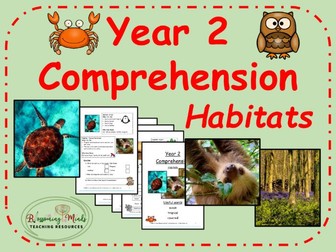
This resource is a non-fiction comprehension booklet for year 2. It is all about habitats and covers what a habitat is, followed by a short look at deserts, oceans, cities, rainforests, woodlands and seashores.
It is split into 3 differentiated levels. There is a different booklet for each level.
Each booklet contains a title page with helpful words, followed by four pages of pictures with short written extracts to read and 2-3 questions per page.
There are a range of ‘what,’ ‘how,’ ‘which’ and ‘why’ questions, some multiple choice tick questions and some that require more detailed answers. Answers are also included.
I have included colour and black & white versions of each of the 3 levels. The preview pages show the title page and one of the comprehension pages, from the middle ability booklets.
PDF file format.
The students were taken on a discovery tour of our Australian school bushland to identify evidence of animal habitats. The students had to circle ‘yes’ of ‘no’ as to whether there was evidence that the depicted animals lived in the bushland. We then returned to discuss their findings.
This resource could be used in any Australian school yard or alternatively take your students on an excursion to a local park.
Animals and Habitats Matching Activity
Packed with colourful visuals and engaging matching activities, this resource is specially designed for lower ability students to explore different animals and their habitats.
Animal Habitat Worksheet for Primary Classes
PDF - 5 pages (one page is a tip page for teachers on how to use/play it)
Printable
I value your feedback greatly. Please don’t forget to give a quick rating and leave a short comment on the product. Thank you very much for your purchase!
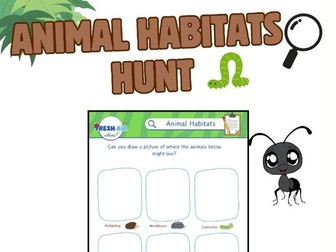
Ignite your students curiosity and foster a deep connection with the natural world using this Key Stage 1 (KS1) resource! This Habitat Scavenger Hunt activity is designed to embed core science curriculum concepts through engaging outdoor learning and discovery. Perfect for enhancing your Science lessons, it offers a hands-on exploration of woodland creatures and their diverse habitats.
The Activity
The hunt focuses on six commonly found animals and their habitats:
Hedgehog (Under logs, dense bushes, leaf piles)
Woodlouse (Damp, dark places: under stones, bark, or compost)
Caterpillar (On specific plants, leaves, or stems)
Bird (Nests in trees, bushes, or hedgerows)
Spider (Webs between branches, fences, or in corners)
Ladybird (On leaves, flowers, or bark surfaces)
How to Use
Children record their findings by drawing or sketching the habitat where they believe the creature lives (e.g., drawing a pile of leaves for the Hedgehog, or a damp log for the Woodlouse).
Outdoor Exploration
Take the class to a an outdoor area. Discuss searching techniques (e.g., gently lifting logs, looking under stones, examining leaves).
Drawing & Recording
Children use their clipboards to sketch the location and details of the habitat they discover or identify, reinforcing observation skills and scientific recording.
Discussion & Review
Conclude by discussing why each habitat is suitable (e.g., the Woodlouse needs moisture, the Bird needs shelter).
This interactive resource helps children identify an animal living in the environment around them, how seasons affect it and how our actions can impact on its life. The resource encourages children to ask and answer questions and consider how they can demonstrate care, responsibility and concern for living things in their area.
Are you looking at living things with your class? Try out this habitat matching activity.
When I used this in class, I made it a team activity where the children carouselled around the habitats and if they had an animal that belonged there they stuck it down. you could also make this a station activity, individual or pairs.
Pupils m ust match the animal to the correct habitat. This activity is part of lesson 5 in the BTEC Biology scheme of work. For BTEC in Applied Science: Biology.


 Quick View
 Quick View
 Quick View
 Quick View
 Quick View
 Quick View
 Quick View
 Quick View
 Quick View
 Quick View