Specific Heat CapacityQuick View
BrainJar

Specific Heat Capacity

(1)
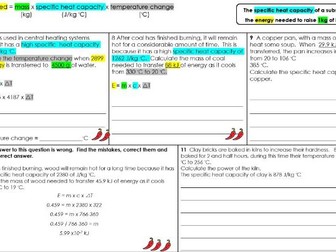
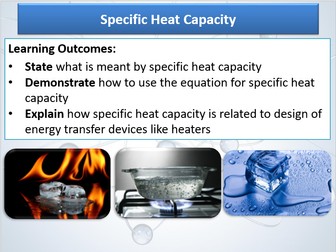
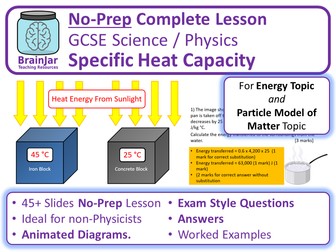
Complete No-Prep lesson with exam questions, tasks and answers on Specific Heat Capacity for AQA GCSE (9-1) Science / Physics. Rewritten and improved 16.05.22. Specific Heat Capacity is included in the exam specification in two separate places: Energy Topic (Physics 4.1.1.3 / Combined Science 6.1.1.3) where it is followed by a required practical. Particle Model of Matter Topic (Physics 4.3.2.2 / Combined Science 6.3.2.2) The exam spec points are virtually the same for each. I have written this lesson so that it can be taught in either place, however the required practical means it is likely to be taught in the energy topic. As a Secondary Science teacher, Deputy Headteacher, writer and examiner for many years I make high quality no-prep lessons so busy teachers can teach outstanding lessons without spending hours planning. This high quality lesson includes explanations, different types of in-lesson assessment (all with answers) and unique exam questions. My lessons are ideal for non-Physicists - as a Biologist who retrained as a Physics teacher I know how to take learners on a journey that builds up their understanding step by step, while still going into a lot of depth. The preview video shows a representative sample of slides from the resource so that you get a good idea of what it includes before you buy. What’s Included: • Starter / Do Now Activity with answers • Explanation slides in “chunked” sections with animated diagrams. • Worked examples of calculations / questions. • Multiple questions in different question styles and difficulties - no need for worksheets. Each “chunked” explanation section typically includes a set of “learning check / quick questions” followed by a set of in-depth questions on the learning from that “chunk” of the lesson. All questions have answers. • Exam-style questions on the whole lesson at the end of the lesson- these are unique, based on real exam questions but not just copied from exam boards. • Answers for all questions • All easily editable to adapt to your teaching or to use in existing lessons. . Learning objectives: Describe the difference between thermal energy and temperature. Define specific heat capacity. Describe the factors that affect the amount of energy stored in or released from a system as its temperature changes. Explain how specific heat capacity can affect temperature changes and energy stored or released for different substances. Use the equation below to determine the temperature change, mass or specific heat capacity of an object, or the change in thermal energy. Change in thermal energy = Mass x Specific Heat Capacity x Temperature Change The lesson was written for AQA GCSE Science / Physics but is very likely to be applicable to other exam specifications. Please leave a rating / review and all other feedback gratefully received!
Specific heat capacity calculationsQuick View
patmac494

Specific heat capacity calculations

(0)
Worksheet consisting of 15 questions where students need to calculate the energy using specific heat capacity formula. Answers are included, so can be used as revision or as a final assessment task
Specific Heat Capacity CalculationsQuick View
rachel_tasker

Specific Heat Capacity Calculations

(0)
AQA GCSE Physics and Science Trilogy. Differentiated calculation questions from foundation to grade 9. Designed using colour coding and backwards fading to support and challenge.
AQA GCSE Physics (Foundation Tier) – Required Practical: Specific Heat CapacityQuick View
Malachite44

AQA GCSE Physics (Foundation Tier) – Required Practical: Specific Heat Capacity

(1)
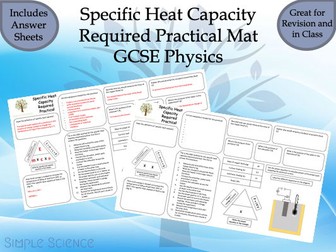
**Save 61% with the Complete Temperature and Heat Transfer Bundle! ** Get this lesson as part of our GCSE Temperature and Heat Transfer Bundle and enjoy a huge discount! Instead of buying lessons individually, grab the entire unit with 9 lessons, including the required practicals, for just £7.00. Click here to get the bundle now: https://www.tes.com/teaching-resource/resource-13155109 This PowerPoint resource is a detailed guide designed to teach students how to measure the specific heat capacity of a material. It provides a step-by-step method, theoretical background, and practical tips, making it an essential resource for science classes. Key learning objectives include: Understanding the concept of specific heat capacity and its definition. Learning to calculate specific heat capacity using the equations: Q=mcΔT and E=IVt Conducting a practical investigation to determine the specific heat capacity of an object, such as an aluminum block. The resource begins with a starter activity to activate prior knowledge, prompting students to define key terms, write equations, and apply their understanding to real-world examples like boiling water. It guides students through setting up the experiment, collecting data, and calculating specific heat capacity. Detailed instructions ensure students can perform the practical accurately, including using insulation to minimize energy loss and interpreting results. Students are encouraged to reflect on their results, evaluate sources of error, and explore extensions, such as testing different materials or types of insulation. The importance of precision, repeatability, and minimizing energy loss is emphasized throughout. This editable ‘.pptx’ file aligns with high school physics curricula and is ideal for practical sessions or revision. It includes refined instructions and clear visuals, ensuring students gain a thorough understanding of specific heat capacity and its experimental determination.
Capacity PackQuick View
tecimener

Capacity Pack

(0)
Pack contains: fill the jar with 3 jar templates one large jar template Funky fingers 3 jar templates cut and stick sorting of sweet jars (x1 sort 3, 2x sort 4, x1 sort 5) jar visual guides
Comparing Capacity and Volume - Year 1Quick View
Online_Teaching_Resources

Comparing Capacity and Volume - Year 1

(0)
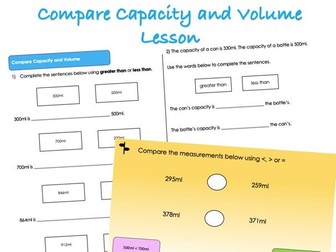
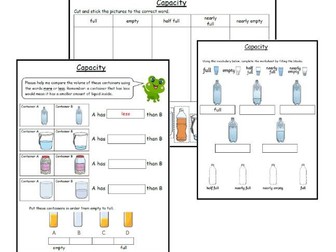
Comparing Capacity and Volume - Year 1 In this teaching resource pupils begin to compare and describe capacity and volume (full, half full, empty, nearly full and nearly empty) as per the year 1 maths programme of study (Measurement). This colourful and animated PowerPoint presentation includes interactive activities, link to a short video introducing the subject of comparing capacity and 4 accompanying worksheets. As with all our PowerPoint teaching resources, ‘Comparing Capacity and Volume - Year 1’ is completely editable so that teachers can adapt, alter and revise it as much or as little as required. Not quite what you’re looking for? Click below to see similar Year 1 measurement resources: Longer or Shorter - Year 1 Comparing Lengths and Heights - Year 1 Taller or Shorter - Year 1 Comparing Weight - Year 1 Year 1 Measurement Bundle
Capacity - Language of CapacityQuick View
DosbarthJJ

Capacity - Language of Capacity

(0)
An introductory presentation and accompanying differentiated worksheets used with a year 1 class based on capacity. Using the language of ‘full’, ‘half full’, ‘empty’, ‘nearly/almost full’ and ‘nearly/almost empty’.
Specific heat capacity worksheetQuick View
bharryb

Specific heat capacity worksheet

(1)
2 sets of questions Easy and difficult about SHC Easy questions just apply the equation More difficult questions require students to re-arrange the equation and convert units. Comes with answers.
Specific Heat CapacityQuick View
aer

Specific Heat Capacity

(2)
Lesson that would include the standard practical for shc. Adapted from another fab TES user. Equation, explanation. Outcomes.
GCSE Specific Heat CapacityQuick View
jbaldwin9

GCSE Specific Heat Capacity

(12)
This is a contained lesson on specific heat capacity for KS4 physics lessons. It is designed to be accessible for all ability groups, though from experience top sets will work through this reasonably quickly. It works very nicely in conjunction with a suitable practical. I have designed it so that the complexity is built from the ground up to ensure pupil understanding. Please give feedback as this is my first upload to TES.
Year 3 Mass and Capacity - Use Scales LessonQuick View
krisgreg30

Year 3 Mass and Capacity - Use Scales Lesson

(0)
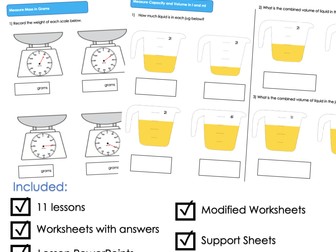
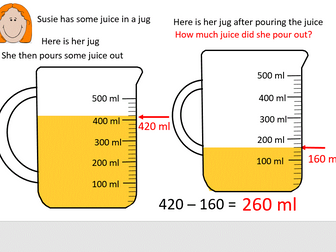
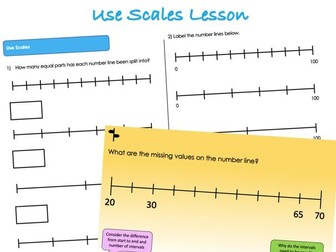
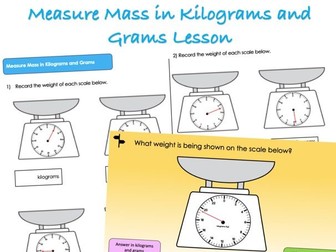
A fully resourced mass and capacity lesson for being able to use scales through intervals on a number line and being able to work out the missing values in Year 3 based on the objective from White Rose Maths. Included in the resource is: A lesson PowerPoint with starter, vocabulary, modelling (with teacher notes) and guided practice Lesson plan Worksheet with answer sheet Scaffolded worksheet with answer sheet Modified worksheet for those who need additional changes to access the learning with answers Challenge tasks Support strips that can be stuck in books Everything is included that could be needed to run the lesson successfully, with each resource carefully considered in ensuring accessibility for all as well as ensuring there are plenty of opportunities for challenge to provide depth of understanding.
Volume and Capacity - Level 1 Functional Skills MathsQuick View
Krazikas

Volume and Capacity - Level 1 Functional Skills Maths

2 Resources
This resource has been designed for Entry Level 3 students working towards Functional Skills Maths qualifications at Level 1 (Edexcel-Pearson, NCFE, City and Guilds, AQA, Highfield Qualifications, NOCN, Open Awards). It contains an age-appropriate, 380-slide PowerPoint lesson and a 32-page workbook on volume and capacity. The resource will help pupils to achieve these outcomes: convert between units of volume and capacity - millilitres and litres use knowledge of volume and capacity to solve real-life problems millilitres and litres and provides many real-life examples and opportunities for pupils to practice this skill. Workbook The workbook contains 8 explanation pages, 21 worksheets (with answers), 2 progress checks and a certificate of achievement. It is provided in PDF and an editable PowerPoint version. It can be used for classwork, homework, revision or as an independent learning pack. PowerPoint Lesson The editable PowerPoint lesson explains how to convert between millilitres and litres and provides many real-life examples and opportunities for pupils to practice this skill. It contains links to several videos on capacity and volume and example exam questions on measure. It is ideal for introducing pupils to this component of the specification and for revision purposes. If you buy this resource and are pleased with your purchase, I would be grateful if you could leave a review. As a token of appreciation, you can have a free resource up to the value as your purchased resource. Just email inspireandeducate@aol.co.uk with your user name, the resource you have reviewed and the resource you would like for free. You may also be interested in the bundles below. They contain workbooks and PowerPoint lessons which cover all of the outcomes students are required to achieve at each level. Level 1 - Using Numbers and The Number System 10 Workbooks - 10 PowerPoint Lessons Entry Level 3 - 16 Workbooks - 16 PowerPoint Lessons Entry Level 2 - 13 Workbooks - 13 PowerPoint Lessons Entry Level 1 - 11 Workbooks - 11 PowerPoint Lessons More Functional Skills Maths Resources Entry Level English Resources
CapacityQuick View
arronspall

Capacity

(0)
Initially for Year 5 maths as part of conversion and measurement unit. Smart Notebook lesson on Capacity.
Specific heat capacityQuick View
CMGsSciencelessons

Specific heat capacity

(0)
During this lesson (P2.4 Specific heat capacity) GCSE students work through a variety of tasks to develop their understanding of what is meant by the specific heat capacity of a substance and how to calculate it. Based on the 4th from the AQA 9-1 GCSE Physics (OUP scheme) P2: Energy transfer by heating chapter. Also available as a digital worksheet, which is ideal for distance learning, independent study or catch-up of missed work through absence. Presentation contains (26 slides)- Bell work activity Lesson objective and success criteria Information slides Challenge activities (group work) Practical activity (where appropriate) Demonstrate understanding tasks (with answers) Lesson resources (additional to scheme) Aimed at a mixed ability class covering content 1-8. Please note: Kerboodle worksheets from scheme are not included due to license.
Capacity and Capacity UtilisationQuick View
jonathanremmington1

Capacity and Capacity Utilisation

(0)
A 52 slide presentation detailing capacity and capacity utilisation. This presentation includes: A depreciation starter activity Introductory activity on the concept of capacity Examples of capacity utilisation in different contexts Calculation activity Activity demonstrating hoe capacity utilisation impacts costs / average costs Detailed notes throughout This lesson took me an hour to go through.
CapacityQuick View
ScienceSpot

Capacity

(0)
Capacity: These task cards are a great way for students to have fun while they practice with units of capacity. Problems include converting units of capacity (ounces, cups, pints, quarts, and gallons), as well as determining the most appropriate unit of measurement. An answer key with answers to all problems is provided. Do a search for my other Math Task Cards: ♦ Ages 6-9: Addition Arrays Balancing Equations Coins Estimating Sums Expanded Form Fact Families Greater Than Less Than Long Division Missing Addends Multiplication Word Problems Number Bonds Word Problems Skip Counting Subtraction Telling Time ♦ Ages 9-11: Balancing Equations Capacity Comparing Decimals Decimals Elapsed Time Expanded Form Exponents Fact Families Factors & Multiples Fractions Fractions on a Number Line Greater Than Less Than Greatest Common Factors Least Common Multiple Long Division Mean, Median, Mode, & Range Metric Measurement Mixed Numbers Multiplication Number Patterns Order of Operations Percents Place Value Prime & Composite Numbers Prime Factorization Probability Properties of Mult. Rounding Word Problems ♦ Ages 11-14: Customary Measurements Fractions: Add & Sub, Decimals, & Percents Fractions: Equivalent & Reducing Fractions Greater Than Less Than Improper Fractions & Mixed Numbers Integers Operations with Fractions Rational Numbers Ratios Simple Interest ♦ Geometry: 3D Shapes Angle Pair Relationships Area of a Circle & Composite Figures Circumference of a Circle Missing Angles Perimeter Polygons Pythagorean Theorem Quadrilaterals Surface Area of Rectangular Prisms Volume & Surface Area of Cylinders Volume of Cones, Rectangular Prisms, & Triangular Prisms
CapacityQuick View
ScienceSpot

Capacity

(0)
Capacity: These cootie catchers are a great way for students to have fun while they practice with units of capacity. How to Play and Assembly Instructions are included. There are 2 cootie catchers in this product, each one having 8 problems for a total of 16 problems. Problems include converting units of capacity (ounces, cups, pints, quarts, and gallons), as well as determining the most appropriate unit of measurement. Answers are provided for each problem. *** Enjoy this Lesson? Do a search for my other Cootie Catchers: *** ♦ Grades 1-3: Addition Arrays Balancing Equations Coins Estimating Sums Expanded Form Fact Families Greater Than Less Than Long Division Missing Addends Multiplication Word Problems Number Bonds Word Problems Skip Counting Subtraction Telling Time ♦ Grades 3-5: Balancing Equations Capacity Comparing Decimals Decimals Elapsed Time Expanded Form Exponents Fact Families Factors & Multiples Fractions Fractions on a Number Line Greater Than Less Than Greatest Common Factors Least Common Multiple Long Division Mean, Median, Mode, & Range Metric Measurement Mixed Numbers Multiplication Number Patterns Order of Operations Percents Place Value Prime & Composite Numbers Prime Factorization Probability Properties of Mult. Rounding Word Problems ♦ Grades 6-8: Customary Measurements Fractions: Add & Sub, Decimals, & Percents Fractions: Equivalent & Reducing Fractions Greater Than Less Than Improper Fractions & Mixed Numbers Integers Operations with Fractions Rational Numbers Ratios Simple Interest ♦ Geometry: 3D Shapes Angle Pair Relationships Area of a Circle & Composite Figures Circumference of a Circle Missing Angles Perimeter Polygons Pythagorean Theorem Quadrilaterals Surface Area of Rectangular Prisms Volume & Surface Area of Cylinders Volume of Cones, Rectangular Prisms, & Triangular Prisms ♦ Algebra: Absolute Value Combining Like Terms Distributive Property Equations Evaluating Expressions Inequalities Linear Equations Polynomials Proportions Quadratic Equations Scientific Notation Simplifying Expressions Slope System of Equations Two Step & Multi Step Equations Writing Expressions