KS3 new for the AQA and Oxford Activate 2 unit ‘Earth’.
Full lesson ready to use straight ‘out of the box’.
Though designed for teachers to deliver (specialist and non-specialists), the lessons are structured in an intuitive way for students to navigate for independent/ remote learning/ homework covering missed content/recap
Similar structure to my other power points following the input - activity - review phasing
plenary sections for progress checking
Clear learning objectives and outcomes
Modern and engaging layout
Little adaptation needed
Covers an hour lesson of content matched to the specification
31 ppt slides
Please give constructive feedback :D
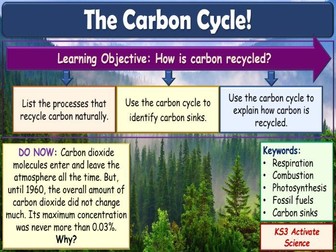
Perfect lesson resource for KS3 Chemistry! A fully differentiated and resourced lesson that assists students in learning about how carbon is recycled. Students will describe the processes that recycle carbon naturally, identify carbon sinks and use the carbon cycle to explain how carbon is recycled.
The resource includes a detailed and engaging lesson PowerPoint with differentiated activities, worksheet and quizzes for students to complete. This resource is part of The Earth topic and has been created for the delivery of the Activate KS3 Science course. Also great for GCSE Science.
16 slides in total for the lesson PPT
New version - updated to complete lesson!
If you have already paid for this resource you can download it again without extra payment.
My resources now cover the whole of OCR AS Chemistry.
Each download includes a list of all available lessons and bundles.
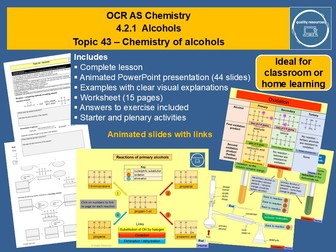
This complete year 12 lesson on alcohols covers OCR section 4.2.1 (alcohols). Content includes the physical and chemical properties of alcohols, as well as naming and classification. The resource features a 44 slide animated PowerPoint that illustrates and explains the concepts in a lively and visual way. Many of the PowerPoint slides contain links to other slides, to enable easy navigation and to emphasise links between the types of alcohol and the types of reaction. As well as pages devoted to each of the main types of reaction (substitution, oxidation and elimination), primary, secondary and tertiary alcohols each have a page with a clear chart of numbered reactions, where each number is linked to a page detailing that reaction. Information given includes type of reaction, reagents and conditions and an equation, as well as key definitions. In addition the reactions have an animated mechanism or structural equation. There are links to pages describing and explaining practical techniques, where relevant.
There is a starter and a plenary activity as well as a 15 page workbook. Exam tips and answers to the exercises are provided. Ideal for the classroom or blended learning, this resource could be used as an introduction to the topic, or for revision, extension or consolidation.
This lesson is part of a series covering the OCR AS Chemistry specification and relates to the following part of the specification:
Module 4 – Core organic chemistry
Part 2 – Alcohols, haloalkanes and analysis
4.2.1 Alcohols
Content covered
• Comparing methods of making ethanol
• Naming alcohols
• Physical properties of alcohols, in terms of hydrogen bonding
• Primary, secondary and tertiary alcohols
• Substitution reaction of alcohols
• Oxidation of alcohols
• Elimination (dehydration) reaction of alcohols
• Reactions of primary, secondary and tertiary alcohols
• Animated mechanisms
• Reaction classification
• Reagents and conditions
• Structural equations
• Key definitions
• Heating under reflux
• Distillation to prevent complete oxidation
Duration: 1-2 lessons and/or independent study
Please review
Links
Previous lesson – Topic 42 − Polymers from alkenes
https://www.tes.com/teaching-resource/polymers-from-alkenes-ocr-as-chemistry-13316815
Next lesson – Topic 44 − Haloalkanes
https://www.tes.com/teaching-resource/haloalkanes-ocr-as-chemistry-13324028
This PowerPoint is a whole lesson included with student activities, animated answers, homework questions with answers provided.
This lesson covers:
Forming nitriles from haloalkanes
Forming nitriles from aldehydes and ketones
Forming amines from nitriles (reduction)
Forming carboxylic acids from nitriles (hydrolysis)
Friedel-Crafts alkylation of benzene
Acylation of benzene with acyl chloride
A three lesson, 78 slide PowerPoint presentation on NMR. There is enough content here for three lessons covering areas:
- introduction to NMR
- solvents
- TMS
- carbon environments
- carbon NMR
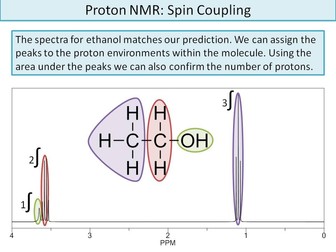
- proton NMR
- integration and number of protons
- spin coupling/splitting patterns
There are five accompanying worksheets for students, and a teacher version with answers. There are also NMR chemical shift data sheets that can be printed out for students.
This has been written for the AQA A-Level specification, however, it is easily applicable to a variety of specifications.
OCR A level Chemistry: 29.3 Carbon-13 NMR Spectroscopyy
This PowerPoint is a whole lesson included with student activities, animated answers, homework questions with answers provided.
This lesson covers:
Identifying different carbon environments
The types of carbon environment
The amount of chemical shift ẟ / ppm
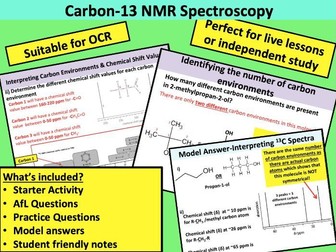
A complete lesson including starter activity, AfL work tasks and main work tasks (all with answers included) on Carbon-13 NMR Spectroscopy
By the end of this lesson KS5 students should be able to:
To analyse a carbon-13 NMR spectrum of an organic molecule to make predictions about:
The number of carbon environments in the molecule
The different types of carbon environment present from chemical shift values
Possible structures for the molecule
Declaimer: Please refrain from purchasing this popular resource for an interview lesson or a formal observation. This is because planning your own lessons including using your own lesson PowerPoints is a fundamental skill of a qualified/unqualified teacher that will be reviewed during these scenarios outlined above
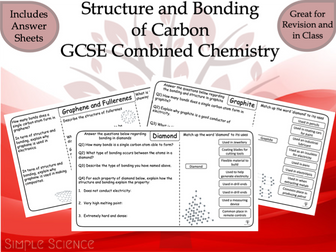
This resource contains 3 worksheets for the structure and bonding of carbon that can be used in class or as homework to enable your students to practice what they have learnt in the classroom.
This pack includes:
Diamond
Graphite
Graphene and Fullerene
We have worksheets for the following topics in Chemistry Paper 1:
Atomic Structure and The Periodic Table
Atoms, Elements and Compounds
Mixtures and Separation Techniques
Relative Atomic Mass and Electronic Structure
The Periodic Table and Metals
Groups 0 & 1
Group 7
Bonding, Structure, and The Properties of Matter
Ionic Bonding
Covalent and Metallic Bonding
Structure and Bonding of Carbon
Quantitative Chemistry
Balancing Equations
% Mass
Relative Atomic and Formula Mass
Amount of Substances in Equations
The Mole
Using Moles to Balance Equations
Limiting Reactants
Concentration of Solutions
Chemical Changes
Metal Oxides and Reactivity Series
Displacement Reactions
Extraction of Metals and Reduction
Ionic Equations
Reactions of Metals with Acids
Neutralisation of Acids
pH Scale, Neuralisation, and Strong & Weak Acids
Electrolysis
Energy Changes
Energy Transfers and Reaction Profiles
Energy Changes of Reactions
More worksheets will be added in the future.
Please rate and review this resource. Thank you!
Suitable for C1. Ppt contains method for practical of the thermal decomposition of Calcium Carbonate. Worksheet has method for decomposition of different carbonates and opportunity to calculate yields from balanced chemical equations and to find the relative reactivity of the metals.
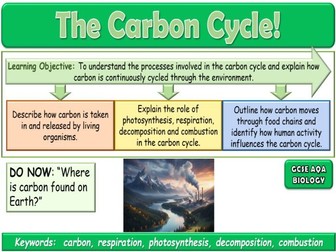
Perfect if you teach AQA GCSE Biology Combined Science or Single Science, this fully differentiated and resourced lesson supports your students in learning about the carbon cycle. By the end of the lesson students will beable to understand the processes involved in the carbon cycle and explain how carbon is continuously cycled through the environment. In addition, the resource can easily be adapted to cover other exam boards.
The resource includes a detailed and engaging PowerPoint Presentation with key points, differentiated activities, exam style questions and progress check questions/quizzes for students to complete. A differentiated worksheet is included.
INCLUDED IN RESOURCE:
17 slide PowerPoint Presentation with key points, exam questions and quizzes.
Differentiated worksheet included
Enjoy and feel free to leave a review. For the full set of AQA Biology, Chemistry and Physics topic bundles please visit:
https://www.tes.com/teaching-resources/shop/ychebbout
This GCSE Chemistry PowerPoint presentation covers the extraction of metals, focusing on different methods used based on the metal’s position in the reactivity series. It includes engaging explanations, practical applications, and exam-style questions to help students understand carbon reduction, electrolysis, and the extraction of iron in a blast furnace.
What’s Included?
Definition of a metal ore – Explanation of what ores are and why some metals need to be extracted while others exist in pure form.
Reactivity series – Understanding how metal reactivity determines the extraction method used.
Electrolysis for highly reactive metals – Explanation of why metals above carbon (e.g., aluminum, sodium, magnesium) are extracted using electrolysis.
Reduction with carbon – How metals below carbon (e.g., iron, zinc, lead) are extracted using carbon reduction.
Blast furnace process for iron extraction – Step-by-step reactions, role of coke, limestone, and hot air, and key chemical equations.
Oxidation and reduction concepts – Identifying what is oxidized and reduced in metal extraction reactions.
Word and symbol equations – Example equations for extracting different metals, with opportunities for student practice.
Review and exam-style questions – to check understanding.
Why Use This Resource?
Aligned with GCSE Chemistry (AQA) specification.
Fully editable PowerPoint (.pptx) – Customizable for different lesson styles and student needs.
Clear visuals and structured explanations – Ideal for classroom teaching or independent learning.
Develops key exam skills – Helps students practice writing equations and explaining extraction methods.
Last updated: February 2025.
Perfect for teachers, tutors, and students looking for a comprehensive and engaging resource on metal extraction. Download now to enhance your chemistry lessons!
This PowerPoint presentation with worked examples and student questions covers:
Prefixes mono- and poly-
Alkanes and alkenes functional groups
Saturated and unsaturated carbon bonds
Addition polymerisation reactions
Conditions needed for polymerisation reactions
How monomers form polymers
Repeat units and monomers
AfL learning wheel for pupils to fill in during lessons & then be able to use as a revision aid.
This was created for use along side Edexcel GCSE C1, Unit 5: Fuels.
This bundle of resources contains 12 lessons which meet all learning outcomes within the ‘Organic Chemistry’ unit for the NEW AQA Chemistry Specification.
Lessons include:
Alcohols, carboxylic acids and esters.
Complete & incomplete combustion
Cracking hydrocarbons
Fractional distillation
Hydrocarbons
Natural polymers & DNA
Polymerisation
Reactions of alkenes
The lessons contain a mix of differentiated activities, progress checks, extra challenge questions and exam questions plus more than one opportunity, per lesson, for self/peer red-pen assessment of tasks.
This resource is for KS3/4 student taking the AQA science GCSE
The resource contains methods in a condensed format suitable for revision and class instruction
Complete with example exam questions for each experiment - sourced from 2018 AQA where possible
Practicals included
Making salts
Temperature changes
Rates of reaction - observing colour change - Concentration & Temperature
Rates of reaction - measuring product volume (cm3) - Concentration & Temperature
Rates of reaction - measuring product lost (g) - Concentration, Temperature & Surface area
Chromatography
Water purification
Electrolysis
Neutralisation - Higher and Foundation
Ion testing - Flame tests, carbonate test, sulphate test & Halide test
Good luck!
Elevate your chemistry knowledge with our GCSE Chemistry - Carbon Chemistry & Fuels guide! This innovative resource is designed to be both engaging and straightforward, delivering crucial information in an accessible format. Featuring 19 expertly designed slides, it aligns with the Edexcel GCSE Chemistry syllabus while being applicable for any exam board. Validated by teachers and meticulously refined so you can achieve the coveted grade 9, this guide will help you unlock your potential and achieve high marks effortlessly. Highlighted terms make your study sessions more efficient. We’d love to hear your feedback—leave a review and tell us how our guide contributed to your success!
Includes:
1 PDF document with no access or editorial restrictions
Covers the specification points 8.1-8.17, 9.10C-9.34C from the official 2018 Pearson GCSE(9-1) Edexcel Specification
Paper 2 Higher Tier Content(seen emboldened in the official Pearson Specification)
Detailed practicals, inlcuding the method, saftey hazards & analysis
Included definitions aligned with official mark schemes to ensure full marks
Periodic Table & Ion Table included
This guide delves into the following topics:
Crude Oil & Fractional Distillation
Alkanes & Alkenes
Cracking
Addition, Condesation & Natural Polymers
Alcohols & Carboxylic Acids
Fermentation & Futher Fractional Distillation
For a detailed preview of the document’s contents, please refer to the second image.
For cheaper prices and free sample guides check out our website revisionguru.uk and give us a follow on instagram @revision.guru for a free revision guide
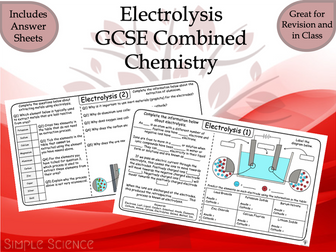
This resource contains 2 worksheets for electrolysis that can be used in class or as homework to enable your students to practice what they have learnt in the classroom.
This does NOT include half-equations at the electrodes which should be taught to higher students.
We have worksheets for the following topics in Chemistry Paper 1:
Atomic Structure and The Periodic Table
Atoms, Elements and Compounds
Mixtures and Separation Techniques
Relative Atomic Mass and Electronic Structure
The Periodic Table and Metals
Groups 0 & 1
Group 7
Bonding, Structure, and The Properties of Matter
Ionic Bonding
Covalent and Metallic Bonding
Structure and Bonding of Carbon
Quantitative Chemistry
Balancing Equations
% Mass
Relative Atomic and Formula Mass
Amount of Substances in Equations
The Mole
Using Moles to Balance Equations
Limiting Reactants
Concentration of Solutions
Chemical Changes
Metal Oxides and Reactivity Series
Displacement Reactions
Extraction of Metals and Reduction
Ionic Equations
Reactions of Metals with Acids
Neutralisation of Acids
pH Scale, Neuralisation, and Strong & Weak Acids
Electrolysis
Energy Changes
Energy Transfers and Reaction Profiles
Energy Changes of Reactions
More worksheets will be added in the future.
Please rate and review this resource. Thank you!
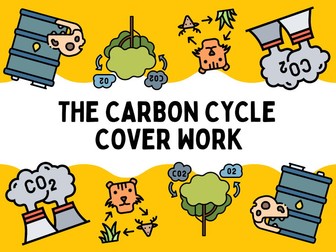
What is included?
Reading text for the main stages of the carbon cycle (Suitable for year 8 students)
Diagram of the carbon cycle
Instructions for cover work with a literacy focus
Comprehension questions based on the text
Answers to questions
CC8f lesson from the Edexcel combined science GCSE (9-1) all about reactions of acids with metals and carbonates.
The lesson includes metals reacting with acids, ionic and half equations for these reactions, acids reacting with metal carbonates and how to test for the gases produced.


 Quick View