This resource is one that can be used to log child protection concerns. Primarily it is useful for DSLs (Designated Safeguard Leads) and DSPs (Designated Senior Person). I have given some examples; all of it is fictitious and of my own making. None of the examples represent any people whatsoever.
This powerpoint has up to date guidance taken from recent training and includes scenarios for staff to discuss and guidance on what to do. It explains the importance of completing logging concern forms correctly and has many sarting points to encourage lots of discussion.
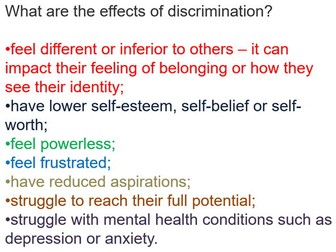
Two lesson presentations introducing the protected characteristics to your UKS2 or LKS3 classroom. These lessons are designed to support pupils’ understanding of equality, diversity, inclusion, and respect for others in an age-appropriate and engaging way.
Resources for both lessons are included and can be adapted to suit the needs of your class. One resource is a child-friendly version of the Equality Act, which I downloaded from Children’s Rights Alliance for England.
I followed these lessons with a sequence of activities exploring and challenging gender stereotypes.
Please let me know how you get on with the resources. Feedback and reviews are always appreciated!
This is a 'Child Protection' policy for a primary school and covers all aspects of a school policy and outlines the responsibilities by all stake-holders.
It is a comprehensive document that is adaptable to any school or organisation involved with working with young people.
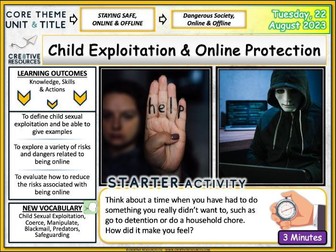
Child Exploitation and Online Protection. PSHE Lesson. Editable 22 slide PowerPoint, Lesson Assessment, Student Resources, Signposting to extra support services. Bonus Mindfulness Activity and much more.
Learning Outcomes:
To define child sexual exploitation and be able to give examples
To explore a variety of risks and dangers related to being online
To evaluate how to reduce the risks associated with being online
Some Key Terms Covered
Child Sexual Exploitation, Grooming, Influence, Coercion, Manipulation, Bribery
Each Lesson Pack Contains:
☞ 1 Fully Editable PowerPoint (Learning Outcomes, Confidence Checkers, Assessment of Learning, Variety of Tasks, Video Embedded URL Clips, Engaging Premium Quality Slides, Extra Support Websites, Challenging & Thoughtful Questioning)
☞ Mindfulness Extension Activities
☞ Assessment Opportunity (Confidence Checker)
☞ Teacher Notes (On some slides)
☞ Mapped against Latest Health and RSE DfE Guidance, PSHE Association & Character Education Guidance from DfE.
⟴ T2 - Internet Safety & Harmful Behaviour
⟴ T3 - Online + Media
⟴ PSHE Association - Theme Relationships KS3 R28
⟴ Be Ofsted and DfE PSHE ready with our resources! Product Code: RSE/C8/LS/89
We sell Complete Careers and Gatsby Careers Benchmark Units - Take a look at some of them here:
⇨ CAREERS KS3 UNIT
⇨ Puberty and Body Development
⇨STI and Contraception Unit
⇨Sex, the law and Consent Unit
⇨Relationships & Sex Education Unit
⇨Politics, Parliament and Me Unit
⇨Gangs, Dugs and Alcohol Unit
Child Protection Training for Nurseries, Childminders, and Playgroups in Scotland
This comprehensive online resource, designed on Canva, is tailored to equip early years practitioners in Scotland with essential knowledge and skills in child protection. This training resource is designed for nursery managers, leaders or childminders who want to freshen their team’s understanding of child protection processes in Scotland.
The training resource explores:
Scottish Legislation and Statistics: Gain a clear understanding of the legal framework surrounding child protection in Scotland, supported by relevant and up-to-date statistics.
Understanding Child Abuse: Learn to identify the types, signs, and indicators of child abuse, empowering you to recognize and respond effectively.
Adversity in Early Years: Explore the impact of adverse childhood experiences (ACEs) on development and the crucial role early years practitioners play in mitigating these effects.
Support Strategies: Discover practical tools and approaches to create a nurturing, supportive environment for children, promoting resilience and positive outcomes.
This resource is designed to help nurseries, childminders, and playgroups confidently navigate child protection processes, ensuring every child’s safety and well-being.
This is a PowerPoint resource to support tutors in teaching the topic or can be given to learners as a standalone resource.
• Can be used to support apprentices in their off the job learning or learners to research as part of their self-study.
• This resource is suitable to train your staff team on the subject.
• Fully editable for customisation to any learner group
• Professionally designed by a Curriculum Quality Manager
• Aligned with current 2025 frameworks and legislation
• Suitable for blended, remote or classroom delivery
• Ready for Ofsted or EQA evidence folders
Great to use as a wider curriculum resource for apprentices and learners.
Please check out our shop for may more resources and if you are looking for a resource on a specific topic, send us a message and we will be happy to help!
You will receive:
1 × Editable Learner PowerPoint
Thank you for your purchase
This is a 10-15 minute assembly or tutor time PSHE or Safeguarding session which is fully narrated and designed for KS3, KS4 & KS5 (Ages 11-18, Years 7-13). It outlines:
What peer on peer abuse / child to child abuse is
Why stopping it is so important
How students can access help and support
The 9 protected characteristics of the Equality Act
How peer on peer / child to child abuse affects someone
Signs of a negative relationship
Pupil code of conduct
How pupils can show positivity at school and form positive relationships
Definition of peer pressure and the need to create an equal community
There are discussion questions and quotes to aid discussion and these can be turned into written activities if you want to make this session last a whole lesson. There are two downloaded video clips that will never disappear and it is narrated although you can delete this by just deleting the icon on each slide if you would prefer. This session contributes to ‘Keeping Children Safe in Education’ and the new Relationships & Sexual Education and Health Education. It also highlights safeguarding, British values and can be used as part of the PSHE curriculum. It can easily be adapted if needed but covers all the necessary guidance. Pupils have responded very well to this presentation in the past and I have updated it for this year.
Delivery workbooks for KS1/KS2/lower KS3
Resources to support including:
Facilitator flipchart
Parental consent form pro forma
Parental information booklet
Worksheets - Billy the robot, posters, Worries, Rights and responsibilities, imaginary place, feelings, thoughts, behaviours.
Also free supporting posters and worksheets
Ideal for child protection / safeguarding
How to use (suggestion):
If a child displays signs of physical abuse, annotate where necessary and complete the form. Then hand to the school’s designated safeguarding / child protection leader.
.
Please note: Always follow your school’s safeguarding referral procedures.
Fully editable.
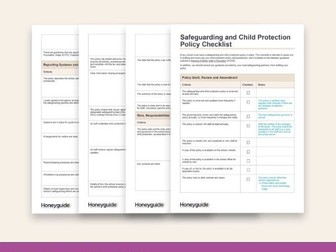
f you’re needing to update your safeguarding and child protection policy but want to ensure that it covers all of the necessary criteria, this checklist will support you. Included in this download is a seven-page editable checklist that covers key areas of safeguarding policy and practice, including roles, responsibilities and training, reporting systems and procedures, safer recruitment, allegations against staff, child-on-child abuse, vulnerable pupils, online safety and filtering and monitoring.
For each of these sections, the checklist talks you through what your policy should contain as well as helpful guidance notes to prompt your thinking about what else to include. There is also a section for drafting, reviewing and amending your safeguarding policy so if you do ever need to make changes, you can be sure you’re following the correct processes.
Fully in-line with guidance from the 2024 KCSIE, this checklist is ideal for DSLs, headteachers, trust leaders or anyone with responsibility for safeguarding in a school or college setting.
Further safeguarding resources can be found on our website.
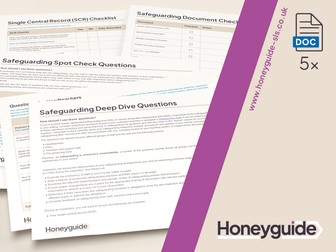
Thinking about doing a spot check on your safeguarding and child protection procedures or wondering what Ofsted will ask about safeguarding when they visit? This pack, perfect for school leaders and DSLs, has been designed to give you the tools to gather a snapshot view of safeguarding in your setting, allowing you to gain insight into how others could view your safeguarding practice.
Fully up to date with the latest 2024 Keeping Children Safe in Education (KCSIE) and the September 2024 changes to safeguarding in the Ofsted School Inspection Handbook, this bundle is designed to support DSLs, school and trust leaders. It contains five fully editable templates that allow you to gather information about the effectiveness of your current safeguarding practices over a short period of time, similar to how Ofsted would gather safeguarding information during an inspection. The questions within are designed in a safeguarding deep dive style and you can pick and choose from the huge range available if you’re looking to test out how robust your safeguarding processes are, meaning you can use the pack multiple times where needed. You can gather information about your school’s culture of safeguarding by using the following editable documents in this bundle pack:
Included:
Safeguarding Deep Dive Questions
Safeguarding Spot Check Questions
Safeguarding Deep Dive Questions for Pupils
Single Central Record Monitoring Checklist
Safeguarding Document Checklist
This pack is available on our website for £10.