Industrial Revolution - Children Working Conditions  Textile MillQuick View
RAResources

Industrial Revolution - Children Working Conditions Textile Mill

(1)
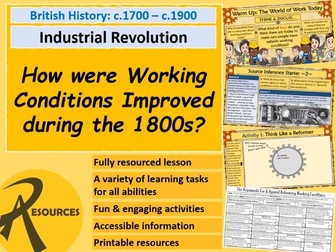
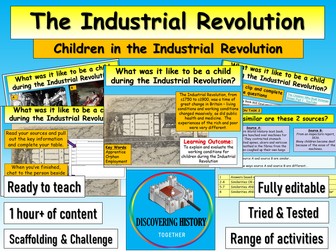
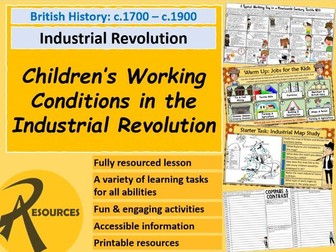
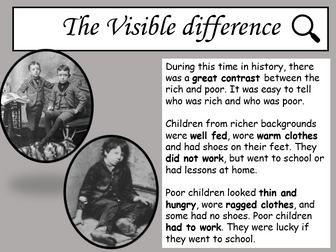
In this lesson, will learn about the harsh working conditions of the children who worked in the textile mills and factories of Industrial Britain. They will be able to describe a typical working day for the children and make comparisons with their own typical school day. The lesson includes the following: Slide 1: Title slide Slide 2: Lesson learning aims and progress Slide 3: Lesson Warm Up – Students will use the images to help them identify the various jobs that children did during the Industrial Revolution. Slide 4: Lesson Warm Up - Answers Slide 5: Starter Activity: Students will look at a map showing the location of various industries and features of the Industrial Revolution – prompt questions provided. Slide 6: Starter Activity 2: Source analysis of a child worker in a textile factory – with prompt questions Slide 7: Photograph of children working in a textile mill and prompt questions Slide 8: Photograph of children working in a textile mill and prompt questions Slide 9: Printable lesson fact sheet in the style of an illustrated storyboard. Slide 10: Task 1: Instructions of how to complete a mind map Slide 11: Printable mind map for students to write on Slide 12: Activity 2 – Students to write their own interview with a child in a textile mill Slide 13: Activity 3 – A 60 minute documentary with task – links to the documentary are hyperlinked and in the notes section Slide 14: Activity 4 – Students create their own 24-hour timeline of their own typical day and compare this with a 24-hour timeline of a child in the textile mills. Slide 15: Learning Review Quiz – Filling in the missing terms Slide 16: Learning Review Quiz answers I would be really grateful if you could leave a positive review for the lesson if you feel the lesson is effective for you. All images used in this lesson are in the public domain and are therefore copyright free at the time of publishing. Images which require attribution have been attributed in the notes section of each slide where the image appears. If you feel any errors have been made, please contact me at raschoolresources@gmail.com in the first instance to resolve any issues. Thank you.
Children Refugees - Reading Comprehension Worksheet / TextQuick View
MariaPht

Children Refugees - Reading Comprehension Worksheet / Text

(0)
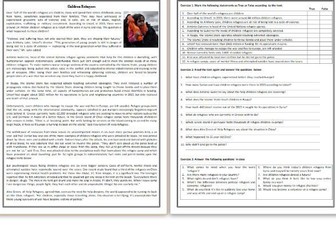
This Reading Comprehension worksheet is suitable for higher elementary to proficient ESL learners or native English speakers. The text explores the harsh reality of children refugees and exposes the shortfalls in funding, aid and support for war-stricken children. After carefully reading the text, students are required to complete some comprehension exercises including a comprehension questions, True or False exercises, a crossword and engage in an in-class discussion. The text can be used for vocabulary building purposes. This handout can be completed in class or assigned for homework.
BBC Children in Need Assembly PowerPointQuick View
theassemblyhub

BBC Children in Need Assembly PowerPoint

(0)
This clear, engaging PowerPoint is perfect for a primary school assembly on BBC Children in Need. It explains what the charity is, how it began, and why it’s important, using child-friendly language and eye-catching visuals. Pupils will learn about Pudsey Bear, the impact of fundraising, and how they can get involved in fun, accessible ways. Slides include: What is BBC Children in Need? A brief history of the appeal and Pudsey Bear How donations help children across the UK Key statistics and impact Inspiring stories of change Fundraising ideas (bake sales, sponsored events, wear yellow day) How pupils can help This resource is ideal for assemblies, PSHE lessons, or charity fundraising launches during the November campaign period. No prep needed—simply present and go.
Industrial Revolution - Children's Working Conditions Source EnquiryQuick View
RAResources

Industrial Revolution - Children's Working Conditions Source Enquiry

(0)
**In this lesson, students will have an opportunity to study several written and visual sources about children’s working conditions during Britain’s Industrial Revolution. ** They will use these sources to form their own opinion about the conditions and challenges that children faced in a variety of jobs such as in the factories, textile mills and mines. Students will then be guided to think about the usefulness and reliability of the sources they have studied. ** The lesson includes the following:** Slide 1: Title slide Slide 2: Lesson learning aims Slide 3: Lesson Warm Up – A quick quiz and discussion about the rules which impact young people working today Slide 4: Background information and discussion – What jobs did children do during the Industrial Revolution? Slide 5: Background information and discussion – Why did so many children work during the Industrial Revolution? Slide 6: Starter Activity: Source Inference – a visual source about the conditions in mines Slide 7: Background information – An overview of working conditions and the role of ‘pauper apprentices’. Slide 8: Background information – An overview of working conditions Slide 9: 9 sources covering the topic of children’s working conditions Slide 10: Single source analysis activity and instructions Slide 11: Printable table for students to complete their analysis Slide 12: Source Analysis Task 2 Instructions and model examples Slide 13: Usefulness and reliability help sheet Slide 14: Follow Up Challenge Questions Slide 15: Learning Review Please be kind enough to leave a review of this lesson if you have found it effective. Thank you. All images used in this lesson are in the public domain and are therefore copyright free at the time of publishing. Images which require attribution have been attributed in the notes section of each slide where the image appears. If you feel any errors have been made, please contact me at raschoolresources@gmail.com in the first instance to resolve any issues. Thank you.
Assembly: Children's Mental Health Week 2025Quick View
wilfy

Assembly: Children's Mental Health Week 2025

(1)
An assembly to support work on Children’s Mental Health Week 2025 with the theme of ‘Know Yourself, Grow Yourself’. This highly dynamic presentation has an assembly plus a range of ideas and resources for follow-up form time activities. This beautifully-designed and editable 34-slide Powerpoint presentation creatively presents information on this event and can be showcased to any age group and includes specific pages for primary or secondary students. It includes images, dynamic transitions, informative text, video and links for extension work in form time – including extra video and classroom activities. Slide 1: What is Children’s Mental Health Week? Includes embedded video. Slide 2: Why do you need to ‘Know Yourself’? Slide 3-4: Why do some young people people suffer from anxiety? Slide 5: This rise of teenage anxiety. Includes national statistics. Slide 6-8: How to look after you mental health – top tips. Slide 9: How to cope with teenage anxiety? BBC Newsround embedded video. Slide 10: Where to go for support. Includes links. Slide 11: Final Thought Slide 12: Follow-up form time activities title screen Slide 13: Top tips for overcoming anxiety: Breathing exercises. Includes video Slide 14: Top tips for overcoming anxiety: Move more. Includes video Slide 15: Top tips for overcoming anxiety: Get sleep and rest. Slide 16: Top tips for overcoming anxiety: Eat healthy Slide 17: Top tips for overcoming anxiety: Food that aids sleep Slide 18: Top tips for overcoming anxiety: Get outside. Includes video Slide 19: Top tips for overcoming anxiety: Connect with people Slide 20: Top tips for overcoming anxiety: Retrain your brain Slide 21-23: Form time activities: Mindful colouring Slide 24: Form time activities: Wordsearch activity Slide 25: Form time activities: Poetry activity Slide 26: Form time activities: Creative activity from Place2Be to support Children’s Mental Health Week. Includes video. Slides 27-32: Form time activities: Children’s Mental Health Week quiz – with answers Slides 33-34: Other form time ideas to support Children’s Mental Health Week strategies. As reviewers have stated for previous resources shared: “I sat down to plan my assembly for next week and found this resource, and it’s perfect. The best £2 spent. Thank you. I can teach this straight from the slides.” “Just buy it!” “Your resources have been life savers!” “Well worth the money and really saved my life” “I just wanted to say that as a non-specialist these resources are worth every single penny! Thank you so much for making and sharing them.” “Blown away by this! Can’t thank you enough!” “They have saved me a huge amount of time and the detail that goes into your work is second to none. You put others to shame who charge twice as much for very little. Can’t thank you enough.” “Your new spec resources are saving me hours & hours of work! Thanks, they are really good.”
Holocaust L6 - Children's Kindertransport ExperiencesQuick View
History_Wizard

Holocaust L6 - Children's Kindertransport Experiences

(0)
This lesson contains: A ‘do it now’ starter which you can edit as needed to revise concepts you have previously taught. An introduction to the word ‘refugee’ which students discuss and can write a definition of. They can discuss why children may have been refugees in the 1930’s from Germany. A background tot he Kindertransport program, including the reasons after Kristallnacht, the British hesitation and then their eventual offer of help. The students consolidate this by filling in a gap fill once you have gone through the slides. A short look at the experience of Stephanie Shirley by watching a video interview with her and discussing her difficulties in the kindertransport program. The main task to study a series of sources containing experiences of different youths who came the Britain. Students then use this to complete the diagram and questions on their worksheets to show the experiences of the journey, arriving and whether they felt welcome. A plenary to discuss how we remember this event, and to re-review their definitions of refugees and summarise the experiences they learned about. Attachments: 1 x Powerpoint Presentation 2 x Publisher Files
EYFS - Construction Planning Sheet for ChildrenQuick View
MissFreeman25

EYFS - Construction Planning Sheet for Children

(0)
This Construction Planning Sheet is designed to support early years children in developing their design and technology skills through hands-on construction activities. It provides a simple framework for children to think about what they want to build, the materials they will need, what it will look like and the purpose of their construction. This sheet encourages writing, planning, problem-solving, and creative thinking, fostering independence and confidence in young builders. It has: A space for a sketch/drawing Key questions for them to consider Appropriately sized lines for young writers Images to capture their attention
Animals including humans reading comprehensions for Year 3 children - ScienceQuick View
missgsteacherthings25

Animals including humans reading comprehensions for Year 3 children - Science

(0)
Animals Including Humans: Reading Comprehensions for Year 3 Children This educational resource includes a series of engaging worksheets designed to help Year 3 students explore key topics in science related to animals and humans. With a focus on the human skeleton, animal classifications, nutrient groups, muscles, skeleton types, and life processes, these reading comprehensions are perfect for developing reading skills while learning important scientific concepts. Page List: The Skeleton: The Framework of Your Body - Learn about the skull, rib cage, spine, femur, and the three main functions of the skeleton. Questions on the Skeleton - Review questions based on the previous page to reinforce understanding. Vertebrates and Invertebrates - Discover the differences between vertebrates and invertebrates, with examples from the animal kingdom. Questions on Vertebrates and Invertebrates - A set of questions to check comprehension and understanding of vertebrates and invertebrates. Nutrient Groups and Their Jobs - Understand the different nutrient groups including carbohydrates, proteins, fats, vitamins, minerals, fiber, and water, and their roles in the body. Questions on Nutrients - Assess students’ knowledge of the different nutrient groups and their importance. Muscles: How Your Body Moves - Learn about voluntary and involuntary muscles, with a focus on arm and leg muscles. Questions on Muscles - A set of questions to check understanding of muscle function and how muscles work in pairs. Types of Skeletons - Explore the three main types of skeletons: endoskeletons, exoskeletons, and hydrostatic skeletons. Questions on Skeleton Types - Review questions about the different types of skeletons found in animals. MRS GREN: The Seven Life Processes - Introduce the seven essential life processes: Movement, Respiration, Sensitivity, Growth, Reproduction, Excretion, and Nutrition. Questions on MRS GREN - A set of questions to test comprehension of the seven life processes and their significance. This no-prep resource is ideal for reinforcing students’ knowledge of biology, providing both informative content and review questions to ensure understanding. Perfect for classroom use or at-home learning, it is aligned with Year 3 science curriculum goals.
Inside Out 2: Zones of Regulation – Identifying Emotions for Primary ChildrenQuick View
phillipsadula1

Inside Out 2: Zones of Regulation – Identifying Emotions for Primary Children

(0)
Inside Out 2: Zones of Regulation – Identifying Emotions for Primary Children Inspired by Inside Out 2, this fun and engaging resource helps primary-aged children identify and regulate their emotions using the popular Zones of Regulation framework. With characters like Joy, Sadness, Anger, and Anxiety guiding them, children can easily learn to recognise their emotions and apply strategies to manage them effectively. Features: Inside Out-Themed: Featuring characters from Inside Out 2 to make emotional learning fun and relatable. Child-Friendly Design: Simplified language and colourful visuals make it engaging for young learners. Emotion Recognition: Helps children identify and understand a wide range of emotions, from feeling calm and happy to frustrated or overwhelmed. Self-Regulation Strategies: Offers practical strategies and prompts for children to manage their emotions in each zone. This resource is ideal for promoting emotional literacy, supporting wellbeing, and fostering a positive classroom environment where children can learn emotional regulation with the help of their favourite Inside Out characters.
AAQ in Early Childhood Development, Unit 1: Children's Development: Learning aim AQuick View
love2teach82

AAQ in Early Childhood Development, Unit 1: Children's Development: Learning aim A

(0)
This resource relates to the new AAQ in Early Childhood Development spec. Teaching to commence Sept 2025. It relates to Unit1: Children’s Development, Learning aim A. The powerpoint provides full coverage of learning aim A with lots of different revision activities and consolidation, recap tasks such as case study analysis, class debates, paired challenges, research tasks etc 17 slides in total with additional handouts such as a RAG rating sheet of the full unit content; Learning aims A, B, C, D, E and F, an article on the importance of early intervention, misconceptions quiz and a handout on nature vs nurture.
Industrial Revolution - Working Condition Reforms for Women & ChildrenQuick View
RAResources

Industrial Revolution - Working Condition Reforms for Women & Children

(0)
**In this lesson, students will be able to learn about the arguments which were used during the 1800s to support and argue against reforms to improve working conditions in the mines, mills and factories of the Industrial Revolution. ** In addition, students will then learn how some of the reforms set out to help workers. The lesson includes the following: Slide 1: Title slide Slide 2: Lesson learning aims and progress Slide 3: Lesson Warm Up – Class discussion about how laws today make sure people are safe and looked after in their workplace. Slide 4: Source Inference Task Slide 5: Source Inference Task 2 Slide 6: Think & Discuss – What are ‘Reforms’? How does Parliament create new laws? Slide 7: Think & Discuss – Arguments for and Against the reform of working conditions during the Industrial Revolution Slide 8: Background information – The public reaction and outrage at finding out about working conditions Slide 9: Background Information – Who were the ‘Reformers’ and what did they call for? Slide 10: Activity 1 – What would the Reformers want to do to help improve working conditions? Slide 11: Activity 1 – An alternative way to think about what the reformers would want to do to help improve working conditions Slide 12: Activity 2 – Students given a choice of written or creative tasks linked to their learning so far. Slide 13: Activity 3 – Organise the facts about the reforms worksheet instructions Slide 14: Printable worksheet Slide 15: Organise the facts answer sheet Slide 16: Follow Up Challenge tasks and questions Slide 17: Learning Review Activity Pyramid. I would be really grateful if you could leave a positive review for the lesson if you feel the lesson is effective for you. All images used in this lesson are in the public domain and are therefore copyright free at the time of publishing. Images which require attribution have been attributed in the notes section of each slide where the image appears. If you feel any errors have been made, please contact me at raschoolresources@gmail.com in the first instance to resolve any issues. Thank you.
Children In Need - Pudsey Bear Fine Motor SkillsQuick View
Vonnie-EYFS

Children In Need - Pudsey Bear Fine Motor Skills

(0)
Fine motor skills activity to include in continuous provision. Children could cut out the spots to stick on the bandana, they could finger paint spots on, use sequins or pom poms.These sheets could be laminated and used with felt tip pens/dry wipe pens. There are many implementations depending upon your intention.
Children's and Young Persons Counselling Contract TemplatesQuick View
lbrowne

Children's and Young Persons Counselling Contract Templates

(1)
Here are 3 templates that counsellors working with children and young people could use as a more visual aid and way of communicating the counselling contract. There is a blank one where you could fill in your own information or questions. There is one with key questions included. The third has key questions but added pictures / symbols. There is a black and white version and colour version of each of the 3 templates. Play therapists may also adapt the templates for their work with children and young people.
PSHE Children’s RightsQuick View
melville_m

PSHE Children’s Rights

(0)
This is a stand-alone lesson for PSHE on Children’s Rights. It includes questions to discuss and a link to a video as well as help and support for students to access after the lesson. It is suitable for KS3 and KS4 and can be delivered by specialist and non specialist teachers of PSHE
Children’s Rights  FlashcardsQuick View
27102025

Children’s Rights Flashcards

(0)
Make learning about children’s rights Flashcards, Designed for primary and early years learners, this activity helps students understand and remember key rights through visual and textual connections. Each card features a simple illustration and a short statement describing a specific right, encouraging discussion, empathy, and awareness. Perfect for classroom games, group work, or citizenship lessons. What’s Included: 10 pairs of matching cards (image + text) Printable flashcards for classroom or home use Child-friendly illustrations and inclusive language Learning Objectives: Recognize and understand basic children’s rights Develop social awareness and empathy Strengthen memory and matching skills
World Children's Day - AssemblyQuick View
danguiney

World Children's Day - Assembly

(0)
“My purpose is to engage students in dialogue so they can see other’s points of view – in a world that needs this more than ever. I do this by sharing resources on this site which connect students with the past and inspire critical thinking. Please read below to find details about this one.” Dan This resource is titled “World Children’s Day – Assembly.” The 63-slide PowerPoint assembly begins with starter anagrams with explanations. Get four students to come to the front with a whiteboard and marker and make it a game. Each is a child who has changed the world such as Malala, Mozart, Ruby Bridges etc. A script is provided so students can read out key information about World Children’s Day. This is followed by a short video from UNICEF. There is then a teacher led interactive true or false quiz featuring 10 questions about the day. The assembly invites students to become active changers and features graduated criteria which are revisited at the end. The assembly concludes with a talk from Audrey Hepburn inviting them to share their thoughts (this can be with post it notes or using the Padlet website). It is a lesson which is designed for 11-18 year old students. I hope your students get as much out of this lesson as mine always do. Before you leave be sure to follow Dan’s History Highway for more info on hundreds of fully-resourced lessons for busy teachers! Wishing you a terrific day.
Christmas Activity Pack for ChildrenQuick View
hayley72

Christmas Activity Pack for Children

(1)
Fun Christmas activity pack for children. Fun Christmas activity pack which includes : Spot the difference Cookie Recipe Design your own Christmas cracker Design your own Christmas tree decoration Word matching Word Search Design your own baubles Letter to Santa Design your own Christmas card Design your own Christmas drop Colouring activities Mental health resources for children ages 3-7. Get creative this Christmas with RainbowSmart For more content and FREE resources visit RainbowSmart.
Children’s Rights Coloring WorksheetsQuick View
27102025

Children’s Rights Coloring Worksheets

(0)
Celebrate Universal Children’s Day with this engaging set of Children’s Rights Coloring Worksheets! Designed to raise awareness about children’s rights in a fun and creative way, these printable pages help students learn about equality, education, safety, and kindness through art. Each worksheet features simple, child-friendly illustrations and short, easy-to-understand statements about key rights every child should enjoy. Perfect for classroom discussions, citizenship lessons, or themed activities around human rights and global awareness. What’s Included: 10 original coloring worksheets (education, play, protection, equality, family, health, and more) Positive, inclusive messages suitable for all ages Black-and-white line art for easy printing and coloring Ideal for early years, primary, and ESL learners Learning Objectives: Understand the basic rights of children around the world Encourage empathy, respect, and inclusion Develop fine motor and reading comprehension skills
Children's General Knowledge QuizQuick View
MissJoojoo

Children's General Knowledge Quiz

(27)
2 fun team/pub-style quizzes comprising of 6 rounds each, on a range of topics suitable for primary/secondary school students. The questions were taken from The Telegraph website. Please rate the resource and leave some feedback, it will be much appreciated. *newly edited 17/09/2012*