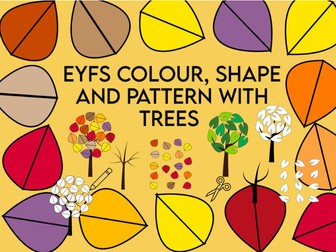
An EYFS activity based on Trees linked to Colour, Shape and Pattern.
There are 3 designs of trees.
Each of the types of trees have 3 worksheets.
Colour in the black and white tree to match the colour version.
Cut out the colour leaves and add them to the tree outline to recreate the tree exactly or to make a new version.
Colour in the leaf outlines to match the colours or use own colours. Then cut out the leaves and add to the tree.
For little fingers, you may want to enlarge the sheets for cutting out.
Enlarge even more to make a lovely classroom display tree.
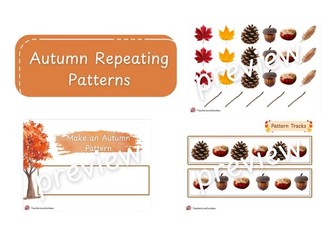
In this activity, children will either recreate one of the patterns on the tracks or create their own.
This resource provides:
14 autumn pattern tracks
Autumn pictures to create patterns
Make an autumn pattern page
Table sign
Blank table sign
This resource particularly supports:
Colour recognition
Pattern recognition
Memory & concentration
Visual discrimination
Understanding of nature and the changes in the seasons
A cute little activity to support colour knowledge and pattern matching
Contains -
x9 strips with various arrangments of the colour monsters
x1 table sign
dots to stick on pegs for colour matching
colour monster images to sue for pattern matching
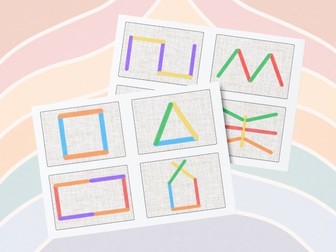
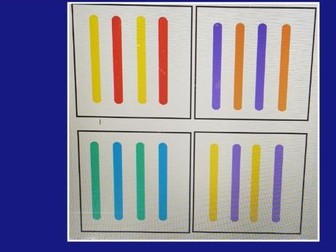
A set of flash cards with pictures of coloured lolly pop sticks on them.
They range from 2 - 4 sticks on a page
This can be used to colour match or to carry on patterns
This is made in word and the lolly pop sticks have been created by auto shapes so the colour can be changed to the colours of sticks you have.
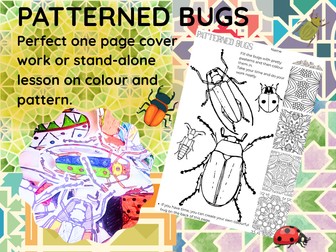
This is a great resource for when you are pushed for time, need cover work or need a gap-fill at the end of a topic. It’s also a nice mindful activity to do if (you or) your students need to de-stress!
It is literally a ‘print and go’ activity with minimal supplies needed- just something to draw and colour with.
The aim is for students to add patterns to the bodies of the bugs and then colour them in. There are some patterns along the edge of the page to inspire too. Early finishers can draw their own bug on the reverse of the paper and then fill it with colour and patterns.
I have used this resource successfully with KS2 AND KS3 students several times.
The bugs look nice cut out and stuck on the wall or window-another good activity for early finishers to do!
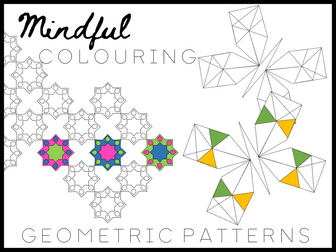
5 mindful colouring pages to create a moment of calm in the classroom. Focus your student’s attention and enjoy the beauty and simplicity of repetitive patterns. Using colours that reflect inner mood, complete stunning images. Count shapes, find patterns, spot types of angles and encourage use of geometrical terms.
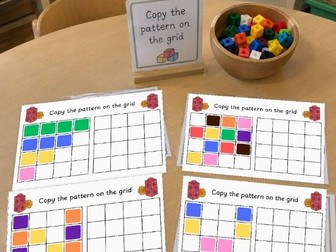
Copy the Pattern on the Grid – EYFS Maths Activity
A fun, hands-on maths activity designed to encourage young children to explore and copy colour patterns using multi-link cubes.
Children look carefully at the completed pattern on the grid and then recreate the same pattern on the empty grid using linking cubes. This makes a lovely practical activity for developing children’s observation, concentration and early mathematical thinking.
Perfect for:
EYFS maths provision
Continuous provision
Maths areas
Small-group activities
Independent learning
Practical pattern activities
Early years intervention and support
What is included?
This resource includes 10 printable pattern-copying sheets. Each sheet provides a pattern on a grid alongside an empty grid for children to recreate the pattern.
Simply print, laminate and provide with a selection of multi-link cubes for a reusable maths activity.
Skills supported
Children can develop:
Pattern recognition
Visual discrimination
Observation skills
Concentration and attention
Spatial awareness
Colour recognition
Problem-solving
Early mathematical reasoning
Fine motor skills through manipulating linking cubes
This is a great resource to put in pupil's individual TEACCH boxes or for independent tasks to consolidate matching, sequencing and following a pattern.
The flashcards are clear and uncluttered for maximum pupil focus.
They can be used with threading cubes to also promote and encourage fine motor skills.
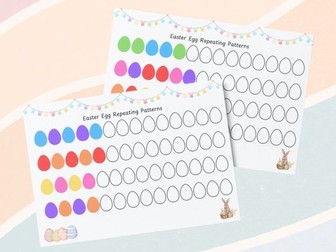
set of 54 colour pattern strips, these can be used with pegs, counters, anything with the matching colours! great for colour recognition and pattern work. There are also incomplete patterns for children to carry on and blank strips for children to make their own patterns. These can be laminated and used as a classroom resource or photocopied and used as a worksheet or homework.
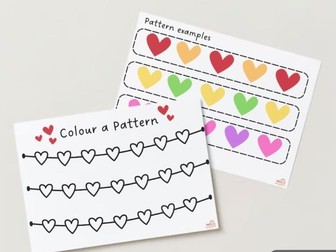
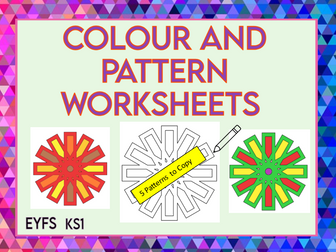
Here are 5 colour patterns for children to copy.
Each page shows a colour pattern and a black and white template to fill in.
Children can also make their own design colour patterns.
A resource linked to Spring, Summer, Animals or Insects.
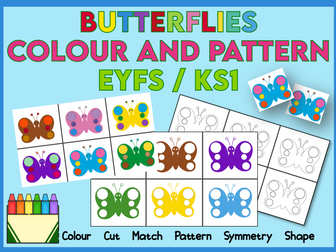
Sheet 1 shows 6 outline butterflies for children to colour in using their own ideas of colour and pattern. They could make them all the same, all different, or make them so that they match the colour butterflies in sheet 2.
Sheet 3 shows the 6 colour butterflies in sheet 2 with the colour circles left clear. Children can add their own colours or the matching colours for sheet 2.
Talk about colour, pattern, shape and symmetry with the children.
Duplicate the sheets, cut out and laminate for matching games.
Enlarge the sheets for use with a range of media such as paint and collage or to add to displays.
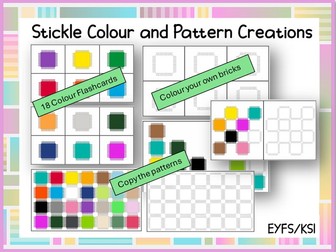
This resource is a collection of 18 colour flashcards that can be cut out and laminated if desired. It can be used with practical resources such as blocks, bricks, gummed squares of paper.
It includes:
Flashcards (18): Brightly coloured images of ‘Stickle’ blocks / bricks.
Practical Activity Sheets (2): Children use blocks, bricks, or square gummed paper to recreate the patterns shown on the sheets. They can also incorporate number by counting colours and how many blocks in each tower.
Colouring Sheets (2): White brick templates where children can colour in the bricks to match the colour patterns shown.
Brick Copying Pages (2): Colourful brick patterns for children to replicate by placing bricks or blocks directly on the template and / or colour in the template.
This resource supports learning about colour, pattern, and shape.
It’s ideal for Early Years Foundation Stage (EYFS) and Key Stage 1 (KS1), helping develop fine motor skills, spatial awareness, and pattern recognition through hands-on and creative activities.
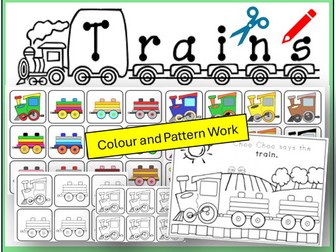
This train-themed resource includes a variety of activities to support matching, colouring, and pattern for KS1 and EYFS learners.
Page 1: A train engine with 11 colourful carriages, each a different colour pattern. (You could duplicate, cut out and laminate the small cards for matching games).
Page 2: 12 different colour patterned engine cards. Duplicate, cut and match or children can use to build a train with their choice of colour carriages.
Page 3: Black-and-white version of the engine and carriages for children to colour freely or copy colours from previous pages.
You could task the children with making each carriage different using a set number of crayons. Children could share their creations at the end of the session to see if anyone else has an engine or carriage the same as them!
Page 4: Black-and-white version of the engines sheet for children to colour in. Page 5: A train scene colouring page, using an engine and two carriages.
Learning Links: Supports colour recognition, pattern, matching skills, and fine motor control, while engaging young learners in a fun train theme! Links also with Transport and Toys topics.
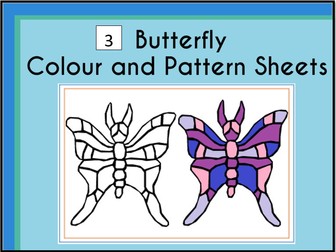
3 different butterfly colour patterns for children to copy.
They could use a range of media such as felt pens, paint, collage or crayons.
Extend by asking children to make a colour butterfly pattern for their friends to copy.
Links to symmetry.
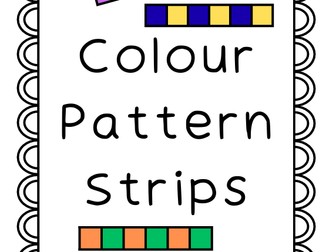
A quick and easy activity set up to help support pattern matching and colour identification.
I use these with multilink cubes.
Contains -
x1 table sign
x4 A4’s each with 3 pattern strips
Each pattern strip is a simple repeating pattern of 2 colours. Ideal activity for start of year
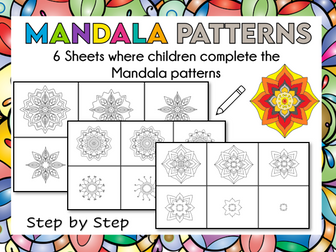
A mandala pattern is a design made up of repeating shapes, lines, and patterns arranged symmetrically around a central point. Mandalas are often found in art, nature, and different cultural traditions, helping to develop an appreciation for balance and harmony in design.
This resource consists of six worksheets designed for KS1, linking art and symmetry through mandala patterns.
Each worksheet starts with a completed mandala design and then gradually removes parts of the pattern in five steps. Children will carefully observe and reconstruct the missing sections, completing the design while reinforcing their understanding of symmetry.
This activity supports:
Recognizing and applying symmetry in designs
Fine motor skill development through precise drawing
Mathematical thinking in pattern-making
Creativity and focus in an engaging, structured task
Perfect for use in maths, art, or cross-curricular lessons, these worksheets encourage children to explore patterns, symmetry, and artistic expression.
This is a lesson plan with an associated Student Worksheet.
In this lesson, students use their observation skills to explore our environment. They will explore some of the amazing colours, shapes, patterns and textures that can be found in nature. The class will walk around the school or a nearby park, spot as many colours as they can, observe the different shapes and patterns found along the walk and feel the different textures of a variety of objects.
Students will build on their skills to recognise and classify familiar two-dimensional shapes and three-dimensional objects using obvious features. They will use a range of methods to sort information, including drawings, and learn about how to behave in a safe manner while outdoors.
 Quick View

 Quick View
 Quick View
 Quick View
 Quick View
 Quick View
 Quick View
 Quick View
 Quick View
 Quick View
 Quick View
 Quick View
 Quick View
 Quick View
 Quick View
 Quick View
 Quick View
 Quick View