Handling Information and Data (Statistics) - Level 1 Functional Skills MathsQuick View
Krazikas

Handling Information and Data (Statistics) - Level 1 Functional Skills Maths

12 Resources
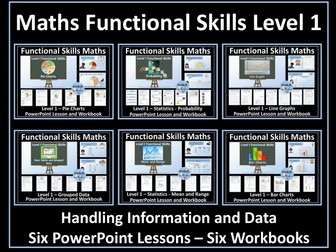
This resource has been designed for Entry Level 3 students working towards Functional Skills Maths qualifications at Level 1 (Edexcel-Pearson, NCFE, City and Guilds, AQA, Highfield Qualifications, NOCN, Open Awards). It contains 6 workbooks and 6 PowerPoint lessons on handling information and data. These resources will help pupils to achieve these outcomes: represent discrete data in tables, diagrams and charts including pie charts, bar charts and line graphs group discrete data and represent grouped data graphically find the mean and range of a set of quantities understand probability on a scale from 0 (impossible) to 1 (certain) and use probabilities to compare the likelihood of events use equally likely outcomes to calculate the probability of a simple event and to express it as a fraction in its simplest form The bundle includes six workbooks and six PowerPoint lessons: Workbooks The 25+ page workbooks contain explanation pages, worksheets,progress checks and certificates of achievement. They are provided in PDF and editable PowerPoint versions. They can be used for classwork, homework, revision or as an independent learning pack. PowerPoint Lesson The PowerPoint lessons clearly explain the skills and knowledge needed for the handling information and data component of the Level 1 specification. Many opportunities are provided within the PowerPoints for students to reinforce and consolidate their knowledge and to practise their skills in handling data. All the PowerPoints contain video links to the various components of data handling and representation and to example exam questions. They are ideal for introducing the various components of the handling information and data specification and for revision purposes. If you buy this resource and are pleased with your purchase I would be grateful if you could leave a review. In return, you can have a free resource up to the value of your purchased resource. Email inspireandeducate@aol.co.uk with your user name, the resource you have reviewed and the resource you would like for free. You may also be interested in: Level 1 - Numbers and The Number System Bundle Level 1 - Measures, Shape, Space Bundle Level 1 - Handling Information and Data Bundle Entry Level 3 Maths Bundle Entry Level 2 maths Bundle Entry Level 1 Maths Bundle Entry Level English Resources
T-Level Health 2024-2025 A5.1-11 Managing information and dataQuick View
HSCresources

T-Level Health 2024-2025 A5.1-11 Managing information and data

(0)
T-Level Health 2024-2025 complete pick-up-and-run teaching package, if you are following my SoW this is for weeks beginning 25th November and 2nd December 2024 Included is a 186 slide PowerPoint with pause points, embedded videos, exam question practice and activities. There is content in this package which is relevant to the 2nd year delivery and is above and beyond the A5 spec, as it fits well. There is also a 57-page student booklet for student notes, activities and exam practice questions. The content of these resources covers the below; A5.1 Collect data: quantitative and qualitative methods A5.2 Collecting and record info A5.3, Detail and legibility A5.4 Pro’s+ cons of sources A5.5 Technology recording and data: A5.6 Personal information, Data Protection Act 2018, GDPR A5.7 Ensure confidentiality A5.8 Restrictions for social media A5.9 Pro’s + cons IT systems integrated working A5.10 Security measures to maintain strict confidentiality A5.11 Info not stored securely issues PLEASE LEAVE A REVIEW FOR THIS RESOURCE, THANK YOU The hscresources TES shop has free and small charge teaching packages for all Health & Social Care and T-Level Health qualifications. It has a handy search facility to save on time. You could join the biggest subject team, become a member of the Health and Social Care Resources Facebook group. There are now over 5,400+ teachers sharing ideas, resources, signposting and propping each other up! Good luck in your teaching :-) #hscresources #tlevelhealth
From data to informationQuick View
kevin_b_savage

From data to information

3 Resources
This bundle begins with an overall introduction to information systems. The ORM unit shows how to design and develop relational database tables in 3NF. Finally the SQL unit shows how a 4GL can be queried to obtain meaningful data. Full details of each unit in its product descriptor.
DATA KNOWLEDGE & INFORMATIONQuick View
Mo-Hanma

DATA KNOWLEDGE & INFORMATION

(0)
CAMBRIDGE AS LEVEL ICT AS ICT 9626/CAN BE USED FOR OTHER ICT SYLLABUS ALSO. 75 MARKS DATA KNOWLEDGE INFORMATION PROCESSING ENCRYPTION
3 - Data & Information (Modelling Data Series)Quick View
enjoycomputing

3 - Data & Information (Modelling Data Series)

(0)
Lesson includes skeleton presentation which includes learning objectives, videos, task direction and plenary questions Video demonstrate (with narration): The difference between data and information Making the information stand out with gridlines and fill bucket Displaying information in a graph How to make a graph (Video for Microsoft Excel and Google Sheets) Exercises to complete within one spreadsheet (Microsoft Excel format) Suitable to support students using NCCE Modelling Data unit in a clear and concise way Ideal for remote learning delivery – I’ve used it for this!
OCR J836 IT R050 Unit 3: Data and TestingQuick View
MrBond_

OCR J836 IT R050 Unit 3: Data and Testing

(0)
Download the complete scheme of work for J836 Cambridge National in IT, R050 Unit 3: Data and Testing. Includes fully editable student workbooks, end of topic test, PowerPoints, and all answers. This full scheme of work includes: 3.1 Information and data 3.2.1 Use of data types in different contexts 3.2.2-4 Data Verification 3.2.3-4 Data Validation + example Excel file 3.3 Data collection methods + printable scenario cards 3.4 Storage of collected data + printable Top Trump style game cards 3.5 Importance of testing 3.6 Revision and assessment lesson Revision and assessment lesson includes test paper and mark scheme. Printable student workbook (PDF and editable Word documents) Engaging lessons, packed with dual-coding illustrations for your students, with ease of planning and flexibility for you! All R050 units of work are now available
Yr1 Grouping Data (Data and Information)Quick View
Archives_of_IT

Yr1 Grouping Data (Data and Information)

(0)
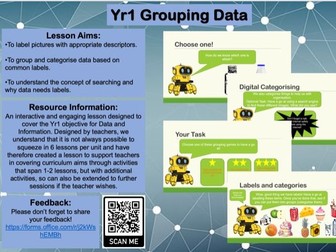
Lesson Aims: -To label pictures with appropriate descriptors.  -To group and categorise data based on common labels.  -To understand the concept of searching and why data needs labels. An interactive and engaging lesson designed to cover the Yr1 objective for Data and Information. Designed by teachers, we understand that it is not always possible to squeeze in 6 lessons per unit and have therefore created a lesson to support teachers in covering curriculum aims through activities that span 1-2 lessons, but with additional activities, so can also be extended to further sessions if the teacher wishes.
Data, Information and Knowledge - QUIZ / ASSESSMENTQuick View
NK2014

Data, Information and Knowledge - QUIZ / ASSESSMENT

(0)
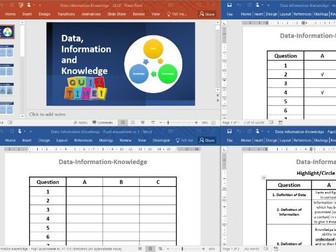
Key Stages: 3 and 4 Subjects: Computing, Computer Science (CS), Information Tecnhnology (IT), Information Communication Technology (ICT) Topic: Data > Data, Information and Knowledge Content: Definitions and examples of data, information and knowledge Resources included: Presentation with animations to show the correct answers. Answers also written in notes section. Total Slides: 14. Pupil assessment sheet for them to record their answers ONLY and self-assess. Pupil assessment sheet with questions. Pupils to highlight the correct answer. Either the Teacher can mark the assessment using the answer sheet (Resource 4) or the answers can be presented (Resource 1) and the pupil mark their own/peers assessment. Answer Sheet. Total Documents: 4 Can be used as a plenary, revision, rewards method, mini assessment, checking for understanding etc.
Year 1 Computing - Data and Information - Grouping Data - Knowledge Organiser!Quick View
TandLGuru

Year 1 Computing - Data and Information - Grouping Data - Knowledge Organiser!

(0)
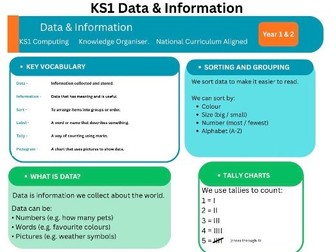
This clear, detailed and visually-appealing resource offers a complete reference point for Year 1 children, teachers and parents covering knowledge relating to ‘Data and Information’ as a part of their computing learning. The organiser has a particular focus on introducing children to how different objects can be labelled, grouped, compared and counted. It contains comprehensive sections on: -Overview; -Labels and Properties; -Grouping and Counting; -Comparing and Answering Questions; -Key Vocabulary… The content is fully aligned with the age-related expectations for Year 1 children in computing. The resource is designed to be printed onto A3, and is provided as both a PDF and a Word version (so that you can edit if you want to). All images used are licensed for commercial use and are cited on a separate document (included).
Year 4 Computing - Data and Information - Data Logging - Knowledge Organiser!Quick View
TandLGuru

Year 4 Computing - Data and Information - Data Logging - Knowledge Organiser!

(0)
This clear, detailed and visually-appealing resource offers a complete reference point for Year 4 children, teachers and parents covering knowledge relating to ‘Data and Information’ as a part of their computing learning. The organiser has a particular focus on introducing children to data logging, including using data loggers to collect, log and interpret data. It contains comprehensive sections on: -Overview; -Data Collection; -Data Recording; -Analysing Data; -Answering Questions; -Key Vocabulary. The content is fully aligned with the age-related expectations for Year 4 children in computing. The resource is designed to be printed onto A3, and is provided as both a PDF and a Word version (so that you can edit if you want to). All images used are licensed for commercial use and are cited on a separate document (included).
Presenting dataQuick View
CMGsSciencelessons

Presenting data

(0)
This fully resourced lesson on presenting data is designed to help Year 7 students develop their understanding of how to present data clearly and concisely using tables, charts, and graphs through clear explanations and engaging activities. This is the 4th in a series of lessons and covers the AQA KS3 Enquiry skill 2.4 Present data and the Activate 1 (OUP) Enquiry processes 1: EP3 Collecting, recording, and presenting data lesson. All resources are included, making it easy to run the lesson straight away. All text is editable, so you can adjust the depth, pace, or challenge to suit your class and the time you have available. Presentation contains (33 slides): ● Lesson prep and materials guide: Clear guidance for preparing the lesson. ● Student worksheets/handouts: All the printable materials needed for the lesson. ● Do Now activity: Starter activity to refresh students’ memory and introduce the upcoming lesson. ● Clear lesson aim, objectives & success criteria: Provides students with a clear understanding of what they’ll learn and how to show their understanding. ● Warm-up slides: Thought-provoking prompts and questions to introduce the topic. ● Information slides: Differentiated content catering to a range of learning styles and abilities. ● Engaging group activities: Differentiated activities that encourage students to collaborate, participate actively, and deepen their understanding of the topic. ● Questions with answers: Questions with three difficulty levels to cater to different learning styles and abilities. Answers are provided, making them perfect for self-assessment and creating clear, effective notes. ● Homework activities: Differentiated homework tasks to cater to various learning styles and abilities. These activities are designed to reinforce key concepts from the lesson while promoting independent learning. Aimed at a mixed ability Year 7 class, with three levels of demand to cater to different learning styles and levels: ● K- Know (low demand) ● A- Apply (standard demand) ● E- Extend (high demand) This lesson is also available as: ● Cover lesson worksheet: Perfect for unplanned absences, this version provides everything a cover teacher needs to deliver a smooth and engaging lesson. Presenting data Cover lesson ● Digital worksheet: Perfect for absent students, distance learning, or independent study, this digital version allows students to catch up on missed work at their own pace. Presenting data Distance learning If you require more assistance, please contact me at- info@cmgsciencelessons.com
Computing Data and Information - Primary Knowledge Organisers Bundle!Quick View
TandLGuru

Computing Data and Information - Primary Knowledge Organisers Bundle!

6 Resources
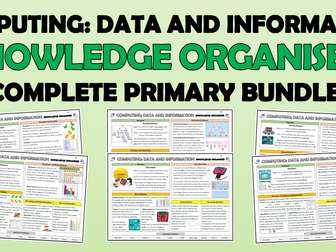
These clear, detailed and visually-appealing resources offer a complete reference point for subject leaders, teachers, parents and children covering knowledge relating to ‘Data and Information’ throughout the primary computing curriculum. Included are organisers for years 1-6, each with a particular focus that builds on prior knowledge: -Year 1: Grouping Data -Year 2: Pictograms -Year 3: Branching Databases -Year 4: Data Logging -Year 5: Flat-File Databases -Year 6: Spreadsheets The content is fully aligned with the age-related expectations for primary children in computing. The resources are designed to be printed onto A3, and are provided as both PDF and Word versions (so that you can edit if you want to).
Analysing dataQuick View
CMGsSciencelessons

Analysing data

(0)
This fully resourced lesson on analysing data is designed to help Year 7 students develop their understanding of how to analyse patterns in data and draw conclusions through clear explanations and engaging activities. This is the 5th in a series of lessons and covers the AQA KS3 Enquiry skills 2.1 Analyse patterns, and 2.3 Draw conclusions and the Activate 1 (OUP) Enquiry processes 1: EP 4, Analysing patterns in data lesson. All resources are included, making it easy to run the lesson straight away. All text is editable, so you can adjust the depth, pace, or challenge to suit your class and the time you have available. Presentation contains (33 slides): ● Lesson prep and materials guide: Clear guidance for preparing the lesson. ● Student worksheets/handouts: All the printable materials needed for the lesson. ● Do Now activity: Starter activity to refresh students’ memory and introduce the upcoming lesson. ● Clear lesson aim, objectives & success criteria: Provides students with a clear understanding of what they’ll learn and how to show their understanding. ● Warm-up slides: Thought-provoking prompts and questions to introduce the topic. ● Information slides: Differentiated content catering to a range of learning styles and abilities. ● Engaging group activities: Differentiated activities that encourage students to collaborate, participate actively, and deepen their understanding of the topic. ● Questions with answers: Questions with three difficulty levels to cater to different learning styles and abilities. Answers are provided, making them perfect for self-assessment and creating clear, effective notes. ● Homework activities: Differentiated homework tasks to cater to various learning styles and abilities. These activities are designed to reinforce key concepts from the lesson while promoting independent learning. Aimed at a mixed ability Year 7 class, with three levels of demand to cater to different learning styles and levels: ● K- Know (low demand) ● A- Apply (standard demand) ● E- Extend (high demand) This lesson is also available as: ● Cover lesson worksheet: Perfect for unplanned absences, this version provides everything a cover teacher needs to deliver a smooth and engaging lesson. Analysing data Cover lesson ● Digital worksheet: Perfect for absent students, distance learning, or independent study, this digital version allows students to catch up on missed work at their own pace. Analysing data Distance learning If you require more assistance, please contact me at- info@cmgsciencelessons.com
Types of Data + ANSWERSQuick View
jamesclegg

Types of Data + ANSWERS

(15)
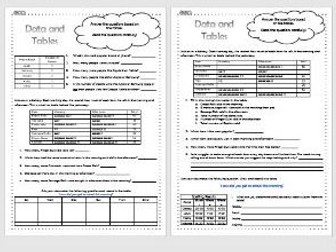
Pupils have to create their own frequency table/tally chart using the given structure. They then have to identify which type of data each question shows. Qual/Quant Discrete/Cont and Primary/Secondary Feel free to edit the names/information given etc. ANSWERS INCLUDED
PD Data Ecosystem to inform teaching and learningQuick View
shujahatmunir

PD Data Ecosystem to inform teaching and learning

(0)
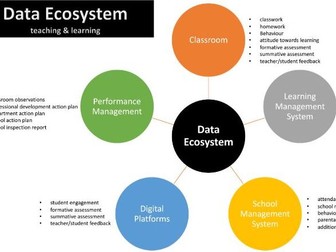
This PD will help teachers to understand components of a schools data ecosystem. While some components may require to be edited to suit your own school, this initial PD can support in improving teachers ability to use data to inform their practice.
BTEC Level 2 Component 3: Data and Information Flow DiagramsQuick View
michaelleski

BTEC Level 2 Component 3: Data and Information Flow Diagrams

(1)
Data and Information flow diagrams proves still a difficult topic for the students. This high quality resource, which comes as a full lesson, with exercises to facilitate the theory, and of course based on past exam questions, tackles the topic by introducing and explaining the differences between data and information flow diagrams. The students complete the exercises based on examples, which are fully explained in the lesson with the use of appropriate boxes and shapes. The resource has proven effective especially with my weaker students, who initially found it difficult to understand the topic. Pearson endorsed and produced on the basis of theory and exam questions.
OCR Cambridge Nationals 2018  Data & Information Learning Objective 3Quick View
IMCMJ

OCR Cambridge Nationals 2018 Data & Information Learning Objective 3

(1)
This is for the OCR Cambridge Nationals first exam 2018. This is a revision resource used to aid the teaching of Learning Objective 3 - Data and Information. Good to complete on the computer or print out a copy. My students have found it very helpful. Any feedback is welcome. Enjoy!