This resource contains interactive tasks for Ks3 students
the contents of this resource includes.
video
worksheets
powerpoint presentation
The resource can be used to introduce students to the hazards that may arise within a workshop and rules they must follow.
D&T Theory AQA Lesson Bundle
NOW INCLUDES : D&T Exam Revision & Task Booklet- AQA
This bundle includes 14 engaging theory lessons linked to the Design Technology GCSE AQA Specification:
♦ Timbers and Metals
♦ Polymers
♦ Textiles & New Materials
♦ Research & Investigation
♦ Explore & Develop Ideas
♦ Design Strategies
♦ Eco, Environmental & Social
♦ Design Companies
♦ Work of Other Designers
♦ Electronic Systems
♦ Material Finishes
♦ Material Selection
♦ Mechanical Systems
♦ Standard Components
These theory lessons do not require the use of specialist equipment or computers. Allowing the work to be set remotely or to be taught in non-specialist classrooms.
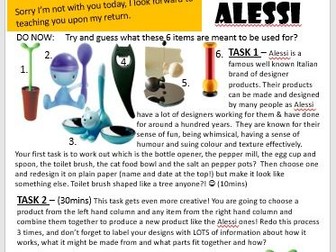
A stand alone lesson which is perfect for any KS3 or higher KS2 or lower KS4 Cover Lesson or the start of a new project. Based on the designer Alessi and designing new products for market, I based this one on unusual inspirations, but you can easily change the wording so that it mentions your own made up objects too.
All you need to do is print one sheet per student (or 1 between 2) and the only other resources needed are plain paper and pencils/crayons whatever you would like them to draw with!
My 2nd ever upload so I am hoping this is helpful to someone!
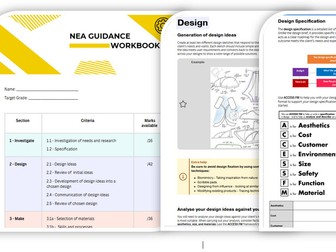
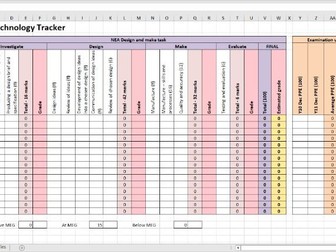
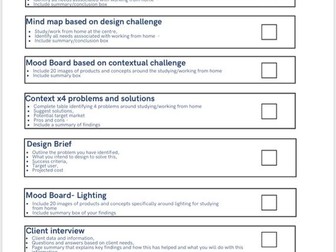
This resource can be used to ease marking of NEA for Design and Technology. The specific language is taken directly from the AQA mark scheme, but it has been put in chart form with areas identified, so that different mark bands can be easily seen for each section of the NEA. This is a new resource this year for my department, this type of format has helped a lot in Food for several years. It can also be shared with students so they can see how to progress to higher marks using simplified terms. Simply tick the box that you think the students work fits into for that section and the use that information to make your judgement about each section, information can then be transfered easily to the AQA official paperwork.
This document is designed to support and guide pupils through their Design and Technology (DT) coursework.
While it is tailored to the Edexcel GCSE in Design and Technology, it is also suitable for students following the AQA specification, as both follow a similar structure and approach.
The document outlines the marking criteria along with the available marks, helping students understand exactly what is required. It includes a clear checklist and detailed guidance for each section of the coursework. Colour-coded throughout, the workbook features real student examples, prompts, and additional hints and tips to support progress.
This resource encourages independent learning, allowing pupils to take ownership of their projects while reducing workload for teachers. Many pupils achieve strong outcomes when using this workbook as a structured guide.
A KS3 project (year 8 or 9).
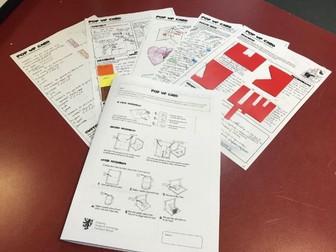
A project written for an environment without powerpoints and interactive boards. It hangs on the initial two lessons researching into pop up mechanisms and then pop out mechanisms. Students practically manufacture a range of them, but also record and analyse the mechanisms in a work booklet.
The remaining weeks focus on concept designs, then developments and a final working card.
Included are all the resources (templates & handouts) along with lots of exemplars from previous students.
GCSE Design and Technology Full Specification Revision Booklets with Answer Sheets – Ideal for Low-Stakes Testing & Exam Prep
This printable and editable revision booklet covers the entire specification for GCSE Design and Technology. It’s packed with varied, student-friendly tasks designed to boost knowledge, improve exam technique, and support retrieval practice in a low-pressure format.
This resource is for one subject but each specification point has a revision booklet and answers that fully align with the relevant GCSE.
Included in this resource:
5 multiple choice questions
Two batches of true or false statements
Gap-fill paragraph with word bank
Keyword match-up activity
Spot the mistake exam-style task
5 short answer questions
2 explain-with-example questions
1 ranking activity
Concept sorting table
Mini retrieval quiz (3×3 format)
Command word practice template
Whiteboard Q&A (10 questions)
2 mini case study application tasks
Full answer sheet included
Perfect for independent revision, in-class consolidation, or homework. Ideal for preparing students for topic tests, mock exams or final assessments.
revision booklet, GCSE, full specification, low stakes testing, retrieval practice, exam questions, answer sheet, command words, KS4 revision, printable booklet, editable Word resource Ai was used to help make these resources.
One booklet for each of the following specification points:
3.1.1 - New and emerging technologies
3.1.2 - Energy generation and storage
3.1.3 - Developments in new materials
3.1.4 - Systems approach to designing
3.1.5 - Mechanical devices
3.1.6 - Materials and their working properties
3.1.7 - Common specialist technical principles
3.2.1 - Selection of materials or components
3.2.2 - Forces and stresses
3.2.3 - Ecological and social footprint
3.2.4 - The six Rs
3.2.5 - Scales of production
3.2.6 - Sources and origins
3.3.1 - Investigation, primary and secondary data
3.3.2 - Environmental, social and economic challenge
3.3.3 - The work of others
3.3.4 - Design strategies
3.3.5 - Communication of design ideas
3.3.6 - Prototype development
3.3.7 - Selection of materials and components
3.3.8 - Tolerances
3.3.9 - Material management
3.3.10 - Specialist tools and equipment
3.3.11 - Quality control
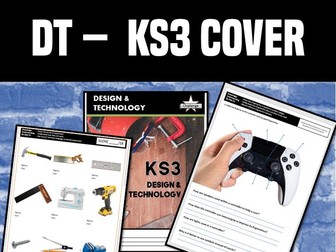
This Design Technology booklet consists of a range of tasks and covers skills that students will learn at KS3.
It includes:
Wordsearch
Ergonomics Comprehension
Identifying Ergonomics Tasks
Graphic Design - App Design
Textiles - Trainer Design
Health and safety drawing task
Tools and equipment in Product Design.
This booklet can be used as cover work for multiple lessons, used as a homework booklet or simply used in lesson to help extend the learning of pupils.
Design Technology Remote Learning and Cover Work; suitable for KS3 students. Tried and tested with year 7, year 8 and year 9 classes. The worksheets cover Illustration, Logo Design, Typography, Graffiti, Packaging Design, Scale & Proportion, Clothes Design, fabrics, DT Design Solutions, Structutal integrity (Textiles) Influence Design and Design Technology Interactive Quiz.
These DT resources may also come in handy
DT Project - 31 Template Pages - Understand the Design Process -
DT KS3 Mini project - Waterproof Overall
DT KS3 Mini Project - Collapsible Bin Store
DT KS3 Mini Project - Seat Belt Protector
DT KS3 Mini Project - Magnetic Wrist Band
DT Lesson Bundle
With an assessment sheet linked to the national curriculum criteria, this Year 4 project booklet is designed to allow for the analysis and creation of logos.
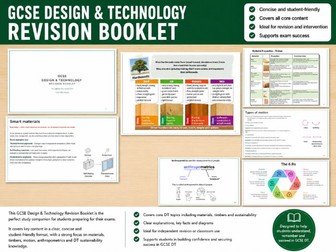
Support your students with this comprehensive GCSE Design & Technology Revision Booklet, designed to consolidate core knowledge and build confidence ahead of exams.
This student-friendly revision resource covers essential theory content in a clear, concise and accessible format, making it ideal for independent revision, homework, intervention sessions, cover lessons and classroom support.
Included Topics
New and Emerging Technologies
Modern and Smart Materials
Material Properties
Timbers and Manufactured Boards
Polymers and Biopolymers
Forces and Stresses
Types of Motion
Anthropometrics and Ergonomics
Sustainability
Fairtrade and Deforestation
The 6Rs
Life Cycle Assessment (LCA)
Linear and Circular Economies
Renewable and Non-Renewable Energy
Numeracy in Design & TechnologyKey GCSE DT Vocabulary
Why Teachers Love It
✓ Covers key GCSE DT theory content in one place
✓ Clear explanations supported by diagrams and visual aids
✓ Ideal for revision, intervention and independent study
✓ Supports knowledge retention and exam preparation
✓ Helps students build confidence in core DT concepts
✓ Suitable for classroom use, homework tasks and revision programmes
The booklet has been carefully structured to break down complex concepts into manageable sections, helping students understand, recall and apply their knowledge more effectively.
Whether used as a complete revision guide, an intervention resource, or a supplement to classroom teaching, this booklet provides students with the essential knowledge needed for GCSE Design & Technology success.
Pages: 44
Suitable for: GCSE Design & Technology students (Years 10–11)
Perfect for: Revision • Intervention • Homework • Independent Learning • Exam Preparation
Tracker for the NEA. As you enter the grades for each section it will work out if the students are at or below there target grade. Grade boundaries are inflated to provide challenge.
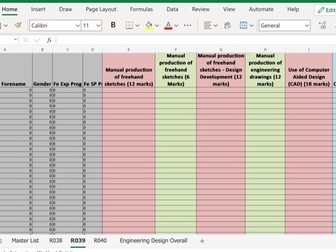
This is a tracker i developed for the new Engineering Design Level 1/Level 2 - J822. This will break down all the various units and also create an average top score for mock exams.
Feel free to contact me for support or other resources.
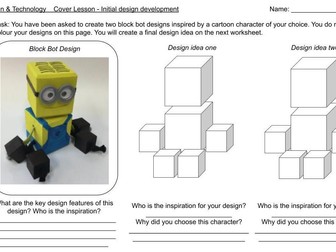
This is a one of design cover lesson (could be two lessons depending on the length) that includes following the design process and create a 3D model at the end. This should take two lessons if correctly paced.
Two worksheets and Design Net template - Powerpoint, PDF and JPEG
It is recommended to print the worksheets in A3 to ensure students have enough space to fully explore and demonstrate their design ideas.
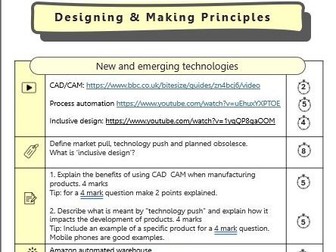
A pic ‘n’ mix revision booklet for Design and Technology GCSE. 15 pages with 50 video explanations, 28 exam questions and over 50 revision tasks. To be used independently, during tutor time, supporting class revision for students and parent/carers.
If a student only completes the definitions and watches the videos they should get a 4/5 grade in the exam. I created it for students who are disengaged with revision.
For each topic there is:-
video explanations
definitions of key terms question
exam questions
further revision tasks
The sections link to the AQA specification, however it is fully editable so you can adapt to fit other exam boards. It covers:
Core technical principles
Specialist technical principles - timber (although most are generic links/questions so can be adapted to other materials)
Design and making principles
Feedback welcome.
This powerpoint covers the majority of the GCSE AQA Engineering specification.
Suitable for all examboards, and this powerpoint is complete with highlights to each part of the spec.
Created for the 2022 Exams with Advanced Information, but the content will be examined for all exams.
Can be used for DT revision.
I achieved a Grade 9 in the Summer 2022 GCSE Exams using this booklet and received 80/80 in my NEA Component, achieving a grade 9 overall.
Here you have a Design Technology Quiz, tried and tested with KS3 and GCSE students studying DT. The quiz is interactive throughout using Hyperlinks navigating to the correct and incorrect answers which appear clearly on the screen for students to see.
The quiz contains 23 questions and covers:
environmental impact, selecting the correct materials, textiles fabrics, obsolescence and standard components and their function.
This Quiz has been tried and tested and has had fantastic feedback from students and teachers. It is great for a specialist teacher or a non-specialist teacher during a DT cover lesson.
You may also be interested in:
Made for teachers Shop
Design Technology Theory Lessons
Design Technology Cover Worksheets
Complete Food Lesson Bundle
AQA Food Preparation and Nutrition Nea 1 & 2 Coursework Guidance & Exam/Mock Questions Preparation
EDUQAS Food Preparation and Nutrition NEA 1 & 2 Coursework Guidance & Exam/Mock Questions Preparation
Food Written Exam/Mock Questions and Revision suitable for all exam boards (Larger Bundle
GCSE Food Exam/Mock Questions with Model Answers BUNDLEsuitable for all exam boards (smaller Bundle)
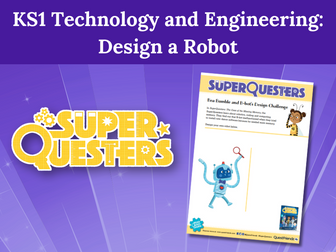
In SuperQuesters: The Case of the Missing Memory, the SuperQuesters learn about robotics, coding and computing memory. They find out that B-bot malfunctioned when they tried to install new dance software because he needed more memory. This activity sheet is all about designing your own robot.
Time required to teach: 20 minutes. We suggest this supports a Computing lesson on robots or a lesson on Design and Technology (e.g. with a focus on the importance of design appeal and creating a design that meets a brief).
Additional material required: None but you can find more free resources at www.questfriendz.com
Links to the National Curriculum:
KS1 Design and Technology - design
-KS1 Art and Design - creatively design products; use drawing to share ideas
Links to complementary resources:
The activity sheet is linked to the book SuperQuesters: The Case of the Missing Memory. Shortlisted for The Week Junior Book Awards 2023: Children’s Book of the Year - STEM category.
The second instalment in a STEM-sational series which inspires a love of STEM learning in children aged 4-8 through a unique blend of adventure stories and interactive play. Read the book, solve the quests using stickers and learn STEM skills in immersive ways never done before.
Meet Lilli and her best friends Leo and Bea - three endlessly curious kids with BIG imaginations. When they unite to solve a challenging science problem, they turn into SUPERHEROES Lillicorn, Leo Zoom and Bea Bumble and journey to a world full of magic, adventure and quests.
When Bea’s robot B-bot malfunctions after installing new dance software the three friends put their heads together and return to Questland as the SUPERQUESTERS to find a solution. Upon arrival, the trio discover that the evil Lord Grumble is wreaking havoc with his new Memory Machine, stealing memories from everyone, including the Queen of Questland. Adventure and excitement await as the friends work together to crack this latest case. Can you help them find Lord Grumble’s Memory Machine and restore normality to Questland?
Children develop over 12 STEM skills including problem solving, coding, sequencing, debugging and algorithms as they complete each interactive quest…and discover their inner superhero along the way.
The book includes 100 reusable stickers (which can be removed for classroom use), a reward chart, glossary and answer page.
Further learning resources to download at: www.questfriendz.com
Also available in the SuperQuesters series:
SuperQuesters: The Case of the Stolen Sun
SuperQuesters: The Case of the Great Energy Robbery
SuperQuesters: The Case of the Angry Sea
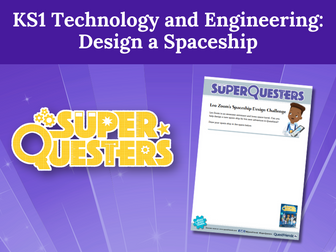
Leo Zoom is an awesome astronaut and loves space travel. Can you help design a new space ship for his next adventure in Questland? Draw your space ship in the space below. Challenge! Can you label the materials you would use to make the space ship?
Time required to teach: 20-30 minutes. Could be part of a lesson about space or transportation.
Additional material required: None but you can find more free resources at www.questfriendz.com
Links to the National Curriculum:
KS1 Science – working scientifically; everyday materials
KS1 Design and Technology – design
Art and Design – using drawing to develop and share ideas
Links to complementary resources:
The activity sheet is linked to the book SuperQuesters: The Case of the Missing Memory. Shortlisted for The Week Junior Book Awards 2023: Children’s Book of the Year - STEM category.
The second instalment in a STEM-sational series which inspires a love of STEM learning in children aged 4-8 through a unique blend of adventure stories and interactive play. Read the book, solve the quests using stickers and learn STEM skills in immersive ways never done before.
Meet Lilli and her best friends Leo and Bea - three endlessly curious kids with BIG imaginations. When they unite to solve a challenging science problem, they turn into SUPERHEROES Lillicorn, Leo Zoom and Bea Bumble and journey to a world full of magic, adventure and quests.
When Bea’s robot B-bot malfunctions after installing new dance software the three friends put their heads together and return to Questland as the SUPERQUESTERS to find a solution. Upon arrival, the trio discover that the evil Lord Grumble is wreaking havoc with his new Memory Machine, stealing memories from everyone, including the Queen of Questland. Adventure and excitement await as the friends work together to crack this latest case. Can you help them find Lord Grumble’s Memory Machine and restore normality to Questland?
Children develop over 12 STEM skills including problem solving, coding, sequencing, debugging and algorithms as they complete each interactive quest…and discover their inner superhero along the way.
The book includes 100 reusable stickers (which can be removed for classroom use), a reward chart, glossary and answer page.
Further learning resources to download at: www.questfriendz.com
Also available in the SuperQuesters series:
SuperQuesters: The Case of the Stolen Sun
SuperQuesters: The Case of the Great Energy Robbery
SuperQuesters: The Case of the Angry Sea