This revision resource is designed for AQA GCSE Biology Revision 9-1 but would suit other specifications too. Covers the whole of the Ecology topic. Two versions of the powerpoint - one for triple, one for combined.
Covers content for all of triple and combined higher + foundation.
Includes:
teacher slides (covers the whole of the specification - information, lots of activities and independent practice - answers to every task)
20 review MCQs that covers a broad range of the topic (I use as a google form)
A full 1 hour lesson designed for a low ability year 10 class studying the AQA GCSE Combined Science syllabus.
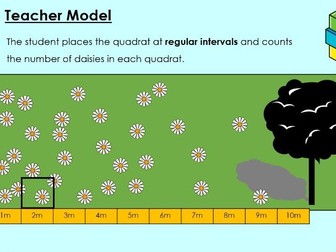
This is a theory lesson, so suitable for teaching random sampling with quadrats in the winter months!
This lesson focuses on the method of systematic sampling using transect lines.
This resource includes:
A ‘5 in 5’ retrieval-style starter
A retrieval practice (recalling method for random sampling)
Teacher input slides with dual coding and reduced cognitive load
Teacher model slides (examples)
An animated teacher model, helping students to visualise the method
Guided class discussions
Multiple choice hand signals quiz
‘Fill in the blanks’ closed task with answer slide
Exam questions, with optional scaffolds, and answer slides
Written plenary
This resource was made for the new AQA scheme of work for Triple science biology
Included are 16 lessons with full objectives and spec references (based on 1 hour lessons.) I have changed the order of teaching from the specification to help it flow a little better as well as including recap elements from earlier units.
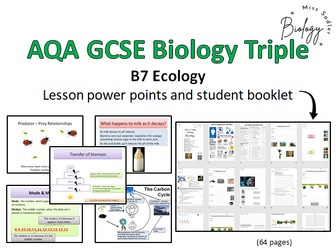
There is a student booklet included with space for notes, diagrams, exam questions and lined paper in the back for flexibility (64 pages)
Communities
Adaptations
Organisation of an ecosystem
4-5. RPA 9 Quadrtats and transects
How materials are cycled
Decomposition
8-9. RPA 10 decay of milk
Biodiversity
Global warming
Maintaining biodiversity
Food production
Biotechnoogy
Summary
All other biology lessons available. Please also see revision resources for ALL AQA units if you are interested.
Feedback always really appreciated
A bundle of all teaching materials for ESS Foundations Unit 2 – Ecology For the new IB Diploma Environmental Systems and Societies course, first assessment 2026, which is first taught in 2024.
Created by an IB curriculum developer, examiner & workshop facilitator, this Standard Level unit is the second unit of the ESS course.
This bundle contains 22 hours of lesson material with PowerPoint lessons and worksheets. The materials can be used both in-person and for online learning, added to your Google Classroom, or opened using Google Slides.
Save yourself time, all resources are ready to click and go! All my resources are informed by over 15 years of IB DP ESS teaching and examiner experience, so you can be sure you are getting a quality resource with everything you need to teach the IB ESS content.
Features:
• IB unit planner for the Ecology Unit
• Lesson 1 – Introduction to the biosphere
• Lesson 2 – Biotic and abiotic factors (Practical skills)
• Lesson 3 – Population interactions
• Lesson 4 – Measuring populations (Fieldwork skills)
• Lesson 5 – Capture, mark, release, recapture (Practical skills)
• Lesson 6 – Human impacts on ecosystems
• Lesson 7 – Laws of thermodynamics
• Lesson 8 – Food chains
• Lesson 9 – Food webs
• Lesson 10 – Toxins in ecosystems
• Lesson 11 – Ecological pyramids
• Lesson 12 – Biogeochemical cycles (the carbon cycle)
• Lesson 13 – Human impacts on biogeochemical cycles
• Lesson 14 – Human impacts on the carbon cycle presentation task
• Lesson 15 – The role of agricultural and ocean systems as carbon sinks
• Lesson 16 – Weather and climate
• Lesson 17 – Introduction to the Earth’s biomes presentation task
• Lesson 18 – Atmospheric systems, ocean currents and climate
• Lesson 19 – What is zonation?
• Lesson 20 – Ecological succession (Primary)
• Lesson 21 – Ecological succession (Secondary)
• Lesson 22 – Sand dune systems case study
• Worksheets to support learning tasks
• Clear lesson aims to meet the 2024 syllabus strands (SL)
• Key ESS terminology highlighted
• Integrated case studies
• Engaging classroom activities
• Knowledge review questions
• Home learning tasks
• Starter and plenary activities
The resource is completely developed by me as an author with no use of Artificial Intelligence tools.
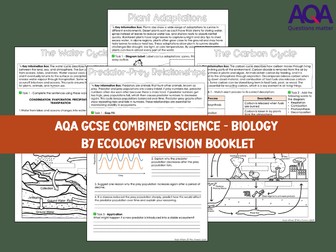
Printable GCSE Biology ecology topic workbook with retrieval tasks and exam-style questions. Perfect for independent revision or homework.
This AQA GCSE Ecology revision booklet is designed to help students master every part of the B7 Ecology topic in the GCSE Biology ecosystems unit.
It’s an easy-to-use, printable workbook that supports independent revision, classwork, or GCSE science homework — ideal for teachers who want a ready-to-use, low-prep resource.
What’s Inside?
This comprehensive GCSE ecology printable workbook includes short information summaries, retrieval practice questions, and application-style activities on all key subtopics:
Interdependence and competition
Abiotic and biotic factors
Animal and plant adaptations (including extremophiles)
Organisation in ecosystems and predator–prey relationships
Measuring population size (Required Practical)
The carbon and water cycles
Human population growth and waste management
Deforestation and peat bogs GCSE content
Global warming and climate impacts
Why Teachers Love This Resource?
Reduces workload: A true print-and-go GCSE science homework pack ecology teachers can use for homework, revision, or cover lessons.
Boosts confidence: Supports retrieval practice and helps students apply ecological concepts to exam-style questions.
Spec aligned: Fully matched to the AQA GCSE Biology and Combined Science (Trilogy) specification – Topic B7 Ecology.
Flexible use: Great for independent study, revision sessions, or as a class workbook.
Exam Board: AQA Combined Science Trilogy
Topic: B7 Ecology — Lesson 3
Overview
This lesson introduces how abiotic (non-living) and biotic (living) factors influence organism survival, competition and population size. Students then explore adaptations in animals and plants, using real ecological examples and exam-focused language.
Key Content Covered
• Abiotic vs biotic factors and definitions
• Limiting factors and photosynthesis link
• Competition revisited (plants & animals)
• Animal & plant adaptations with case examples
• Exam response scaffolding + indicative content
Lesson Features
• Retrieval Do Now & MWB checks
• Real case studies (e.g., pathogens, invasive species, desert plants)
• Vocabulary + technical exam phrasing
• Crossover links to B4 (photosynthesis) & B6 (inheritance)
• Suitable for Foundation and Higher tier students
Specification Links
Aligned with AQA Combined Science B7:
• Factors affecting ecosystems and populations
• Adaptations for survival & competition
• Influence of biotic/abiotic conditions
Ideal For
• GCSE teaching
• Revision/intervention
• Cover-ready lessons
Ecology Revision Placemat
An A3 revision mat for the Ecology chapter in AQA GCSE 1-9 Combined Science and Biology. Includes combined Science content only and no separate Biology content.
Includes answer
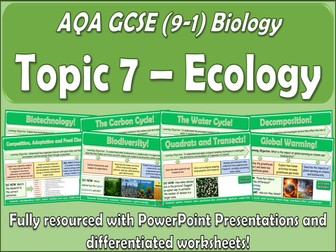
Perfect if you teach AQA GCSE Biology Single Science or Combined Science, this fully differentiated and resourced topic supports your students in learning about Topic 7 -Ecology. Designed to be taught over a unit of lessons, this resource has been created to cover all the specification points from topic 7 and can also be easily adapted to cover other exam boards.
The resource includes detailed and engaging PowerPoint Presentations with key points, worked examples, differentiated activities, knowledge questions and answers, exam style questions and progress check questions/quizzes for students to complete. Differentiated worksheets with answers are included.
*INCLUDED IN BUNDLE:
PowerPoint Presentations with key points, progress checks and quizzes.
Differentiated worksheets with answers included. *
Enjoy and feel free to leave a review. For the full set of AQA Biology, Chemistry and Physics topic bundles please visit:
https://www.tes.com/teaching-resources/shop/ychebbout
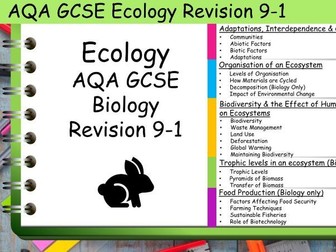
This revision resource is designed for AQA GCSE Science Biology & Combined Science Biology revision 9-1 for the topic B7 – Ecology.
This resource contains links to over 15 videos tutorials for all topics covered in the Ecology unit of the AQA specification to help your students revise.
This resource also contains the key specification points that your students will need to know when revising for Ecology as well as exam style practice questions with answers.
Topics include:
Adaptations, Interdependence & Competition
• Communities
• Abiotic Factors
• Biotic Factors
• Adaptations
Organisation of an Ecosystem
• Levels of Organisation
• How Materials are Cycled
• Decomposition (Biology Only)
• Impact of Environmental Change
Biodiversity & the Effect of Human Interaction on Ecosystems
• Biodiversity
• Waste Management
• Land Use
• Deforestation
• Global Warming
• Maintaining Biodiversity
Trophic Levels in an Ecosystem (Biology only)
• Trophic Levels
• Pyramids of Biomass
• Transfer of Biomass
Food Production (Biology only)
• Factors Affecting Food Security
• Farming Techniques
• Sustainable Fisheries
• Role of Biotechnology
There are 5 long answer exam style practice questions with mark schemes, for each unit as well as short answer questions within the PowerPoint document.
Exam style paper questions can also be printed from the Word documents included.
Includes:
• 5 Long exam style paper questions with mark schemes.
• 50 short answer question.
• Over 15 selected video tutorials to help with revision
• Over 100 slides of content.
• Videos sources from Cognito, FUSE school, Ted Ed, Freesciencelessons and more.
All YouTube links are included within the document under the photograph of the video thumbnail.
Videos have not been embedded due to copyright.
Click on the tabs to take you to the topic of your choice and use the home icon to take you back to the home page.
The round arrow will take you to the main topic menu and the video icon will take you to the video links for each topic.
B1 - Cell Biology, B2 - Organisation, B3 - Infection & Response, B4 – Bioenergetics and B5 – Homeostasis & Response and B6 – Inheritance, Variation & Evolution are available for purchase individually or as part of a bundle.
Please leave a review if you find my resources helpful.
If you have any issues or would like to get in touch, please email me at: MsM.Hanson@gmail.com
Thank you.
Ms Hanson
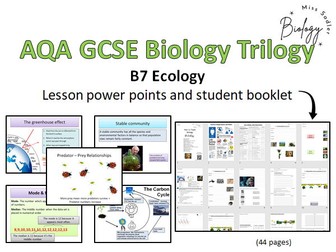
This resource was made for the AQA scheme of work for Trilogy science biology
Included are 10-11 lessons with full objectives and spec references (based on 1 hour lessons.) I have changed the order of teaching from the specification to help it flow a little better as well as including recap elements from earlier units.
There is a student booklet included with space for notes, diagrams, exam questions and lined paper in the back for flexibility (44 pages)
1.Communities
2.Adaptations
3.Organisation of an ecosystem
4-5. RPA 9 Quadrtats and transects
6.How materials are cycled
7.Biodiversity
8.Global warming
9.Maintaining biodiversity
10. Summary
All other biology lessons available. Please also see revision resources for ALL AQA units if you are interested that I use for mock and exam preparation.
A huge amount of work has gone into these resources and feedback always really appreciated
Full lessons for biology B2b for key stage 3 year 8 students from Febo Learning. Answers included for tasks in slide form for self-assessment.
Suggested Lesson Order:
Photosynthesis
Leaves
Plant minerals
Chemosynthesis
Aerobic respiration
Anaerobic respiration
Food chains
Disruption to food chains and webs
Ecosystems
Revision lesson (Ecosystems)
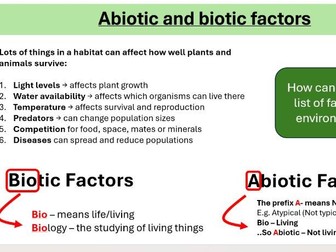
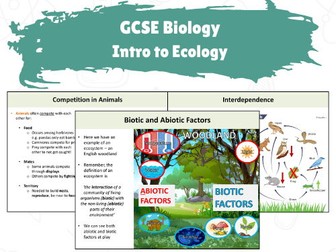
Full GCSE Biology Lesson / Revision Powerpoint on Intro to Ecology (Communities, Competition and Biotic & Abiotic Factors)
A carefully laid out powerpoint covering the main content in easy to understand slides, including exam practise and answers as well as a summary page of all the main revision points included. Workbook available for purchase to go alongside powerpoint.
Includes
Ecology Key Terms
Ecosystems, Communities and Competition
What is interdependence?
Stable communities
Abiotic and Biotic Factors
Food webs
Need another lesson from this topic? Check out our other downloads below:
Save with the Unit 7 Lessons BUNDLE
1 - Intro to Ecology
2 - Adaptations
3 - Food Chains & Predator Prey Cycles
4 - Trophic Levels & Pyramids of Biomass
5 - Quadrats & Transects
6 - The Carbon & Water Cycles
7 - Decay
8 - Biodiveristy & Waste Management
9 - Land Use & Deforestation
10 - Global Warming & Maintaining Biodiveristy
11 - Food Security, Farming & Fishing
12 - Biotechnology
Searching for lessons from other GCSE Biology topics? Find them all below:
Unit 1 - Cell Biology
Unit 2 - Organization
Unit 3 - Infection & Response
Unit 4 - Bioenergetics
Unit 5 - Homeostasis & Response
Unit 6 - Inheritance, Variation & Evolution
Unit 7 - Ecology
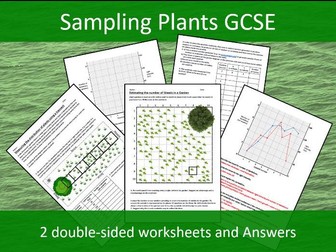
2 double-sided worksheets on sampling plants.
Perfect for the British summers or consolidation of the required practicals.
One is a sheet on a belt transect, the other is a sheet on random sampling.
Both sheets involve data analysis and working scientifically skills.
Suited to the AQA Ecology topic 7, but will be relevant to other exam boards where plant sampling is required.
Suggested Answers included
Ecology: This ecology bundle includes of all of the cootie catchers as outlined below: Playing directions and folding Directions (with pictures) are Included.
Important: All these Cootie Catchers sell for $19; as a bundle they are 25% off, for $14!
There are 7 different topics, each one having multiple versions in color and black and white:
♦ Animal Adaptations
♦ Biomes
♦ Ecosystems
♦ Evolution
♦ Food Web
♦ Habitats
♦ Water Cycle
Ecology: This ecology bundle includes of all of my interactive notebooks as outlined below: Completed facts and blank pages for students to fill out are included in all versions.
Important: All these sell for $30; as a bundle they are 50% off, for $14.95!
There are 4 different topics, each one comes in an accordion booklet and lapbook format and come in color and black and white:
♦ Animal adaptations: Booklet, Lapbook
♦ Biomes: Booklet, Lapbook
♦ Habitats: Booklet, Lapbook
♦ Water Cycle: Booklet, Lapbook
A bumper collection of twenty resources (worth £40 individually!) including starter activities, guides to experiments, detailed worksheets and independent research tasks on the topic of ecology. All resources are aimed at advanced level study and would best suit biology students, although some resources could well be used by geography or environmental science students.
Please view the description of each resource for more details.
Further resources from the same author can be found at Bioscience Rocks:
https://www.tes.com/teaching-resources/shop/cmrcarr
A set of ideas for in-field ecology investigations into biodiversity, abiotic effects, populations distributions etc. The ideas focus on heathlands, but many could be used in different habitats.


 Quick View