English Language InterventionQuick View
PateResources

English Language Intervention

(6)
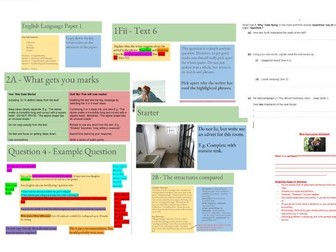
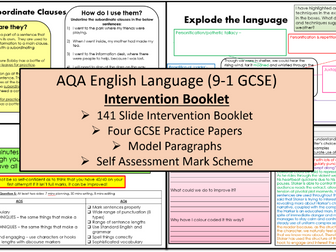
This comprehensive PowerPoint, when printed (or emailed) as a booklet, can be used as an English Language intervention and also makes an ideal revision aid. It is modelled on the AQA 9-1 GCSE English Language new specification and includes eight sessions covering both paper one and paper two helping pupils to feel more prepared for their exams. With over 140 slides, this booklet has a series of easy to follow activities, exam questions and model answers for each of the ten questions of the GCSE. Each session is designed for students to be able to work through independently, or in small groups. Personally, I have given it as revision to my students, where they work through the booklet in their own time and use what they have learned on the homework tasks - which I then mark and give feedback on and my pupils have enjoyed the challenges and gained confidence in their exam technique. It could be used for isolation and exclusion tasks, extra revision, class work, homework, for intervention groups, or for GCSE re-sit students. The tasks are aimed at enabling pupils to obtain a grade 5 or above. Skills from all six AQA Assessment Objectives of the English Language course are included, along with extracts from the mark scheme and starter tasks centered around improving the AO6 and grammar skills of the students. There are four GCSE practice papers included: Paper One - Dracula Paper One - The Red Room Paper Two - Bank Robberies Paper Two - Prisons Please check out my other resources. Any feedback would be greatly appreciated.
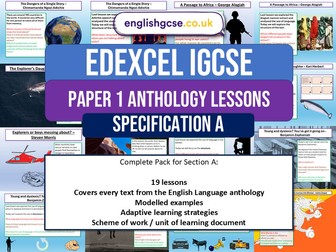
AQA English Language Paper 2 2026Quick View
EnglishGCSEcouk

AQA English Language Paper 2 2026

20 Resources
AQA English Language Paper 2 Section A 2026 bundle - designed for the new questions from 2026 onwards. This complete pack will cover all four Section A questions once completed, and includes models, sentence starters, scaffolds, adaptive learning/differentiated activities and more! Paper 2 Section A introduction (Q1) Q2 summary writing lesson Improving summaries lesson (inferences, inferring) Language analysis (purpose, audience, type) Improving language answers (explanations, quotes, examples) Comparing texts Q4 (purpose, audience, type, tone, language) Comparisons (tone, comparing texts) Comparing texts (writers’ methods, evidence, connectives, linking sentences) Q1 and Q2 lesson - two texts on prisons Q2 summary/summaries - prison texts Improving summaries lesson (inferences, inferring) Language analysis (purpose, audience, type) Improving language answers (explanations, quotes, examples) Comparing texts Q4 (purpose, audience, type, tone, language) Comparisons (tone, comparing texts) Comparing texts (writers’ methods, evidence, connectives, linking sentences) Q1 and Q2 lesson - two texts on life in London Q2, Q3 and Q4 mock - London life SOW document
AQA English Language Paper 1 2026Quick View
EnglishGCSEcouk

AQA English Language Paper 1 2026

20 Resources
AQA English Language Paper 1 Section A 2026 bundle - designed for the new questions from 2026 onwards. This complete pack covers all four Section A questions and includes models, sentence starters, scaffolds, adaptive learning/differentiated activities and more! Paper 1 Section A introduction (Q1) Q2 language analysis lesson Improving language analyses lesson Q3 structure/structural analysis lesson Empathy, narrative perspective and Q3 Improving structural analysis lesson Q4 critical evaluation skills lesson Q4 model answer and writing our own answers Q4 improving evaluative answers Q1 and Q2 lesson (football extract) Q2 language analysis lesson (with model) Improving language analysis lesson (football) Structure Q3 - mood and place Q3 structure - time (with model) Structure - improving analysis Q4 critical evaluation lesson (football) Q4 critical evaluation (with football model answer) Q4 critical evaluation improvements (football) Scheme of learning/work document Please leave a review! Leave a review and we’ll send you a single resource for free. Just email info@englishgcse.co.uk once you’ve left your review :)
Language and Global and World Englishes A Level UnitQuick View
JPResources

Language and Global and World Englishes A Level Unit

(0)
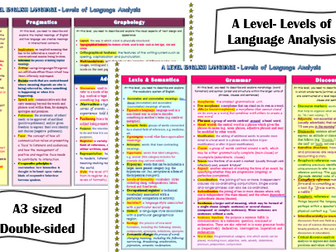
A 10 lesson unit comprising a 67 slide PowerPoint, 9 different worksheets (including transcripts) exploring the topic of Language and Global and World Englishes and a summary terminology and theory sheet. Each lesson includes a starting discussion prompt which acts as a learning objective, detailed notes on the theories and concepts listed below, a worksheet (with the exception of lesson nine) and activities, and a homework task. The following theories and concepts are covered: David Crystal – World English: Past, Present, Future (1999) Jennifer Jenkins – Lingua Franca Core (2000) Nicholas Ostler – The Last Lingua Franca (2010) David Graddol – The Future of English? (1997) Bagele Chilasa – Hierarchy of Language (2011) Braj Kachru – Three Circle Model of World Englishes (1985) Jean Paul Nerrière – Globish (2004) Pidgins and creoles William Stewart (1965) and Derek Bickerton (1973) – Post-Creole Continuum Bettina Migge and Isabelle Léglise – Attitudes towards creoles in the Caribbean (2006) Einar Haugen - Code Switching (1954) David Crystal – Tri-English (2000) Tom McArthur – Circle Model of World English (1987) Peter Strevens – World Map of English (1980) Barbara Seidlhofer – Teaching English as a Lingua Franca (2004) Stress-Timed and Syllable-Timed Languages Rhotic and Non-Rhotic Accents Lisa Lim – Language Ecology Mark Pagel – The Future of English (2011) David Deterding and Andy Kirkpatrick – Influence of Technology on World Englishes (2011) British Council – The Future of English: Global Perspectives (2023) Lynne Murphy – British and American Politeness Features (2013) Yohai Hakak, Sophia Bosah, Kwaku Amponsah and Kei Long Cheung – Australian Politeness (2022) McMaster University – Canadian v. American Politeness in Tweets (2018) There are some references to AQA-style A Level specification questions, but you can adapt these if needs be. These can be found on slides 56-64. Lesson 9 is based on an AQA A Level question. The final lesson is a consolidation activity complete with guided revision cards. Alternatively, you could use an app such as Quizlet so that the students could produce digital revision resources. Check out my other English Language A Level resources! Language and Gender Language and Region Language and Power and Occupation Language Change Language and Technology Language and Social Groups Language Discourses Child Language Acquisition - Speech Language Investigation
AQA English Language Paper 2 Question 5Quick View
EnglishGCSEcouk

AQA English Language Paper 2 Question 5

20 Resources
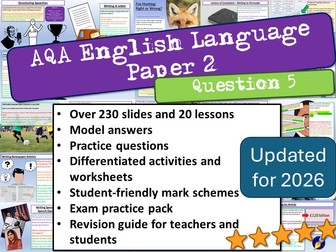
A collection of TWENTY English Language Paper 2 Question 5 lessons (17 x1 hour and 3x 2 hour) that cover writing to argue, writing to advise, writing to persuade, letter writing and essay writing. UPDATED FOR THE 2026 EXAMS! A great collection of differentiated activities, modelled examples, scaffolded sentences and guided peer and self reflection that enables students to learn from others and improve their non-fiction writing in preparation for AQA English Language Paper 2 Section B or Question 5. The suggested order of lessons is as follows (although this is by no means obligatory): AQA Paper 2 Section B Speech Writing Speech Openers Churchill Speech Writing Lincoln Speech Writing Speech Structure Newspaper Writing Magazine Article Writing Writing to Persuade - Football Greta Thunberg Speech Writing Black History Month - Essay Writing Writing to Advise Letter Writing - Writing A Formal Letter Writing to Persuade - Letters of Complaint AQA English Language Exam Prep/Mock prep lesson Pack also contains: Assessment planning for writing to argue - could be used as a separate writing to argue lesson Assessment planning for letter writing - could be used as a separate letter writing lesson Paper 2 Question 5 revision pack Knowledge organiser for revision June 2018 AQA exam review lesson if you use this paper as a mock/prep Check out our English Shop for loads more free and inexpensive KS3, KS4, KS5, Literacy and whole school resources. We also have new complete packs for the 2026 papers: Paper 1 Section A: https://www.tes.com/teaching-resource/aqa-english-language-paper-1-2026-13193444 Paper 1 Q5: https://www.tes.com/teaching-resource/aqa-english-language-paper-1-q5-2026-13214866 Paper 2 Section A: https://www.tes.com/teaching-resource/aqa-english-language-paper-2-2026-13201545 Paper 2 Q5: https://www.tes.com/teaching-resource/aqa-english-language-paper-2-q5-2026-13223813 One Year Complete AQA 2026 pack: https://www.tes.com/teaching-resource/aqa-english-language-2026-13234726 AQA English Language Paper 1 and Paper 2 Knowledge Organisers AQA English Language Paper 1 Section A package AQA English Language Paper 1 Sections A and B package AQA English Language Paper 1 package AQA English Language Paper 2 Question 5 package AQA English Language Paper 1 Question 5 package AQA English Language Paper 2 Section A package AQA English Language and English Literature revision package An Inspector Calls whole scheme package An Inspector Calls revision package Macbeth whole scheme package Macbeth revision package A Christmas Carol whole scheme package A Christmas Carol revision package Jekyll and Hyde whole scheme package Jekyll and Hyde revision package Romeo and Juliet whole scheme package Power and Conflict poetry comparing poems package Power and Conflict poetry whole scheme package Love and Relationships poetry whole scheme package Unseen Poetry whole scheme package
GCSE English Language Practise InferenceQuick View
Rachel___

GCSE English Language Practise Inference

(1)
This is a seven page workbook to help learners understand inference. The workbook includes four short pieces of fiction with questions on what is inferred in each text. The learners are then asked to describe a character to a reader and guided through the process of using inference in their writing. The booklet also includes a peer assessment sheet to allow the learners to evaluate the success of the inference. This resource has simplified inference making it ideal for learners who struggle to find inference in more complex texts. Suitable for GCSE English Language and Functional Skills learners. This booklet takes about an hour to complete and a highlighter should be used to complete the reading section.
AQA English Language 2026Quick View
EnglishGCSEcouk

AQA English Language 2026

(1)
80+ resource packs for both AQA English Language Paper 1 and Paper 2. Includes the following schemes: AQA English Language Paper 1 Section A complete pack AQA English Language Paper 1 Section B/Q5 complete pack AQA English Language Paper 2 Section A complete pack AQA English Language Paper 2 Section B/Q5 complete pack Every scheme includes a scheme of work/scheme of learning document, as well as: Modelled examples Scaffolds and success criteria Adaptive learning strategies Student-friendly mark schemes and AOs Planning lessons All designed for the new 2026 papers Any queries or questions? Please don’t hesitate to get in touch at info@englishgcse.co.uk
GCSE English Language, Sentence StructuresQuick View
bazajak

GCSE English Language, Sentence Structures

(2)
A visually powerful Powerpoint deconstructing the various sentence structures learners need to know for GCSE English Language. This Presentation, combined with various worksheets at key stages, ensures that learners not only learn the various sentence structures, but they also combine with punctuation rules, and sentence development to ensure that learners come away from the lesson more confident of being able to differentiate between the different structures (especially compound and complex), but are also better versed in the use of the comma within both compound and complex structures. This has been an extremely well received resource in the classroom.
Edexcel IGCSE English Language Question 4: Language and Structure Analysis GuideQuick View
englishexcels

Edexcel IGCSE English Language Question 4: Language and Structure Analysis Guide

(0)
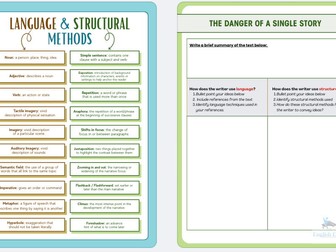
An 11 page resource designed to support students in analysing language and structure for Question 4 of the Edexcel IGCSE English Language Exam. It provides a structured approach for recording key ideas, making it ideal for both ongoing study and revision. **Templates included: ** From The Danger of a Single Story From A Passage to Africa From The Explorer’s Daughter, Kari Herbert Explorers or boys messing about? Either way, taxpayer gets rescue bill, From Between a Rock and a Hard Place, Young and dyslexic? You’ve got it going on From A Game of Polo with a Headless Goat From Beyond the Sky and the Earth: A Journey into Bhutan From H is for Hawk From Chinese Cinderella How to Use This Resource: During Analysis of texts: Use the templates as students work through each Anthology text, enabling them to organise and record their insights systematically. For Revision: Provide this resource as a review tool for students to revisit their notes and refine their understanding of key language and structure techniques.
Cambridge IGCSE First Language English Language Paper 1 Scheme/Unit - 1st Exam in 2027Quick View
MrIsherwoodsLiterature

Cambridge IGCSE First Language English Language Paper 1 Scheme/Unit - 1st Exam in 2027

(0)
First Exam in 2027 Cambridge IGCSE English Language Paper 1 Unit of Work (0500). This unit is for the new paper if your students are sitting their IGCSE exams in 2026 then this resource is not designed for you. This unit has been designed to teach students the key elements of exam technique for Paper 1. I have included 20 different short texts which are used as a means to go through each of the questions on the paper in a methodical way. This scheme is intended to give you and your students everything you need to succeed with Paper 1 and more. It has been produced based on my experience examining for Cambridge IGCSE English Language Paper 1 and 2 and aims to give students the tools to succeed in hitting the markscheme. Included: Over 200 slides with a range of activities for approaching each question on the paper. A textbook containing 20 texts. Two full practise exam papers, created by me, modelled on the new exam paper. Example mark schemes. Tips and advice for each question. Model answers. Step by step guides. Bonus lessons/mini units on spelling, punctuation and grammar and persuasive writing. An outline of the key changes to the paper. Leave a review and get a free resource of your choice from my TES shop. Simply email me at: mrisherwoodliterature@outlook.com with your purchase receipt and which resource you would like me to share.
English Language: Basic Literacy Skills SchemeQuick View
chillingtontuition

English Language: Basic Literacy Skills Scheme

(0)
Basic Literacy Scheme – 10 Fully-Resourced Lessons for Years 7–11 Boost literacy confidence across KS3 and KS4 with this ready-to-teach 10-lesson scheme. Perfect for whole-class teaching, intervention groups, catch-up sessions, or tutor time, this flexible scheme covers essential literacy skills in a fun, accessible, and highly structured format. What’s Included: 10 clear, progressive PowerPoint lessons (over 160 slides) Scheme of learning plan Fully scaffolded tasks and model examples Key focus on: Word classes (nouns, verbs, adjectives, adverbs) Sentence types and structure Sentence demarcation and subject-verb agreement Apostrophes (contractions and possession) Homophones and commonly confused words Verb tense control Creative and descriptive writing skills Why Teachers Love It: No planning required – just pick up and teach Supports lower-ability learners and EAL students Great for whole-school literacy focus or cover lessons Ideal for KS3 catch-up and KS4 exam skills refreshers
English Language Learning VerbsQuick View
lbrowne

English Language Learning Verbs

(0)
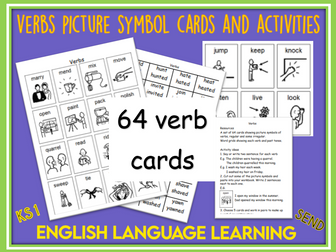
Activities suitable for English Language learners, SEND and KS1 pupils. Instructions and ideas included. Verbs Resources A set of 64 cards showing picture symbols of verbs, regular and some irregular. Word grids showing each verb and past tense. Activity ideas Say or write two sentence for each verb E.g. The children were having a quarrel. The children quarrelled this morning. E.g. I wash my hair each week. I washed my hair on Friday. Cut out some of the picture symbols and paste into your workbook. Write 2 sentences next to each one. E.G. Opening window picture symbol I open my window in the summer. Dad opened my window this morning. Choose 5 cards and work in pairs to make up a verbal or written story. Share with the group or class. *PCS Licenced - Boardmaker symbols.
English Language: Remote LearningQuick View
DavidM89

English Language: Remote Learning

(0)
This is a fully differentiated lesson looking at paper one Explorations in Creative Reading and Writing. The lesson helps learners to gain a firm understanding of the key questions and how to develop their response to get high marks. The lesson includes model answers and many opportunities for AFL. This lesson also helps learners to improve their creative writing skills and improve on their response for question five. This lesson works well both online and face-to-face and it requires no additional printing. All of my lessons have been tried and tested with my own groups. If you liked this lesson, then please check out my shop for more lessons and resources uploaded each week.
English Language: Remote LearningQuick View
DavidM89

English Language: Remote Learning

(0)
This is a fully differentiated, nineteen slide lesson looking at paper one of the English language qualification. The lesson looks at developing learner’s understanding of question four and five. There are many opportunities for AFL and an exam-style question for both q4 and q5. This lesson works well both online and face-to-face and this lesson have been tried and tested with my own groups. If you liked this lesson; then please check out my shop for more lessons and resources uploaded each week.
English Language: Remote LearningQuick View
DavidM89

English Language: Remote Learning

(0)
This is a fully differentiated lesson looking at the key questions for paper one of English language. The lesson helps learners to recap their understanding of both language and structural techniques. The lesson can be taught over two hours and also has an opportunity to develop learner’s understanding of creative writing. This lesson works well both on-line and face-to-face. All of my lessons have been tried and tested with my own groups. If you liked this lesson, then please check out my shop for more lessons and resources uploaded each week.
English language: Remote LearningQuick View
DavidM89

English language: Remote Learning

(0)
This is a fully differentiated lesson looking at explorations in creative reading and writing using the text Jamaica inn. The lesson helps learners gain a good understanding of language and structure and how to approach exam-style questions. The lesson also has a strong emphasis on developing the skills for creative writing and helping learners understand how to use skills such as show and not tell to develop their writing. This lesson works well both online and face-to-face and has been tried and tested with my own groups. If you liked this lesson, then please check out my shop for more lessons and resources uploaded each week.
English language: Remote learningQuick View
DavidM89

English language: Remote learning

(0)
This is a fully differentiated, sixteen side lesson looking at paper one English language. The lesson uses a key extract from the Hobbit and helps learners to understand key language and structural techniques and how to apply these to an exam-style response. Additionally, the lesson also has a creative writing challenge that helps learners develop their writing ability. This lesson works well both online and face-to-face and has been tried and tested with my own groups. If you liked this lesson, then please check out my shop for more lessons and resources uploaded each week.
Learning English as a second languageQuick View
NGfLCymru

Learning English as a second language

(6)
This resource is split into seven sections: Animals Body parts, Classroom objects, Clothes Colours and shapes, Food Numbers and Verbs There are also some general resources. Each section contains a self-correcting interactive resource along with printable games and writing frames.
Why learn a language?Quick View
msr2015

Why learn a language?

(1)
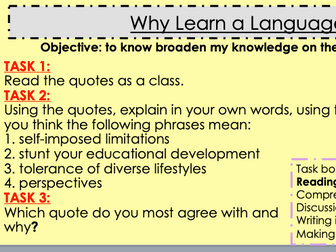
A generic lesson (for any language) that looks at different reasons to learn a language. Involves discussion and analysis of key ideas, comprehension and justification of ideas. We used this as a buffer before our language groups were set. Can also be used for European Day of Languages or cross curricular English/PSHE/Languages.
English Learning JourneyQuick View
EnglishGCSEcouk

English Learning Journey

(3)
A detailed learning journey overview of the Complete KS3 and KS4 package for English Language and Literature. This is an ‘at a glance’ overview which can be downloaded alongside our free schemes of work for all year groups. There is a separate page for each year group and although they are A4 sheets, they could easily be printed on A3 to create a colourful display for your classroom. Check out our English Shop for loads more free and inexpensive KS3, KS4, KS5, Literacy and whole school resources. AQA English Language Paper 1 and Paper 2 Knowledge Organisers AQA English Language Paper 1 Section A package AQA English Language Paper 1 Sections A and B package AQA English Language Paper 1 package AQA English Language Paper 2 Question 5 package AQA English Language Paper 1 Question 5 package AQA English Language Paper 2 Section A package AQA English Language and English Literature revision package An Inspector Calls whole scheme package An Inspector Calls revision package Macbeth whole scheme package Macbeth revision package A Christmas Carol whole scheme package A Christmas Carol revision package Jekyll and Hyde whole scheme package Jekyll and Hyde revision package Romeo and Juliet whole scheme package Power and Conflict poetry comparing poems package Power and Conflict poetry whole scheme package Love and Relationships poetry whole scheme package Unseen Poetry whole scheme package