Made for the IB Standard Level chemistry course, option E.
It's got some bits missing, notably acid deposition, plus a graph for fuel/air ratio.
Note: some of the slides that have a lot of writing on were for printing rather than projecting.
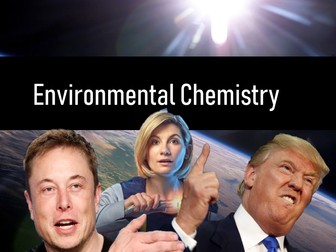
Each lesson includes a ‘blast from the past quiz’, a range of activities and an AFL task that relates to their progress. A range of lessons are designed to relate to the future AQA syllabus as well as allowing students to apply a unit of work to novel and interesting applications e.g. Following Dr Who to the early Earth’s atmosphere, choosing an alternative fuel for a new Elon musk prototype car and narrating a climate change trailer for Leonardo Decaprio.
It wa sa lot of fun teaching for what can be a very dry subject!
For KS3 low ability/SEN
Presentation with LOs, experiment and Qs
Use with low ability/SEN yr7 and yr8. Simple language and easy instructions.
Picture clues to introduce the lesson
Opportunity to design results table for the experiment
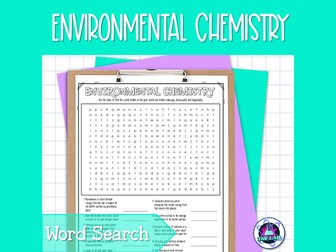
This Environmental Chemistry Word Search Review Activity is perfect for review or emergency sub-plans. This word search activity gives students a chance to review vocabulary in a fun way.
This resource includes a separate page with a word bank. You can choose to print it for your students or challenge them without it.
How to use Word Search Puzzles in your Middle School Science classroom:
I have a file with these ready for students who finish early or those who want to start on revision for a test or exam.
They are perfect for reviewing vocabulary.
These are amazing emergency sub-plans.
This product forms part of my Chemistry Word Search Bundle
This pack contains a plethora of powerpoints, worksheets, and mark schemes for all of the content in unit 5 - Energy changes of AQA 8462 Triple Chemistry, and 8464 Combined Science Trilogy.
For those of you whom regularly purchase my resources, you will know that I hold off releasing my resources until I am happy that you will be satisfied with the quality, quantity and ease of deliverance of your purchase - I’m now happy, I hope you are too!
Lesson packs include:
4.5.1.1 Energy transfer during exothermic and endothermic reactions
4.5.1.2 Reaction profiles
4.5.1.3 The energy change of reactions (HT ONLY)
4.5.2.1. Cells and batteries (Chemistry only)
4.5.2.2. Fuel cells (Chemistry only)
Required practical 4 worksheet pack
All folders organised into zip folder
Resources are checked against the specification, and income tax is paid on all my sales. As always your feedback is greatly appreciated as good reviews really aid sales.
I hope you enjoy
Lewis
This resource contains 3 revision mats for the required practicals in the Chemistry section of the new AQA Science Trilogy paper 2. Answer sheets have been added.
They contain questions about methodology, scientific enquiry and analysis of results. These can be given after teaching the required practical, homework or at the end of year 11 for revision before their exams.
Required practicals included:
Rates of Reaction
Chromatography
Water Purification
My year 11s have found these particularly useful to go through in revision lessons and have taken extra home to use as revision tools.
Please rate this resource.
You can also find our other bundles for the following:
Biology Paper 1
Biology Paper 2
Biology Triple
Physics Paper 1
Physics Paper 2
Chemistry Paper 1
Chemistry Paper 2
Other resources and revision mats can be found in my shop by clicking the following link:
https://www.tes.com/teaching-resources/shop/cal-w11
Perfect if you teach GCSE Chemistry Single Science, this fully differentiated and resourced lesson supports your students in learning about rates of reaction. Covering the full GCSE Chemistry specification, this resource is adapted to cover all exam boards. Students will:
State what is meant by rate of reaction.
Calculate the rate of a reaction.
Describe the different experimental methods used to investigate the rate of a reaction - disappearing cross experiment, change in mass experiment, volume of gas given off experiment.
Explain what is meant by collision theory and state what factors the rate of a reaction depends on.
Explain how changes in temperature, concentration, pressure and surface area affect the rate of reaction.
Complete rate experiments involving gases and precipitates.
Describe what a catalyst is and explain how it affects the rate of a reaction.
This lesson includes a detailed and engaging lesson PowerPoint with differentiated activities, class practical/demo activities, exam style questions and progress quizzes for students to complete. Enjoy and feel free to leave a review.
*INCLUDED IN BUNDLE:
24 slide PowerPoint Presentation with key points, progress check questions, checkpoints, practice exam questions, quizzes, class practical activities. *
UPDATED MAY 2019 with workbook for the whole unit!
As promised, here is the whole of Unit 3: Quantitative Chemistry for the New AQA Combined Science Trilogy.
Every lesson is covered exactly to the specification with a plethora of worksheets and homeworks.
I have also included a scheme of work for the unit, with blooms taxonomy learning objectives paired with the new GCSE grades.
I can confidently state that this is the most comprehensive and high quality resource I’ve ever made, I hope you’ll agree.
Highly animated presentations & resources include:
3.1.1 - Conservation of mass & balanced symbol equations + 3 x worksheet + 1 x homework
3.1.2 - Relative formula mass + 2 x worksheet + 1 x homework
3.1.3 - Mass change when reactant is a gas + 1 x worksheet + 1 x homework
3.1.3 - Mass change when product is a gas + 1 x worksheet + 1 x homework
3.1.4 - Chemical Measurements
3.2.1 - Moles + 3 x worksheet + 1 x homework
3.2.2 - Amounts of substances in equations + 2 x worksheet + 1 x homework
3.2.3 - Using moles to balance equations + 2 x worksheet.
3.2.4 - Limiting reactants + 1 x worksheet
3.2.5 - Concentrations of solutions + 5 x worksheet + 3 x homework.
+ Scheme of work
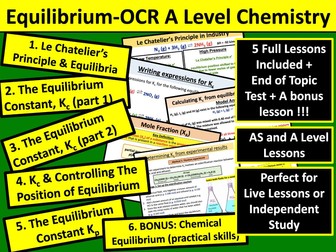
6 Full Lesson Bundle (includes a bonus lesson) on the topic of Equilibrium from the OCR A Level Chemistry specification plus an end of topic test. See below for the lessons and learning objectives
Lesson 1: Le Chatelier’s Principle
To explain the term dynamic equilibrium
To apply le Chatelier’s principle to homogeneous equilibria in order to deduce qualitatively the effect of a change in temperature, pressure or concentration on the position of equilibrium
To explain why catalysts do not change the position of equilibrium
To explain the importance to the chemical industry of a compromise between chemical equilibrium and reaction rate in deciding the operational conditions
Lesson 2: The Equilibrium Constant Kc (Part 1)
To construct expressions for the equilibrium constant Kc for homogeneous reactions
To calculate the equilibrium constant Kc from provided equilibrium concentrations
To estimate the position of equilibrium from the magnitude of Kc
To know the techniques and procedures used to investigate changes to the position of equilibrium for changes in concentration and temperature
Lesson 3: The Equilibrium Constant Kc (Part 2)
To construct expressions for the equilibrium constant Kc for homogeneous and heterogeneous reactions
To calculate units for Kc
To calculate quantities present at equilibrium and therefore kc given appropriate data
Lesson 4: Controlling The Position of Equilibrium (Kc)
To understand and explain the effect of temperature, concentration, pressure and catalysts on Kc and controlling the position of equilibrium
Lesson 5: The Equilibrium Constant Kp
To use the terms mole fraction and partial pressure
To construct expressions for Kp for homogeneous and heterogeneous equilibria
To calculate Kp including determination of units
To understand the affect of temperature, pressure, concentration and catalysts on Kp and controlling the position of equilibrium
Lesson 6 (BONUS): Chemical Equilibirum (Practical Skills):
To understand how a titration experiment can be used to calculate the equilibrium constant, Kc
To understand how a colorimeter can be used to calculate the equilibrium constant, Kc
To analyse exam questions based on titration experiments in order to calculate out Kc
End of Topic Test:
A 45 minute end of chapter test on chemical equilibrium. The test covers content from both year 12 and 13 OCR on chemical equilibrium. A markscheme with model answers is also included which enables students self assess their answers in class with their teacher or as a homework task.
The test is based on the following learning objectives:
Apply le Chatelier’s principle to deduce qualitatively (from appropriate information) the effect of a change in temperature, concentration or pressure, on a homogeneous system in equilibrium.
Explain that a catalyst increases the rate of both forward and reverse reactions in an equilibrium by the same amount resulting in an unchanged position of equilibrium
Deduce, for homogeneous and heterogeneous reactions, expressions for the equilibrium constant Kc.
Calculate the values of the equilibrium constant, Kc (from provided or calculated equilibrium moles or concentrations), including determination of units.
Estimate the position of equilibrium from the magnitude of Kc.
Calculate, given appropriate data, the concentration or quantities present at equilibrium.
Deduce, for homogeneous and heterogeneous reactions, expressions for the equilibrium constant Kp.
Calculate the values of the equilibrium constant, Kp (from provided or calculated equilibrium moles or pressures), including determination of units.
Explain the effect of changing temperature on the value of Kc or Kp for exothermic and endothermic reactions.
State that the value of Kc or Kp is unaffected by changes in concentration or pressure or by the presence of a catalyst.
Explain how Kc or Kp controls the position of equilibrium on changing concentration, pressure and temperature
Declaimer: Please refrain from purchasing this popular resource for an interview lesson or a formal observation. This is because planning your own lessons including using your own lesson PowerPoints is a fundamental skill of a qualified/unqualified teacher that will be reviewed during these scenarios outlined above
Brand New Chemistry Escape Room - 2nd Generation Virtual Escape Room by Cre8tive Resources! This lasts an hour or under depending on how quick the teams can solve each puzzle! Students love this style of lesson, great as an educational treat for your class.
Our other totally different but very popular first generation Science Escape room is here SCIENCE ESCAPE ROOM FIRST GENERATION
Product Contents:
☞ Escape Room Interactive Tracker PowerPoint - Keeps the competitive nature on display
☞ Escape Room Puzzle Keys (Six Sets for Six Teams)
☞ Escape Room Team sheet - Record codes, answers clues as they progress through the 7 rooms
☞ Escape Room Puzzles (7 Rooms = 7 Different styles of Puzzles involving numeracy, literacy and lateral thinking)
☞ Teacher Answer Sheet - Quickly confirm to teams they have solved the puzzle correctly
☞ Teacher instructions of how to set up the escape room and what to print and top tips and shortcuts.
☞ Successful Escape Certificates for those that complete the entire challenge (There is a difficult bonus escape too :) for any quick teams
✿ The 7 Rooms include: Playground, Hallway F, English Classroom, Never Ending Basement, Heads Office, The Library and Finally the Secret Laboratory (Each Puzzle has been adapted to suit the topic of this Escape Room and is suitable to KS3 and KS4 Student.
Our Philosophy
✿ We aim to help you equip students with the knowledge and skills to take ownership of their own learning. Our Products come ‘Ready-to-Teach’ with everything you need to teach fun and creative lessons. Our products are teacher-designed, classroom tested & student approved.
JUST PRINT AND GO!
✿ They can also be used to encourage a flipped learning environment. Cre8tive Product Code C8/ES/37
✰✰✰✰✰✰✰✰✰✰✰✰✰✰✰✰✰✰✰✰✰✰✰✰✰✰✰✰✰✰✰✰✰✰✰✰✰✰✰✰✰
You may also want to check out these other great Science Cre8tive resources for your students
⇨ Science Christmas Quiz
⇨ Sciece KS3 Christmas Quiz
⇨ Chemistry Escape Room
⇨ Biology Escape Room
⇨ Physics Escape Room
⇨ Science End of Year Escape Rooms Bundle
⇨ How to Draw Graphs in Science
⇨ General Science KS3 Escape Room
A complete lesson covering AQA trilogy and chemistry GCSE paper 2.
It includes:
Rates
Equilibria
Hydrocarbons
Atmosphere
Using resources
chromatography RPA
Rates RPA
Gas tests
Includes a variety of activities including multiple choice and exam questions
Includes the 2022 version and an updated version for 2023
All answers provided
My resources now cover the whole of OCR AS Chemistry.
Each download includes a list of all available lessons and bundles.
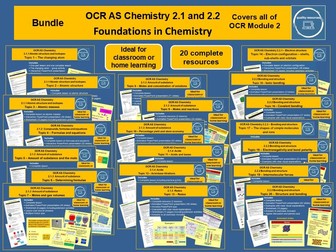
This bundle is ideal for classroom or home learning and covers the whole of the OCR A level chemistry specification module 2 - Foundations in Chemistry, sections 2.1 and 2.2.
Each topic includes a fully interactive PowerPoint including starter, group activities, questions and plenary along with a worksheet and a lesson plan. Answers to all exercises are provided. Some of the resources include a PowerPoint quiz. A practical activity on titration is also included.
This bundle relates to the following sections of the OCR AS Chemistry specification:
Module 2 – Foundations in chemistry
Part 1 – Atoms and reactions (whole)
2.1.1 – Atomic structure and isotopes
2.1.2 – Compounds, formulae and equations
2.1.3 – Amount of substance
2.1.4 – Acids
2.1.5 − Redox
Part 2 – Electrons, bonding and structure (whole)
2.2.1 – Electron structure
2.2.2 – Bonding and structure
Module 3 – The Periodic table and energy
Part 1 –The Periodic Table (part)
3.1.1 (Periodicity) (part)
Content covered:
The changing atom
How Science Works - HSW7 - The changing accepted models of atomic structure over time.
The contributions of five scientists to the development of the theory of atomic structure.
Atomic structure
• Protons, neutrons and electrons – mass and relative charge
• Atomic number and mass number
• Isotopes
• Key definitions
Atomic masses
• Relative masses - comparison of masses to carbon-12
• Calculating relative atomic mass from the masses and abundances of the isotopes
• Mass spectrometry and its use in the above
• Calculating relative molecular and relative formula masses from formulae
• Key definitions of relative atomic mass and relative isotopic mass
Formulae and equations
• Formulae of ions
• Predicting ionic charges from the Periodic Table
• Writing the formulae of ionic compounds and elements
• Writing and balancing equations
• Common types of reaction and their equations
Amount of substance and the mole
• Relative masses and the mole
• Avogadro constant
• Calculating number of atoms
• Amount of substance
• Molar mass
• Calculating amount of substance from total mass and vice versa
• Mole triangle
Determining formulae
• Definitions and use of the terms empirical and molecular formula
• Simplest whole number ratios
• Calculations of empirical and molecular formulae, from composition by mass or percentage compositions by mass and relative molecular mass
• Calculating % by mass from the formula
• The terms anhydrous, hydrated and water of crystallisation
• Calculation of the formula of a hydrated salt from given percentage composition, mass composition or based on experimental results
Moles and gas volumes
• Molar volume of a gas
• Moles and gas volume triangle
• Summary of relationships for gases between amount of substance, volume, mass and number of molecules
• Calculating amount of substance from volume of gas and vice versa
• Ideal gases
• The ideal gas equation
Moles, concentrations and solutions
• Definitions and use of the terms concentration and mass concentration
• Concentrated and dilute
• Relationship between concentration, amount in mol and volume including concentration triangle
• Calculating concentration, amount in mol, volume and mass from given data
• Example calculations
• Mass concentrations
• Choosing the correct glassware to measure volumes
• Standard solutions
• Practical activity – making up a standard solution
• Diluting solutions and calculations
• Practical activity – diluting solutions
Moles and reactions
• Balanced chemical equations and stoichiometry
• Molar ratios
• Using molar ratio to calculate amounts in moles of reactants and products in a chemical reaction
• Using molar ratio to calculate masses of reactants and products in a chemical reaction
• Using molar ratio to calculate volumes of gases in a chemical reaction
• Flow diagrams showing steps in calculations involving quantities of reacting substances
• Example calculations – clearly illustrated in a highly visual way
Percentage yield and atom economy
• Introduction to Green Chemistry
• Reasons why reactions do not have 100% yield
• % yield and how to calculate it
• Calculations of % yield involving limiting reactant
• Atom economy and its importance in the sustainability of a chemical process
• Calculating atom economy
• Example calculations – clearly illustrated in a highly visual way
• Differences between atom economy and % yield
• Comparing chemical processes in terms of sustainability (using production of ethanol as an example)
Acids and bases
• Definitions of acid, base, alkali and salt
• Formulae of acids, bases, alkalis and salts
• The relationship between bases and alkalis
• The pH scale
• Everyday examples of acids and bases
• Weak and strong acids
• Diprotic acids
• Writing and balancing neutralization reactions (including acid-carbonate reactions)
• Ionic equations
Acid-base titrations
• Titration and uses
• Standard solution
• Glassware and procedure for titration with detailed hints for technique
• Reading burette
• Recording titration results and calculating the mean
• Titration calculations
• Examples of structured and unstructured calculations
• Revision of calculations involving masses and volumes
• Practical titration activity
• Evaluation of titration experiment
• Uncertainties and calculating % uncertainties
• Procedural errors
Redox
• Redox definition in terms of electron transfer
• Oxidation numbers and how to calculate them
• Oxidation number in chemical names
• Redox definition in terms of oxidation number
• Using oxidation numbers to identify redox reactions and determine what has been oxidised and reduced
• Oxidising and reducing agents
• Disproportionation as oxidation and reduction of the same element
Electron configuration - shells, sub-shells and orbitals
• Energy levels
• Main shells, sub-shells and orbitals
• Rules for filling orbitals
• Electron configurations of atoms and ions
• Deducing electron configuration using the Periodic Table
• Relationship of electron configuration to the Periodic Table
Ionic bonding
• Bonding and the Periodic Table
• Predicting ionic formulae
• Definition of ionic bonding
• Dot-and-cross diagrams – some of them animated
• Half equations
• Giant ionic lattice
• Physical properties of ionic compounds including:
• melting point
• electrical conductivity
• solubility in polar and non-polar solvents
Covalent bonding
• Definition of a covalent bond
• Single, double and triple covalent bonds
• Lone pairs
• How to construct dot-and-cross diagrams
• Dative covalent or coordinate bonds
• The Octet Rule and exceptions
• Average bond enthalpies
Shapes of molecules and ions
• Electron pair repulsion theory (VSEPR)
• Effect of lone pairs on shape
• Model answer to exam question
• How to draw simple shapes in 3D
• Bond angles
Electronegativity and bond polarity
• Definition of electronegativity
• Atomic core and calculation of core charge
• Factors affecting electronegativity
• Pauling scale of electronegativity
• Electronegativity and bond polarity
• Non-polar and polar covalent bonds
• Electronegativity and bonding type (including intermediate bonding)
• Polarity of molecules from the bond polarities and the molecular shape
• Predicting whether a molecule will have an overall dipole from its symmetry
Intermolecular forces
• What are intermolecular forces?
• Strengths of bonds and intermolecular forces
• Types of intermolecular forces
• Induced dipole-dipole interactions (London (dispersion) forces)
• How London forces arise
• Factors affecting strength of London forces
• Permanent dipole-dipole interactions
• How permanent dipole-dipole interactions arise
• How intermolecular forces affect properties
• Hydrogen bonding
• What’s special about hydrogen bonds
• Effects of hydrogen bonds on properties
• Special properties of water
• Summary of intermolecular forces
• Predicting the type of intermolecular forces
Structure and bonding
• Factors influencing physical properties
• The way the atoms/ions are grouped together (structure)
• The type of particles the solid is built up from
• The bonds or forces holding these particles together
• Structure and physical properties of ionic compounds (see also topic 15)
• Structures and physical properties of covalent substances including giant covalent and simple molecular
• Diamond and graphite – structures and properties
• Graphene
• Metallic bonding, structure and physical properties
• Summary of types of bonding
• Jigsaw discussion to summarise 4 main types of structure and their properties
Links
Next lesson – free resource: Topic 21 – the Periodic Table past and present
http://www.tes.com/teaching-resource/periodic-table-past-and-present-ocr-as-chemistry-12964450
Next large bundle
Periodic table and energy
https://www.tes.com/teaching-resource/periodic-table-and-energy-13214245
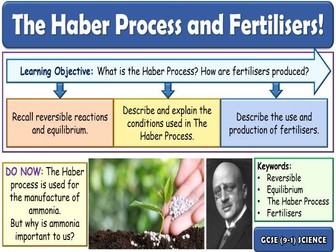
Perfect if you teach GCSE Chemistry Single Science, this fully differentiated and resourced lesson supports your students in learning about The Haber Process and fertilisers. Covering the full GCSE Chemistry specification, this resource is adapted to cover all exam boards. Students will recall reversible reactions and equilibrium, describe and explain the conditions used in The Haber Process, and describe the use and production of fertilisers.
This lesson includes a detailed and engaging lesson PowerPoint with differentiated activities, exam style questions and progress check questions for students to complete. Enjoy and feel free to leave a review.
INCLUDED IN BUNDLE:
16 slide PowerPoint Presentation with key points, progress checks and practice exam questions.
This resource is for KS3/4 student taking the AQA science GCSE
The resource contains methods in a condensed format suitable for revision and class instruction
Complete with example exam questions for each experiment - sourced from 2018 AQA where possible
Practicals included
Making salts
Temperature changes
Rates of reaction - observing colour change - Concentration & Temperature
Rates of reaction - measuring product volume (cm3) - Concentration & Temperature
Rates of reaction - measuring product lost (g) - Concentration, Temperature & Surface area
Chromatography
Water purification
Electrolysis
Neutralisation - Higher and Foundation
Ion testing - Flame tests, carbonate test, sulphate test & Halide test
Good luck!
This is an up to date version on the IGCSE Chemistry science course. I have carefully crafted these PPt over ten years, you will not need to create another Powerpoint again!
Includes all PowerPoints with assessment questions throughout (New for 2026-27).
Every lesson start with a knowledge retrieval recap.
All answers are provided and animated onto the PPt ready to appear when you wish.
Stop buying indiviudal lessons for £5+ - you have the whole course here! Prices always kept low so your students get the best resources - please leave a review :)
Acid Rain Comprehension Task. Useful to pad out an Acid Rain lesson and develop written responses. Levelled tasks and extension, data analysis and graph interpretation.
 Quick View

 Quick View
 Quick View
 Quick View
 Quick View
 Quick View
 Quick View
 Quick View
 Quick View
 Quick View
 Quick View
 Quick View
 Quick View
 Quick View