A fully-resourced, detailed and differentiated 2 hour lesson which serves as an introduction to Ethics. This is perfect as part of a KS3/KS4 RE or philosophy unit and focuses on philosophers, theories and fallacies.
This lesson is editable, so easy to adapt for your own planning and contains match up tasks, clip tasks, literacy and debate tasks, information sheets and more, as well as an engaging 2 hour PowerPoint. It is well-differentiated with three-level challenges for each task and very easy to follow.
Who are EC Resources?
EC Resources are the top TES PSHE providers and are a group of teachers who work together to create easy to use, high quality and editable lessons and units of work. We have created lessons for The Children’s Commissioner, MACS Charity, Tes, LikeToBe Careers, the Criminal Cases Review Commission (UK Gov) and have also completed PSHE and Citizenship commissions for schools across the UK.
Check out our RE and PSHE Packages here:
Complete KS3 PSHE and RSE
Complete KS4 PSHE and RSE
One Year of KS5 PSHE and RSE
One Year of Citizenship and British Values
Complete Year 7 and 8 RE
Complete Careers and Employability
AQA Citizenship GCSE Mega Pack
Check out the EC Publishing website for full, affordable PSHE, Citizenship and RE Packages for all year groups including the new 2024 Complete PSHE Package. You can contact us at info@ecpublishing.co.uk
Teaching PSHE, RE or Citizenship GCSE next year? Why not join our Citizenship and PSHE teachers Facebook group, with 8000 other teachers, for guidance, advice and resource sharing.
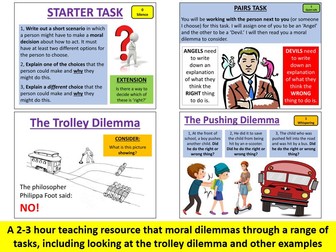
This resource helps students to consider the concept of moral dilemmas. There are tasks in which students are asked to consider how they would approach various dilemmas, Phillipa Foot’s ‘Trolley Dilemma’ is discussed in relation to absolutist vs situationist approaches and ideas around judging morality based on consequences or intentions are discussed. There is also a basic consideration of how religious groups may approach these ideas.
Overall, the (fully editable) PowerPoint is 32 slides in length and likely to take 2-3 lessons to complete. It was originally created to cover two 1-hour lessons, but always seems to take longer if you let the debates run!
A NOTE ABOUT MY POWERPOINTS:
All slides have information for delivery provided in the ‘Notes’ section.
Gold boxes contain information that can be read to the class; it’s also a good opportunity to select a student to read for literacy.
Blue ‘TASK’ boxes are always tasks to be completed (these may link to an extra resource that has been provided, such as a worksheet). There will also be a ‘sound level icon’ suggested for these (there is also a slide at the end full of sound levels icons that you can use to edit). Some tasks also have key careers/employability skills indicated.
Orange ‘CONSIDER’ boxes are questions that can be discussed as a class or in groups.
Green ‘EXTENSION’ boxes are extra work/challenge for those who complete the main blue box tasks or are otherwise ready for something more difficult.
Red boxes generally have some information hidden behind them and will reveal as you click through the PowerPoint.
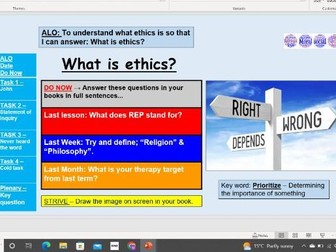
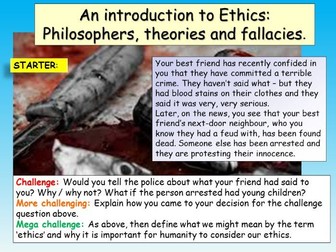
Introduction lesson to a unit of work focusing on what ethics is and some ethical theories. Students will learn what ethics is, be introduced to new vocabulary and have the chance to apply their ethics to a situation.
Features - On screen task management board for SEN students. Differentiated questioning for HAT/MAT/LAT students by Gold, Silver, Bronze task. Worksheets included in powerpoint ready to print.
This is the fourth lesson for the A-Level RE topic, Ethical Language: meta-ethics, focusing on Emotivism. This lesson has been made in line with the OCR spec in particular, but will be useful for other specs. This lesson has been created with a starter task, lesson objectives, engaging tasks throughout and all relevant information needed to enable students to succeed.
You will need the OCR A Level Religious Studies Religion and Ethics textbook for the task on slide 4.
Please leave a review of this lesson.
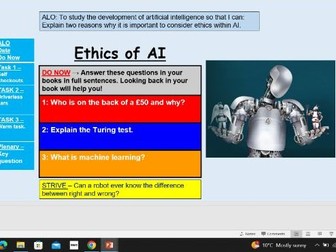
Third lesson of four focusing on introducing pupils to artificial intelligence and the ethics around it.
This lessons introduces students to the ethical debate that AI throws up focusing on how AI has changed jobs in this country and how driverless cars are programmed and where computers get their ethics from.
AQA Religious Studies 7062 Catholic Christianity course specification. Intro to ethics strand - student will cover in this lesson intro to alevel, outline of the course, intro to the three ethical strands they cover in the ethics unit (YR12) Natural moral law, Situation Ethics and Virtue ethics, apply this to a real life case study, and then cover the advantages and disadvantages of these normative ethical theories - homework worksheet also included
A whole unit (11 lessons) on Ethics, Beliefs and Values designed for Year 8, but easily adaptable to other year groups. Students have found this unit engaging and insightful as it covers Religious and Ethical issues surrounding life, genetic modification, abortion, euthanasia, environmental issues and animal rights. Each lesson has been carefully designed to allow students opportunities to check their understanding and each lesson includes a range of activities.
This is a whole unit of lessons to teach the Meta-Ethics unit of the OCR Religious Studies A-level. It would likely be appropriate for other exam boards also.
This resources includes lesson powerpoints for the whole unit, an accompanying student booklet which follows the powerpoint exactly, as well as a summary / revision map, revision crossword and information sheet on Prescriptivism. It is all ready to teach and supports independent, student-led learning.
This covers all the points on the OCR specification with a focus on naturalism, intuitionism and emotivism. The three key approaches are explored through many scholars, including but not limited to Bradley, Hume, Ayer, Moore, Mackie, Prichard and Foot. Each approach is also individually evaluated. The resources also goes further including Hare’s proposal of prescriptivism. It encourages students to evaluate whether or not what is meant by the word ‘good’ is the defining question in the study of ethics; whether or not ethical terms such as good, bad, right and wrong have an objective factual basis that makes them true or false in describing something or reflect only what is in the mind of the person using such terms; whether ethical terms can be said to be meaningful or meaningless; and whether or not, from a common sense approach, people just know within themselves what is good, bad, right and wrong.
A complete unit of work, ready to teach!
Please leave a review and happy teaching!
Topic: Application of Finnis & Proportionalism
Unit: Unit 3: Religion & Ethics
Exam Board: Eduqas
This is a full lesson on the topic of the application of Finnis & Hoose to immigration and capital punishment. This is designed for the Eduqas exam board but should suit other exam boards. This is for Paper 3: Religion and Ethics.
This lesson is designed to be taught across two or three lessons.
A student version is also included which has answers removed.
All necessary worksheets are included along with any links needed.
Homework tasks are included.
Activities
Starters: 3
Plenaries: 3
Main Activities: 12
Small Activities: 8
Knowledge Checks: 3
Challenge Points: 5
Practice Essays: 1
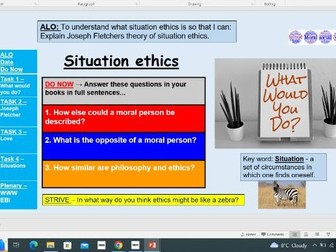
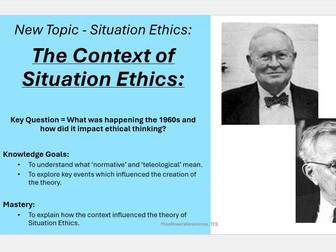
Fifth lesson in unit of work exploring what ethics is. Students will be exposed to the philosophies of Joseph Fletcher and his beliefs in Jesus’ teaching of “Love your neighbor”.
Features - On screen task management board for SEN students. Differentiated questioning for HAT/MAT/LAT students by Gold, Silver, Bronze task. Worksheets included in powerpoint ready to print.
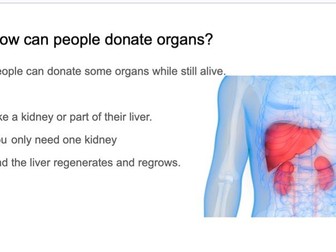
Dive into the complex and thought-provoking world of medical ethics with our “Medical Ethics: Lesson 2” resource. This lesson is designed to prepare students for GCSE-level studies by exploring the ethical dimensions of In Vitro Fertilization (IVF) and organ transplants, setting the stage for more advanced topics like abortion and euthanasia in Year 11 Religious Studies.
Key Features:
IVF and Organ Transplants: Students will explore the ethical considerations surrounding IVF and organ transplants, examining the moral questions these medical procedures raise.
Real-World Case Studies: Engaging case studies provide real-world contexts for students to apply ethical theories and develop their analytical skills.
Interactive Discussions: Structured activities and group discussions encourage students to articulate their views and consider different perspectives.
Future Readiness: This resource bridges the gap to GCSE content, ensuring students have a strong ethical foundation without overlapping with upcoming topics like abortion and euthanasia.
Equip your students with the tools to navigate the challenging ethical landscape of modern medicine, fostering critical thinking and moral reasoning in preparation for their GCSE studies.
A bundle of all teaching materials for ESS Higher Level Lenses – (Law, Economics & Ethics). For the new IB Diploma Environmental Systems and Societies course, first assessment 2026, which is first taught in 2024.
Created by an IB curriculum developer, examiner & workshop facilitator, these Higher Level lenses can be taught at any time during the ESS course.
This bundle contains 17 hours of lesson material with PowerPoint lessons and worksheets. The materials can be used both in-person and for online learning, added to your Google Classroom, or opened using Google Slides.
Save yourself time, all resources are ready to click and go! All my resources are informed by over 15 years of IB DP ESS teaching and examiner experience, so you can be sure you are getting a quality resource with everything you need to teach the IB ESS content.
Features:
• HL.a Law
• Lesson 1 – The role of environmental law
• Lesson 2 – The effectiveness of environmental laws
• Lesson 3 – Environmental laws at local, national, and international level
• Lesson 4 – Environmental laws, application and enforcement
• Lesson 5 – Environmental laws – legal personhood
•** HL.b Economics**
• Lesson 6 – What is economics and environmental economics
• Lesson 7 – Market Failure
• Lesson 8 – Greenwashing
• Lesson 9 – Governing the commons
• Lesson 10&11 – Ecological economics
• Lesson 12 – Doughnut economics and circular economic models
•** HL.c Ethics**
• Lesson 13 – Introduction to environmental ethics
• Lesson 14 – The concept of value in environmental ethics (instrumental & intrinsic)
• Lesson 15 – Traditional ethics (virtue, consequential and rights-based)
• Lesson 16 & 17 – Ethical debate – Northern Spotted Owl conservation
• Worksheets to support learning tasks
• Clear lesson aims to meet the 2024 syllabus strands (SL)
• Key ESS terminology highlighted
• Integrated case studies
• Engaging classroom activities
• Knowledge review questions
• Home learning tasks
• Starter and plenary activities
The resource is completely developed by me as an author with no use of Artificial Intelligence tools.
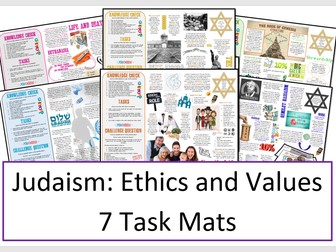
Creative and visually engaging learning mats / revision sheet for Judaism: Ethics and Values.
Can be used for revision, cover work, homework or class work - incredibly versatile resource! Download as an editable A3 Word document and as an A4 PDF (for compatibility)
Topics are:
Jewish Morality
Stewardship
Family Life
Holocaust
War and Peace
Life and Death
Wealth and Poverty
Each Mat includes:
Knowledge on the topic
Knowledge Check
Choice of Tasks
Challenge question (Analysis question for extended writing) with exam technique
Created with the WJEC / Eduqas RS GCSE in mind, though can be applied across specifications and qualifications. As an examiner for this specification, I have used what I know of the course to create this resource. Please give feedback! I am always happy to respond to comments - whether positive or constructive - this will help to improve the quality of my resources in the future and, more importantly, the quality of pupils’ RE/RS education in general - which is what we’re all here for!
Introduction to Ethics: Lesson 1.
This engaging and informative resource is designed to introduce students to the fundamental principles of ethics, focusing on three major ethical theories: Utilitarianism, Kantian Ethics, and Situation Ethics.
Key Features:
Ethical Theories Overview: Students will gain a solid understanding of Utilitarianism, Kantian Ethics, and Situation Ethics, learning the core principles and applications of each theory.
Interactive Dilemmas: Through thought-provoking ethical dilemmas, students will apply these theories in practical scenarios, enhancing their critical thinking and ethical reasoning skills.
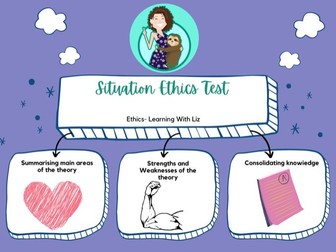
Strengths and Weaknesses: The resource provides a balanced exploration of the strengths and weaknesses of each ethical theory, encouraging students to form their own reasoned opinions.
**Multimedia Support: ** Carefully selected video links are included to support non-specialist teachers and facilitate group work, making complex ideas accessible and engaging for all learners.
This lesson resource is perfect for sparking thoughtful discussion and deepening students’ understanding of ethical concepts, laying a strong foundation for further study in philosophy and moral reasoning.
This is a complete unit of work that meets the specification of Eduqas’s A-level RS - Component 3 - Ethics - Theme 1c - Ethical Egoism.
This resource includes 10 lessons (designed as 50 minute lessons but would easily fill 1 hour lessons). It was designed for Year 12 in my school and to be taught as the third topic in the ethics component.
MINIMAL PRINTING
It includes:
A tracker for the whole of the Y12 content (Theme 1abc, Theme 2abc, Theme 3abcdef)
What is ethical egoism? lesson
Max Stirner lesson
Union of Egoists lesson
Writing a 20MQ lesson
DIRT on 20MQ lesson
Strengths and weaknesses of EE lesson
Issues for analysis and evaluation lesson
How to write a 30MQ lesson
Writing a 30MQ lesson
Summary and revision of EE
DIRT on 30MQ lesson
2x model answers (1x20MQ and 1x30MQ)
20MQ and 30MQ marking stickers (ready to print on consortium stickers - pack of 8 - 99mmx68mm)
All learning objectives are based around ‘know, apply, extend’.
This is complete and ready to teach!
Hopefully this will save you time and energy :)
Please leave a review!
A Medical Ethics Unit lasting 12 hours (one lesson is a double) that was created for Year 9 RE, but could easily be used for a capable Year 8 or none-GCSE KS4 group.
Each lesson is very detailed, editable and differentiated three ways with colour-coded challenge tasks for every activity. The lessons are very easy to follow as all the instructions are on the PowerPoints and worksheets. Each of the individual lessons have had excellent reviews so far.
The unit includes:
What are the religious and ethical views on abortion? A lesson exploring the pro-choice and pro-life debate and introducing the concept of sanctity and quality of life.
What are the religious and ethical views on euthanasia? A lesson examining the quality vs sanctity of life debate in detail while examining types of euthanasia and religious views on these.
Stem Cell Research - an investigation into embryology and the controversial issues surrounding the science. The lesson investigates how scripture can be applied to these issues and why there is so much debate.
Capital Punishment and The Death Penalty - a two hour lesson which focuses on capital punishment, its legal status around the world, the moral and religious arguments for and against and the history of the death penalty.
Drugs and morality - a lesson exploring the moral and religious debate around drug use before examining religious quotes and practicing GCSE style exam questions.
Genetic Engineering - an overview lesson on test tube and designer babies as well as religious objections to the technology, with a focus on Christianity and Islam.
An detailed article with differentiated comprehension questions all about the ethics, morality and faux-science of the anti-vaxxer movement.
Why do some religions have objections to particular medical technologies and procedures?
IVF - what is this and what are the different religious views towards it?
What do Islam and Christianity believe about medical death?
Religion and science - are they forever destined to work against each other, or can they work together?
Assessment, feedback and mark scheme
Scheme of work
Who are EC Resources?
EC Resources are the top TES PSHE providers and are a group of teachers who work together to create easy to use, high quality and editable lessons and units of work. We have created lessons for The Bank of England, The Children’s Commissioner, MACS Charity, Tes, LikeToBe Careers, the Criminal Cases Review Commission (UK Gov) and have also completed PSHE and Citizenship commissions for schools across the UK.
Check out our RE and PSHE Packages here:
Complete KS3 RE
Complete KS3 PSHE and RSE
Complete KS4 PSHE and RSE
One Year of KS5 PSHE and RSE
One Year of Citizenship and British Values
Complete Year 7 and 8 RE
Complete Careers and Employability
AQA Citizenship GCSE Mega Pack
Check out the EC Publishing website for full, affordable PSHE, Citizenship and RE Packages for all year groups including the new 2024 Complete PSHE Package. You can contact us at info@ecpublishing.co.uk
Teaching PSHE, RE or Citizenship GCSE next year? Why not join our Citizenship and PSHE teachers Facebook group, with 8000 other teachers, for guidance, advice and resource sharing.
Powerpoint slides with scholars’ comments for the Year 1 (AS) and Year 2 (A2) ethics topics. Specifically for the new 2016 OCR H173/H573 specification. Covers Aquinas’ Natural Law, Kant, Utilitarianism, Fletcher’s Situation Ethics, euthanasia, meta-ethics, conscience and sexual ethics.
This PowerPoint has notes to help students revise sexual ethics and the main theories that surround the issue. Links are made to Kant, Augustine and Aquinas so that students have an overview of key thinkers. Students should be encouraged to take notes as PowerPoint is delivered to aid revision.
The value of fat in meat varies across cultures and, like all commodities, fat can be traded to markets where there is a demand for it. However, there is some debate about trading fat as a commodity and whether we should allow cheaper fatty meats to be sold for human consumption.
This article looks at the trade of 'belly flaps' from Australia and New Zealand to Pacific island nations such as Fiji.
This is part of 'Big Picture: Fat' (www.bigpictureeducation.com/fat), which was published by the Wellcome Trust in December 2015.