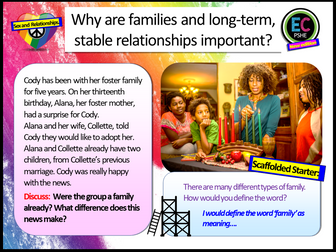
Family : Types of Family PSHEQuick View
EC_Resources

Family : Types of Family PSHE

(3)
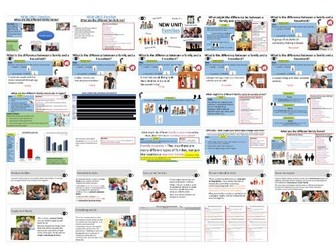
2 HOURS PSHE MEETS NEW 2026 GUIDELINES (see lesson plan included for references) - Different Families + Committed, Stable Relationships PSHE lesson exploring different, stable family relationships and roles - including single parenting, same-sex parenting, adoption, extended families and other non-traditional family units. Suitable for new 2026 RSHE guidance. The lesson also explores different long-term commitments (marriage, civil partnerships) that couples often enter into when starting a family. Best suited to KS3, all editable. Lesson plan included. Check out the EC Publishing website for full, affordable PSHE, Citizenship and RE Packages for all year groups. You can contact us at info@ecpublishing.co.uk This is taken from the EC Publishing 2026 KS3 KS4 PSHE Package. Who are EC Resources? EC Resources are the top TES PSHE providers and are a group of teachers who work together to create easy to use, high quality and editable lessons and units of work. We have created lessons for The Children’s Commissioner, The Bank of England, The British Legion, MACS Charity, Tes, LikeToBe Careers, the Criminal Cases Review Commission (UK Gov) and have also completed PSHE and Citizenship commissions for schools across the UK. Check out our PSHE Packages on Tes here: Complete KS3 PSHE and RSE Complete KS4 PSHE and RSE Complete KS5 PSHE and RSE One Year of Citizenship and British Values Complete KS3 RE Complete Careers and Employability AQA Citizenship GCSE Mega Pack Teaching PSHE, RE or Citizenship GCSE next year? Why not join our Citizenship and PSHE teachers Facebook group, with 12,000 other teachers, for guidance, advice and resource sharing.
AQA Sociology GCSE Families RevisionQuick View
madsmattwills1

AQA Sociology GCSE Families Revision

(0)
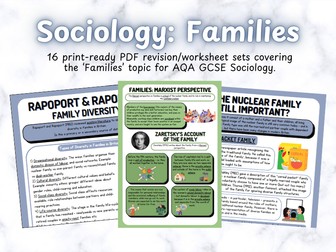
This is a large pack of resources for learning and revision of the “Families” section of AQA Sociology GCSE. The pack includes: The Functionalist Perspective The Marxist Perspective The Feminist Perspective Different Families Rapoport & Rapoport Conjugal Role Relationships Changing Families Changing Households Wider Family Relationships Marriage and Divorce Theories of Divorce Criticisms of Families Is the Nuclear Family Still Important? Knowledge Organisers Practice Exam Questions
Relationships & Families - WHOLE UNIT! (AQA RS GCSE)Quick View
SBReligiousStudies

Relationships & Families - WHOLE UNIT! (AQA RS GCSE)

(0)
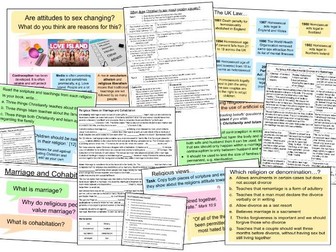
Complete unit of work covering the relationships and families topic as part of the AQA Religious Studies GCSE, though may also be appropriate for other exam boards. This resource includes at least 8 hours of teaching time, covering the nature and purpose of families; marriage; divorce and remarriage; attitudes towards sex, including sex before and outside of marriage; cohabitation; contraception; homosexuality / same-sex relationships, parents and marriage; gender roles and equality; and revision resources. There are a range of activities, lesson powerpoints and worksheets to keep students engaged and lessons varied. All content is covered from Christianity and Islam, inclusive of lots of religious teachings and examples, as well as non-religious ideas. The whole unit is complete and ready to teach with easy to follow lessons. Please leave a review, and happy teaching!
My family - Who lives in my house.Quick View
Becky7333

My family - Who lives in my house.

(0)
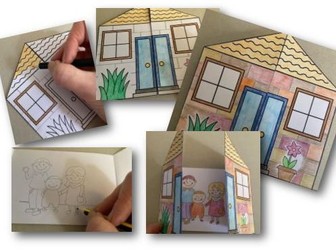
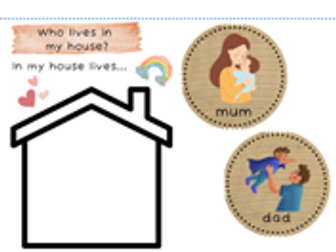
A fantastic start of the school year activity. The children cut out, fold and colour the house template. Then the children can open the door and either add a photograph or a drawing of their family. In my class I read the children ‘The Family Book’ by Todd Parr (on YouTube) which describes lots of different types of families. Then I introduced this activity.
My Family - Who Lives in My House?Quick View
DollyLHargreaves

My Family - Who Lives in My House?

(0)
A lovely little activity to use at the start of the school year. The children discuss and draw who lives in their home. In my class we read the story ‘My Family and Other Families’ by Richard and Lewis Edwards-Middleton. We have the physical book but also look at it on You Tube. We read this and then we introduce this fun little activity. Contains - X1 worsksheet with house X6 A4’s each with 2 discs on with family words vocabulary
Marxist view of the family Sociology AQA A-levelQuick View
Smithh4

Marxist view of the family Sociology AQA A-level

(1)
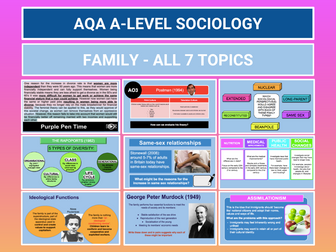
TES Resource Summary: Marxist View of the Family – Complete A-Level Sociology Lesson & Evaluation This fully resourced A-Level Sociology lesson provides a comprehensive and engaging introduction to the Marxist perspective of the family, ideal for Paper 2 (Families and Households – AQA specification). Designed for approximately 1 hour 40 minutes, this lesson includes a balance of teacher-led explanation, real-life application, retrieval, discussion, and evaluation, with carefully scaffolded tasks that build challenge and desirable difficulty throughout. No prior knowledge of Marxism is needed. What’s Included: PowerPoint presentation covering all key Marxist thinkers: Engels – inheritance of property Zaretsky – unit of consumption & illusory haven Poulantzas – ideological functions of the family Thought-provoking discussion prompts and scenario-based application tasks Multiple-choice retrieval questions to check understanding Differentiated evaluation worksheet comparing Marxism and Functionalism Key terms bank and sentence starters to support students’ written analysis Stretch questions for high-attaining students Exam-style question scaffolding for 10-mark practice Learning Objectives: Understand and explain the Marxist view of the family Apply theory to real-life and historical contexts Evaluate the strengths and limitations of Marxist explanations Compare Marxism with Functionalism using key sociological language Perfect for KS5 Sociology teachers who want a lesson that’s ready to go, clearly structured, and designed to support all learners through application, challenge, and critical thinking.
Families Assembly | Celebrating Family TypesQuick View
georgeandsmudge

Families Assembly | Celebrating Family Types

(0)
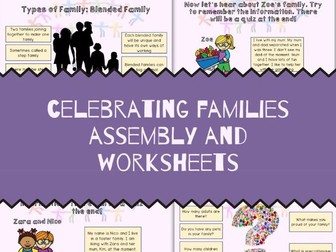
This assembly is all about diversity of families and different family types. It would be perfect for a diversity week or just as part of your assembly schedule. The assembly PowerPoint teaches pupils about different family types, guides discussion, introduces case studies about different types of family and also has a quiz at the end. Also included are three worksheets: A celebrating families crossword (and answers) A family portrait A true or false quiz (and answers) What’s included? A 23 slide PowerPoint 3 worksheets and answers
AQA GCSE Sociology Different family structures introductionQuick View
TheSociologyHub

AQA GCSE Sociology Different family structures introduction

(0)
•Detailed lesson with lots of scaffolding based on adaptive teaching that helps students identify the difference between a family and a household, describe the different family types that exist in Britain and consider how and why ‘the family’ is changing. •Covers the following key terms: Family, Household, Cohabitation, Family form, Family diversity, Nuclear family, Lone-parent family, Same-sex family, Reconstituted family, Extended family (horizontally and vertically), Empty-nest family, Traditional, Contemporary society (extension), Homosexuality (extension) and Heterosexuality (extension) •Makes reference to the following key terms students might know: Gender - Sex •Includes a teaching to all activity •ANSWERS FOR SOME ACTIVITIES INCLUDED •Includes a carousel activity with a capture sheet on the different family forms •Includes up-to-date ONS graphs (Families and households in the UK, 2025) as a statistics activity •Includes think, pair, share discussion tasks and deeper thinking analysis questions •No key sociologists are covered in this lesson •INCLUDES KEY TERM SHEET WITH DEFINITIONS FOR THE LESSON •Pedagogical approaches used: retrieval practice, explicit vocabulary instruction, modelling, worked examples, scaffolding, metacognitive prompts (think, pair, share), adaptive teaching through extension terms, and stretch and challenge deeper thinking questions •Resources can be found at the end of the PPT
French Family Ma Famille WorksheetsQuick View
FullShelf

French Family Ma Famille Worksheets

(0)
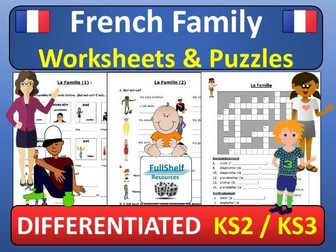
Beginners KS2 / KS3 writing activities for a My Family / La Famille topic: 3 worksheets, a crossword puzzle, a word search and 2 vocabulary support pages for consolidation and revision of family members vocabulary in French and linked phrases.   My FSL / MFL French basics resources and units suit students beginning French, near beginners (and intermediate learners for revision) in: Upper Primary (Key Stage 2) - Year 4, 5, 6 (Y4 Y5 Y6) Secondary (Key Stage 3) - especially Year 7 and 8 (Y7 / Y8) Equivalents such as Grades 4, 5, 6, 7 and 8 Core French in Canada May suit others, depending on experience   Differentiation: one of the worksheets and the 2 puzzles are included in two versions to suit different abilities. Answers included for all. All are in PDF format within the Zip File.   SAVE: Available in a French Family BUNDLE with a French Family Lesson Presentation and French Family Games. ALSO AVAILABLE IN: French Family and Pets BIG BUNDLE French KS2 / KS3 MEGA BUNDLE 2 French Worksheets MEGA BUNDLE YOU MIGHT ALSO LIKE… 24 French Family and Pets Role Play Cards   Includes these family members: le frere (brother), la soeur (sister), le fils (son), la fille (daughter), le pere (father), la mere (mother), le bebe (baby), le grand-pere (grandfather), la grand-mere (grandmother), le beau-pere (stepfather), la belle-mere (stepmother), le demi-frere (stepbrother), la demi-soeur (stepsister), l’oncle (uncle), la tante (aunt), le cousin (male cousin), la cousine (female cousin), les jumeaux (twins), enfant unique (only child). ‘Mon’ and ‘ma’ are also used to say ‘my father’, ‘my sister’ etc.   The worksheets also practise answering questions about families such as Qui est-ce? (Who is this?), Tu as des freres ou des soeurs? (Do you have any brothers or sisters?) and Combien de personnes il y a dans ta famille? (How many people are there in your family?). Giving names, ages and information about where people live is also consolidated alongside family vocabulary.   MANY MORE FRENCH TOPICS TO EXPLORE… French KS2 / KS3 MEGA BUNDLE 1 French KS2 / KS3 MEGA BUNDLE 3
Mi familia - Family relations Spanish KS3Quick View
SecondaryMFLresources

Mi familia - Family relations Spanish KS3

(0)
A standalone resource to support KS3 pupils to talk about their family relations using ‘me llevo bien/mal con…/’ . The resource requires some familiarity with family members vocabulary and some basic adjectives. It is pitched at KS3 with vocabulary, reading and translation activities and a sentence builder. Format: Word document and PDF with answers.
RWI cursive handwriting family worksheetsQuick View
RPhipps-Bennett

RWI cursive handwriting family worksheets

(0)
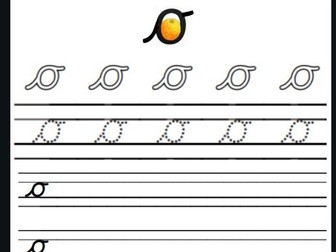
RWI phonic scheme with pictures and cursive writing handwriting practice. Seperate handwriting sheets to help children learn how to write in cursive writing. Year 1 red words at the bottom- 3 a letter to learn throghout the year. I send these home weekly in the order they are in, so the children can also learn the handwriting families.
The FamilyQuick View
avilchez

The Family

(0)
Family members in French using the Addams Family as aid.
AQA GCSE SOCIOLOGY - Unit 3 - Families (UPDATED FOR 2025/2026)Quick View
alessandrokaye

AQA GCSE SOCIOLOGY - Unit 3 - Families (UPDATED FOR 2025/2026)

15 Resources
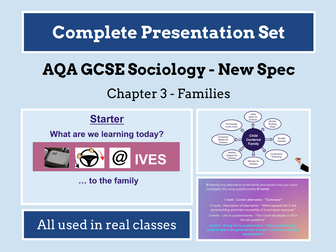
Complete set of presentations for the third unit of the new AQA specification, tried and tested with real classes. Includes a full assessment of this chapter, and the previous chapter, and a full feedback lesson. Mini-whiteboards would be ideal and access to ICT is required for a couple of lessons - one laptop/computer between two students. Created to fit with AQA’s recommended scheme of work.
Worksheet: Family / Description (French)Quick View
pgrand19

Worksheet: Family / Description (French)

(0)
One page revision French worksheet for Year 7 Students Duration: 1 lesson of 60 minutes without correction. Includes: Family School subjects Description Activities: One match up One fill in the gaps Two translation into English One Translation into Spanish One ‘broken words’ One writing activitiy I have used this worksheet with my Year 7 (mixed ability) to revise before their assessment. It works great and they can also take the sheet home to revise. You can use this revision worksheet for 2 lessons, where the second lesson would be used for corrections. The worksheet can be used for a cover lesson too.
family members / my / family treeQuick View
delphinedubreucq

family members / my / family tree

(1)
Lesson on family members/ introducing mon-ma-mes. Made up from some other TES resources and modified them slightly. The reading exercice (last 3 slides) is for the children to create a family tree from the information they read (differentiated BA/MA/HA)
Spanish Family - Mi FamiliaQuick View
ajsanzcaro

Spanish Family - Mi Familia

(16)
Basic family tree Worksheet with exercises. It’s good practice for Family, Vocabulary and Revision of Numbers (family members' age).