B15 Genetics and evolutionQuick View
CMGsSciencelessons

B15 Genetics and evolution

10 Resources
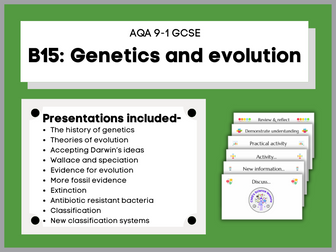
Genetics and evolution contains 10 comprehensive lessons designed to help GCSE students develop their understanding of the history of genetics, theories of evolution, the evidence for evolution, extinction, and classification systems through engaging activities and differentiated instruction. These lessons cover the content from the AQA 4.6.3 The development of understanding of genetics and evolution unit, 4.6.4 Classification and AQA GCSE Biology OUP Scheme B15, Genetics and evolution chapter. The lessons include all necessary resources, making them easy to implement in your classroom. Additionally, the editable text allows you to adjust the duration and depth of the activities based on your students’ progress and time constraints. Each editable presentation contains: ● Lesson Prep and Technician Notes: Guidance notes for teachers to prepare the lesson and technician instructions. ● Bell Work / Do Now Activity: Engaging task to activate student prior knowledge and set the stage for the lesson. ● Clear Lesson Aim, Objectives & Success Criteria: Explicitly defined learning targets to guide students and measure their understanding. ● Discussion Slides: Thought-provoking prompts and questions to introduce the topic. ● Information Slides with Levelled Content: Varied levels of information catering to diverse learning styles and abilities. ● Differentiated Activities (Group Work): Collaborative tasks in small groups to encourage active participation and enhance learning. ● Practical Activity (if appropriate): Hands-on experience to apply concepts and gain practical skills. ● Differentiated Questions with Answers: Comprehensive questions with accompanying solutions for self-assessment and note-taking. ● Student Worksheets/Handouts (if appropriate): Printable materials for students to complete and gather notes. ● Homework Activities (if appropriate): Varied homework tasks to cater to individual needs and promote independent learning. Aimed at a mixed ability class covering content Grades 1-9, with three levels of demand to accommodate different learning styles and levels: ● Level 1: Low demand ● Level 2: Standard demand ● Level 3: High demand If you require more assistance, please contact me at- info@cmgsciencelessons.com
Exploring Science 9A Genetics and evolutionQuick View
Ozocat21

Exploring Science 9A Genetics and evolution

(1)
An exceptional set of powerpoints and accompanying resources to help you effectively teach and deliver the 9A unit. Resources have been built for varying abilities and all worksheets can be found for free on TES. Exploring Science worksheets can also be purchased to accompany these powerpoints. Happy Teaching!
Exploring Science 9A- Genetics and EvolutionQuick View
fosterpaul

Exploring Science 9A- Genetics and Evolution

(1)
Lessons from the 9A unit in the new Exploring Science scheme of work all about genetics and evolution. Including lessons for: 9Aa Environmental Variation 9Ab Inherited Variation 9Ac DNA 9Ac DNA Discovery 9Ad Genes and Extinction 9Ae Natural Selection *One lesson includes a link to a video on ActiveTeach but could be replaced with another available video. *
AQA Biology Trilogy - B15 Genetics and EvolutionQuick View
ellejayd24

AQA Biology Trilogy - B15 Genetics and Evolution

(2)
Full lessons and resources for AQA Biology (triology only) B15 Genetics and Evolution. Resources include PowerPoints, exam questions, card sorts, worksheets, differentiated questions and discussions. Lessons include: B15.5 Evidence for Evolution B15.6 Fossils and Extinction B15.7 More About Extinction B15.8 Antibiotic Resistance B15.9 Classification B15.10 New Classification Systems
Evidence for evolutionQuick View
CMGsSciencelessons

Evidence for evolution

(0)
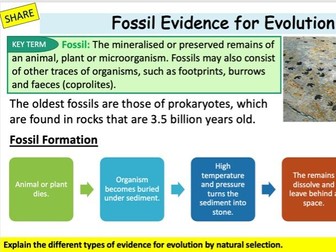
Evidence for evolution is a comprehensive lesson designed to help GCSE students develop their understanding of how fossils provide evidence for the theory of evolution through engaging activities and differentiated instruction. This lesson is the 5th in a series of lessons and covers the content from the AQA 4.6.3.5 Evidence for evolution- fossils lesson (B6 Inheritance, variation, and evolution unit), and AQA GCSE Biology OUP Scheme B15.5 Evidence for evolution lesson (B15 Genetics and evolution chapter). The lesson includes all necessary resources, making it easy to implement in your classroom and the lesson’s text is adaptable, allowing you to adjust the duration and depth of the activities based on your students’ progress and time constraints. Presentation contains (31 slides)- ● Lesson Prep and Technician Notes: Guidance notes for teachers to prepare the lesson and technician instructions. ● Bell Work / Do Now Activity: Engaging task to activate student prior knowledge and set the stage for the lesson. ● Clear Lesson Aim, Objectives & Success Criteria: Explicitly defined learning targets to guide students and measure their understanding. ● Discussion Slides: Thought-provoking prompts and questions to introduce the topic. ● Information Slides with Levelled Content: Varied levels of information catering to diverse learning styles and abilities. ● Differentiated Activities (Group Work): Collaborative tasks in small groups to encourage active participation and enhance learning. ● Differentiated Questions with Answers: Comprehensive questions with accompanying solutions for self-assessment and note-taking. ● Student Worksheets/Handouts: Printable materials for students to complete and gather notes. Aimed at a mixed ability class covering content Grades 1-9, with three levels of demand to accommodate different learning styles and levels. ● Level 1: Low demand ● Level 2: Standard demand ● Level 3: High demand If you require more assistance, please contact me at- info@cmgsciencelessons.com
AQA B6 Inheritance, Variation and Evolution Triple (17-18 lessons)Quick View
hephelumps

AQA B6 Inheritance, Variation and Evolution Triple (17-18 lessons)

(4)
This resource was made for the new AQA scheme of work for Triple Science Biology Included are 18 lessons with full objectives and spec references (based on 1 hour lessons.) I have changed the order of teaching from the specification to help it flow a little better as well as including recap elements from earlier units. Student booklet included with space for notes and exam questions this is 60 pages with 2 lined pages in the back for flexibility. 1. DNA and the genome 2. DNA structure 3. Reproduction and meiosis 4. Sexual and asexual reproduction 5. Genetic inheritance 6. Inherited disorders 7. Mendel and the understanding of genetics 8. Variation 9. Evolution and extinction 10. The Theory of Evolution and fossils 11. Speciation 12. Selective breeding 13. Genetic engineering 14. Cloning 15. Resistant bacteria 16. Classification 17. Summary lesson 18. Podcast activity Feedback really appreciated :-)
Evolution and Speciation A level BiologyQuick View
hbscienceresources

Evolution and Speciation A level Biology

(0)
This is a lesson I used myself to teach the Evolution and Speciation concept of the Inheritance Genetics Inheritance and Populations unit, unit 7. - A level Biology, AQA specification. Learning objective: To understand how genetic variation, environmental pressures, and population events interact to drive evolution and the formation of new species over time. By the end of the lesson learners should be able to: Success criteria: SC1: Describe how genetic variation arises and how allele frequencies can change due to natural selection, genetic drift, and population events. SC2: Explain how isolation (geographical or reproductive) leads to speciation and long-term evolutionary divergence. SC3: Analyse data or models (e.g. simulations or selection graphs) to explain how selection pressures shape populations and biodiversity. Contains past paper questions that target this topic, some questions require knowledge from prior lessons. The mark scheme is also included to verify answers. Powerpoint contains 17 slides and 6 past paper questions.
Inheritance Variation and Evolution AQA Foundation lesson bundle.Quick View
Kiran_Keele

Inheritance Variation and Evolution AQA Foundation lesson bundle.

(0)
Inheritance, Variation and Evolution lesson titles include: Sexual and asexual reproduction, The genome, Gnetic Inheritance, Inherited disorders, Sex determination, Variation, Evolution, Selective Breeding, Genetic engineering, Extinction, Principles of Classification, Evolutionary trees. Lessons include progress indicators, context of the topic, links to relevant YouTube video clips, content in line with the AQA specification and contain past exam questions. All questions have answers within the PowerPoint for pupils to self-assess their work. Most lessons have a homework task. The Demonstrate and Connect tasks are for learners to demonstrate what they have learnt through the lesson. This is designed for them to do independently. The pupils can self-assess using the answers. The Connect tasks are a series of follow up questions to address gaps in understanding. If they got the first question wrong, they would attempt the first connect task, etc. The PowerPoints are designed as a one stop shop to reduce printing to be eco-friendly as possible. The Green for Growth documents cover all the key knowledge questions in the Inheritance, Variation and Evolution topic. These are directly linked to the specification and cover the AO1 content for the module, The revision cards can be purchased separately.
Topic 7: Revision Genetics, populations, evolution and ecosystemsQuick View
ScienceStarsEducation

Topic 7: Revision Genetics, populations, evolution and ecosystems

(0)
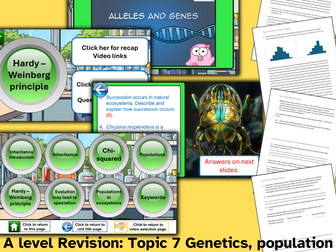
KS5 Biology revision resource for AQA A level Biology 3.7 Genetics, populations, evolution and ecosystems. This resource contains a selection of carefully chosen video tutorials and over 100mins of exam style questions linked to content from Unit 3.7 Genetics, populations, evolution and ecosystems of the AQA specification: 3.7.1 Inheritance 3.7.2 Populations 3.7.3 Evolution may lead to speciation 3.7.4 Populations in ecosystems With additional sections on Hardy-Weinburg Principle and Chi-squared (so if delivered at least two lessons worth of content). There are exam style questions to challenge your students in each unit with markschemes and model answers included in the PowerPoint, designed to test a range of understanding and application of knowledge. Lesson contents summary: Hand-picked quality video tutorials to support students’ revision of content and practical work (just click on the topic you need), with Q&A for each section. Includes: 110 slide PowerPoint (I have included a few screen shots in the uploads so you can see even more of the PowerPoint before making a decision) 7 multi-page worksheets (containing questions for each spec. section) Detailed answers to all tasks on PowerPoint. 40 video tutorials from a range of excellent sources: FreeSciencelessons; Course Hero; Your Genome; Miss Estruch; Amoeba sisters; Tedx; Launchpad learning plus many more. Keyword glossary linked to each specification section. This resource can be used to deliver revision lessons or to support students independent work. Designed for teachers to deliver (specialist and non-specialists). Can also be used for a flipped learning approach. Each topic is easily accessible by clicking on the tabs, with icon buttons to take you back to the home page or video libraries. All YouTube & other video links are included within the PowerPoint just click on the picture to be taken straight to the video. Videos have not been embedded due to copyright. If you are looking for more resources to teach Science check out my shop or a complete taught revision lesson try Topic 8 The control of gene expression I aim to produce cheap and affordable resources for the price of a good cup of coffee so that you can spend more time doing the things that you want. Last thing, if you liked this resource, please think about leaving a review.
Genetics Revision Mat Worksheet (SB3 Genetics Edexcel)Quick View
PinkPaux

Genetics Revision Mat Worksheet (SB3 Genetics Edexcel)

(1)
This sheet covers all the topics in SB3 for Edexcel: Sexual vs asexual reproduction Mitosis vs Meiosis Structure of DNA Protein Synthesis Mendelian genetics: key terms (alleles, genotype, phenotype, homozygous, heterozygous) Mendelian genetics: monohybrid crosses Pedigrees Multiple and missing alleles: codominance and sex-linked disorders Variation: genetic/environmental & continuous/discontinuous
Genetics and Evolution Knowledge BookletQuick View
mindset_learning

Genetics and Evolution Knowledge Booklet

(0)
This is a book full of questions which is great to give to students to learn and revise. This can be used as a great source of revision or a homework task where students have to learn the answers and then they are tested on them next lesson. The Knowledge booklets contains the key scientific knowledge that has been formed in association with the 2016 onward, AQA specification. This key scientific Knowledge is the fundamental information that students will need to learn to apply to exam style questions.
B15 Genetics and evolutionQuick View
Lagoondry

B15 Genetics and evolution

3 Resources
Save £2 (33%) Includes: B15.5 Evidence for evolution B15.8 Antibiotic resistance B15.9 Classification Please note: I had to remove the AQA worksheets so as to abide by TES’s code of conduct. Only my worksheets and PPT are included.
Evolution and Natural SelectionQuick View
nextpagescience

Evolution and Natural Selection

(0)
Comprehension and additional task exercises pages 42 and 43 from Next Page Science KS3 Complete. Accompanying PowerPoint and word searches available for free from the website. This exercise covers: • What to evolve means • Genetic changes can happen naturally or due to the environment e.g. radiation • Survival of the fittest as those traits that help survival are passed on and become more common in the population • Extinction of a species • Charles Darwin as the scientist credited with first presenting the idea • The fact that evolution is still happening today • Amazing WHAT? facts
AQA GCSE B6 Genetics, Inheritance & Evolution Revision BookletQuick View
KaylaWilliams89

AQA GCSE B6 Genetics, Inheritance & Evolution Revision Booklet

(0)
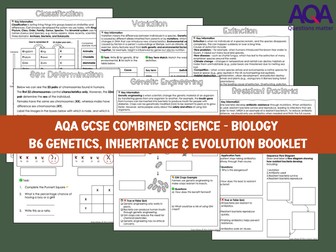
Genetics, Inheritance & Evolution Revision Booklet – AQA GCSE Combined Science (B6 Topic). Simplify your lesson planning and help your students master homeostasis with this print-and-go 17-page activity booklet! This comprehensive and engaging digital resource is the perfect way to review the AQA GCSE B6 Genetics, Inheritance & Variation topic. Whether used for independent revision, homework, or cover lessons, this booklet supports students in consolidating key knowledge and applying it through targeted tasks. What’s Inside: This 17-page booklet covers all the core content from the AQA GCSE Combined Science B6 topic, including: Sexual vs Asexual Reproduction Meiosis DNA & the genome Genetic Inheritance Genetic Inheritance (Punnett Square practice) Inherited Disorders Sex determination Variation Evolution Selective Breeding Genetic Engineering Evidence for Evolution Fossils Extinction Resistant Bacteria Classification Each page includes short, focused activities designed to reinforce learning and encourage retrieval practice. Why Teachers Love This Booklet: Reduces Workload: Just print and go – perfect for last-minute lessons, homework, or student catch-up. Boosts Student Confidence: Helps learners recall key facts and make connections between concepts. Flexible Use: Great for revision, classwork, homework, or cover lessons – no extra resources needed. Supports Independent Learning: Students can complete it using class notes, textbooks, or online research. Aligned to AQA Spec: Fully matched to the GCSE Combined Science Biology specification. Teacher-Tested and Student-Approved: I created this booklet after noticing how much my students struggled to retain content weeks after we’d covered it. These short, snappy worksheets made a huge difference – giving them all the key information in one place to revisit anytime.
NEW AQA GCSE Biology - 'Inheritance, Variation & Evolution' lessonsQuick View
SWiftScience

NEW AQA GCSE Biology - 'Inheritance, Variation & Evolution' lessons

16 Resources
This bundle of resources contains 12 lessons which meet all learning outcomes within the 'Inheritance, Variation & Evolution’ unit for the NEW AQA Biology Specification. Lessons include: Types of reproduction Variation Meiosis Selective Breeding Genetic Engineering Inherited Disorders Gene Expression & Inheritance DNA & Protein Synthesis Ethics of gene technologies Evolution by natural selection Evidence of evolution: Fossils Evolution of antibiotic resistant bacteria The lessons contain a mix of differentiated activities, progress checks, extra challenge questions and exam questions plus more than one opportunity, per lesson, for self/peer red-pen assessment of tasks.
Evolution and Genetics  PuzzlesQuick View
Cre8tive_Resources

Evolution and Genetics Puzzles

(0)
Four printable Science puzzles based on the topic of Evolution and Genetics suitable for KS4 students. This Tarsia puzzle booklet contains 16 pages. This is a set of engaging no prep editable worksheet printable puzzles for your students to practice their problem solving skills and consolidate their knowledge on this topic Each Tarsia puzzle comes complete with: A scrambled puzzle worksheet ready to print for students Optional placeholder template which can be used to help differentiate downwards. Answer sheet for the teacher :) Students love this engaging and entertaining style of learning. Tarsia puzzles are a great way to reinforce learning on a topic or to assess learning either before starting a topic or after teaching a topic. **Contents of Tarsia Puzzle Set ** ☞ 1 x Higher Ability Puzzle ☞ 1 x Middle ability Puzzle ☞ 1 x Lower Ability Puzzle Topic 1 ☞ 1 x Lower Ability Puzzle Topic 2 ☞ 4 x Completed Answer Puzzle Sheet ☞ 1 x Set of three blank templates for students to make their own puzzles ✰✰✰✰✰✰✰✰✰✰✰✰✰✰✰✰✰✰✰✰✰✰✰✰✰✰✰✰✰✰✰✰✰✰✰✰✰ How could you use it? Assess prior knowledge As a class based activity / team activity An educational ‘treat ’ for your students. Edit the Tarsia puzzles and make your own differentiated version and add school logo etc Have students create their own version for homework or as part of a project Teacher Top Tip Laminate a department/ class set and you can use them year after year or across all classes… We also sell this in a digital format - Just search the product code below on TES to locate it. Product Code: C8/TA/41 ✰✰✰✰✰✰✰✰✰✰✰✰✰✰✰✰✰✰✰✰✰✰✰✰✰✰✰✰✰✰✰✰✰✰✰✰✰ What is a Tarsia puzzle? Think of it as a puzzle or even a more complicated version of playing snap or pairs but instead of the information being the same students are matching key terms with definitions or dates with events or equations, etc
Genetics and evolution key word loopQuick View
olivia_calloway

Genetics and evolution key word loop

(2)
A good starter, based around AQA's B1 unit 3. Covers: cloning, reproduction, genetic modification, evolution etc. Each definition links to a different keyword, so that theoretical the game &'loops&'; all the way around the class. Adapt the definitions according to pupils' ability, and add definitions depending on class size! [Thanks for the comments - I have now converted it to a word file]
REVISION Genetics & InheritanceQuick View
georgiamarsden20

REVISION Genetics & Inheritance

(1)
Please review! Revision resource tackling DNA, inheritance, evolution, selective breeding, classification, adaptations, variation, biodiversity, genetic engineering etc. Used with high ability year 8 class as a closed book revision activity, as soon as they couldnt answer anymore they swapped pens to a different colour, opened their book and completed the remainder of the sheet. This was so effective in highlighting what they needed to re-visit in their revision ahead of the end of topic test. Adapted from resource found on TES
Genetic engineeringQuick View
amyk137

Genetic engineering

(51)
If you use this resource please let me know what you think! Print these slides off in colour and spread them around the room, students can then collect information from the sheet about the different genetically engineered organisms. I think this is a good activity to illustrate the wide variety of ways that organisms can be genetically engineered.