English Language InterventionQuick View
PateResources

English Language Intervention

(6)
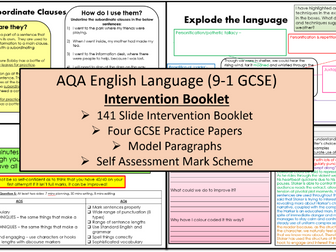
This comprehensive PowerPoint, when printed (or emailed) as a booklet, can be used as an English Language intervention and also makes an ideal revision aid. It is modelled on the AQA 9-1 GCSE English Language new specification and includes eight sessions covering both paper one and paper two helping pupils to feel more prepared for their exams. With over 140 slides, this booklet has a series of easy to follow activities, exam questions and model answers for each of the ten questions of the GCSE. Each session is designed for students to be able to work through independently, or in small groups. Personally, I have given it as revision to my students, where they work through the booklet in their own time and use what they have learned on the homework tasks - which I then mark and give feedback on and my pupils have enjoyed the challenges and gained confidence in their exam technique. It could be used for isolation and exclusion tasks, extra revision, class work, homework, for intervention groups, or for GCSE re-sit students. The tasks are aimed at enabling pupils to obtain a grade 5 or above. Skills from all six AQA Assessment Objectives of the English Language course are included, along with extracts from the mark scheme and starter tasks centered around improving the AO6 and grammar skills of the students. There are four GCSE practice papers included: Paper One - Dracula Paper One - The Red Room Paper Two - Bank Robberies Paper Two - Prisons Please check out my other resources. Any feedback would be greatly appreciated.
Leaving Certificate - Language GenresQuick View
RescueResource

Leaving Certificate - Language Genres

(1)
A fun, engaging guide to the five Leaving Cert language genres - Information, Argument, Persuasion, Narration, and Aesthetic. Packed with current, relatable examples (Taylor Swift, TikTok, school debates) and interactive tasks, this resource makes genres clear, memorable, and exam-focused. Perfect for keeping students laughing, learning, and writing with confidence!
Assembly: European Day of Languages EDLQuick View
wilfy

Assembly: European Day of Languages EDL

(2)
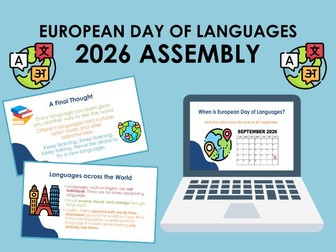
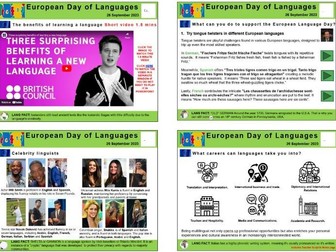
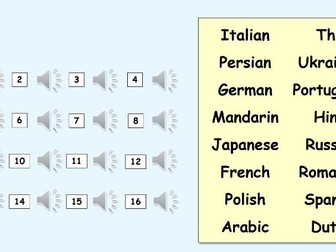
An assembly to support work during the European Day of Languages in September. This highly dynamic presentation has an assembly plus a range of ideas and resources for follow-up form time activities. This beautifully-designed and editable 25-slide Powerpoint presentation creatively presents information on this event and can be showcased to any age group and includes specific pages for primary or secondary students. It includes images, dynamic transitions, informative text, video and links for extension work in form time – including extra video and classroom activities. Slide 1: What is the European Day of Languages. Includes video. Slide 2: Why does this matter to us all? Slide 3: The benefits of learning a language. Includes short video. Slide 4: The benefits of learning a language. Includes long video. Slide 5: Why diversity of language matters. Slide 6: Examples of different ways of saying Hello in Europe. Includes sound files. Slide 7: Celebrity linguists. Slide 8: International tongue twisters. Includes sound files. Slide 9: What careers can languages take you into? Includes teacher script. Slide 10: It starts with small steps and it starts with you… Slide 11: Closing Thoughts Slide 12: Follow-up form time activities title screen Slide 13: Links to official EU resources for follow-up. Slide 14: Form time activities: Colouring activity Slide 15: Form time activities: European Languages Wordsearch Slide 16: Form time activities: Write a Languages poem activity Slides 17-22: Form time activities: Languages quiz – with answers Slides 23-25: Other form time ideas to support Language Day awareness in schools As reviewers have stated for previous resources shared: “I sat down to plan my assembly for next week and found this resource, and it’s perfect. The best £2 spent. Thank you. I can teach this straight from the slides.” “Just buy it!” “Your resources have been life savers!” “Well worth the money and really saved my life” “I just wanted to say that as a non-specialist these resources are worth every single penny! Thank you so much for making and sharing them.” “Blown away by this! Can’t thank you enough!” “They have saved me a huge amount of time and the detail that goes into your work is second to none. You put others to shame who charge twice as much for very little. Can’t thank you enough.” “Your new spec resources are saving me hours & hours of work! Thanks, they are really good.” “These resources are so useful - I cannot tell you how much time they have save me - very clear to follow and easy to adapt for revision material — well worth the money”
AQA English Language Paper 2Quick View
EnglishGCSEcouk

AQA English Language Paper 2

(5)
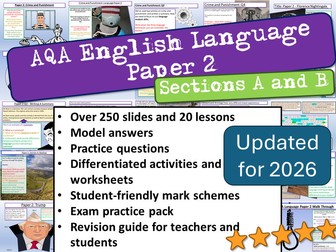
AQA English Language Paper 2 resource that has recently been revamped, that helps students approach Section A and questions Q1 - Q4 with engaging activities, differentiated tasks, modelled examples and different ways of understanding and opening up the demands of each question. A fully resourced lesson to aid GCSE students in their preparations for AQA English Language Paper 2: Writers’ Viewpoints and Perspectives. Updated for the 2026 papers. Query or question? Get in touch at info@englishgcse.co.uk Check out our English Shop for loads more free and inexpensive KS3, KS4, KS5, Literacy and whole school resources. AQA English Language Paper 1 and Paper 2 Knowledge Organisers AQA English Language Paper 1 Section A package AQA English Language Paper 1 Sections A and B package AQA English Language Paper 1 package AQA English Language Paper 2 Question 5 package AQA English Language Paper 1 Question 5 package AQA English Language Paper 2 Section A package AQA English Language and English Literature revision package An Inspector Calls whole scheme package An Inspector Calls revision package Macbeth whole scheme package Macbeth revision package A Christmas Carol whole scheme package A Christmas Carol revision package Jekyll and Hyde whole scheme package Jekyll and Hyde revision package Romeo and Juliet whole scheme package Power and Conflict poetry comparing poems package Power and Conflict poetry whole scheme package Love and Relationships poetry whole scheme package Unseen Poetry whole scheme package
AQA English Language Paper 1Quick View
EnglishGCSEcouk

AQA English Language Paper 1

20 Resources
AQA English Language Paper 1 materials. TWENTY hours worth! A collection of well differentiated lessons and revision materials to prepare GCSE students for AQA English Language Paper 1: Explorations In Creative Reading And Writing, prepared by an Outstanding-rated English specialist and Lead Practitioner. Lessons included: 1) AQA English Language Paper 1 Introduction 2) Falcons (Language and Character analysis) 3) Birdsong (Language and Character analysis) 4) Reluctant Fundamentalist (Language and Structure analysis) 5) Spies (Language and Structure analysis) 6) The White Tiger (Character evaluation) 7) Structure lesson (I'm the King of the Castle) 8) Structure (Beginnings and Endings) 9) Section A Walkthrough (Mock exam paper, indicative answers, success criteria, exam tips) 10) Full SOW document 11) Descriptive Writing Introduction 12) Descriptive Writing (Zooming In and Structure) 13) AQA English Language Paper 1 escape room 14) Analysing descriptive writing examples (Jamaica Inn and Little Dorrit) 15) Language techniques recap 16) Section B assessment planning lesson 17) Revision guide which covers both Section A and B 18) Jamaica Inn Mock Review (Based on specimen exam paper) 19) Paper 1 Section A Knowledge Organiser 20) Section A exam practice papers and answers We also have new complete packs for the 2026 papers: Paper 1 Section A: https://www.tes.com/teaching-resource/aqa-english-language-paper-1-2026-13193444 Paper 1 Q5: https://www.tes.com/teaching-resource/aqa-english-language-paper-1-q5-2026-13214866 Paper 2 Section A: https://www.tes.com/teaching-resource/aqa-english-language-paper-2-2026-13201545 Paper 2 Q5: https://www.tes.com/teaching-resource/aqa-english-language-paper-2-q5-2026-13223813 One Year Complete AQA 2026 pack: https://www.tes.com/teaching-resource/aqa-english-language-2026-13234726
AQA English Language Paper 2Quick View
EnglishGCSEcouk

AQA English Language Paper 2

20 Resources
AQA English Language Paper 2 bundle that has recently been revamped and updated. Every lesson took around 7-10 hours to make and include modelled answers, scaffolds, differentiated activities, sources, engaging activities to open up challenging Q1, Q2, Q3, Q4 and Q5 (Non-fiction writing) tasks to all students. The bundle contains 20 resources that cover both Section A (Nonfiction reading) and Section B (Nonfiction writing) so you know you'll be looking at the whole exam. The lessons contained are: 1) Introduction lesson that looks at travel writing (Q1, Q2, Q4) - Armitage and Dickens 2) Lesson on Donald Trump article that covers Q1 and Q3 3) Lesson on travel writing (Rory Stewart, Dorothy Wordsworth) that covers Q1, Q2 and Q3. 4) Summary writing lesson that looks at Dickens and a Unicef speech 5) Crime and Punishment lesson on Q1 and Q2 6) Crime and Punishment lesson on Q2 7) Crime and Punishment lesson on Q3 8) Crime and Punishment lesson on Q4 9) Paper 2 walking, talking mock that uses the theme of crime and punishment 10) Section B opening and ending articles 11) Newspaper article writing / writing to explain 12) Magazine article writing / writing to argue 13) Speech writing (Winston Churchill) 14) Speech writing (Barack Obama) 15) Paper 2 exam preparation lesson 16) Paper 2 revision lesson 17) Escape room revision lesson 18) Paper 2 Section A knowledge organiser 19) Paper 2 Section A exam practice pack 20) Florence Nightingale themed Q1-Q4 lessons Bundle (20x 1hr PP, differentiated tasks throughout using new GCSE numbering system) All tasks differentiated according to new GCSE numbering system, this bundle is designed for the New Spec AQA Language Paper 2. Complete 1 hour, well differentiated lessons, with worksheets where applicable. Suitable for KS4 or adaptable for KS3 Different level tasks for MA,LA or Core Designed to fit Ofsted criteria for' Good' or above. Many more inexpensive, high quality English resources are available at my shop: EnglishGCSEcouk We also have new complete packs for the 2026 papers: Paper 1 Section A: Click here Paper 1 Q5: Click here Paper 2 Section A: Click here Paper 2 Q5: Click here One Year Complete AQA 2026 pack: Click here
Figurative Language Devices (Literary Techniques)Quick View
NovelTeachingUK

Figurative Language Devices (Literary Techniques)

(1)
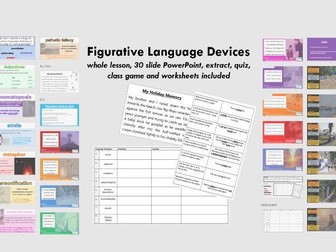
A whole lesson on figurative language techniques- metaphor, simile, adjectives, personification, pathetic fallacy, onomatopoeia and sensory description. This resource includes a clear and colourful 30 slide Powerpoint, ready to print worksheets, a quiz and a class game. After a brief introduction, students are encouraged to identify the techniques used in a short extract and comment on the effect. There is also a worksheet with an examples/definitions matching activity and students write their own examples using the devices studied in the lesson. Finally there is an interactive class game, where students work in a pair or a team. After looking at an image prompt, students then take it in turns to craft a description using one of the techniques for a certain amount of points. Suitable for KS3 creative writing lessons or as an introduction to AQA Paper 1 Q5 descriptive writing for KS4.
Language and Social Groups A Level UnitQuick View
JPResources

Language and Social Groups A Level Unit

(1)
A 10 lesson unit comprising a 67 slide PowerPoint, 9 different worksheets (including texts for analysis) exploring the topic of Language and Social Groups (with lots of work on Language and Age) and a summary terminology and theory sheet. Each lesson includes a starting discussion prompt which acts as a learning objective, detailed notes on the theories and concepts listed below, a worksheet (with the exception of lesson nine) and activities, and a homework task. The following theories and concepts are covered: Idiolect, dialect, sociolect and ethnolect Communication Accommodation Theory (Convergence, Divergence, Interpersonal & Intergroup Communication) – Giles (1971) Communities of Practice – Lave and Wenger (1991 and 1998) Social Network Theory Belfast Study – Milroy (1975) New York Study & Martha’s Vineyard Study – Labov (1966 and 1963) Follow up to Martha’s Vineyard Study – Blake and Josey (2003) Reading study and ‘Age and Generation-specific use of language’ – Cheshire (1982 and 2006) Emerging Adulthood in Sociolinguistics – Bigham (2012) Trends in Teenage Talk – Stenström, Andersen and Hasund (2002) Age in Sociolinguistics – Eckert (1997) Age identity in Japan and the US – Ota, Harwood, Williams and Takai (2000) Teenage Talk – Eckert (2003 and 1989) Teenage language in West Yorkshire – Ives Bolton Study – Moore (2010) Teenage Slang – de Klerk (1997) and Zimmerman (2009) Teenage Talk - Stenström (2014) The Language of British Teenagers - Martínez (2011) Use of tags – Berland (1997) ‘Like’ as a discourse maker – Odato (2013) Creative linguistic processes in teenage slang – Fajardo (2018) Elaborated and Restricted Code – Bernstein (1964 and 1971) Criticisms of Bernstein – Rosen and Labov (1972) and Ivinson (2017) Discourse Community – Swales (1990) There are some references to AQA-style A Level specification questions, but you can adapt these if needs be. These can be found on slides 56-64. Lesson 9 is based on an AQA A Level question. The final lesson is a consolidation activity complete with guided revision cards. Alternatively, you could use an app such as Quizlet so that the students could produce digital revision resources. Check out my other English Language A Level resources! Language and Gender Language and Region Language and Power and Occupation Language and Global and World Englishes Language Change Language and Technology Language and Ethnicity Language Discourses
Language Change A Level UnitQuick View
JPResources

Language Change A Level Unit

(3)
A 10 lesson unit comprising a 70 slide PowerPoint, 9 different worksheets (including texts for analysis) exploring the topic of Language Change and a summary terminology and theory sheet. Each lesson includes a starting discussion prompt which acts as a learning objective, detailed notes on the theories and concepts listed below, a worksheet (with the exception of lesson nine) and activities, and a homework task. The following theories and concepts are covered: Lexical, Semantic, Phonological, Grammatical and Orthographical processes David Crystal – A Sea of Language Change and tidal metaphor (1999) Diachronic and Synchronic Linguistic Change Origins of Old English and Middle English Descriptivism and Prescriptivism Samuel Johnson – Dictionary of the English Language (1755) Robert Lowth – A Short Introduction to English Grammar (1762) Jonathan Swift - ‘A Proposal for Correcting, Improving and Ascertaining the English Tongue’ (1712) John Walker – A Critical Pronouncing Dictionary (1791) Otto Jespersen – Great Vowel Shift (1909) William Caxton – Printing Press (1476) John McWhorter – Textspeak (2013) Jean Aitchison – Language Change Progress or Decay? (2012) Vocal Fry and Uptalk Martin Janssen – Lexical gaps (2012) Functional view/theory Linguistic determinism and the Sapir-Whorf Hypothesis Charles Hockett - Random Fluctuation Theory (1958) Peter Trudgill – Language Myths (1990) John Humphrys – Prescriptivist grammatical change Lynne Truss – Eats, Shoots and Leaves (2003) Jean Aitchison – A Web of Worries (1996) Guy Deutscher – The Unfolding of Language (2006) James Milroy and Lesley Milroy – Complaint tradition (1985) Robert Lane Greene – You Are What You Speak (2011) There are some references to AQA-style A Level specification questions, but you can adapt these if needs be. These can be found on slides 59-67. Lesson 9 is based on an AQA A Level question. The final lesson is a consolidation activity complete with guided revision cards. Alternatively, you could use an app such as Quizlet so that the students could produce digital revision resources. Check out my other English Language A Level resources! Language and Gender Language and Region Language and Power and Occupation Language and Global and World Englishes Language and Technology Language and Ethnicity Language and Social Groups Language Discourses Child Language Acquisition Speaking
Language and Ethnicity A Level UnitQuick View
JPResources

Language and Ethnicity A Level Unit

(0)
A 10 lesson unit comprising a 68 slide PowerPoint, 9 different worksheets (including texts for analysis) exploring the topic of Language and Ethnicity and a summary terminology and theory sheet. Each lesson includes a starting discussion prompt which acts as a learning objective, detailed notes on the theories and concepts listed below, a worksheet (with the exception of lesson nine) and activities, and a homework task. The following theories and concepts are covered: Idiolect, dialect, sociolect and ethnolect Pidgins and creoles Multicultural London English – Cheshire andKerswill (2011) Multicultural British English – Drummond (2016) Black British English – Thompson (2022) Code switching – Haugen (1950s) Code mixing – Wardhaugh (1986) Types of Code Switching West Yorkshire Study - Ives (2014) White talk Black talk - Hewitt (1986) South London Study - Ives (2014) Code Switching - Holmes (2017) Language in a Black Community - Edwards (1986) The objectification of ‘Jafaican’ - Kerswill (2014) Ethnolects - Eckert (2008) Stylising the ‘roadman’ - Ilbury (2023) Style-shifting in Multicultural London English - Oxbury and De Leeuw (2020) Phonetic variation and change in the Cockney Diaspora - Cole and Evans (2020) Style Repertoire and Social Change in British Asian English – Sharma (2011) Style variation – Sharma and Rampton (2015) Aspects of identity in a second language – Drummond (2012) Language as a resistance identity – Pitts (2012) Black/white borders through linguistic stylization – Clark (2003) Style shifting and identity – Barrett (1994) Cultural appropriation in language – McWhorter (2021) Language and ethnicity and identity – Ogbu (1999) Linguistic Injustice – Baker-Bell (2020) There are some references to AQA-style A Level specification questions, but you can adapt these if needs be. These can be found on slides 57-65. Lesson 9 is based on an AQA A Level question. The final lesson is a consolidation activity complete with guided revision cards. Alternatively, you could use an app such as Quizlet so that the students could produce digital revision resources. Check out my other English Language A Level resources! Language and Gender Language and Region Language and Power and Occupation Language and Global and World Englishes Language Change Language and Technology Language and Social Groups Language Discourses Language Discourses Opinion Writing
Language and Gender A Level UnitQuick View
JPResources

Language and Gender A Level Unit

(0)
A 10 lesson unit comprising a 66 slide PowerPoint, 9 different worksheets (including transcripts) exploring the topic of Language and Gender and a summary terminology and theory sheet. Each lesson includes a starting discussion prompt which acts as a learning objective, detailed notes on the theories and concepts listed below, a worksheet (with the exception of lesson nine) and activities, and a homework task. The following theories and concepts are covered: The Deficit Approach – Robin Lakoff (1973 & 1975) The Dominance Approach - Don Zimmerman & Candace West (1975), Dale Spender (1980) and Pamela Fishman (1978) The Deficit Approach – Otto Jesperson (1922) Folklinguistics Criticism of Zimmerman and West - Geoff Beattie (1981) Gossip – Jane Pilkington (1992 and 1998) The Difference Approach – Deborah Tannen (1990) and Janet Holmes (1995) Criticism of Holmes and politeness – Sara Mills (2003) Women, Men and Language – Jennifer Coates (1993) Norwich Study – Peter Trudgill (1974) Gender Trouble – Judith Butler (1990) The Myth of Mars and Venus – Deborah Cameron (2008) The Gender Similarities Hypothesis – Janet Hyde (2005) Verbal Hygiene – Deborah Cameron (1995) The Whole Woman – Penelope Eckert (1990) Relational Aggression – Rosalind Wiseman (2002) Gossip - Deborah Jones (1980) Gossip – Holly Hom (2004) Gossip – Nigel Nicholson (2001) Powerless Language – William O’Barr and Bowman Atkins (1980) Gendered workplace language – Barbara Eakins and R. Gene Eakins (1976) Gendered workplace language – Carole Edelsky (1981) There are some references to AQA-style A Level specification questions, but you can adapt these if needs be. These can be found on slides 56-63. Lesson 9 is based on an AQA A Level question. The final lesson is a consolidation activity complete with guided revision cards. Alternatively, you could use an app such as Quizlet so that the students could produce digital revision resources. Check out my other English Language A Level resources! Language and Region Language and Power and Occupation Language and Global and World Englishes Language Change Language and Technology Language and Ethnicity Language and Social Groups Language Discourses Language Discourses Opinion Writing Language Investigation AQA Paper 2 Revision
Language and Technology A Level UnitQuick View
JPResources

Language and Technology A Level Unit

(0)
A 10 lesson unit comprising a 68 slide PowerPoint, 9 different worksheets (including texts for analysis) exploring the topic of Language and Technology and a summary terminology and theory sheet. Each lesson includes a starting discussion prompt which acts as a learning objective, detailed notes on the theories and concepts listed below, a worksheet (with the exception of lesson nine) and activities, and a homework task. The following theories and concepts are covered: Hiltz and Turoff – CMC (1978) Emmanuel Schegloff – Telephone conversation structure (1986) David Crystal – Textspeak (2004) Celia Klin – The role of full stops in text messages (2015) David Crystal – Netspeak (2004 and 2008) Eric Partridge – Dictionary of Abbreviations (1942) Crispin Thurlow – Sociolinguistic functions of text messages (2003) Tim Shortis – The Language of ICT (2000) John McWhorter – Fingered speech and texting (2013) Elizabeth Eisenstein – The Printing Press (1983) Jeff Jarvis – the positive impact of the internet on language (2023) Susan Herring – CMC and CMDA (2018) Christopher Werry – IRC and Netiquette (1996) Condon and Čech – E-mail discourse (2010) Amanda Roig-Marin – Cyber-neologism blends (2016) Evelyn Nien-Ming Ch’ien – The Democratization of English (2004) Hyejeong Ahn and Jieun Kiaer – Korean Pop Culture Words (2021) Philip Seargeant – The Emoji Revolution (2019) Michele Zappavigna and Lorenzo Logi – Emoji and Social Media Paralanguage (2024) danah boyd – It’s Complicated: The Social Lives of Networked Teens (2004) Gretchen McCulloch – Because Internet (2022) There are some references to AQA-style A Level specification questions, but you can adapt these if needs be. These can be found on slides 57-65. Lesson 9 is based on an AQA A Level question. The final lesson is a consolidation activity complete with guided revision cards. Alternatively, you could use an app such as Quizlet so that the students could produce digital revision resources. Check out my other English Language A Level resources! Language and Gender Language and Region Language and Power and Occupation Language and Global and World Englishes Language Change Language and Ethnicity Language and Social Groups Language Discourses Language Discourses Opinion Writing Language Investigation AQA Paper 2 Revision
Language and Power and Occupation A Level UnitQuick View
JPResources

Language and Power and Occupation A Level Unit

(0)
A 10 lesson unit comprising a 69 slide PowerPoint, 9 different worksheets (including a range of transcripts) exploring the topic of Language and Power and Occupation and a summary terminology and theory sheet. Each lesson includes a starting discussion prompt which acts as a learning objective, detailed notes on the theories and concepts listed below, a worksheet (with the exception of lesson nine) and activities, and a homework task. The following theories and concepts are covered: Shân Wareing – Types of Power, 1999 Pierre Bourdieu – Language and Symbolic Power, 1993 Norman Fairclough – Types of power, 1984 Erving Goffman – Face-work, 1967 Brown and Levinson – Politeness Theory, 1987 Howard Giles – Communication Accommodation Theory, 1973 Drew and Heritage - Institutional Talk and Inferential Frameworks, 1992 John Swales – Discourse Community, 1990 Sinclair and Coulthard – IRF Model and Teacher Talk, 1975 and 1992 Paul Grice – Cooperative Principle and Gricean Maxims, 1975 Almut Koester – Phatic Talk in the Workplace, 2004 Judith Baxter – Double-voiced discourse, 2014 Janet Holmes and Maria Stubbe - Power and Politeness in the Workplace, 2003 & 2015 There are some references to AQA-style A Level specification questions, but you can adapt these if needs be. These can be found on slides 58-66. Lesson 9 is based on an AQA A Level question. The final lesson is a consolidation activity complete with guided revision cards. Alternatively, you could use an app such as Quizlet so that the students could produce digital revision resources. Check out my other English Language A Level resources! Language and Gender Language and Region Language and Global and World Englishes Language Change Language and Technology Language and Ethnicity Language and Social Groups Language Discourses Analysing Spoken Language Child Language Acquisition - Speech Child Language Acquisition - Reading and Writing Language Discourses Opinion Writing Language Investigation AQA Paper 2 Revision
AQA English Language Paper 1 Section A - 2026+Quick View
PateResources

AQA English Language Paper 1 Section A - 2026+

(0)
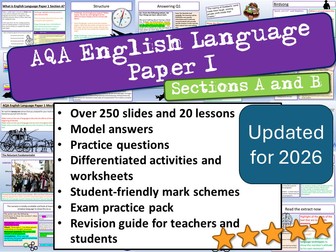
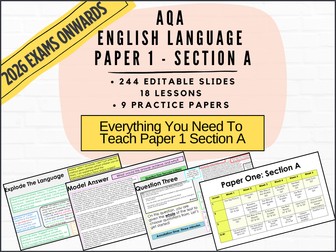
A complete, fully updated scheme of work for AQA GCSE English Language Paper 1, Section A – perfect for building exam skills and confidence. Covers all changes announced by AQA for students sitting the exam in 2026 and beyond. This resource contains 18 one-hour lessons (over 200 slides), designed specifically to prepare students for Questions 1–4 of AQA English Language Paper 1 (8700). Lessons focus on AO1, AO2, and AO4, with a step-by-step approach to help students master reading unseen prose fiction. Includes: 18 full lesson PowerPoints Weekly homework tasks Original model answers (Grades 6–9) Starter tasks, timed practice & peer/self assessment 9 full practice papers (with Q1–Q5) featuring fiction extracts from: Dracula, Jane Eyre, Great Expectations, The Red Room, The Time Machine, and more (provided in MS Word and PDF) formats. Extension activities for stretch and challenge Fully aligned with the latest AQA exam updates All tasks written for the 9–1 GCSE English Language Specification This resource is perfect for: Teaching AQA Paper 1 Section A from scratch Revision or intervention for KS4 students Teachers looking to save time with a ready-to-teach, exam-focused unit Boosting students’ confidence with unseen texts and exam technique Save hours of planning with everything ready to go—for the price of a coffee and cake!
AQA English Language Paper 1 Question 5Quick View
EnglishGCSEcouk

AQA English Language Paper 1 Question 5

(13)
Revise AQA English Language Paper 1 Question 5 or Section B with this mammoth 34 slide revision and exam practice pack! Contains: Revision guide for students Resources that could be used for revision lessons for teachers Modelled examples of both descriptive writing and narrative writing Step-by-step guides to writing both descriptive writing and narrative writing Self-reflection sheets for students to reflect on their own writing The perfect exam practice questions and revision pack for AQA English Language Question 5, but easily adaptable for other exam boards such as Edexcel, OCR, WJEC, Eduqas and so on. UPDATED FOR THE 2026 EXAMS Query or question? Get in touch at info@englishgcse.co.uk Check out our English Shop for loads more free and inexpensive KS3, KS4, KS5, Literacy and whole school resources. AQA English Language Paper 1 and Paper 2 Knowledge Organisers AQA English Language Paper 1 Section A package AQA English Language Paper 1 Sections A and B package AQA English Language Paper 1 package AQA English Language Paper 2 Question 5 package AQA English Language Paper 1 Question 5 package AQA English Language Paper 2 Section A package AQA English Language and English Literature revision package An Inspector Calls whole scheme package An Inspector Calls revision package Macbeth whole scheme package Macbeth revision package A Christmas Carol whole scheme package A Christmas Carol revision package Jekyll and Hyde whole scheme package Jekyll and Hyde revision package Romeo and Juliet whole scheme package Power and Conflict poetry comparing poems package Power and Conflict poetry whole scheme package Love and Relationships poetry whole scheme package Unseen Poetry whole scheme package
AQA English Language Paper 2 Question 5Quick View
EnglishGCSEcouk

AQA English Language Paper 2 Question 5

(7)
Revise AQA English Language Paper 2 Question 5 or Section B with this mammoth 46 slide revision and exam practice pack! Contains: Revision guide for students OR resources that could be used for revision lessons for teachers Modelled examples included that cover writing to argue and writing to explain, as well as letters and magazine articles Step-by-step guides to writing for all purposes, audience and forms or types Self-reflection sheets for students to reflect on their own writing The perfect exam practice questions and revision pack for AQA English Language PaQuestion 5, but easily adaptable for other exam boards such as Edexcel, OCR, WJEC, Eduqas and so on. Updated for the 2026 papers. Query or question? Get in touch at info@englishgcse.co.uk Check out our English Shop for loads more free and inexpensive KS3, KS4, KS5, Literacy and whole school resources. AQA English Language Paper 1 and Paper 2 Knowledge Organisers AQA English Language Paper 1 Section A package AQA English Language Paper 1 Sections A and B package AQA English Language Paper 1 package AQA English Language Paper 2 Question 5 package AQA English Language Paper 1 Question 5 package AQA English Language Paper 2 Section A package AQA English Language and English Literature revision package An Inspector Calls whole scheme package An Inspector Calls revision package Macbeth whole scheme package Macbeth revision package A Christmas Carol whole scheme package A Christmas Carol revision package Jekyll and Hyde whole scheme package Jekyll and Hyde revision package Romeo and Juliet whole scheme package Power and Conflict poetry comparing poems package Power and Conflict poetry whole scheme package Love and Relationships poetry whole scheme package Unseen Poetry whole scheme package
AQA Language Paper 1 Revision Pack 2026Quick View
EnglishGCSEcouk

AQA Language Paper 1 Revision Pack 2026

(15)
AQA English Language Paper 1 revision pack that covers both Section A and Section B (Question 5). Includes example questions and answers, plus step-by-step advice on how to answer each question. This resource was recently revamped and has been transferred from a Word document to a PowerPoint one which can still be printed if a hard copy is needed for students. A printable PDF file is also included. A fully differentiated revision guide for KS4 students to prepare for Language Paper 1 - Explorations in Creative Reading and Writing - of the new specification AQA English Language specification, which includes differentiated activities and resources to support students. UPDATED FOR THE 2026 EXAMS! Query or question? Get in touch at info@englishgcse.co.uk
GCSE English Language WorkbookQuick View
kilbridejack91

GCSE English Language Workbook

(43)
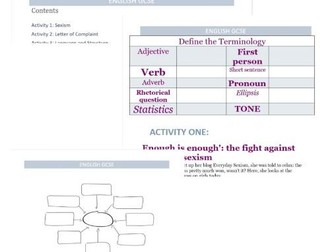
Hi This workbook contains 13 activities that are tailored to Edexcel and AQA, but mainly Edexcel. The transactional writing activities can be used for most specs. Inside is: SPaG activities Spider Diagram/Story planner Non Fiction Fiction MOCKS Comparison 7a and 7b Speeches Articles Text Book Letters Please review/share :)
Nationalities & Languages SpanishQuick View
jennifer218

Nationalities & Languages Spanish

(0)
This table is great to practise Spanish nationalities and languages spoken. This helps students to understand the differences of male and female languages and nationalites.