These two PowerPoints are designed for students at GCSE level.
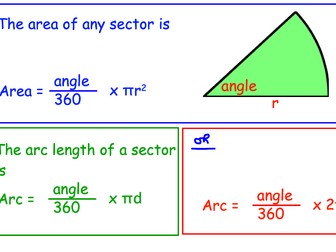
Through worked examples students learn how to work out the area of a sector or the length of an arc.
The lessons are accompanied with two worksheets one for each lesson. Answers are included.
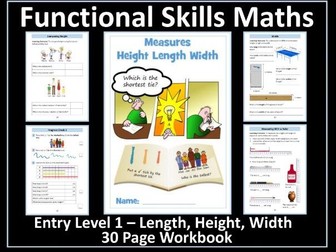
This resource has been designed for students working towards Functional Skills Maths qualifications at Entry Level 1 (Edexcel-Pearson, NCFE, City and Guilds, AQA, Highfield Qualifications, NOCN, Open Awards). It contains an age-appropriate, 30-page workbook on measure.
The workbook will help pupils to achieve these outcomes:
use the words big, bigger, biggest, small, smaller, smallest to describe and compare size.
use the words long, longer, longest, short, shorter, shortest, tall, taller, tallest, wide, wider, widest to describe and compare length, height and width
The workbook contains 5 information pages, 23 worksheets, 2 progress checks and a certificate of achievement. The resource is available in PDF and an editable Powerpoint version. It can be used for classwork, homework, revision or as an independent learning pack.
Please note, the watermark on the preview images is not present on the resource itself.
If you buy this resource and are pleased with your purchase, I would be grateful if you could leave a review. In return, you can have a free resource up to the value of your purchased resource. Just email inspireandeducate@aol.co.uk with your user name, the resource you have reviewed and the resource you would like for free.
You may also be interested in:
Entry Level 1 - Size, Length, Height, Width - 60 Slide PowerPoint Lesson
The editable PowerPoint provides many opportunities for students to practice the above skills. It also contains links to several short videos on measure. It is ideal for introducing students to this component of the specification and for revision purposes.
Save money and buy both resources at a discounted rate:
Entry Level 1 - Size, Length, Height, Width - PowerPoint Lesson and Workbook
Level 1 - Numbers and The Number System Bundle
Level 1 - Measures, Shape, Space Bundle
Level 1 - Handling Information and Data Bundle
Entry Level 3 Bundle
Entry Level 2 Bundle
Entry Level 1 Bundle
Entry Level English Resources
**Save 54% with the Complete Electricity Bundle! **
Get this lesson as part of our GCSE Electricity Bundle and enjoy a huge discount! Instead of buying lessons individually, grab the entire unit with 13 lessons, including required practicals, for just £12.00.
Click here to get the bundle now: https://www.tes.com/teaching-resource/resource-13199110
This “Required Practical: Investigating Resistance” PowerPoint lesson is designed for AQA GCSE Physics students. It focuses on experimentally determining how the length of a wire affects resistance, reinforcing the relationship between voltage, current, and resistance using Ohm’s Law. The lesson follows the AQA required practical method, ensuring students understand data collection, analysis, and graph plotting.
Key Learning Objectives:
Investigate how the length of a wire affects resistance using a circuit with an ammeter and voltmeter.
Apply Ohm’s Law (R=V/I) to calculate resistance at different wire lengths.
Analyze and interpret results, including identifying patterns and sources of error.
Develop practical skills by setting up circuits, recording measurements, and plotting graphs.
Lesson Features:
The lesson begins with a starter activity where students solve Ohm’s Law problems to recall resistance calculations:
Core Topics Covered:
Aim of the Practical:
To investigate how changing the length of a wire affects resistance.
Explanation of how resistance occurs as electrons collide with metal ions in the wire.
Method (Step-by-Step Practical Guide):
Set up the apparatus using a power supply, wires, a ruler, crocodile clips, an ammeter, and a voltmeter.
Measure the wire length using a ruler and record it in a table.
Turn on the power supply, record the voltage and current.
Repeat the experiment for different wire lengths (e.g., 20 cm, 40 cm, 60 cm).
Turn off the power supply between readings to prevent overheating.
Use Ohm’s Law (R=V/I) to calculate resistance.
Plot a line graph of wire length vs. resistance.
Expected Results:
Resistance should increase with wire length, as a longer wire means more collisions between electrons and metal ions.
The relationship between length and resistance is directly proportional.
Interactive Activities:
✔ Complete the missing steps in the practical method.
✔ Predict what will happen to resistance as wire length increases.
✔ Analyze example data, perform resistance calculations, and plot a graph of wire length vs. resistance.
✔ Answer key GCSE-style questions, such as:
Why must the power supply be turned off between readings?
How does increasing wire length affect current?
File Details:
Format: Editable PowerPoint (.pptx)
Updated: February 2025
Aligned with: AQA GCSE Physics Required Practical Specification
This lesson provides clear guidance, structured activities, and real-world applications, making it an essential resource for mastering resistance investigations in GCSE Physics.
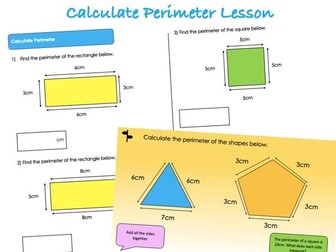
A fully resourced length and perimeter lesson for being able to calculate the perimeter of different shapes in Year 3 based on the objective from White Rose Maths.
Included in the resource is:
A lesson PowerPoint with starter, vocabulary, modelling (with teacher notes) and guided practice
Lesson plan
Worksheet with answer sheet
Scaffolded worksheet with answer sheet
Modified worksheet for those who need additional changes to access the learning with answers
Challenge tasks
Support strips that can be stuck in books
Everything is included that could be needed to run the lesson successfully, with each resource carefully considered in ensuring accessibility for all as well as ensuring there are plenty of opportunities for challenge to provide depth of understanding.
Check out a free lesson in the sequence to get an idea of what is included.
Add Lengths Lesson
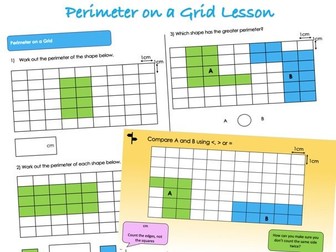
A fully resourced length and perimeter lesson for being able to work out/ calculate the perimeter of shapes on a grid in Year 4 based on the objective from White Rose Maths.
Included in the resource is:
A lesson PowerPoint with starter, vocabulary, modelling (with teacher notes) and guided practice
Lesson plan
Worksheet with answer sheet
Scaffolded worksheet with answer sheet
Modified worksheet for those who need additional changes to access the learning with answers
Challenge tasks
Support strips that can be stuck in books
Everything is included that could be needed to run the lesson successfully, with each resource carefully considered in ensuring accessibility for all as well as ensuring there are plenty of opportunities for challenge to provide depth of understanding.
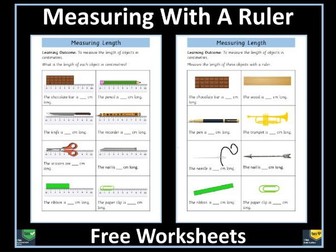
This resource contains two worksheets on measuring the length of an object with a ruler.
More Free Maths Resources
You may also be interested in:
Year 1 Length and Height - Set of 28 Worksheets For the Delivery of White Rose Maths Small Steps Scheme
This resource contains 28 worksheets / workbook (with answers and progress check) of mastery maths resources to support the delivery of the Year 1 Measurement - Block 3 - Spring Term White Rose (WRM) ‘small steps’ programme. These resources are for Weeks 8 -9.
The worksheets contain tasks (concrete, pictorial and abstract) linked to the White Rose small steps with an emphasis on the mastery approach to learning advocated by the White Rose scheme and includes reasoning and problem-solving tasks.
The resources focus on the following objectives and small steps:
Year 2 Maths National Curriculum Objectives
Measurement: Length and Height Measure and begin to record lengths and heights.
Compare, describe and solve practical problems for: lengths and heights (for example, long/short, longer/shorter, tall/short, double/half)
White Rose Small Steps
Compare lengths and heights
Measure length (1)
Measure length (2)
The worksheets are designed to enable the pupils to achieve the following learning outcomes:
Pupils use the following terms to describe and compare length and height - long, longer, longest; short, shorter, shortest; tall, taller, tallest, small, smaller, smallest.
Pupils use non-standard units such as cubes, hands and straws to measure the length and height of objects.
Pupils recognise that different non-standard units are more suitable for measuring the length and height of different objects.
Pupils understand that non-standard units should be exactly in line with the object to get an accurate measurement.
Pupils measure the lengths of objects using a ruler.
Pupils measure objects from the 0 on the ruler.
Pupils use reasoning and problem solving skills to work out solutions to measurement problems.
Thinking of publishing your own resources? Check out this step-by-step guide:
How to Become a Successful TES Author: Step-by-Step Guide
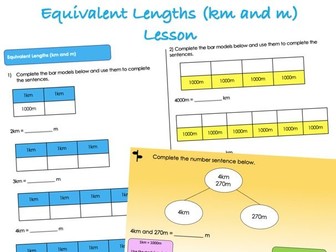
A fully resourced length and perimeter lesson for being able to convert been equivalent measurements in km and m (e.g. 4300m = 4km and 300m or 7km and 130m = 7130m) in Year 4 based on the objective from White Rose Maths.
Included in the resource is:
A lesson PowerPoint with starter, vocabulary, modelling (with teacher notes) and guided practice
Lesson plan
Worksheet with answer sheet
Scaffolded worksheet with answer sheet
Modified worksheet for those who need additional changes to access the learning with answers
Challenge tasks
Support strips that can be stuck in books
Everything is included that could be needed to run the lesson successfully, with each resource carefully considered in ensuring accessibility for all as well as ensuring there are plenty of opportunities for challenge to provide depth of understanding.
Comparing Lengths and Heights - Year 1
In this maths teaching resource pupils learn how to compare and order different lengths and heights and look at the words used to describe them as per the year 1 maths programme of study (measurement).
This colourful animated 31 slide PowerPoint presentation includes interactive activities and an accompanying worksheet.
'Comparing Lengths and Heights - Year 1' is fully editable so teachers are able to adapt the resource to suit each class they teach.
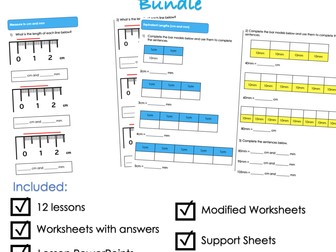
A bundle of fully resourced length and perimeter lessons based on the Year 3 White Rose maths unit for length and perimeter with 12 fully planned and resourced lessons included
Included are lessons for:
Lesson 1 - Measure in m and cm
Lesson 2 - Measure in mm
Lesson 3 - Measure in cm and mm
Lesson 4 - M, Cm and Mm
Lesson 5 - Equivalent lengths (m and cm)
Lesson 6 - Equivalent lengths (cm and mm)
Lesson 7 - Compare lengths
Lesson 8 - Add lengths
Lesson 9 - Subtract lengths
Lesson 10 - What is perimeter?
Lesson 11 - Measure perimeter
Lesson 12 - Calculate perimeter
All lessons include:
A lesson PowerPoint with starter, vocabulary, modelling (with teacher notes) and guided practice
Lesson plan
Worksheet with answer sheet
Scaffolded worksheet with answer sheet
Modified worksheet for those who need additional changes to access the learning with answers
Challenge tasks
Support strips that can be stuck in books
Everything is included that could be needed to run the lesson successfully, with each resource carefully considered in ensuring accessibility for all as well as ensuring there are plenty of opportunities for challenge to provide depth of understanding.
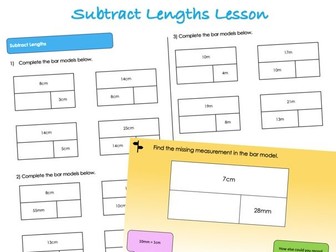
A fully resourced length and perimeter lesson for being able to subtract one length from another whilst being able to convert one unit of measurement to another (cm, mm and m) in Year 3 based on the objective from White Rose Maths.
Included in the resource is:
A lesson PowerPoint with starter, vocabulary, modelling (with teacher notes) and guided practice
Lesson plan
Worksheet with answer sheet
Scaffolded worksheet with answer sheet
Modified worksheet for those who need additional changes to access the learning with answers
Challenge tasks
Support strips that can be stuck in books
Everything is included that could be needed to run the lesson successfully, with each resource carefully considered in ensuring accessibility for all as well as ensuring there are plenty of opportunities for challenge to provide depth of understanding.
Check out a free lesson in the sequence to get an idea of what is included.
Add Lengths Lesson
These activity sheets are ideal to use in your continuous provision.
The four colourful downloadable sheets consist of measuring:
Balloons
Trees
Buildings
Ties
They can be measured using multilink cubes, a ruler etc.
A resource introducing the method to find an arc length. Includes examples and questions using arc length to calculate the perimeter of sectors. Challenge questions for higher ability including questions with algebraic terms.
The lesson is structured using Rosenshine’s principles of instruction.
Worksheets and Answers are included.
A PowerPoint conversion from my SMART file is included too if you do not have access to the SMART NOTEBOOK
If you enjoy this lesson and the resources, if it saves you time, lightens your huge workload or engages your students, please leave me a REVIEW as your feedback is valuable to me as it helps me improve and create more resources that meet your needs.
2 nice worksheets to use when measuring in cm and mm.
Fully editable and answer sheet provided.
I normally allow the children a small degree of error either side of the exact measurement (1mm more or 1mm less).
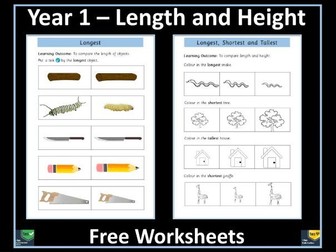
This resource contains two worksheets on length and height.
More Free Maths Resources
You may also be interested in:
Year 1 Length and Height - Set of 28 Worksheets For the Delivery of White Rose Maths Small Steps Scheme
This resource contains 28 worksheets / workbook (with answers and progress check) of mastery maths resources to support the delivery of the Year 1 Measurement - Block 3 - Spring Term White Rose (WRM) ‘small steps’ programme. These resources are for Weeks 8 -9.
The worksheets contain tasks (concrete, pictorial and abstract) linked to the White Rose small steps with an emphasis on the mastery approach to learning advocated by the White Rose scheme and includes reasoning and problem-solving tasks.
The resources focus on the following objectives and small steps:
Year 2 Maths National Curriculum Objectives
Measurement: Length and Height Measure and begin to record lengths and heights.
Compare, describe and solve practical problems for: lengths and heights (for example, long/short, longer/shorter, tall/short, double/half)
White Rose Small Steps
Compare lengths and heights
Measure length (1)
Measure length (2)
The worksheets are designed to enable the pupils to achieve the following learning outcomes:
Pupils use the following terms to describe and compare length and height - long, longer, longest; short, shorter, shortest; tall, taller, tallest, small, smaller, smallest.
Pupils use non-standard units such as cubes, hands and straws to measure the length and height of objects.
Pupils recognise that different non-standard units are more suitable for measuring the length and height of different objects.
Pupils understand that non-standard units should be exactly in line with the object to get an accurate measurement.
Pupils measure the lengths of objects using a ruler.
Pupils measure objects from the 0 on the ruler.
Pupils use reasoning and problem solving skills to work out solutions to measurement problems.
Thinking of publishing your own resources? Check out this step-by-step guide:
How to Become a Successful TES Author: Step-by-Step Guide
Stage 2
Year 4
Mathematics
Measurement
Length
A single worksheet on converting between units of measurement in length
Year 4
Mathematics Australian & New South Wales Curriculum
MA2 9MG measures, records, compares and estimates lengths, distances and perimeters in metres, centimetres and millimetres, and measures, compares and records temperatures
Editable Word version. Purchase separately or as part of a bundle from Mathematics Program
Resource Includes:
1 hour of teaching
A powerpoint covering how the carbon chain can be extended and the reactions of nitriles
Questions and answers
Lots of diagrams
Please see my other A Level Chemistry resources. Follow me on Twitter for lots of ideas: @Teach_Chem602
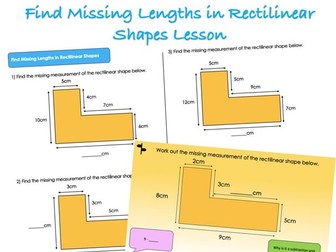
A fully resourced length and perimeter lesson for being able to find the missing lengths of rectilinear shapes in Year 4 based on the objective from White Rose Maths.
Included in the resource is:
A lesson PowerPoint with starter, vocabulary, modelling (with teacher notes) and guided practice
Lesson plan
Worksheet with answer sheet
Scaffolded worksheet with answer sheet
Modified worksheet for those who need additional changes to access the learning with answers
Challenge tasks
Support strips that can be stuck in books
Everything is included that could be needed to run the lesson successfully, with each resource carefully considered in ensuring accessibility for all as well as ensuring there are plenty of opportunities for challenge to provide depth of understanding.
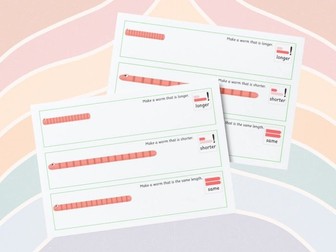
Get ready for an exciting journey into the world of length! This visually-rich resource is specially designed for Early Years Foundation Stage (EYFS) children to easily understand and compare things that are long and things that are short.
What’s Inside?
Vivid Visuals: Packed with bright, clear, and engaging pictures of everyday objects (like pencils, ribbons, snakes, and worms) side-by-side to help children clearly see and compare their lengths.
Hands-On Activities: Fun, simple activities encourage children to put objects together and use their own hands and eyes to decide which is longer and which is shorter while discussing using the PPT.
Key Vocabulary Focus: Dedicated practice to help children become familiar and confident using the key comparison words: long and short.
Learning Goals:
By the end of this resource, children will be able to:
Compare the length of two different objects.
Identify which object is long and which is short.
Use the words long and short correctly when describing objects.
It’s the perfect tool for building foundational measurement skills!
 Quick View

 Quick View
 Quick View
 Quick View
 Quick View
 Quick View
 Quick View
 Quick View
 Quick View
 Quick View
 Quick View
 Quick View
 Quick View
 Quick View
 Quick View
 Quick View