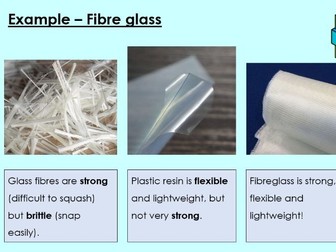
Are you wanting to teach about how we use different materials? This bundle helps students learn how we use a wide range of different common materials. It also comes complete with the key vocabulary they need to learn about the topic and interesting English story writing prompts to help them get the most out this subject. It is a perfect way to explore what properties we are using in each of the uses we use for each material.
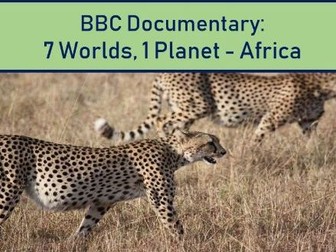
7 Worlds, 1 Planet: Africa
BBC documentary, currently playing on iPlayer.
A question and answer worksheet based around the 50 minute documentary seven worlds, one planet, episode 7. This documentary is all about Africa and the variable conditions it presents to wildlife.
It could be used to support learning around ecosystems, animal habitats and adaptations or place specific study of Africa. Some discussion on how humans impact landscapes in Africa. Can cover a lesson or used as a stand-alone homework.
Topics include:
Animal habitat
Rainforest - climate and wildlife
Human impacts on animals
Africa
I specialise in worksheets to support science and nature documentaries across BBC iPlayer and Netflix. Check my shop to view materials to support other episodes in this series.
Suitable for 14-19-year olds (secondary and high schools, and college), this article and accompanying activity sheet can be used in the classroom, STEM clubs and at home.
This resource links to KS4 and KS5 physics, maths, chemistry and engineering.
It can also be used as a careers resource and links to Gatsby Benchmarks:
Gatsby Benchmark 2: Learning from career and labour market information
Gatsby Benchmark 4: Linking curriculum learning to careers
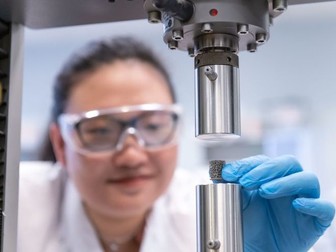
• This teaching resource explains the work of Discover Materials, an organisation promoting the field of materials science and engineering. From lunar homes constructed from moondust and astronaut urine, to bamboo cricket bats, explore the incredible applications of and opportunities in materials science and engineering.
• This resource also contains interview with members of the Discover Materials team and offers an insight into careers in materials science and engineering. If your students have questions for any of the team, they can send them to them online. All they need to do is to go to the article online (see the Futurum link below), scroll down to the end and type in the question(s). The team will reply!
• The activity sheet provides ‘talking points’ (based on Bloom’s Taxonomy) to prompt students to reflect on the applications of materials science and engineering and challenges them to design an experiment to investigate the material properties of chocolate.
This resource was first published on Futurum Careers, a free online resource and magazine aimed at encouraging 14-19-year-olds worldwide to pursue careers in science, tech, engineering, maths, medicine (STEM) and social sciences, humanities and the arts for people and the economy (SHAPE).
If you like these free resources – or have suggestions for improvements –, please let us know and leave us some feedback. Thank you!
An assembly to support work during World Mental Health Day in October. This highly dynamic presentation has an assembly plus a range of ideas and resources for follow-up form time activities.
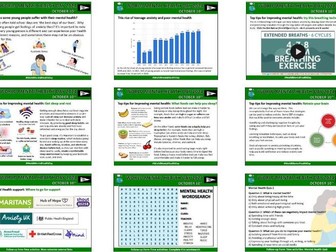
This beautifully-designed and editable 26-slide Powerpoint presentation creatively presents information on this event and can be showcased to any age group and includes specific pages for primary or secondary students. It includes images, dynamic transitions, informative text, video and links for extension work in form time – including extra video and classroom activities.
Slide 1: What is World Mental Health Day? Includes video.
Slide 2-3: Why do some young people suffer with their mental health?
Slide 4: This rise of teenage anxiety and poor mental health [inc national research graphs]
Slide 5: Top tips for improving mental health: Breathing exercise. Includes video.
Slide 6: Top tips for improving mental health: Move more. Includes video.
Slide 7: Top tips for improving mental health: Sleep habits.
Slide 8 and 9: Top tips for improving mental health: Healthy eating. Includes video.
Slide 10: Top tips for improving mental health: Get outside. Includes video.
Slide 11: Top tips for improving mental health: Be social.
Slide 12: Top tips for improving mental health: Retrain your brain
Slide 13: Closing Thought
Slide 14: Follow-up form time activities title screen
Slide 15: Form time activities: Support links to explore
Slide 16: Form time activities: Art activity
Slide 17: Form time activities: Wordsearch activity
Slide 18: Form time activities: Poetry activity
Slides 19-23: Form time activities: Mental Health quiz – with answers
Slides 24-25: Other form time ideas to support anxiety strategies.
As reviewers have stated for previous resources shared:
“I sat down to plan my assembly for next week and found this resource, and it’s perfect. The best £2 spent. Thank you. I can teach this straight from the slides.”
“Just buy it!”
“Your resources have been life savers!”
“Well worth the money and really saved my life”
“I just wanted to say that as a non-specialist these resources are worth every single penny! Thank you so much for making and sharing them.”
“Blown away by this! Can’t thank you enough!”
“They have saved me a huge amount of time and the detail that goes into your work is second to none. You put others to shame who charge twice as much for very little. Can’t thank you enough.”
“Your new spec resources are saving me hours & hours of work! Thanks, they are really good.”
“These resources are so useful - I cannot tell you how much time they have save me - very clear to follow and easy to adapt for revision material — well worth the money”
Resources that I have designed for my Reception class. All the resources link to the Material World topic. I have placed one item on here that compliments the waterproof coat activity. The resource named 'Letters' is the only item that is not my work, all other resources I have created myself.
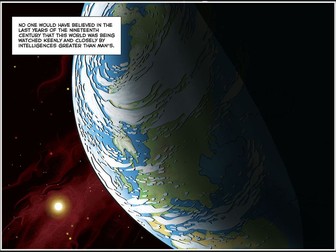
The War of the Worlds (1899) is an exciting story but a difficult text for new readers. These presentations, worksheets and adapted extracts (text & audio) introduce the central narrative of one of the most influential science fiction novel in all literature. They stay stay close to the original H.G Wellsltext and maintain the same chapter structure.
The materials are ideal for GCSE English Literature classes, guided reading, exam preparation or as an introduction to late 19th Century fiction. They are all free to access and include links to the original for cross reference.
About me - I write graded reading materials, and my published titles include original stories like Love by Design (Macmillan Readers) & simplified versions of classics like Washington Square, The Secret Garden, Vanity Fair (OUP), Jaws, A Picture of Dorian Gray, A Picture of Dorian Gray & Rainman (Penguin).
A full 1 hour lesson designed for a mixed ability year 8 class.
This is the 8th lesson in “Chapter 3 - Metals and other materials" from Activate 2, Chemistry. This lesson is on 'composite materials’.
This lesson should be suitable to teach to any KS3 Chemistry class, even by those where Chemistry is not their specialism.
This lesson (and all lessons in this unit) is designed to be interactive and engaging, with plenty of real world examples and independent tasks.
From this lesson, students should be able to:
Define the term ‘composite material’
Give some examples of composite materials
Predict the properties of a composite material when given the properties of the materials it is made up of
Explain how the properties of a composite material make it useful for its application
Evaluate composite materials using data tables on their properties
All of my lessons contain:
A 5-in-5 retrieval-style starter
An interesting lesson hook, careers link, or retrieval practice to start the lesson
Teacher input slides with dual coding and reduced cognitive load
Teacher models
Regular ‘check for understanding’ slides, such as hand signals quizzes and whiteboard quizzes
Regular student independent practice slides, with optional scaffolds, challenges and answer slides
A plenary task
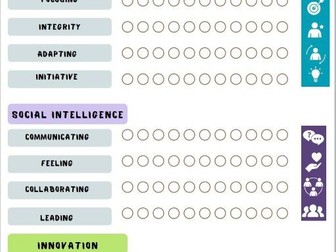
I wanted to make my KS3 booklets more interactive, exiting and visually appealing to learners of all abilities. I used angry birds as a theme as I found that my learners responded well to this type of visual stimuli. The project I am doing with them is a simple balancing toy to develop their basic metal work skills. I also wanted to emphasise the national curriculum requirements in a simple way. At the start of the project learners are given the opportunity to discuss and develop an understanding of the curriculum logo's (thinking, communication, etc) and how they relate to their work. I have added the document in both PDF and Microsoft publisher format. All fonts such as 'angry birds' are available from dafont.com .
This resource is my whole-school skills framework (P1-P7) that directly links to the Skills Development Scotland (SDS) meta-skills. It comes with all the supporting materials you’ll need, plus clear connections to the world of work to help pupils see the ‘why’ behind their learning.
We’ve implemented this across our whole school, and the feedback from staff has been amazing! It’s made a real difference to pupil engagement, how they develop essential skills, and their overall learning.
I really hope this helps your school foster those crucial meta-skills and boost curriculum coherence across your primary stages!
Here is a medium term plan for topic called ‘Material World’ that focuses on materials.
This medium term plan follows the New National Curriculum 2014.
Promote student choice and facilitate the process of researching relevant topics from beginning to end with this low-prep activity to conclude a unit on The War of the Worlds by H.G. Wells. Students will choose from thirty research topics—addressing ideas such as real-life UFO sightings (the 1947 Roswell incident, the 1997 Phoenix Lights incident, the 2006 O’Hare International Airport incident, etc.), UFO programs and organizations (Project Blue Book, Mutual UFO Network, SETI Institute, etc.), and famous figures in ufology (J. Allen Hynek, John Mack, George Adamski, etc.)—and navigate academically appropriate sources with the goal of teaching their peers about their topics. A detailed scoring rubric is provided. Materials are delivered in Word Document and PDF formats.
Ultimately, students will perform the following tasks:
Articulate connections between a research topic and the assigned novel
Conduct research using available resources
Collect and classify reliable sources
Develop successful methods of recording information
Evaluate the credibility of nonfiction texts, taking into consideration readability, date, relevance, expertise, and bias
Apply conventions of MLA formatting
Correctly site resources to avoid plagiarism
Organize information in a cohesive manner, using a note-taking system that includes summary, paraphrasing, and quoted material
Analyze, synthesize, and integrate information, generating a thoughtfully comprehensive report, free of generalities and redundancies
Present information in a formal, coherent manner
Fully resourced for History | Ideal for developing historical skills and understanding the Great War
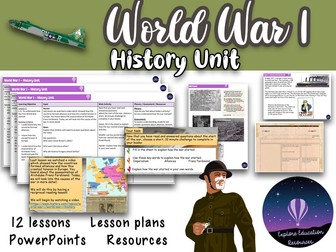
Immerse your KS2 students in the pivotal events of World War I with this engaging and comprehensive unit. Designed for Years 3-6, this resource covers everything you need to deliver exceptional lessons that spark curiosity and foster a deep understanding of the impact of the Great War.
What’s Included:
12 Detailed Lesson Plans: Step-by-step guidance with clear learning objectives, stimulating activities, and differentiation strategies.
Engaging PowerPoint Presentations: Visually rich slides featuring historical photos, maps, and thought-provoking questions.
Diverse Resources: Printable materials like timelines, propaganda posters, trench diagrams, and poetry analysis worksheets.
Creative Activities: Opportunities for students to design propaganda posters and write their own WWI poems.
Key Learning Outcomes:
Causes & Consequences: Understand the complex causes of World War I and its global impact.
Life in the Trenches: Gain insights into the harsh realities of trench warfare and the daily lives of soldiers.
Home Front: Explore how the war affected people on the home front, including rationing and women’s roles.
Propaganda & Communication: Analyse the role of propaganda in shaping public opinion during the war.
Remembrance & Legacy: Reflect on the significance of Remembrance Day and the legacy of World War I.
Why This Resource Stands Out:
Curriculum-Aligned: Meets national curriculum objectives for KS2 History.
Outstanding Quality: Designed to engage and challenge learners, encouraging deep historical understanding.
Ready-to-Use: Save time with clear, organised materials and plans.
Cross-Curricular Links: Explore connections to geography, English, and art, enriching the overall learning experience.
Inspire a love of history and deepen students’ understanding of World War I with this exceptional resource!
Ideal For: KS2 History, Year 3, Year 4, Year 5, Year 6, World War 1, WW1, the Great War, trench warfare, propaganda, remembrance, British history, European history.
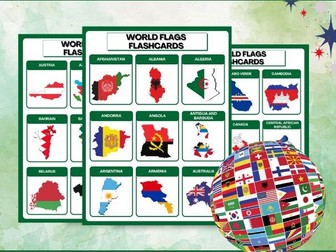
World Flags Geography Flashcards are the ultimate resource for teaching students about the flags of 195 countries from across the globe! This set includes bright and colorful illustrations, designed to capture attention and make learning fun and engaging. With 9 flashcards per page, these printables are perfect for any classroom or homeschool environment.
Use these flashcards to enhance your geography lessons, teach global geography in social studies, or create interactive activities like geography games and quizzes. These printable flag flashcards offer flexibility and convenience, making them an ideal resource for teachers, homeschool parents, or anyone who wants to expand their students’ knowledge of country flags and world geography.
Key Features:
Includes 195 country flags from around the world
9 flashcards per page for easy printing and use
Colorful and bright illustrations to engage students
Ideal for geography lessons, social studies, and classroom activities
Perfect for teachers, homeschoolers, and geography enthusiasts
Great for use in geography games, quizzes, or as a visual resource
Enhances students’ understanding of world geography and flags of countries
Suitable for students of all ages, from elementary to middle school
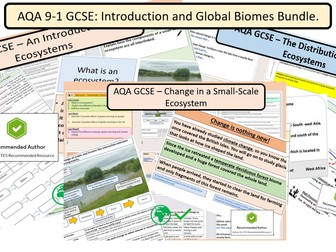
Three complete lessons and supporting materials to cover the first section of the AQA Paper 1 Living World Introduction. Covers Key vocabulary, food chains , a small scale example and the location and characteristics of global biomes. Activities and skills are embedded throughout.
Inspire your Year 7 students to think like real materials scientists with this Designing Composite Materials pack, featuring a clear, visually engaging PowerPoint and a set of ready‑to‑use worksheets. Learners explore why composites are created, how different components work together, and where we use them in everyday life—before tackling fun design challenges of their own. With simple explanations, real‑world examples, and interactive tasks, this no‑prep resource makes a complex topic accessible, creative, and memorable for all abilities.
Some visuals in this resource were made with AI to help bring ideas to life and support student understanding.
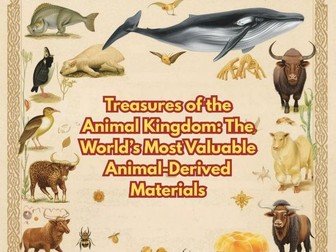
Discover nature’s most prized resources with this visual guide. Explore 20 remarkable animals and the rare, valuable materials they provide — from ambergris and caviar to yak wool and royal jelly. Each entry highlights the animal, the sought-after substance, and the exceptional value these wonders bring to science, fashion, cuisine, and more.
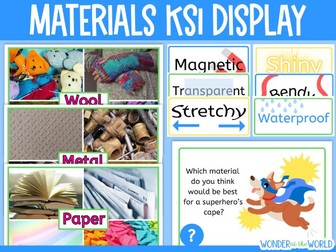
Introduce the topic of materials and their properties to your KS1 class with this colourful and engaging pack of display materials. This resource is ready to print, with minimal trimming required. Just print the pages you need for science classroom display.
This 20-page science display resource (PDF) includes:
9 A4, full colour photo posters showing examples of everyday materials (glass, wood, metal, fabric, wool, plastic, ceramic, leather and paper).
12 descriptive words to add to your display if required (presented 3 to a page, to be cut out and mounted)
5 A4 posters with simple questions about the use of materials (e.g. Which material would be best for a superhero’s cape?).
Materials title - print over 2 A4 pages and join together.
Please note that this PDF file is not editable.
Rise of Hitler. Different resources for student led revision - including information and practice exam questions, these can be used in lesson for student led work, for homework or for non-subject specialist teachers.
Year 4
Stage 2
Science
Properties of Materials
Materials
A variety of learning activities / A single worksheet
*Students decipher how materials are used in everyday life based on their properties
4 Science Australian & New South Wales Curriculum
› Syllabus content focus
ST2 13MW identifies the physical properties of natural and processed materials, and how these properties influence their use Material World (reporting)
› ST2 16P describes how products are designed and produced, and the ways people use them (reporting)
› ST2 2VA demonstrates a willingness to engage responsibly with local, national and global issues relevant to their lives, and to shaping sustainable futures
ST2 5WT applies a design process and uses a range of tools, equipment, materials and techniques to produce solutions that address specific design criteria
Editable Word version. Purchase separately or as part of a bundle from Science Program


 Quick View