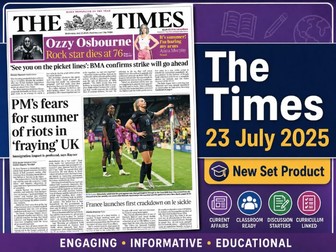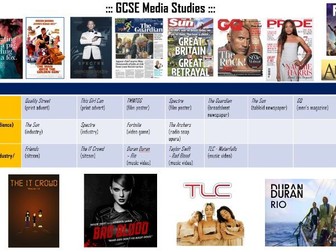
This fully editable worksheet is designed to match the specification and is perfect for homework, cover lessons, or independent study. Each task is carefully structured to help students consolidate key content, deepen understanding, and support effective revision. Ideal for home learning, retrieval practice, flipped learning, or in-class support. Ai was used to help create these accessible and engaging, this no-prep resource helps boost progress while saving teacher time.
This is a PowerPoint created for the teaching of the new set text advert ‘NHS 111’ for the Eduqas GCSE Media Studies Course.
It gives an overview of public service adverts and then focuses on a textual analysis of the print advert itself.
Once a fact sheet is created by Eduqas, I will add in any pertinent information.
There is an accompanying booklet for the pupils to use alongside the PPT.
A comprehensive 37 slide presentation on the brand new AQA CSP product 'BlackPink The Game (BPTG) added to the course in 2024.
This presentation looks exclusively at the game through the theoritical framework of Media REPRESENTATIONS.
This resource also contains multiple video files of gameplay.
I will be uploading further presentations for the other study areas.
A comprehensive revision guide for the CIE 9607 Media Studies Media Regulation unit for the Critical Perspectives A2 paper.
The guide includes the following:
An introduction to AOs and concepts
Key terms and definitions
Media regulatory bodies
Theoretical perspectives and approaches
Case studies (modern and historical) and critical application
Sample essays, approaches to writing, frames and practice questions
Suitable for a year13/A2 class to support revision or as independent study of a unit on Media Regulation.
Resources for the Close Study Product for the AQA GCSE Media Studies course (first teaching September 2021). Designed for AQA, and anyone examining the TV series unit on His Dark Materials: City of Magpies. The 53 slide, 10 lesson resource includes all resources and ten lesson’s work (with possible expansion) and pupil questions/activities. Download also includes a knowledge checklist for the CSP.
Lesson 1: What is ‘His Dark Materials: City of Magpies’ and what are the key themes of the episode.
Lesson 2: Target audience analysis.
Lesson 3: Audience and Marketing/Promotion links. Character links to target audience.
Lesson 4: Audience response to His Dark Materials – including audience numbers, critical response and preferred/oppositional readings of His Dark Materials.
Lesson 5: A semiotic analysis of His Dark Materials – including CLAMPS.
Lesson 6 and 7: Media Language theory including genre, Propp, Todorov, Barthes and Levi-Strauss.
Lesson 8: Representation in His Dark Materials.
Lesson 9: The remit and funding of BBC. The production companies behind His Dark Materials. The BBC/HBO link. The multi-platform, multi-channel media landscape.
Lesson 10: Comparing His Dark Materials and Dr. Who.
As reviewers have stated for previous Media Studies CSPs shared on TES:
“Just buy it!”
“Your resources have been life savers!”
“Well worth the money and really saved my life”
“I just wanted to say that as a non-specialist these resources are worth every single penny! Thank you so much for making and sharing them.”
“Blown away by this! Can’t thank you enough!”
“They have saved me a huge amount of time and the detail that goes into your work is second to none. You put others to shame who charge twice as much for very little. Can’t thank you enough.”
“Your new spec resources are saving me hours & hours of work! Thanks, they are really good.”
“These resources are so useful - I cannot tell you how much time they have save me - very clear to follow and easy to adapt for revision material — well worth the money”
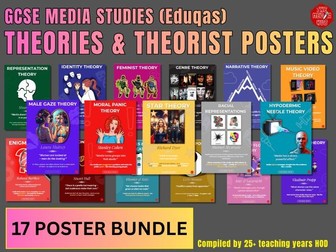
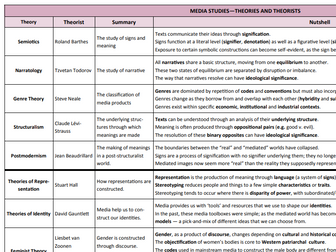
Media theories in a nutshell - A3.
Perfect for a classroom display, or can be printed for revision support.
Covers all named theorists in Eduqas Media Studies A-Level Specification, as well as relevant Eduqas GCSE theories too. Colour co-ordinated into the different key areas of the specification: Media Language, Audience, Industries, Representation + GCSE.
Includes:
GCSE:
Blumler and Katz
Mulvey
Propp
Dyer
Alvarado
Goodwin
A-Level:
Barthes
Levi-Strauss
Todorov
Neale
Baudrillard
Hall
Gilroy
van Zoonen
hooks
Butler
Gauntlett
Curran and Seaton
Livingstone and Lunt
Hesmondhalgh
Bandura
Gerbner
Jenkins
Shirky
Hopefully there are none, but if you spot any errors, please let me know!
These resources should help with the teaching of the Desert Island Discs set text for Media studies GCSE under the Eduqas specification.
There is an accompanying booklet for the students.
As yet, no fact sheet on the programme has been published by the exam board so I will amend the resources if needs be once it is published.
Student work book with questions and information linking to Media Language, Representation, Audience and Industry and Powerpoint of the new curriculum.
Extended exam style questions and short knowledge questions.
Each lesson has:
Date and Title
Do now task
Questions
Key terminology
linked to the specification of AQA
Pictures/images of the Kim Kardashian
Independent tasks
Can be used with a power point.
These excellent resources work perfectly in any media studies classroom! I have used these posters as wall displays, learning mats and hand outs when students are completing classwork/ coursework. My current head teacher commented on these resources stating they were “the best resources” he has seen in the classroom.
My students find them incredibly helpful during lessons especially during assessment/ coursework and revision work.
**The documents include: **
An introduction to Audience (Mass, Niche, Primary + Secondary target audience, demographic and psychometrics).
A guide to audience theories (VALS and Young and Rubicam).
Audience theories (Audience positioning, Stuart Halls Encoding and Decoding theory).
A guide to Uses and Gratification Theory
A guide to Representation
A guide to Todorov’s Narrative Theory (Including clear example, Monsters Inc)
A guide to Propp’s Character Theory
Magazine Terminology
I remember being taught media studies at GCSE and A Level and wished I had resources like this to support me when completing assessment work. I hope your students enjoy them to.
Leave a review and any suggestions for new learning mats and I’ll continue to plan and develop these resources.
Resources for the Close Study Product for the reformed AQA GCSE Media Studies course. Designed for AQA, also applies to Eduqas and anyone discussing the impact of vloggers and their expansion into the media/celebrity landscape. The resources relate to the Dr Who ‘An Unearthly Child’ opening episode, and studies the Media Representation, Audiences, Industries and Language around TV Series, SciFi, the BBC, etc… The 33-slide Powerpoint includes all resources and eight lessons work (with possible expansion).
Lesson 1: The Codes and Conventions of SciFi
Lesson 2: The BBC and Doctor WhoWho is Doctor Who, how important is the Doctor Who franchise to the BBC, the BBC [how is it funded and the public service remit and how has it changed]
Lesson 3: How is the BBC regulated and how are programmes commissioned
Lesson 4: An introduction to ‘An Unearthly Child’ and watch episode
Lesson 5: Narrative theory and ‘An Unearthly Child’ [inc Propp and Todorov]
Lesson 6: The semiotic codes in ‘An Unearthly Child’
Lesson 7: Character analysis of ‘An Unearthly Child’
Lesson 8: Use of stereotypes in ‘An Unearthly Child’ , audience analysis and Use and Gratifcation Thoery.
As previous 5-star reviews for other CSPs published on TES have stated ‘these are great starting points’ for lesson delivery.
Powerpoint file contains all resources, along with a Personal Learning Checklist (PLC) for students to RAG-rate their knowledge, skills and understanding. As reviewers have stated for previous Media Studies CSPs:
"Just buy it!"
“Your resources have been life savers!”
“Well worth the money and really saved my life”
“I just wanted to say that as a non-specialist these resources are worth every single penny! Thank you so much for making and sharing them.”
“Blown away by this! Excellent AS Eduqas revision tool. Can’t thank you enough!”
“They have saved me a huge amount of time and the detail that goes into your work is second to none. You put others to shame who charge twice as much for very little. Can’t thank you enough.”
“Your new spec resources are saving me hours & hours of work! Thanks, they are really good.”
"These resources are so useful - I cannot tell you how much time they have save me - very clear to follow and easy to adapt for revision material — well worth the money"
***Reviews welcomed***
A full SOW looking at the Voice online. Directs through all frameworks - including examples from the site (from 2022). There are exam questions included and all relevent theory and context is explored here, including the Notting Hill Carnival and the relation to the online paper.
This is a 22 slide powerpoint that teaches the A-Level Media Language concept of Postmodernism.
It explores Modernism, then goes on to explain the concepts of:
Intertextuality
Pastiche
Parody
Bricolage
Hybridity
Self-Reflexivity
Hyperreality (Baudrillard)
Versimilitude
Put in simplistic ways in which students can understand. This can then be supplemented by further reading AND application to your own set texts from whichever exam board you are with.
Scheme of learning for the Online Media unit of study as part of the Eduqas A Level Media Studies Specification. Each lesson is broken down by the key areas of assessment; media language, audience, representation and industry. Each area also covers key theoretical approaches.
Content Warning: some of the vidoes and other content taken from KSI’s YouTube and social media channels used in these lessons may be considered racist, homophobic, transphobic, misogynistic, etc. and will need to be shown at your discretion.
Resources designed to support the teaching of the 2001 film The Others and a related critical essay. Includes a PowerPoint (also included as a PDF file), worksheets, a talking task and a critical essay plan.
Resources for the Close Study Product for the AQA GCSE Media Studies course (first teaching September 2021). Designed for AQA, and anyone examining the Magazine unit on Heat. The 48 slide, 7 lesson resource includes all resources and seven lesson’s work (with possible expansion) and pupil questions/activities. Download also includes a knowledge checklist for the CSPs.
Lesson 1: Introduction to Heat and the nature of its target audience. Also, introduction to the celebrities on the cover and the context of the stories.
Lesson 2 and 3: Completing a detailed semiotic analysis of the Heat front cover including verbal, non-verbal and technical codes.
Lesson 4: The values and beliefs of Heat magazine.
Lesson 5: An analysis of the narrative structures using media theories including Propp, Todorov Levi-Strauss and Barthes.
Lesson 6: How groups, people and events are represented in Heat and why.
Lesson 7: Comparing Heat to Tatler. Practice examination questions.
As reviewers have stated for previous Media Studies CSPs shared on TES:
“Just buy it!”
“Your resources have been life savers!”
“Well worth the money and really saved my life”
“I just wanted to say that as a non-specialist these resources are worth every single penny! Thank you so much for making and sharing them.”
“Blown away by this! Can’t thank you enough!”
“They have saved me a huge amount of time and the detail that goes into your work is second to none. You put others to shame who charge twice as much for very little. Can’t thank you enough.”
“Your new spec resources are saving me hours & hours of work! Thanks, they are really good.”
“These resources are so useful - I cannot tell you how much time they have save me - very clear to follow and easy to adapt for revision material — well worth the money”
Resources for the Close Study Product for the AQA GCSE Media Studies course (first teaching September 2021). Designed for AQA, and anyone examining the Online, Social and Participatory unit on Marcus Rashford. The 55 slide 10 lesson resource includes all resources and ten lesson’s work (with possible expansion) and pupil questions/activities. Download also includes a knowledge checklist for the CSP.
Lesson 1: Who is Marcus Rasford?
Lesson 2: Why is Marcus Rashford a CSP? How has Marcus Rashford redefined celebrity through his online presence?
Lesson 3: Who is the audience for Marcus Rashford and why do they engage with his online presence?
Lesson 4: Analysing the codes and conventions of his social media channels.
Lesson 5: Analysing the official Marcus Rashford website.
Lesson 6: Audience positioning and narrative structures.
Lesson 7: Who selects the various representations of Marcus. The rise of social media managers and PR companies.
Lesson 8: The growth of social media companies and who owns them? Who regulates social media companies?
Lesson 9: How do social media companies make money? What businesses link with Marcus Rashford and why?
Lesson 10: Marcus Rashford, the political powerbase and public policy.
As reviewers have stated for previous Media Studies CSPs:
“Just buy it!”
“Your resources have been life savers!”
“Well worth the money and really saved my life”
“I just wanted to say that as a non-specialist these resources are worth every single penny! Thank you so much for making and sharing them.”
“Blown away by this! Excellent AS Eduqas revision tool. Can’t thank you enough!”
“They have saved me a huge amount of time and the detail that goes into your work is second to none. You put others to shame who charge twice as much for very little. Can’t thank you enough.”
“Your new spec resources are saving me hours & hours of work! Thanks, they are really good.”
“These resources are so useful - I cannot tell you how much time they have save me - very clear to follow and easy to adapt for revision material — well worth the money”
A newly updated SOW on the DM - updated with recent research up to 2025 covering relevant contextual issues in the newspaper industry. There are several question 5 style shorter questions included as interleaving tasks and a homework booklet to help consoldidate learning. 11 lessons including an assessment lesson and question. This is a targeted CSP from Media One and this SOW covers all relevant frameworks: industry, contexts and audience. Furthermore, it covers all relevant theories such as: Curran& Seaton, Livingstone & Lunt, etc.
Full lessons and tasks on:
Film – Blinded by the Light: (Gurinder Chadha, UK, 2019)
This is a Targeted Close Study product for which you will need to focus on the following areas of the Theoretical Framework:
• Media Industries
Students are not required to watch the film for the assessment
Film: Blinded by the Light is an example of low-medium budget film making. Students do not need to watch the film but will need to be familiar with the production context and distribution materials including:
o website(BenditNetworks) o website(Warners)
o posters
o trailer
osocialmediapresence(twitter,Instagram,facebooketc). The film should only be studied in relation to Media Industries.
Here are four guides on how to answer 20 mark questions typically seen in AQA GCSE media studies exam papers.
Each guide breaks the question down in to 5 sections, giving students a structure to follow to ensure they cover all of the important aspects of the question.
I have been teaching Media Studies for the last 15 years and have been using these guides with my current year 10 & 11 classes in preparation for exams. I have found that students really like the step-by-step nature of the guides and their confidence is improving as we use them. I have also made a set for A-Level as well.
In this pack there are questions on the following topics:
Film Industry - Black Widow & I, Daniel Blake
TV - Dr Who
Radio - Ownership
Video Games - Harmful effects
A useful guide about narrative theory, covering all the key players including Todorov, Field, Barthes and Levi-Strauss. Links to film clips, consolidatory notes about each theory. Please visit alevelmedia.co.uk for more links and resources. Narrative and Media Studies