Powerpoint lesson Movement and handling
Content overview:
Risk assessment
TILE
moving and handling aids
mechanical equipment
2 person moving and handling
patient dignity
Consent and patient understanding
full explanation of how to safely use:
* wheelchairs
* transfer belts
* transfer board/PAT slide
* hoist and slings
* walking frames
Moving house is often seen as an exciting fresh start, but for many adults, it can be emotionally overwhelming and even feel traumatic. The stress isn’t just about lifting boxes or organizing logistics — it comes from the psychological and emotional impact of leaving a familiar place and entering the unknown.
For adults, moving can feel like a loss in many ways:
Emotional Attachment: Homes are repositories of memories, comfort, and routines. Leaving a place filled with experiences can trigger sadness and grief.
Fear of Change: Even positive moves carry uncertainty. Adjusting to new neighborhoods, schools, workplaces, or communities can create anxiety.
Decision Overload: From packing to utility setup, moving requires countless choices. The pressure to make everything perfect can lead to decision fatigue.
Disconnection from Support Systems: Friends, family, and social networks may be left behind, intensifying feelings of isolation.
Physical and Mental Strain: The physical effort of moving, combined with mental stress, can contribute to exhaustion and burnout.
Adults can experience moving stress in ways similar to trauma: sleepless nights, irritability, low mood, and even moments of panic. Understanding these emotional responses is essential — acknowledging them doesn’t mean weakness, but rather self-awareness and preparation.
Practical strategies help manage this stress: breaking tasks into small steps, practicing mindfulness, maintaining social connections, and creating rituals to honor the home you’re leaving. By combining emotional awareness with practical organization, moving becomes a challenge you can navigate successfully.
For a full guide to overcoming the emotional and mental strain of moving, the ebook Calm Moves: Overcoming Emotional Challenges When Moving House provides step-by-step advice, coping strategies, and tips to make your move calmer, easier, and emotionally manageable.
https://stresslessmove.gumroad.com/l/Move-Stress-Free
Separate skills planning sheets for each of the 11 skills in Physical Development: Moving and Handling (30 - 50 months)
Each sheet has one skill; an expectation for emerging, developing and advanced learners; reasoning why children should be placed in each group to help you decide who to level where and an evaluation section to note children who have worked above or below expectation
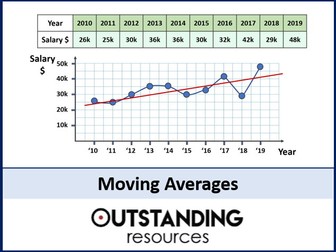
This is a whole lesson on Moving Averages with supplementary resources. This is a great lesson for understanding averages more as well as time series graphs. It looks at how to calculate a moving average and why. The lesson also looks at some interesting real life data. This lesson is ready to go, with no prep required. It is also great for home learning. 22 slide presentation + resources.
The lesson includes:
+ a starter (on finding the median)
+ Matching activity (to practise finding the median if needed!)
+ learning objectives (differentiated)
+ keywords
+ key questions
+ some very clear teaching slides
+ excellent Examples
+ Real life Data (excel file)
+ Worksheet (with answers)
+ plenary
ALL LESSONS on Statistics in one BIG Bundle:
Statistics: All Lessons + All Resources
ALSO:
+ Please provide a RATING with written feedback
+ Please email outstandingresourceshelp@gmail.com if there are any issues and we will respond within 24 hours
+ Lessons are flat-packed (limited editing) for copyright purposes
Thank you in advance for your support, purchase and feedback
#mathslessons #maths #secondarymaths #mathscenters #teachingideas #algebra #teacherslife #teachingkids #teachingmaths #mathsactivities #homeschooling #tesresources #teaching #mathsisfun #teachershare #teachertips #teachers #KS3 #KS4 #KS5 #igcse #learning #gcsemaths
Support your pupils across key data handling, statistics and probability skills with this colourful and comprehensive P7 Maths Anchor Chart Bundle.
This bundle brings together three complete 8-step teaching packs, giving you 24 printable anchor charts covering data handling, mean/median/mode/range and probability. Each poster breaks learning into manageable steps using clear explanations, visual examples, worked calculations, key vocabulary and practice opportunities.
Perfect for introducing new concepts, building a maths working wall, revising previously taught skills or providing pupils with an accessible reference throughout the year.
This bundle includes:
Data Handling – 8 Anchor Charts
Collecting Data – surveys, questionnaires, tally marks, observation and measuring
Tables & Tally Charts – organising information and creating frequency tables
Bar Graphs – constructing and interpreting bar graphs
Line Graphs – plotting data and recognising change - over time
Pie Charts – understanding sectors and links with fractions, decimals and percentages
Reading & Interpreting Graphs – finding totals, differences, highest and lowest values and trends
Choosing the Best Graph – deciding when to use tables, bar graphs, line graphs and pie charts
Data Problem Solving – applying data-handling skills to reasoning and real-life problems
Mean, Median, Mode & Range – 8 Anchor Charts
Meet the Four Measures – introducing mean, median, mode and range
Finding the Mean – add the values and divide by how many values there are
Finding the Median – finding the middle value, including odd and even data sets
Finding the Mode – identifying the most frequent value, multiple modes and no mode
Finding the Range – calculating the difference between the highest and lowest values
Comparing the Measures – understanding what each measure tells us
Choosing the Best Average – considering outliers and selecting an appropriate average
Problem Solving & Mixed Practice – applying all four measures in context
Probability – 8 Anchor Charts
What is Probability? – introducing chance and the probability scale from 0 to 1
Describing Likelihood – impossible, unlikely, even chance, likely and certain
Finding the Probability of a Simple Event – favourable outcomes and total possible outcomes
Experimental Probability – carrying out trials and using results to estimate probability
Theoretical vs Experimental Probability – comparing expected and observed results
Tables & Tree Diagrams – systematically listing possible outcomes
Fair or Unfair? – exploring equal chances and the fairness of games
Probability Problem Solving – applying probability skills to coins, dice, spinners, counters and real-life situations
Throughout the bundle pupils will find:
Clear, pupil-friendly explanations
Colourful diagrams and visual models
Step-by-step teaching methods
Fully worked examples
Key mathematical vocabulary
Tables, graphs and charts
Real-life contexts
Practice questions and challenges
Reasoning and problem-solving opportunities
Helpful Remember prompts
Perfect for:
Whole-class maths teaching
Classroom and corridor displays
Maths working walls
Lesson introductions
Revision and consolidation
Small-group intervention
Independent learning
Pupil reference folders
Early finisher support
You will receive:
3 printable PDF teaching packs containing 24 anchor charts in total:
8 × Data Handling Anchor Charts
8 × Mean, Median, Mode & Range Anchor Charts
8 × Probability Anchor Charts
Designed for P7 / Upper Primary learners and particularly suited to CfE Second Level, as well as being useful for KS2 classrooms.
A bright, consistent and practical maths resource bundle designed to help pupils move from collecting and representing data to analysing information, working with averages and reasoning about probability.
Please note: These resources are supplied as PDFs and are not editable.
An activity to help students develop their skills in answering extended questions in the RO21 Care Values Exam. This activity develops students understanding and ability to answer an extended question that is based on one that frequently comes up in the RO21 exam in which students are asked to explain how personal hygiene, safety and security measures protect individuals. The activity guides students through understanding what the question is asking them to do, planning key words to use, their planning of the key points they need to include and then using this to answer the question. Also included in the document is a marking sheet that can be used for teacher or peer marking. This includes guidance of how to mark the answer and space for feedback to be given as well as space for the student to respond to this feedback. The sheets could be printed on A4, but I enlarge pages 1 and 2 to print A3 double sided and print the 3rd page for peer marking on A4 to then be stuck in their exercise books.
Included in the files is a PDF copy of the activity with an example already in the planning sheet and another PDF document with no examples included.
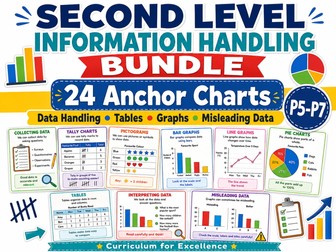
A bright and comprehensive Information Handling Anchor Chart Bundle designed for pupils working within Second Level Curriculum for Excellence.
This bundle includes 24 colourful, child-friendly maths posters covering the key skills pupils need to collect, organise, display, interpret and question data.
The resources progress from introducing data handling and different ways of presenting information, through to interpreting graphs, drawing conclusions and recognising when data may be misleading. They are ideal for creating a complete Information Handling maths working wall or supporting a full classroom topic.
WHAT IS INCLUDED?
DATA HANDLING - 8 ANCHOR CHARTS
What Is Data Handling?
Collecting Data
Tally Charts
Pictograms
Bar Graphs
Carroll Diagrams and Venn Diagrams
Interpreting Data
Data Handling Problem Solving
TABLES, BAR GRAPHS, LINE GRAPHS AND PIE
CHARTS - 8 ANCHOR CHARTS
What Is a Table?
Reading and Making Tables
What Is a Bar Graph?
Reading Bar Graphs
What Is a Line Graph?
Reading Line Graphs
What Is a Pie Chart?
Reading Pie Charts
INTERPRETING AND MISLEADING DATA - 8 ANCHOR CHARTS
Interpreting Data
Answering Questions from Data
Comparing Data and Drawing Conclusions
Interpreting Tables, Bar Graphs and Line Graphs
What Is Misleading Data?
How Graphs Can Mislead
Spotting Misleading Data
Explaining Your Thinking About Data
SKILLS COVERED
Collecting and organising data
Carrying out surveys
Using tally marks
Reading and creating pictograms
Reading and interpreting tables
Reading and interpreting bar graphs
Reading and interpreting line graphs
Reading and interpreting pie charts
Using Carroll diagrams
Using Venn diagrams
Comparing categories and values
Finding totals and differences
Identifying the most and least
Recognising patterns and trends
Drawing conclusions from information
Answering questions using evidence
Choosing appropriate ways to display data
Reading titles, labels, axes, keys and scales
Explaining mathematical thinking
Recognising fair and accurate data displays
Identifying misleading graphs
Spotting unusual or truncated scales
Recognising missing information
Questioning how data has been presented
Solving information handling problems
EACH ANCHOR CHART FEATURES
Bright and engaging primary-friendly design
Clear child-friendly explanations
Key mathematical vocabulary
Worked examples
Colourful diagrams, tables and graphs
Step-by-step strategies
Helpful reminders and top tips
Questions to encourage mathematical thinking
Visual support for independent learning
PERFECT FOR
P5-P7
Second Level Numeracy and Mathematics
Information Handling topics
Data Handling topics
Maths working walls
Classroom displays
Whole-class teaching
Guided maths
Independent pupil reference
Revision and consolidation
Mathematical reasoning
Problem solving
Supporting learners to explain their thinking
The bundle is designed to support progression across an Information Handling topic. Pupils can begin by learning how information is collected and organised before moving on to reading different representations, interpreting results, drawing conclusions and critically evaluating whether information has been presented fairly.
Curriculum: Curriculum for Excellence
Level: Second Level
Subject: Numeracy and Mathematics
Topic: Information Handling / Data Handling
Resources: 3 complete anchor chart packs
Total Anchor Charts: 24
A ready-to-use Information Handling bundle for creating a colourful and consistent maths working wall while giving pupils clear visual support throughout their learning.
This poster provides suggestions for moving to the beat as different Christmas characters whilst playing your favourite Christmas tunes! Develop children's physical confidence, listening skills and co-ordination as you move as a walking elf, creeping tree or jogging snowman! Character "names" match the pace of the step:
- walk-walk-walk-walk like an elf-elf-elf-elf
- creeep-creeep like a treeee-treeee
-jogging-jogging-jogging-jogging like a snowman-snowman-snowman-snowman
As well as physical awareness, this practical application of movement in music helps to develop awareness of phonics and literacy, time and divisions of time, spatial awareness, focus and concentration - and is so enjoyable that it is seen as the Christmas Moving Game - nothing at all like exercise or hard work!
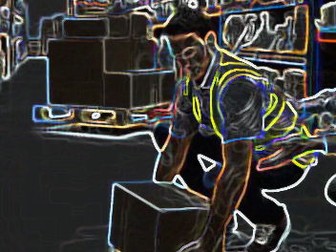
PPT presentation about manual handling methods focused towards engineering activities. There are no additional files as the ones I used are freely available on the HSE website, though there are several single/group work activities that can inspire students to put thought into what they are doing.
Used to teach students in preparation for the City & Guilds level 3 in engineering externally assessed exam, with excellent results in previous years.
Though it has been made with engineering students in mind, the nature of the subject make it ideal for pretty much any subject.
As with all other health and Safety subjects, don't forget to check out the HSE website - that place really has helped me to teach health and safety over the years.
Please feel free to copy, paste and chop down any part of the resource you want.
Moving out can stir up more emotions than we expect — stress, sadness, nostalgia, fear, and even guilt. Leaving behind familiar walls, memories, and people can feel like a quiet heartbreak. It’s not just about packing boxes — it’s about packing a chapter of your life and preparing to start a new one.
If you’ve been feeling emotionally drained or anxious about moving, you’re not alone. Many people experience emotional exhaustion, mood swings, or even tears when preparing to move. This guide explores how to make moving out easier emotionally — with empathy, understanding, and step-by-step strategies that soothe the heart and calm the mind.
You’ll learn how to release emotional attachment to your old home, prepare mentally for change, and find comfort in new beginnings. It’s time to move forward with strength, gratitude, and self-compassion.
Discover how to balance your emotions, reduce moving anxiety, and embrace your next chapter with peace and confidence.
For deeper guidance and emotional tools, explore our transformative ebook,
“Calm Moves: Overcoming Emotional Challenges When Moving House.”
It’s your supportive companion for handling sadness, anxiety, and stress during life’s biggest transition — moving home.
https://stresslessmove.gumroad.com/l/Move-Stress-Free
Moving out on your own is an exciting step — but it can also bring nervousness, anxiety, and panic. The thought of leaving a familiar place, handling everything alone, and stepping into the unknown can create emotional stress that feels overwhelming. Moving anxiety is real, and it’s not just about packing boxes — it’s about facing change, uncertainty, and big life decisions.
This guide gently explores why moving out on your own triggers anxiety and panic, helping you understand your feelings and normalize the process. You’ll learn how to recognize the signs of moving anxiety, manage panic moments, and create a calm mindset before, during, and after your move.
Inside, you’ll find practical advice for easing fears, coping with stress, and preparing emotionally for independent living. From mindfulness techniques to simple step-by-step strategies, this resource empowers you to transform nervousness into confidence.
Moving out doesn’t have to feel terrifying — it can be an empowering milestone. With the right support and mindset, you can turn anxiety into excitement and make your first independent home a joyful experience.
For a complete emotional support system during your move, check out our ebook “Calm Moves: Overcoming Emotional Challenges When Moving House” — your guide to peace, confidence, and calm during relocation.
https://stresslessmove.gumroad.com/l/Move-Stress-Free
This is a SOW for AQA English only for the Moving Image SOW. It is one of the pieces for Unit 3 part B. The students will need to write a piece of descriptive writing with the starting line of 'You can't handle the truth' from a Few Good men.
In addition to basic file handling techniques, students should understand how to import and use the os module - it provides powerful tools for interacting with the file system at a low level. The os module allows students to perform essential file operations such as creating, deleting, renaming, and moving files and directories.
You can easily reuse and adapt our top-quality teaching material to fit your unique teaching style. This activity is suitable for classroom use or for self-study at home, and allows for students to develop their problem-solving skills.
█▀▀ █▀▀ ▄▀█ ▀█▀ █░█ █▀█ █▀▀ █▀
█▀░ ██▄ █▀█ ░█░ █▄█ █▀▄ ██▄ ▄█
Compliant with the AQA/OCR GCSE Computer Science specifications 8525/J277.
This resource contains:
10 challenges provide students with an invaluable opportunity to sharpen their coding skills and problem-solving abilities through using random numbers.
Source code answers allowing for students to self-evaluate their work or explore a different way of solving the problem.
Other useful resources from us:
File Handling - Python Challenges
Random Numbers - Python Challenges
Python Selections Workbook
█▀▀ █▀█ █ █▀▄▀█ █▀ █▀█ █▄░█
█▄▄ █▀▄ █ █░▀░█ ▄█ █▄█ █░▀█
█░█░█ █ ▀█ ▄▀█ █▀█ █▀▄
▀▄▀▄▀ █ █▄ █▀█ █▀▄ █▄▀
Feel free to leave any feedback in the review section below! :)
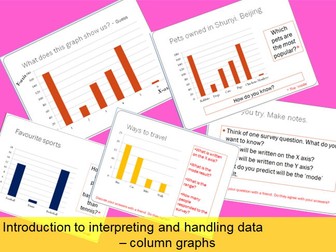
A simple PPT lesson which will introduce interpreting and handling data, specifically with relation to column charts/ bar graphs.
It begins by asking students to guess what a blank graph could represent (interpreting data), before moving on to various graphs with questions designed to introduce the vocabulary related to graphs (axis/axes, mode, range) while also interpreting the data.
There is one slide at the end which asks a number of questions to check understanding of the vocabulary and to interpret the graph, and then a final slide which asks students to create their own survey question and think about what the graph could look like.
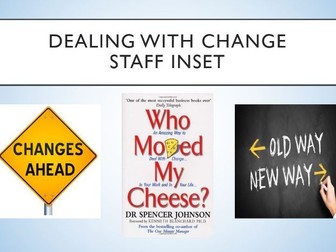
This thought provoking 54 slide assembly support staff when dealing with change in the workplace/school. The presentation tells the story of ‘Who Moved My Cheese’ a best selling book and coping with change. Staff are asked to analyse the characters and find themselves in the story. The presentation then gives simple tips on how to deal with change moving forward. There are a number of opportunities for discussion.
Please also visit my TES Assembly Store where over 100 assemblies are available on a huge range of topics.
LIMITED TIME OFFER
If you purchase this resource and leave a 5-star review, you receive any £3 assembly from my store FREE!!
Leave a review and email Lee_Sullivan@hotmail.co.uk with your review confirmation and choice of assembly.
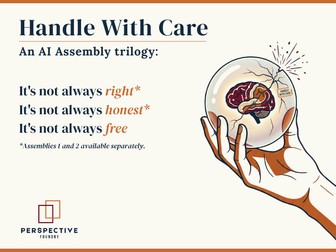
An AI literacy assembly for secondary schools. Students explore what AI and technology actually cost: your data, your attention, and your autonomy. KS3/KS4/KS5.
Handle With Care: It’s Not Always Free is the third assembly in the Handle With Care trilogy, a three-part series designed to help students think critically about artificial intelligence without dismissing it. It works as a complete standalone. Assembly 1, It’s Not Always Right, is available free in my TES shop.
This assembly tackles the idea that free is never quite free. Students look at what they actually hand over when they use AI and technology: their data, their attention, and gradually, their ability to think and decide independently. The assembly moves from the personal to the planetary, taking in data profiling, engineered habits, and the environmental cost of always-on AI services, before landing on a question students can actually do something with.
The assembly uses a commitment-before-reveal mechanic throughout, keeping students actively engaged rather than passively watching. It runs in 15 to 20 minutes and requires no specialist knowledge to deliver.
What’s included:
Editable assembly PowerPoint
Scripted slide notes and comments
Teacher guide including timing tables for 15 and 20 minute versions, tone guidance, and suggested responses to student pushback
Want the full trilogy plus three editable tutor time follow-up activities including The Autonomy Audit, a 20 minute form time activity that extends the learning from this assembly instead? The** Handle With Care bundle **is available here: https://www.tes.com/teaching-resource/resource-13454319
Curriculum links:
Mapped to the PSHE Association Programme of Study (2026) and DfE statutory online safety guidance. Suitable for KS3 and KS4, Years 7 to 11. Works equally well with sixth form students.
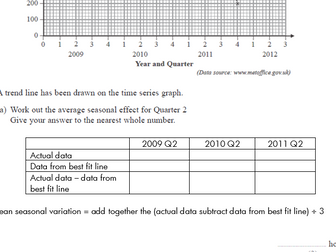
GCSE Statistics:
Three worksheets on:
1) Comparing time series graphs and then plotting.
2) Calculating moving averages and plotting.
3) Calculating the mean seasonal variation.
Peer assessment task on comparing time series graphs (GCSE exam question)
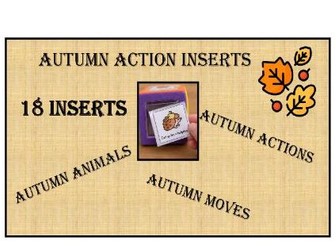
Make autumn learning active, engaging and lots of fun with these colourful Autumn Action Dice Inserts, designed to fit inside foam dice with transparent pockets.
This resource includes 18 bright and engaging inserts across 3 different autumn-themed activities:
Autumn Animals – explore and act out different autumn animals.
Autumn Actions – act out fun autumn-themed actions such as splash in a puddle and shake like a leaf.
Autumn Moves – encourage children to move, stretch, jump, hop and pretend as they explore the autumn theme.
Each insert measures approximately 10cm x 10cm, making them ideal for use in standard foam dice with transparent windows. The inserts can also be enlarged or reduced to suit your particular dice.
The colourful pictures and clear action words make the activities easy for young children to understand and encourage children to get involved, listen carefully and respond physically.
Perfect for:
• EYFS and Reception
• Nursery and preschool
• Autumn-themed provision
• Circle time
• PE and movement sessions
• Gross motor activities
• Listening and attention
• Following instructions
• Outdoor learning
• Brain breaks and active learning
• Tuff tray and continuous provision
Simply print, cut and pop the inserts into the transparent pockets of your foam dice – then roll the dice and let the autumn fun begin!
A fun, low-prep resource for getting young children moving, talking, listening and learning through play.
What’s included?
✔ 18 printable autumn-themed dice inserts
✔ 3 different activities
✔ Bright, child-friendly illustrations
✔ Clear action words and prompts
✔ Approximately 10cm x 10cm
✔ Can be resized to fit different foam dice
✔ Easy to print and use
#EYFS #EarlyYears #EarlyYearsResources #EYFSResources #EYFSActivities #AutumnActivities #AutumnEYFS #AutumnResources #NurseryActivities #ReceptionActivities #PreschoolActivities #GrossMotorActivities #PhysicalDevelopment #MovementActivities #ActiveLearning #ContinuousProvision #CircleTime #ListeningAndAttention #EarlyYearsPE #AutumnProvision
 Quick View

 Quick View
 Quick View
 Quick View
 Quick View
 Quick View
 Quick View
 Quick View
 Quick View
 Quick View
 Quick View