Les instruments de musique | Musical instruments in French | Musical instrumentsQuick View
MmeOakley

Les instruments de musique | Musical instruments in French | Musical instruments

(0)
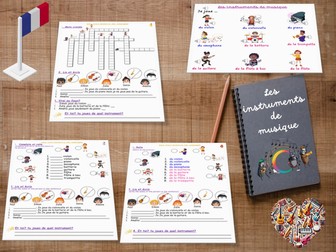
Differentiated worksheet on musical instruments in French. Includes the verb (je joue) and articles (du / de la). 3 different ability worksheets : higher ability, main ability and lower ability. Also contains a powerpoint presentation of the instruments, including AUDIO CLIPS FROM A NATIVE FRENCH SPEAKER to hear the pronunciation of each instrument. All on powerpoint therefore editable if you wish. Copyright © 2024 by Madame Oakley You MAY: • Use free and purchased items for your own classroom, students or personal use. You MAY NOT: • Claim this work as your own. • Sell the files or combine them into another unit for sale / free. • Post this document for sale / free elsewhere on the internet. • Share electronic versions or hard copies of these resources with others. Pictures designed by Freepik
Musical Instruments Worksheet CollectionQuick View
EMSchooley

Musical Instruments Worksheet Collection

7 Resources
A collection of worksheets based around the names of different musical instruments. A range of activities and skills included in the worksheets including: Wordsearch Times table problems Unscrambling words Solving riddles Matching activity Identifying instruments by their image Acrostic poems This worksheet collection could serve multiple lessons on musical instruments. Individual worksheets would work well as starter or plenary activities to either summarise learning, or remind students of what they learned previously, but they could also be used as consolidation activities within lessons after teaching. The worksheet collection could also be used as an independent / paired activity where children could receive all the sheets in a booklet and work through them at their own pace. Answers provided on separate sheets for all activities where appropriate.
OCR As Level MUSIC - Instrumental Music (Haydn, Mozart)Quick View
rhianjenkins1966

OCR As Level MUSIC - Instrumental Music (Haydn, Mozart)

(0)
A resource, originally written for a different exam board, but adapted for OCR. It covers rhythm and pitch dictation practice, as well as general theory practice (keys/chords/harmony/tonality/texture etc), all areas covered in the OCR syllabus. There are 2 questions on vocal music, and although this is not in the OCR syllabus, the questions still provide invaluable practice. The screenshots give a good idea of content. As always, please email misscreativecurriculum@gmail.com with any problems or questions.
Music Cover Work: Musical TheatreQuick View
megrose99

Music Cover Work: Musical Theatre

(0)
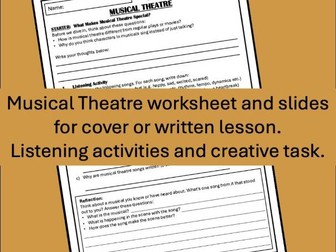
Double sided worksheet and teacher slides for a music cover lesson on musical theatre. Suitable for both Key Stage 3 and Key Stage 4. The lesson includes six short activities: a starter, listening task, composition task (without instruments), a song type question, reading activity and reflection. The lesson has been designed to be delivered without instruments or computers and students may need additional paper for the creative composition task. Prior teaching on the elements of music is recommended. This is the perfect music lesson for a written music lesson or cover lesson with a non-specialist. Please note: This resource includes both printable materials and audio files (MP3 format). Enjoyed this resource? Your feedback helps to improve and create new materials. Thank you for taking the time to leave a review! Discover more cover work topics at: https://www.tes.com/teaching-resources/shop/megrose99
Music Cover Work: Film MusicQuick View
megrose99

Music Cover Work: Film Music

(0)
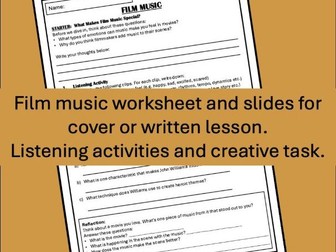
Double sided worksheet and teacher slides for a music cover lesson on film music. Suitable for both Key Stage 3 and Key Stage 4. The lesson includes six short activities: a starter, listening task, composition task (without instruments), a film technique question, reading activity and reflection. The lesson has been designed to be delivered without instruments or computers, though the lesson is easily adaptable to include a practical element should you wish. Prior teaching on the elements of music is recommended. This is the perfect music lesson for a written music lesson or cover lesson with a non-specialist. Please note: This resource includes both printable materials and audio files (MP3 format). Enjoyed this resource? Your feedback helps to improve and create new materials. Thank you for taking the time to leave a review! Discover more cover work topics at: https://www.tes.com/teaching-resources/shop/megrose99
GCSE Music – Revision – Sonority (Instrument Recognition)Quick View
NPTJ

GCSE Music – Revision – Sonority (Instrument Recognition)

(2)
Sonority – Instrument Recognition Questions The GCSE Music Specification includes many terms that students need to know, and be able to identify, but which aren’t covered by many of the styles of music studied. Using only music from Popular Music, this revision resource brings together every instrument, voice and ensemble (apart from “basso continuo”, for obvious reasons!) from the sub-menu “Sonority”, ie instruments, voices, and ensembles. In order to be accessible to students who really struggle with such things, there are 50 simple, 1-mark questions, which ask students to identify an instrument, voice type, or ensemble. In addition, there is also a bonus question alongside every simple question, for students who find such things easier – so 100 questions in total! So that the first group of students don’t feel like they’re underachieving, there are two different PDFs: one with just the 50 simple questions, and one with the bonus questions as well, so teachers can choose which to give their students. The questions are in ten sections: Strings Woodwind Brass Percussion Keyboards Rock and Pop Indian Voices Miscellaneous Ensembles The resource comes with a link to FREE audio, running for 1h15’, either as one file or ten separate files: perfect for a revision lesson, or as homework. The extracts cover a wide range of Popular Music, and features music by the likes of Eva Cassidy, Led Zeppelin, Björk, Yes, Primus, Tanita Tikaram, The Meters, Minnie Riperton, Tom Waits, Genesis, Jamiroquai, Badly Drawn Boy, Freak Power, Blood, Sweat & Tears, and The Cure! The bundle includes the full paper and mark scheme, plus two PDFs of questions (50, or 100), and mark scheme separately, in case you want to set it remotely. Please have a look at my shop for a wide variety of resources to support the GCSE Music course. www.tes.com/teaching-resources/shop/NPTJ
Africa by Toto (Eduqas) - Lesson 2 - Instrumentation & RhythmQuick View
NPTJ

Africa by Toto (Eduqas) - Lesson 2 - Instrumentation & Rhythm

(0)
EDUQAS GCSE MUSIC - AFRICA BY TOTO LESSON 2 - INSTRUMENTATION AND RHYTHM 34-page PPT and accompanying PDF workbook. Second in a series of six lessons designed to cover every aspect of the set work, Africa by Toto. Lesson 2 focusses on Instrumentation and Rhythm, looking at the usual, and more unusual instruments used in the song, such as recorder, marimba and gong. Clear examples and videos of each are given. The numerous rhythms features are presented clearly, with practical exercises to help students understand cross-rhythms and syncopation. There is a 10-mark exam-style question at the end, to consolidate the learning. Please see my TES shop for other resources designed to support the Eduqas GCSE course.
Jingle Bells for classroom instrumentsQuick View
rhymeswithcurrant

Jingle Bells for classroom instruments

(0)
These are for classroom instruments in C: recorders, tuned percussion, boomwhackers, ukulele etc. There are black and white parts and ones with coloured notes. There are three different parts to accommodate different playing abilities. You can play along with my YouTube arrangement or use the parts independently to come up with your own version!
FRENCH - SPORTS, GAMES & MUSICAL INSTRUMENTS - WORKSHEETSQuick View
labellaroma

FRENCH - SPORTS, GAMES & MUSICAL INSTRUMENTS - WORKSHEETS

(0)
A labeling activity to practice learning vocabulary for numerous sports, games and musical instruments in French. Followed by an activity of how to say that you play a particular, sport, game or musical instrument. Introduces the expressions: Jouer à and Jouer de. There is also a writing activity using the third person singular saying what each child plays and what they don’t play. A follow on activity introduces time expressions which includes answers. The last activity is a reading and answering questions in English. Answers are included. There are 7 files in total. If you consider this worth buying, ‘Un très grand merci.’ Feedback and comments are much appreciated. AS TES CONTINUE TO HAVE PROBLEMS WITH WORD DOCUMENT PREVIEWS I HAVE INCLUDED SCREEN PRINTS FOR YOU TO SEE HOW THE WORKSHEETS WILL LOOK. I HAVE DOWNLOADED THIS RESOURCE AND THERE IS NOT A PROBLEM WITH IT.
Music Cover WorkQuick View
tgriches

Music Cover Work

(1)
Independent cover work for KS3 Music lessons. Covering 37 different topics, each on an individual worksheet with a text and then 8 related questions with 1 extended answer question. Ideal for students to complete silently in a cover lesson or in isolation etc Band Skills Banjo BB King Beat Boxing Blues Coding Djembe Drum and Base Drums EDM Effects Grime Guitar Hans Zimmer Harpsichord Instruments of the orchestra John Williams Keyboards Major and Minor Musical Theatre Percussion Pop music Film music Rap artists Rap Peter Tosch Reggae Salsa Saxophone Sequencing Singing Steel Pans TAB Ukulele Vocal Techniques Chords Yodelling
Instruments of the Orchestra PowerPointsQuick View
keirfarrier

Instruments of the Orchestra PowerPoints

(0)
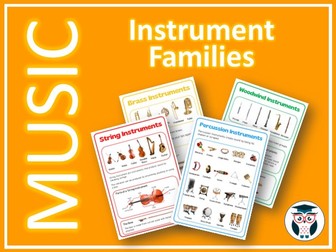
This resource only includes detailed PowerPoints. This is a six lesson scheme of work to teach students about the different instruments in an orchestra. It is targeted at KS2 or lower stage KS3. The aims of the scheme are: To study the four families of the orchestra. To recognise different instrumental timbres. To perform a piece of classical music on the keyboard. To complete an end of topic written appraisal assessment. Additional resources including an assessment worksheet, a scheme of work overview and homework can be purchased separately. This resource includes opportunity for the teacher and can easily be adapted for differentiation. Music is an integral part to the whole curriculum.
African Music 2 - InstrumentsQuick View
chrisgill_1

African Music 2 - Instruments

(0)
Lesson 2 of African Music KS3 scheme of work (or standalone lesson) N.B. This is designed as a modular scheme of work with self-contained lessons linked by recurring themes. It works well in a short half of term and/or one interrupted by trips, exams, etc. Lessons 3 and 4 work best when taught consecutively. Objectives • Performing: to sing traditional African songs and to play African percussion • Composing: to create a layered, syncopated rhythmic ostinato within a group performance • Listening: to learn about, and to recognise, African musical styles and instruments Lesson overview • Lesson 1: Wimmoweh • Lesson 2: African instruments • Lesson 3: African rhythms • Lesson 4: Group composition • Lesson 5: Singing African Songs • Lesson 6: Listening to African Music • Research assignment (cover lesson/homework – no listening required) Vocabulary • African instruments: o CABASA large gourd with a handle covered with a network of stringed beads o KORA a harp with 21 strings, resounding in half a large gourd, covered with skin o TALKING DRUM A drum with two heads which are kept taut by strings o MARIMBA A set of wooden bars arranged in a row over a set of resonating gourds o DJEMBE A large single-headed drum o THUMB-PIANO A wooden board with thin metal strips attached to it • Polyrhythm and cross rhythm • Call-and-response • Ostinato • Layering • A capella • Close and parallel harmony Assessment • Performing: singing an African song (Lesson 5) • Composing: creating a rhythmic ostinato as part of a group composition/performance (Lessons 3 and 4) • Listening: ‘Listening to African Music’ (Lesson 6)
Musical instrumentsQuick View
kdaniels1990

Musical instruments

(0)
French lesson on musical instruments (Unit 6, Expo 1). Includes School of rock video, vocab, mini WB activity and writing activity.
Musical InstrumentsQuick View
ELT-materialz

Musical Instruments

(0)
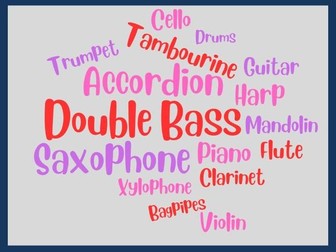
A complete ESL lesson plan and set of resources to teach the names of musical instruments and a range of related lexical phrases at CEFR level B1. Also useful for ESOL and EAL classes. Vocabulary: Cello Drums Trumpet Tambourine Guitar Accordion Harp Double Bass Mandolin Saxophone Piano Flute Xylophone Clarinet Bagpipes Violin a[n] [woodwind, percussion, string, keyboard, electronic] instrument It [sounds] [looks] like … It’s similar to … Resources: Powerpoint presentation [+ musical audio excerpts] A vocabulary worksheet A complete lesson plan
Musical Instruments Sorting CardsQuick View
lbrowne

Musical Instruments Sorting Cards

(0)
Cut and laminate these cards for sorting games and making sets. Instruments can be sorted into: brass woodwind percussion keyboard string There are 24 instrument cards and 5 word cards.
Musical instrumentsQuick View
HamiltonTrust

Musical instruments

(3)
Listen to a variety of musical instruments and investigate how they make sounds in more detail. Explain how to change the pitch and loudness of instruments made in session E and then try out each other’s instruments. Discuss what children have learnt during Strand. Suitable for Y5 pupils.
Musical instrumentsQuick View
saz0885

Musical instruments

(1)
Some information on Ancient Greek musical instruments and then questions for children to evaluate their own instruments.
Jouer + Musical instrumentsQuick View
shropshire14

Jouer + Musical instruments

(10)
PowerPoint to introduce Je joue + musical instruments. Mini cards at the end were printed off and used for playing charades. Main slides can also be used as flashcards.