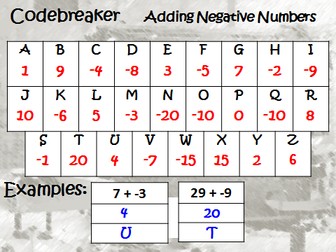
Differentiated Codebreaker
Two different sets of questions using the same keycode.
Worksheets prepared with and without keycode to allow for use in classroom or for homework.
Includes;
a) PPT with keycode and all answers
b) Worksheets with
Tasks and keycode
Just tasks to use with PPT keycode
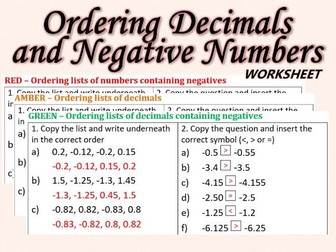
Differentiated worksheet ordering decimals and negative numbers with answers.
Red - Ordering lists of numbers containing negatives
Amber - Ordering lists of decimals
Green - Ordering lists of decimals containing negatives
A selection of resources about negative numbers for KS3
The zip file contains:
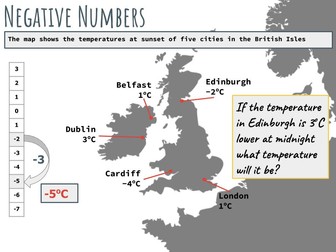
A PowerPoint (pptx) presentation introducing negative numbers using some temperatures on a map of the British Isles.
A worksheet (pdf) that has another map of the British Isles and students are asked to create their own worded questions involving negative numbers.
A worksheet(pdf) used as a starter with a variety of scales that students fill in missing numbers for.
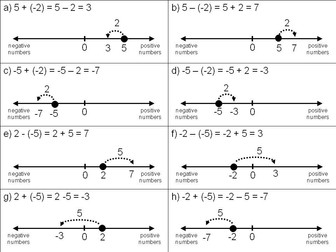
A worksheet(pdf/docx) on adding and subtracting negative numbers with answers.
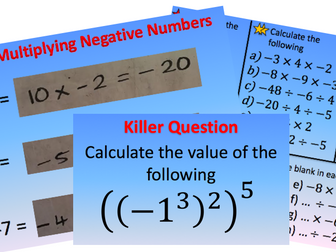
A worksheet(pdf/docx) on multiplying and dividing negative numbers with answers.
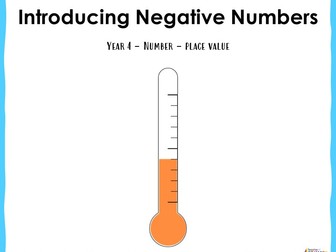
Introducing Negative Numbers - Year 4
In ‘Introducing Negative Numbers - Year 4’ pupils practise counting through zero to include negative numbers. This teaching resource covers the year 4 curriculum objective in the maths programme of study and supports the White Rose small steps guidance for year 4 - Autumn - Block 1 - Place Value.
Content includes:
A negative numbers explanation
Activities to support the teaching of this small step with 2 accompanying worksheets
3 further differentiated worksheets with answers
‘Introducing Negative Numbers - Year 4’ is editable allowing teachers to adapt the resource to meet the needs of each class they teach.
Not quite what you’re looking for? Click below to see more Year 4 White Rose place value resources:
Rounding to the Nearest 10 - Year 4
Rounding to the Nearest 100 - Year 4
Counting in 1000s - Year 4
1000s, 100s, 10s and 1s - Year 4
Partitioning - Year 4
Number Line to 10,000 - Year 4
1,000 More or Less - Year 4
Comparing 4-Digit Numbers - Year 4
Rounding to the Nearest 1,000 - Year 4
Counting in 25s - Year 4
Ordering 4-Digit Numbers - Year 4
Roman Numerals to 100 - Year 4
Year 4 Place Value Bundle
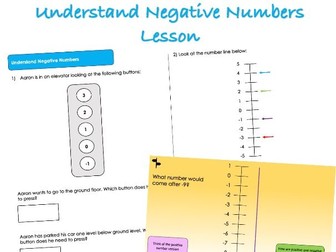
This stimulating and comprehensive enables students to count forwards and backwards through zero using negative numbers, and to solve number problems and practical problems involving negative numbers, including using negative numbers in context.
The lesson follows a step-by-step learning journey, in which children learn through:
Defining, exemplifying, and understanding the basic rules of calculations involving negative numbers, through clear and simple explanations;
Demonstrating their understanding through well-differentiated application and challenge activities;
Applying their understanding to real-life problems, for example temperatures, budgets and balances;
Gauging their own understanding through both AfL activities and self-reflection tasks.
Included is:
Whole lesson PowerPoint - clear and precise, colourful and comprehensive;
Bronze, Silver, and Gold level award worksheets - carefully differentiated and provided in both Word and PDF;
Teacher answer sheets;
A detailed teacher lesson plan;
A number line;
I have previously taught this to children in years 5 and 6, although with suitable adaptations it could be used for children between years 3-9.
All images are licensed for commercial use, and image rights are listed on the last page of the presentation.
As the title suggests, this is a colouring sheet for practising adding, subtracting, multiplying and dividing with negative numbers. Unlike other maths colouring sheets, each sheet only requires four different colours and therefore requires fewer teacher supplies. Students answer the questions and colour based on their solution. This then creates a pattern which looks great on a classroom wall. The solution is the pattern displayed.
All feedback gratefully accepted.
This is an introductory lesson to integers less than zero, which leads on to rudimentary calculations and subtracting negative numbers. This often spreads over two lessons, I find, after a discussion on whether negative numbers actually exist and some number line activity in the classroom, showing students that subtracting negative numbers is akin to facing 'the negative direction&', but then having to walk backwards.
This is the second whole lesson looking at Negative Numbers using the four different operations (add, subtract, multiply and divide) and lots of different real-life contexts and negative problems. This lesson is ready to go, with no prep required. It is also great for home learning. 15 slide presentation + resources.
The lesson includes:
+ starter (reviewing the rules – AFL opportunity)
+ learning objectives (differentiated)
+ keywords (so important for pupils who are EAL)
+ Video link (brain teaser to support remembering the rules)
+ Excellent teaching slides
+ MWB Activities to assess understanding
+ Lots of examples
+ 2 handout for supporting students and for notes
+ Worksheet (with answers)
+ Matching Activity (with answers)
+ Plenary (answer for video link)
+ Exam Questions (often used for homework)
ALL LESSONS on Number in one MEGA BIG Bundle:
Number: All Lessons
For any issues, please email outstandingresourceshelp@gmail.com
and we will aim to respond within 48 hours.
Lessons are flat-packed (with limited editing) to maintain copyright protection.
We would greatly appreciate it if you could leave a rating and feedback.
Thank you for your support, your purchase, and for taking the time to provide feedback!
#mathslessons #maths #secondarymaths #mathscentres #teachingideas #algebra #teacherslife #teachingkids #teachingmaths #mathsactivities #homeschooling #tesresources #teaching #mathsisfun #teachershare #teachertips #teachers #KS3 #KS4 #KS5 #igcse #learning #gcsemaths
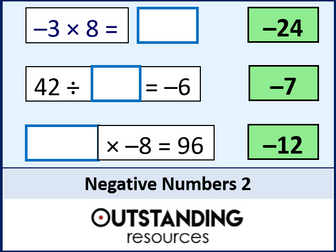
Series of Lessons (1-2) on multiplying and dividing negative numbers. This lesson gives pupils enough opportunity to master the fluency, however gives them the chance to use an apply these numbers in varying contexts.
All tasks include reasoning, problem solving aswell as mastering the fluency of the topic. All tasks include full solutions and worked examples so that pupils can self and peer mark. All tasks are fully differentiated to either 2/3/4 levels.
A fully resourced negative numbers lesson for being able to begin to understand negative numbers, including what they are and how they are different to positive numbers (including real life contexts and understanding them through vertical number lines) in Year 5 based on the objective from White Rose Maths.
Included in the resource is:
A lesson PowerPoint with starter, vocabulary, modelling (with teacher notes) and guided practice
Lesson plan
Worksheet with answer sheet
Scaffolded worksheet with answer sheet
Modified worksheet for those who need additional changes to access the learning with answers
Challenge tasks
Support strips that can be stuck in books
Everything is included that could be needed to run the lesson successfully, with each resource carefully considered in ensuring accessibility for all as well as ensuring there are plenty of opportunities for challenge to provide depth of understanding.
A worksheet to practice all four operations with negative numbers, including questions with two signs such as
- 6 + - 7 and 9 - - 9 along with multiplying and dividing.
If students work across the page, similar questions are grouped together.
Good practice sheet containing 64 individual sums
Maths differentiated negative number and temperature worksheets.
2 sheets for lower and higher ability with appropriate scaffolds and visuals to support.
A series of worksheets revising negative numbers.
- addition and subtraction
- subtracting negative numbers
- multiplying and dividing
- all operations, with fractions and decimals
Full solutions provided.
Suitable for both Key stage 3 and 4. This worksheet is designed to help pupils revise worded GCSE questions on negative numbers. Can be used as classwork, homework or cover work. Perfect to either print off or project onto the board.
Answers included which can be directly projected onto the board to allow pupils to self-assess their answers.
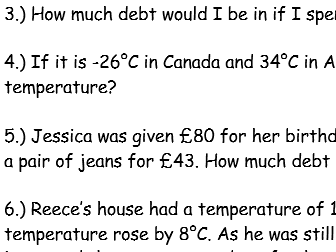
This resource is three activity sheets/worksheets bundled together to reinforce children's understanding of negative numbers in a word problem setting.
-One sheet for the Lower Ability
-One sheet for the Middle Ability
-One sheet for Higher Ability
Answer sheets included.
Suitable for both Key stage 3 and 4. This worksheet is designed to help pupils revise adding and subtracting negative numbers. The challenge allows pupils to apply their knowledge on negative numbers on a GCSE style exam question. The worksheet is fully differentiated (mild, medium spicy, hot and challenge) allowing pupils to work at different levels simultaneously. The worksheet also features a section for pupils to self-assess their understanding and set a target for next lesson.
Answers included which can be directly projected onto the smart board to allow pupils to self-assess their answers.
A negative numbers worksheet covering adding, subtraction, multiplying, dividing and worded problems.
The worded problems are differentiated, I print out either the Level 1, 2 or 3 questions depending on the class. They are roughly the same questions, but with different numbers in.
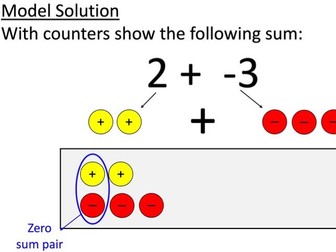
Animated examples modelling how to add and subtract negative numbers using double sided counters. I used this to introduce the topic to a mixed ability year 7 class.
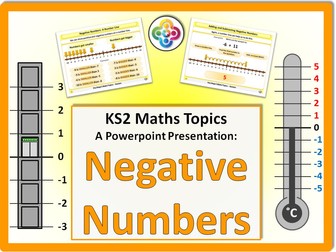
A bright and stimulating Powerpoint to explain Negative Numbers. This powerpoint has 12 slides (Plus one title and one end slide). Designed for KS2.
The topics in the powerpoint are:
Negative Numbers
Negative Numbers: A Number Line
Putting Negative Numbers in the Correct Order
Adding and Subtracting Negative Numbers
Both the original powerpoint, and the new one (with new title and end slides) are included.
A complete lesson designed to be used to consolidate pupils’ ability to add and subtract a negative number.
Activities included:
Starter:
Some straight forward questions to test if they can remember the basic methods and help identify misconceptions.
Main:
A set of differentiated questions to give pupils a bit more practice.
A game adapted from the nrich website.
A closer look at the design of the game, with pupils making a sample space diagram.
Plenary:
Some final questions to prompt discussion and reflection on how to remember the rules used.
Printable worksheets and answers included.
Please review if you use this!


 Quick View