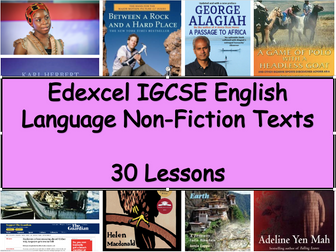
This bundle consists of 30 thoroughly planned lessons that take students through every non-fiction text in the Edexcel IGCSE English Anthology. Lessons incorporate Paper 1-style question practice, guided analysis of each text, and some transactional writing practice (article writing and persuasive writing).
List of non-fiction texts covered:
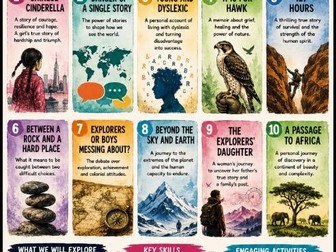
‘The Danger of a Single Story’
‘A Passage to Africa’
‘The Explorer’s Daughter’
‘Explorers or boys messing about? Either way, taxpayer gets rescue bill’
‘Between a Rock and a Hard Place’
‘Young and Dyslexic? You’ve got it going on’
‘A Game of Polo with a Headless Goat’
‘Beyond the Sky and the Earth: A Journey into Bhutan’
‘H is for Hawk’
‘Chinese Cinderella’
2 fully-editable non-fiction resources:
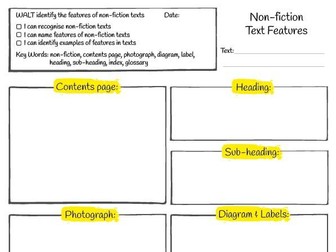
A poster highlighting some features of a non fiction text.
Features of a non-fiction text matching activity - match the correct word with its correct definition.
Answers provided
Ideal for 7 - 11 years.
Fully editable.
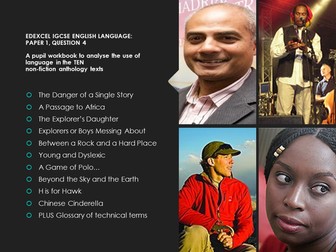
This 100 page Word document resource is aimed at pupils following Edexcel International GCSE English Language specification A. It focuses on preparation for question 4 of the Paper 1 examination on the ten non-fiction Anthology texts: The Danger of a Single Story; A Passage to Africa; The Explorer’s Daughter; Explorers or Boys Messing About; Between a Rock and a Hard Place; Young and Dyslexic; A Game of Polo with a Headless Goat; Beyond the Sky and the Earth: A Journey into Bhutan; H is for Hawk; Chinese Cinderella.
FOR A DETAILED PREVIEW, SEE THE FREE RESOURCE ‘THE DANGER OF A SINGLE STORY: WORKBOOK WITH ANSWERS’ WHICH IS THE FIRST CHAPTER OF THIS BOOKLET
The booklet can be used as a basis for teacher-led lessons, as a revision pack, or as self-study materials for pupils who have missed the teaching of the Anthology due to absence or starting courses late.
The study of each anthology text is divided into the following sections:
Background and context: Brief details about the writer and the topic of the extract
Summary of the text: Summary of the main issues covered in the extract
Get started: Pre-reading activity to lead pupils into the text
Read the text: Instruction to read the whole text in the Anthology before starting the activities
Key vocabulary: List of vocabulary to aid understanding of the text
Analyse the language and structure of the text: Questions and activities to encourage analysis
Consolidate your understanding: Activity to highlight key points about language or structure
Answer a practice examination question: An exam-style question 4 with ten sentence starters
Detailed suggested answers are given for sections 1-7 plus a simplified mark scheme for pupils to self-assess their Section 8 practice essays if working independently.
A glossary of ‘Language Features: Technical Terms’ is included at the end of the booklet and words in the booklet marked * are explained in this list with examples from the Anthology extracts.
The non-fiction extracts are NOT included in this booklet. Pupils should have their own copies of the EdExcel IGCSE English Anthology which is issued by the examination board.
Ks3 worksheet focusing on non-fiction text types. Can be used as homework or classwork. Editable and can be used for Year 7 - Year 9 as well as lower ability Ks4 students
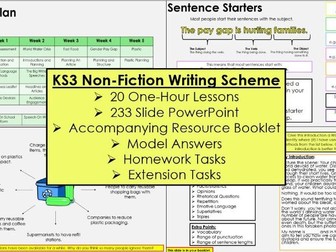
KS3 Non-Fiction Writing Scheme of Work
This PowerPoint contains twenty one-hour lessons (233 slides) that focus on nonfiction writing skills, and is aimed at Key Stage Three.
There are a wide range of tasks (lessons listed below) that focus on building the key skills of nonfiction writing: planning, language and structure methods, accurate punctuation, vocabulary and proofreading. There are practice questions, original non-fiction model responses, extension tasks, punctuation activities, and a whole bunch more! I have also included a second PowerPoint that can be printed as a resource booklet for students. This will save you time in printing and slicing (and will also save you a fortune on glue sticks!).
Additionally, there are weekly homework tasks. And three printable sheets that can be used as KS3 nonfiction cover work if you are in a pinch.
The premise is that students would gather information about a particular non- fiction topic by watching a documentary. They would then learn about the form of the text and plan their responses thoroughly. They would then learn a new skill and use this to complete some extended writing, before proofreading and editing their work. As a result, for some texts, they will be planning and writing over multiple lessons to really give them the chance to develop and hone their non-fiction writing skills.
Please Note: The longer documentaries are available on Netflix; however, I have also provided alternatives on YouTube for teachers that do not have access to a Netflix account.
Areas covered:
Lesson 1: Baseline assessment on tackling climate change
Lesson 2: Editing letters on education
Lesson 3: Exciting introductions on filters
Lesson 4: Writing leaflets on homelessness
Lesson 5: Watching the world water crisis documentary
Lesson 6: Planning, introductions and speech features
Lesson 7: Writing a speech on the world water crisis
Lesson 8: Headlines and newspaper features
Lesson 9: Watching the fast food documentary
Lesson 10: Discourse markers and planning articles
Lesson 11: Writing an article on fast food
Lesson 12: Midterm assessment on fast fashion
Lesson 13: Watching the gender pay gap documentary
Lesson 14: Structural features and letter planning
Lesson 15: Writing a letter on the gender pay gap
Lesson 16: Midterm assessment feedback
Lesson 17: Watching the plastics documentary
Lesson 18: Persuasive methods and planning texts
Lesson 19: Writing the KS3 non-fiction writing end of unit assessment
Lesson 20: Writing leaflets on our planet
Extra: Three cover lessons
Both the scheme and the resource booklet and provided in PPT and PDF formats.
My GCSE Paper Two: Section B scheme of work can be found here:
https://www.tes.com/teaching-resource/resource-11873033
Please check out my other resources.
Any feedback would be greatly appreciated. Thank you!
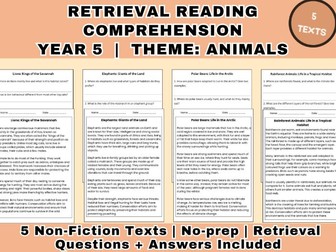
Year 5 retrieval reading comprehension: 5 non-fiction texts, retrieval questions and answer keys. KS2. Cross-curricular science. Print ready!
One pack. Two subjects sorted. This Year 5 retrieval reading comprehension pack features five engaging non-fiction texts on animals, specifically designed to build retrieval skills while hitting Science and Geography curriculum goals.
Stop hunting for separate resources. This no-prep, print-ready pack is perfect for teachers covering animals and habitats who want to maximize their literacy time. Every text is followed by five targeted questions that mirror the KS2 National Curriculum content domain 2b (retrieval).
What is included: (5 texts, 5 question sheets, 5 answer keys):
Text 1 — Lions: Kings of the Savannah. Covers habitat, pride structure, hunting teamwork, and conservation.
Text 2 — Sharks: Masters of the Ocean. Covers cartilage skeletons, sensory abilities, and their role in the ecosystem.
Text 3 — Elephants: Giants of the Land. Covers matriarchal leadership, communication via vibrations, and threats from poaching.
Text 4 — Polar Bears: Life in the Arctic. Covers physical adaptations, sea ice hunting, and the impact of climate change.
Text 5 — Rainforest Animals: Life in a Tropical Habitat. Covers the layers of the rainforest, biodiversity, and the effects of deforestation.
Total: 25 retrieval questions. Each answer key provides precise answers for fast, confident marking.
Question types included:
List and name: Identifying specific features or habitat names.
Comparison: Highlighting differences between species or behaviors.
Explanation: Understanding how biological adaptations or senses work.
Impact and Process: Identifying the results of climate change or how group hunting works.
This pack is the exact tool you need for:
Guided Reading: Targeted Year 5 retrieval practice.
Cross-Curricular Science: Deepen knowledge of habitats and adaptations during literacy.
VIPERS Practice: Focused sessions on the ‘R’ in VIPERS.
SATs Preparation: Early exposure to non-fiction retrieval formats used in Year 6 papers.
Morning Starters/Homework: One self-contained text and question set per session.
Why buy this?
`Engaged children retrieve better. By using high-interest topics like shark senses and lion prides, you remove the barrier of dry text, allowing students to focus entirely on mastering the skill of finding and recording information.
`Also available in this series: Year 5 Retrieval Reading Comprehension — Natural Disasters & Space.
IGCSE Non-Fiction Revision Pack
A focussed guide to mastering non-fiction for IGCSE — includes:
Context: background on author, era & occasion to help situate meaning
Key Quotes: carefully selected quotations with commentary
Themes: central ideas & how they develop across the text
Literary Devices: rhetorical techniques, figurative language, structural features
Style & Form: tone, voice, genre, organization, register
Ideal for revision, exam prep, and in-class review.
Use this to consolidate your understanding, embed quotations, and sharpen your analysis ahead of your exams
KS3 - A lesson where students examine a review of “The Island with Bear Grylls” and answer a question on the language used in the review. A variety of resources including comprehension questions on the text, an annotated model paragraph, a planning table and sentence stems.
Due to copyright the article is not included, but a link to it is in the notes of the first slide. It can also be found online.
This comprehensive scheme of work covers the Edexcel IGCSE English Language Anthology non-fiction texts and has been designed to develop both analytical and examination skills in a structured, engaging way. Lessons are lively and student-focused, incorporating a wide range of activities that encourage discussion, annotation, comparison and critical thinking. Throughout the scheme, students regularly practise exam-style questions in the format of the Edexcel Language paper, building confidence and familiarity with the assessment requirements. Comparative texts are drawn from past examination materials, alongside carefully written original extracts that closely replicate the style and challenge of the exam. Although designed for the Edexcel IGCSE course, the scheme can also be successfully adapted for Key Stage 3 or as a broader non-fiction unit.
These resources have been developed to assist pupils in their analysis of Non-Fiction texts.
It provides a series of questions to help guide pupils through the important aspect of Non-Fiction texts, with several short examples for pupils to practice on.
Also included is a detailed revision sheet to assist pupils in analysing linguistic devices, especially those pupils who find it difficult to discuss the effect of language.
These have been used successfully with GCSE pupils in preparation for their English Language exam, but they can also be used for KS3 English classes.
KS3 - A lesson focusing on Understanding & Reading Non-Fiction Texts using a Non-Fiction article on how insects can help catch Rhino poachers. A variety of activities included, included AQA English Language Question 1.
Due to copyright, the article is not included, but a link to it is in the notes of the first slide. It can also be found online.
After you’ve looked at non-fiction text features, see if your students can identify examples of the text features independently. Grab an appropriate level non-fiction text and get started!
Happy teaching & learning!
Be purposeful teachers
Who are in control
Feel inspired
And knows they’ve done enough.
☆ If you found this product helpful, please leave a review below!
@attheminute.teaching
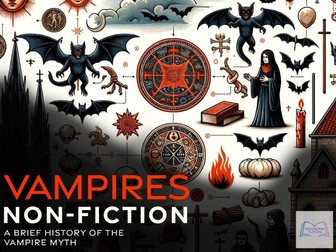
Vampires: Reading Non-fiction. A brief history of the vampire myth.
Can be used as a stand-alone lesson, or incorporated into a wider scheme on the subject of gothic literature.
With a focus on reading and understanding non-fiction, this lesson gives students the opportunity to practise independent or class reading of an engaging text.
Includes:
true or false quiz
comprehension questions based on non-fiction text
Summary activity
Writing imaginatively
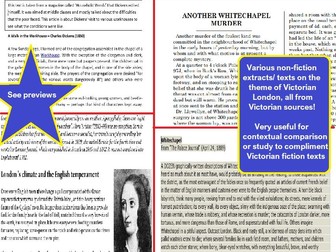
Includes various sources/ texts around the theme of Victorian London. Available in Word and PDF files. Suitable for KS3 or KS4 on the theme of non-fiction, or for contextual knowledge of Victorian times alongside teaching of Victorian texts, such as Christmas Carol or Jekyll and Hyde.
Includes:
A news report from a Victorian newspaper on Jack the Ripper
A description of Whitechapel from the Palace Journal
An extract from Dickens’ ‘Walk in a Workhouse’
An extract from Flors Tristan’s diary about her London travels
This resource focuses on responding to non-fiction texts. Firstly, students will discuss the subject and the article, they will then complete a comprehension section and go on to extended writing and script writing. This worksheet offers differentiation and challenge. It covers at least two hours worth of work on the subject and allows students to respond to non-fiction texts.
GCSE English Language: Reading Non-Fiction Texts
Build the non-fiction reading skills students need for GCSE English Language with this classroom-ready unit. Suitable for AQA, Pearson Edexcel, Eduqas and other courses, it develops students’ ability to retrieve information, make inferences, analyse writers’ methods, evaluate arguments and compare viewpoints.
The resource includes:
- 182-slide editable PowerPoint
- 31-page worksheet booklet
- 10 sequenced lessons
- GCSE-style questions and model responses
- Guided, paired and independent activities
- Peer assessment, revision and exam practice
Students explore audience and purpose; fact, opinion and attitude; summary and synthesis; bias and counterarguments; non-fiction structure; and language and rhetorical techniques. They practise critical evaluation and comparison using clear examples, writing frames and structured tasks before answering questions independently.
Teach the full ten-lesson unit or choose individual lessons for intervention and revision.
Click the images to preview GCSE English Language: Reading Non-Fiction Texts.
Non-fiction Texts (KS4)
Lesson 1-3 The Danger of a Single Story
FREE - Lesson One:
Bundle Sow: https://www.tes.com/teaching-resource/non-fixation-texts-gcse-12942563
FREE Animal Farm SoW: https://www.tes.com/teaching-resource/resource-12942163
Leave a review for a FREE single resource
This SoW is designed in detail and is both differentiated and engaging, and allows you to move pupils through content efficiently.
Made to the highest standard and constructed using current research, both dual coding and retrieval practices are at the heart of this unit. A colour scheme also runs throughout to ease both your delivery and students comprehension.
SoW: Non-fiction Texts (KS4)
Lesson 1-3 The Danger of a Single Story
Lesson 4-6 A Passage to Africa
Lesson 7-9 The Explorer’s Daughter
Lesson 10-13 Explorers or boys messing about
Lesson 14-17 Between a Rock and a Hard Place
Lesson 18-20 Young and Dyslexic - Zephaniah
Lesson 21-22 Game of Polo with a Headless Goat - Levine
Lesson 23-25 Beyond the Sky and Earth - Zeppa
Lesson 26-28 H is for Hawk - Macdonald
Lesson 29-30 Chinese Cinderella - Yen Mah
If you leave a review of any of our resources, you can claim any FREE single resource from our ever growing library. Simply message the above email, which is monitored daily.
teachercentralltd@gmail.com
Best FREE Resources (Teacher Central)
https://www.tes.com/teaching-resource/britain-losing-and-gaining-an-empire-12973075
https://www.tes.com/teaching-resource/financial-literacy-12898983
https://www.tes.com/teaching-resource/romeo-and-juliet-12908635
https://www.tes.com/teaching-resource/shakespeare-12908634
https://www.tes.com/teaching-resource/macbeth-gcse-12863697
https://www.tes.com/teaching-resource/animal-farm-free-sow-12942163 (FREE SoW)
https://www.tes.com/teaching-resource/slavery-sow-12843084 (FREE SoW)
https://www.tes.com/teaching-resource/russia-1917-91-from-lenin-to-yeltsin-12834552
https://www.tes.com/teaching-resources/shop/TeacherCentral?sortBy=lowestPrice&p=5
I hope you find this SoW useful. If you have, I have created a series of resources.
You can check them out here.
https://www.tes.com/teaching-resources/shop/TeacherCentral
This resource explores text which have the purpose to inform, explain, describe and persuade. It provides information on how to write and analyse leaflets and articles. It considers presentation features and language use as well as the purpose of the text and the audience it is intended for.
This PowerPoint explains fully about what non-fiction texts are and what information you need about them for the exam.
Really good for revising non-fiction texts.


 Quick View