Levels of Organization
Included in this resource:
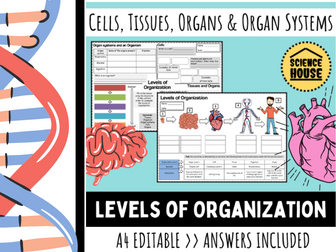
Two summary worksheets outlining the levels of organization (cells, tissues, organs, organ systems and organisms). The worksheets complement learning on this topic by reviewing key features, such as what each level entails, as well as examples of cells, tissues, organs and organ systems and their functions.
The worksheets come both in a color and black and white format. They are set up in A4 PowerPoint, so can be presented in the class as a slide show too, which can support the answering stage. The worksheets are completely editable and full answers are included.
Ideal for:
Introduction
Summary
Revision
Homework
Please note that American English spellings are used in this resource.
Many thanks - Science House.
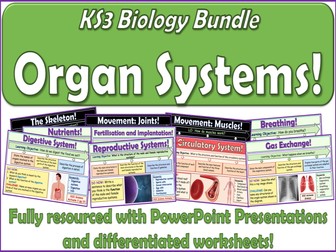
Perfect if you teach KS3 Science, this fully differentiated and resourced topic of 10 lessons supports your students in learning about the digestive system, respiratory system, skeletal system including muscles, reproductive system and circulatory system.
The resource is designed to be taught over ten lessons and composes of the following sequence of lessons (these can be rearranged how you wish):
Lesson 1: The skeleton
Lesson 2: Movement: Joints
Lesson 3: Movement: Muscles
Lesson 4: Nutrients
Lesson 5: Digestive system
Lesson 6: Breathing
Lesson 7: Gas exchange
Lesson 8: Reproductive system
Lesson 9: Fertilisation and implantation (FREE)
Lesson 10: Circulatory system
The resource is suitable for KS3 classes and includes detailed and engaging PowerPoint Presentations with key points, worked examples, differentiated activities, exam style questions, progress check questions/quizzes for students to complete, worksheets with answers included. The resource can also be adapted for GCSE Science classes.
Enjoy and feel free to leave a review. For more resources like this please visit:
https://www.tes.com/teaching-resources/shop/ychebbout
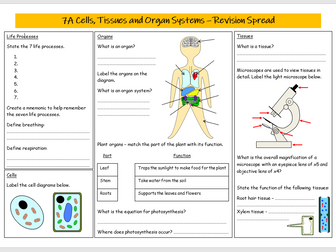
KS3 Science Edexcel Yr7 Revision Spread and Answer Sheet - Biology: Topic 7A Cells, Tissues and Organ Systems.
This A4 revision spread condenses the Edexcel topic 7A onto one A4 sheet which can be printed off and filled in to aid revision and help summarize the topic.
A full answer sheet is provided which can be used to mark the filled in revision spread and can also be used as a revision poster.
UPDATED
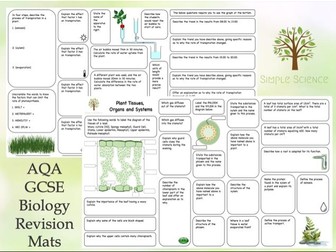
A revision mat for the new AQA Biology specification (foundation). This revision mat includes, diagrams, exam questions (graphs) and lots of different style questions using the AQA specification. Includes answers.
This can also be used as home learning for students if they are requested to isolate for two weeks.
Topics include:
Plant Tissues
Plant Organ System
Students have commented saying that this resource has helped them with their understanding of the new AQA specification and have given them confidence.
Other resources and revision mats can be found in my shop by clicking the following link:
https://www.tes.com/teaching-resources/shop/cal-w11
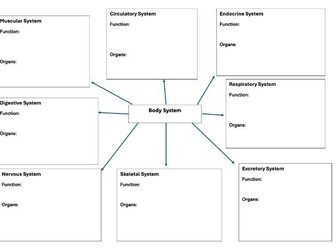
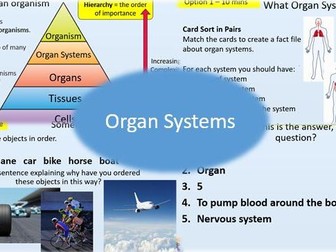
This lesson is a KS3 biology lesson covering the definition of organ systems, examples of organ systems and their functions.
This lesson contains 3 different versions of the main activity for you to use depending on your class disposition and access to computers.
This lesson contains:
Powerpoint (containing relevant video links and answers)
Student worksheet (PDF and Editable)
Student worksheet answers (PDF and Editable)
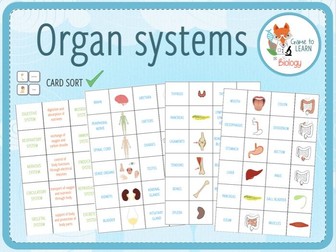
Student Card Sort (Large around the room version and pairs version)
Lesson Objectives:
Define the term “organ system”
Identify some of the key organ systems in the human body and what they do
Describe the hierarchy of organisation in a multicellular organism
Levels of Organisation Lesson
This full lesson includes a lesson PowerPoint with student activities and tasks included within the document. Answers are also included at each stage for student review. This lesson focusses on the relationship between cells, tissues, organs, organ systems and organisms in terms of levels of organisation. Follow up activities include differentiated questions, as well as a plenary true or false quiz.
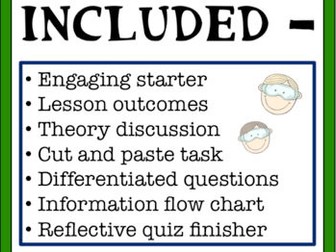
Included in the lesson:
Engaging starter task
Lesson objectives
Task 1: Theory discussion
Task 2: Drawing the levels of oragnisation triangle
Task 3: Differentiated questions
Task 4: Card sort cut and paste
Reflective plenary activity true or false
This lesson is ideal for students who have no prior knowledge on the topic. The lesson introduces new keywords such as ‘organ system’ and ‘organism’ and engages students through linked activities which are fully resourced and come with accompanying answers.
The resource is a Powerpoint presentation with an accompanying PDF copy, so the resource can be edited and there is also a print-ready version for included worksheets.
Please note that this lesson includes American spellings.
Lessons from the 7A unit in the new Exploring Science scheme of work all about cells, tissues, organs and systems.
Including lessons for:
7Aa Life Processes
7Ab Organs
7Ac Tissues
7Ad Cells
7Ae Organ Systems
*Some of the lesson require the use of videos / worksheets from the ActiveTeach but easily be replaced by other videos or available worksheets
*
A lesson looking at some organs and what organ systems they fit into. Follow on lesson from lessons on levels of organization.
Includes info hunt task for organs
AQA Combined Science Trilogy unit ‘Organising Animals and Plants’.
Full lesson ready to use straight ‘out of the box’.
Similar structure to my other power points following the input - activity - review phasing
Plenary section for progress checking
Differentiated worksheets
Clear learning objectives and outcomes
Modern and engaging layout
Little adaptation needed
Covers an hour lesson of content matched to the specification
31 ppt slides
Constructive feedback welcome :D
Worksheet on the different organ systems in the human body. Pupils can complete as a research task individually or as a group.
Adapted from another resource.
NOTE: this resource is also on sale as part of my resource package 'AQA GCSE Additional Science B2.1 - Cells scheme of work' (so if you have that, then you already have this).
A presentation on the nature of cells, tissues, organs and organ systems, designed for KS4 but could also work for KS3. Notes for teachers are included with most of the slides.
Topics include: muscle, epithelial and glandular tissues (as specifically mentioned in the AQA GCSE syllabus); and the digestive system as an example of an organ system.
The presentation includes teacher notes to accompany the slides.
The teaching resource titled “Cells, Tissues, and Organs” is a PPT presentation designed for a year 7 to year 9 science lesson.
The resource covers key concepts such as the hierarchy of biological organization, including cells, tissues, organs, and organ systems.
It explains the functions and interconnections of various organs and organ systems within the human body.
With interactive discussions and activities, this comprehensive resource engages students in understanding the intricacies of multicellular organization, making it an ideal tool for teaching the biology of living organisms.
Worksheets for the digestive system.
*Label the digestive system organs.
Unmarked digestive system diagram for HA or as a discussion/display diagram in your lesson
*A simple question sheet.
*Cut and stick ‘make a model’ of the digestive system.
*-*All sheets come with a lined black and white version for printing -
Image purchased @ Rossys-Jungle
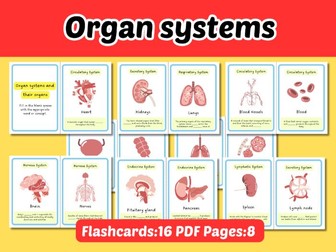
A presentation and worksheet to look at the different organs of the human body and link this to organ systems. A research task by internet of by book on the organ systems
A worksheet that involves pupils defining what tissue, organs and organ systems are. This also involves pupils examining tissue using a microscope. Students will then identify the different organs that make up the digestive system and create a storyboard to show how these organs work together to break down food to absorb nutrients.
Complete No-Prep lesson with exam style questions, tasks and answers on the Digestive System and Principles of Organisation for AQA GCSE (9-1) Science / Biology.
This lesson covers all of AQA GCSE Combined Science / Biology 4.2.1 “principles of organisation” and parts of 4.2.2.1 “the human digestive system”.
In this lesson students learn about cells, tissues, organs and organ systems (4.2.1), and then about the digestive system and its function (which covers parts of 4.2.2.1). Note: The remaining parts of 4.2.2.1, which explain enzymes in detail, are in the next lesson in this topic.
As a Secondary Science teacher, Deputy Headteacher, writer and examiner for many years I make high quality no-prep lessons so busy teachers can teach outstanding lessons without spending hours planning. This high quality lesson includes explanations, different types of in-lesson assessment (all with answers) and unique exam-style questions.
My lessons are designed to take learners on a journey that builds up their understanding step by step, while still going into a lot of depth. The preview video shows a representative sample of slides from the resource so that you get a good idea of what it includes before you buy.
What’s Included:
• Teaching notes
• Starter / Do Now Activity
• Explanation slides in “chunked” sections with animated diagrams.
• Multiple questions in different question styles and difficulties - no need for worksheets. Each “chunked” explanation section typically includes a set of “learning check / quick questions” followed by a set of in-depth questions on the learning from that “chunk” of the lesson. All questions have answers.
• Exam-style questions on the whole lesson at the end of the lesson- these are unique, based on real exam questions but not just copied from exam boards.
• Answers for all questions
• All easily editable to adapt to your teaching or to use in existing lessons.
• Slightly humorous, at points, if you like that sort of thing.
The lesson was written for AQA GCSE Science / Biology but is very likely to be applicable to other exam specifications.
Please leave a rating / review and all other feedback gratefully received!