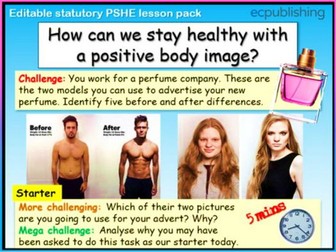
3 LESSONS PSHE body image / self -esteem lessons - (introduction lesson observed as outstanding). 3 full lessons: Includes:
3x 1 hour PowerPoints, worksheets, clips, well differentiated, KS3/ KS4. These resources have been designed to be engaging, detailed and easy to follow. All our PSHE and Citizenship resources are editable (so easy to adapt for your classes) and are designed to last one hour each. Includes lessons on: body image and the media, eating disorders and media pressure and male body image.
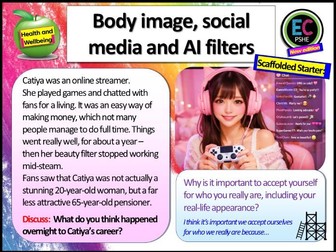
Brand new for 2026 - how are AI filters and social media affecting our body image? In this lesson students delve into ‘filter dysmorphia’ - a new but growing phenomenon affecting the mental health of teens.
Students will investigate how filters are creating completely unrealistic beauty standards - and how with the help of AI, almost undetectable filters are being applied not just to images, but to the videos of influencers and peer social media users too. Students will discover what is behind ‘Instagram Face’, why everyone is starting to look the same as each other in their uploads and the effect this is having on social media users. They will also discover useful and practical ways to relieve any negative thoughts or dysmorphia and the real message of the lesson - the importance of being authentic.
Includes clip tasks, spot the filter edits tasks, literacy tasks and much more.
All editable, will last one hour, suitable for new 2026 RSHE guidelines.
We are confident you’ll be pleased with this resource – however, if you have any issues at all, contact us at info@ecpublishing.co.uk and we’ll help you straight away. If you try to contact us through Tes we may not for be alerted for days so may not be able to help you on time.
Who are EC Resources?
EC Resources are the top TES PSHE providers and are a group of teachers who work together to create easy to use, high quality and editable lessons and units of work. We have created lessons for The Children’s Commissioner, The Bank of England, The British Legion, MACS Charity, Tes, LikeToBe Careers, the Criminal Cases Review Commission (UK Gov) and have also completed PSHE and Citizenship commissions for schools across the UK.
Please visit our Tes store https://www.tes.com/teaching-resources/shop/EC_Resources for everything PSHE, RSE, RE and Citizenship.
email info@ecpublishing.co.uk
Teaching PSHE, RE or Citizenship GCSE next year? Why not join our Citizenship and PSHE teachers Facebook group, with 12,000 other teachers, for guidance, advice and resource sharing.
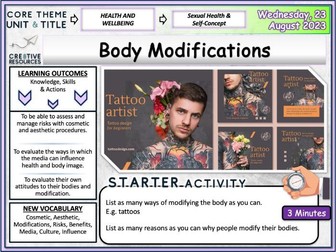
Body Modifications Tattoos Piercings PSHE. A fully-resourced lesson (1 hour +) which can be used by teachers to deliver a detailed PSHE / Citizenship / Personal Development lesson
Learning objectives
To be able to assess and manage risks with cosmetic and aesthetic procedures
To evaluate the ways in which the media can influence health and body image
To evaluate their own attitudes to their bodies and modification
Some Key Terms Covered
-Cosmetic; aesthetic; modifications; risks; benefits; media; culture; influence
Each Lesson Pack Contains:
1 Fully Editable Careers PowerPoint (Learning Outcomes, Confidence Checkers, Assessment of Learning, Variety of Tasks, Video Embedded URL Clips, Engaging Premium Quality Slides, Extra Support Websites, Challenging & Thoughtful Questioning) Assessment Opportunity (Confidence Checker)
The lesson includes a detailed PowerPoint, variety of student facing tasks and comprehension tasks These resources have been designed to be engaging, informative and pick up and teach.
Why not check out some of our latest PSHE super bundles below:
Personal Finance as a young adult
Online Safety + Staying Safe
Y12 Survival Kit - Personal Safety
Y11 Survival Kit - Revision + Exam Stress
British Values Explored Bundle
PSHE - Debating Topical Issues
Society, Body Image + Peer Pressure
Finance Risk + Online Safety
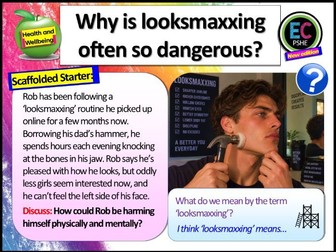
New PSHE 2026 lesson all about the trend of ‘looksmaxxing’ and how it can be dangerous. This lesson focuses on looksmaxxing’s links to the manosphere and misogyny, dangerous trends and male body image / self-esteem. It’s created for the new 2026 RSHE guidelines, is editable and will last an hour. Best suited to KS4/KS5 but nothing unsuitable for KS3 so it could be used with them if needed.
There is a detailed and colourful PowerPoint, clip tasks, an information pack, worksheets, literacy tasks, clip tasks with answers included, signposting to further help agencies and charities and clear outcomes.
It is fully editable, engaging and very easy to follow.
Who are EC Resources?
EC Resources are the top TES PSHE providers and are a group of teachers who work together to create easy to use, high quality and editable lessons and units of work. We have created lessons for The Children’s Commissioner, The Bank of England, The British Legion, MACS Charity, Tes, LikeToBe Careers, the Criminal Cases Review Commission (UK Gov) and have also completed PSHE and Citizenship commissions for schools across the UK.
We also run the EC Publishing site where you can find everything you need for PSHE, RE and Citizenship at discounted rates. You can contact us at info@ecpublishing.co.uk
Check out our PSHE Packages on Tes here:
Complete KS3 PSHE and RSE
Complete KS4 PSHE and RSE
Complete KS5 PSHE and RSE
One Year of Citizenship and British Values
Complete KS3 RE
Complete Careers and Employability
AQA Citizenship GCSE Mega Pack
Teaching PSHE, RE or Citizenship GCSE next year? Why not join our Citizenship and PSHE teachers Facebook group, with 12,000 other teachers, for guidance, advice and resource sharing.
Year 3 Science - Food and Our Bodies
All planning and resources for a half term of science. We used the Rising Stars planning as a basis but this is our own school's fomat of lesson planning.
Our school has a focus on pre-assessing the children and reducing the number of worksheets used.
We use stickers to print LOs and plenary questions onto, however you could put these on paper for children to stick into their workbooks.
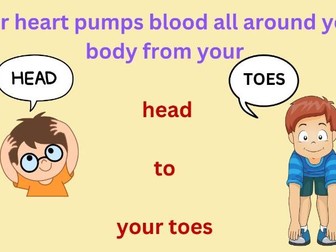
During our topic on People Who Help Us, my children especially enjoyed learning about doctors. They became obsessed with hearts and wanted to know all about them. This is an EYFS friendly explanation of our hearts.
A poem about the body and what it can do with a comprehension sheet. Ten questions largely focused on retrieval and language with a range of formats e.g. true or false, circling the correct options or ticking boxes etc… This resource links to the human body in science and ‘All About Me’ topic. Answer sheet provided. Ideal for KS1 or lower KS2 children.
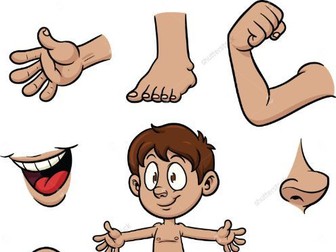
Parts of the Human Body
6 worksheets are included.
The Part of the Human Body and their Functions (we can see).
Label the different parts of our body using the words in the box. (2 worksheets)
Write the appropriate word for each sentence.
The Part of the Human Body and their Functions (We cannot see).
Label the different parts of our body using the words in the box.
Match each organ to its function.
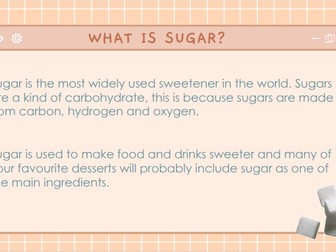
In this engaging lesson, you’ll explore how sugar works in our bodies after we eat, focusing on daily sugar intake for teenagers and the concept of The Perpetual cycle.
You’ll discuss the potential for sugar addiction and differentiate between natural and added sugars. Students will embark on a fun exercise to investigate the sugar content in popular drinks, reinforcing their understanding of what’s in what they consume.
To wrap up, you’ll conduct an experiment boiling Coke versus sugar-free Coke to observe the differences
About this sheet 📝
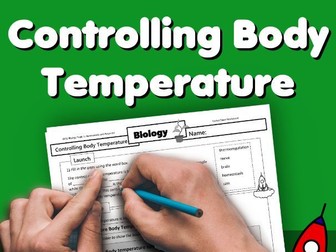
This little revision, home learning or class worksheet comes with answers and helps GCSE students to understand Controlling Body Temperature in B5 GCSE Biology 🧬🌱.
It tests students on using a negative feedback loop to control core body temperature (homeostasis) and ways in which the body can achieve this: vasoconstriction, vasodilation, shivering, respiration rate, hairs on the skin etc.
Tes bundles containing this resource:
94 Sheet GCSE Biology Mega Bundle
15 Sheet Homeostasis GCSE Homework Bundle
You might also like these resources on Tes:
Auxins Home Learning Worksheet GCSE
Homeostasis Home Learning Worksheet GCSE
Controlling Body Water Levels Home Learning Worksheet GCSE
Contraception Home Learning Worksheet GCSE
Controlling Blood Glucose Home Learning Worksheet GCSE
Browse resources in the same category
Biology resources (link in bio)
Homeostasis resources (link in bio)
❤️
You can also try out our free resources on Tes
What’s included? 👀
✔ A worksheet with a variety of questions.
✔ An answer sheet which has the answers filled in.
Which content does it cover? 📚 📚
This practice sheet covers part of Topic 5 of Biology - Homeostasis.
It’s designed for both GCSE Triple Award Science (separate sciences) and Double Award Science (combined science) students.
It’s optimised for the AQA Grade 9-1 Specification 2016 onwards but has been updated for 2022.
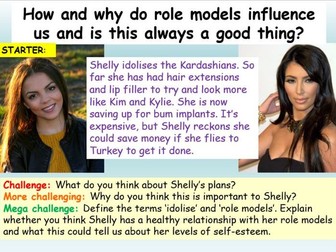
2 HOURS, fully resourced PSHE lesson all about role models, current social media influencers and the positive and negative influence they can have. The lesson follows a girl called Shelly, who wants to look like her idols, the Kardashians, before investigating more thoroughly the link between role models and self-esteem. A large part of the lesson investigates the lack of positive role models for young people in the media and sets students the challenge of establishing what makes a positive role model, before researching whether they can find celebs and public figures that meet their criteria.
This resource pack includes a 2 hour long PowerPoint with accompanying worksheets, well differentiated activities, literacy focus tasks, clip tasks with three-way differentiated questions and information sheets.
The lesson has been left editable and is filled with engaging, well differentiated and fun activities. It is useful for PSHE, Citizenship or Tutor Time. As with all our lessons, you don’t need any prior knowledge as all the information is included - you can just pick up and teach it.
Check out the EC Publishing website for full, affordable PSHE, Citizenship and RE Packages for all year groups including the new 2024 Complete PSHE Package. You can contact us at info@ecpublishing.co.uk
You can find many more inexpensive and free PSHE, Citizenship and RE resources at my shop: MORE PSHE RESOURCES
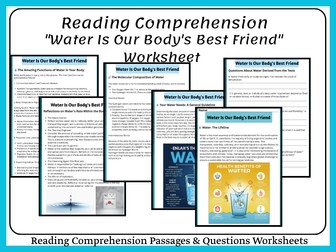
Brief Description of the “Water Is Our Body’s Best Friend” Worksheet
The worksheet addresses the importance of water as the “lifeline,” and describes the five vital functions it performs in the human body, such as being a solvent and transport medium, a temperature regulator, and a cleanser for toxin removal. The sheet also explains the unique chemical composition of the water molecule (It contains 9 pages
H 2 O
) and its polar properties that make it a “universal solvent.” It concludes by providing a practical hydration indicator (urine color), in addition to comprehension questions and a practical activity to reinforce water’s role in life.
Presentation that includes the different type of tissues within the body. Muscle tissues, nervous tissues, epithelial tissue, connective tissue, areolar tissue and adipose tissue. Introductions provided on all areas. Cell diagrams provided.
Class discussion ideas, tasks and methods of assessment provided. Focussed at level 3 but can be edited to aim at higher or lower levels. Can be delivered at BTEC, GSCE Science and introduction to A-level.
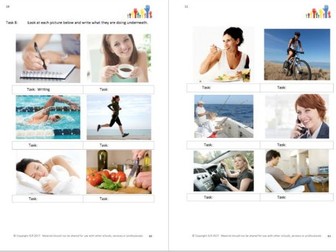
The ABOUT OUR BODIES (3) - USING OUR MEMORIES workbooklet is 15 pages of simple and interesting tasks about how we use our memories in everyday tasks and how we sometimes use them without realising. The workbooklet has a range of tasks that explore a students surroundings and helps them to work their memory using what is around them. This workbooklet is filled with active, visual and practical tasks for special education students and offers staff flexibility about who delivers the workbooklet and how many tasks are completed.
With an easy-to-follow format, a non-specialist teacher or teacher aide can also deliver this workbooklet with confidence, add ideas and many students will self-direct their learning.
This workbooklet also includes a Student Learning Checklist and Assessment for Learning feedback sheets.
The ABOUT OUR BODIES (1) - BODY PARTS workbooklet is 19 pages of simple and interesting tasks about our body parts and body functions. This workbooklet helps a student identify key body parts and how we use them every day as well as explore different organs, muscles and functions. This workbooklet is filled with active, visual and practical tasks for special education students and offers staff flexibility about who delivers the workbooklet and how many tasks are completed.
With an easy-to-follow format, a non-specialist teacher or teacher aide can also deliver this workbooklet with confidence, add ideas and many students will self-direct their learning.
This workbooklet also includes a Student Learning Checklist and Assessment for Learning feedback sheets.


 Quick View