Physical development milestones (Birth - 5 years old)Quick View
5DEducation

Physical development milestones (Birth - 5 years old)

(0)
Physical development progression of skills from birth to 5 years old Do you know that developmental milestones children reach at each stage lay the foundation for progress in school? This comprehensive progression map outlines how children develop physical skills (gross motor and fine motor) from birth to school age. You can follow this chart to assess your child’s progress and readiness for school, as well as plan activities for homeschooling. The school expectations at age 4-5 are taken from the National Curriculum in the UK. Please note that all children develop at a different pace and this progression map is designed to give you a brief overview of what you can expect at each stage. It includes 5 areas of physical skills development: • Moving and handling • Arms and fine motors skills • Collaboration and coordination • Health and self-care • Independence If you find this progression map useful, you can find Mathematical skills, Communication & Language, Literacy, Understanding the World and Personal, Social and Emotional Development progression maps in our shop.
OCR A level Physics: Particle PhysicsQuick View
srshaw89

OCR A level Physics: Particle Physics

5 Resources
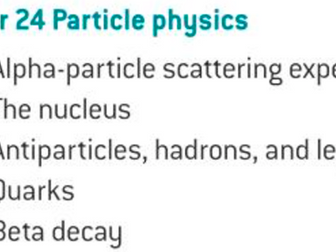
OCR A level Physics: Chapter 24 Particle Physics is apart of the Module 6: Particle and Medical Physics All presentations come with worked examples, solutions and homeworks. 24.1 Alpha-particle scattering experiment 24.2 The Nucleus 24.3 Antiparticles, Leptons, & Hadrons 24.4 Quarks 24.5 Beta decay Developments of scientific models Thompson’s plum-pudding model Rutherford’s nuclear (planetary) model Rutherford’s experiment, observations, and conclusions Using Coulomb’s law to find the minimum distance between particles Nucleons Isotopes Nuclear notation Atomic mass units (u) Radius for atomic nucleus equation Volume and density of atomic nuclei The strong nuclear force Antiparticles, their properties, and symbols Particle and antiparticle annihilation The four fundamental forces (strong nuclear, weak nuclear, electromagnetic, and gravitational forces) and their properties. Definition and examples of hadrons and leptons. The Standard Model of particle physics Quarks, anti-quarks and their charges Baryons and mesons Properties of neutrinos Nuclear notation Nuclear decay equations Beta-plus and beta-minus decays Quark transformation
Uneven Development LessonsQuick View
matthew_geldard98

Uneven Development Lessons

(0)
Two full KS3 lessons on uneven development around an hour each. Lessons includes a starter, learning objectives and plenary. Lessons look at both the physical and human causes of uneven development and get students to critically think about how these different factors are able to impact development. All supporting worksheets included - no further resources required.
AAQ Early Childhood Development Unit 1 - Physical Development 0-8 Years B1 B2Quick View
Health_ChildcareLearningHub

AAQ Early Childhood Development Unit 1 - Physical Development 0-8 Years B1 B2

(0)
This lesson focuses on the stages of physical development from birth to 8 years, covering key milestones in both gross motor skills (such as crawling, walking, and running) and fine motor skills (such as grasping, drawing, and writing). Learners will explore how physical abilities change as children grow and how these skills support wider development. The resource includes: Clear explanations of physical development milestones (B1 & B2) Interactive activities to support recall and application Fully adaptable materials for different learner needs Perfect for non-specialists, cover staff, or busy teachers, this lesson provides an engaging and structured approach to understanding early childhood physical development.
Physical Theatre - CHAIR DUETSQuick View
n_c_schiff

Physical Theatre - CHAIR DUETS

(0)
This simple to follow lesson introduces Frantic Assembly’s ‘Chair Duets’ through easy and clear instructions. The lesson is designed to be delivered by experienced professionals and non-specialists alike. Safe and clear introduction to the use of physical theatre to convey relationships. Develop control and understanding of how movement can communicate subtext to an audience. In particular this lesson will focus upon the creation of movement pieces that communicate relationships, exploring simple ways that young people can craft their own work using simple building blocks. Suggestions of music are included in the downloadable content.
EYFS skills progression FINE and GROSS motor developmentQuick View
kjimenez

EYFS skills progression FINE and GROSS motor development

(0)
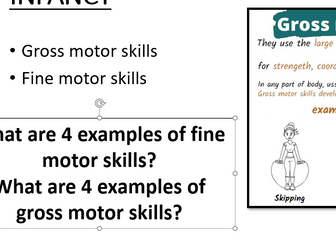
Fine & Gross Motor Skills Progression – Nursery to Reception Support physical development with this term-by-term progression guide for early years. Designed for Nursery and Reception, this resource helps you plan and track children’s motor skill development with ease. Clear Progression – Outlines expected milestones for each term. Fine & Gross Motor Skills – Covers everything from pencil grip and scissor skills to balance and coordination. Practical & Easy to Use – Perfect for planning, assessment, and ensuring curriculum coverage. Ideal for teachers who want to build strong foundations for writing, self-care, and physical confidence in young learners!
Development of the Atomic ModelQuick View
BrainJar

Development of the Atomic Model

(0)
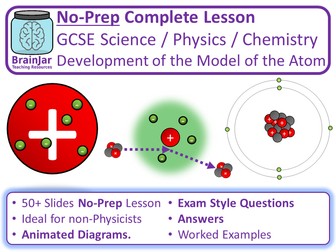
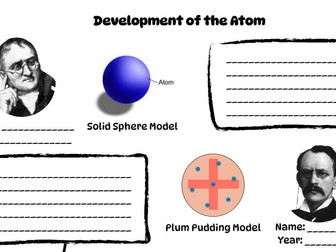
Complete No-Prep lesson with exam questions, tasks and answers on Development of the Model of the Atom for AQA GCSE (9-1) Science / Physics / Chemistry. Exam Spec: This lesson covers all of AQA GCSE Combined Science 6.4.1.3, Physics 4.4.1.3, and Chemistry: 4.1.1.3. As a Secondary Science teacher and Deputy Headteacher for many years I make high quality no-prep lessons so busy teachers can teach outstanding lessons without spending hours planning. This high quality lesson includes explanations, different types of in-lesson assessment (all with answers) and unique exam questions. My lessons are ideal for non-Physicists - as a Biologist who retrained as a Physics teacher I know how to take learners on a journey that builds up their understanding step by step, while still going into a lot of depth. The preview video shows a representative sample of slides from the resource so that you get a good idea of what it includes before you buy. What’s Included: • Starter / Do Now Activity • Explanation slides in “chunked” sections with animated diagrams. • Multiple questions in different question styles and difficulties - no need for worksheets. Each “chunked” explanation section typically includes a set of “learning check / quick questions” followed by a set of in-depth questions on the learning from that “chunk” of the lesson. All questions have answers. • Exam-style questions on the whole lesson at the end of the lesson- these are unique, based on real exam questions but not just copied from exam boards. • Answers for all questions • All easily editable to adapt to your teaching or to use in existing lessons. • Slightly humorous, at points, if you like that sort of thing (or just delete those bits if you don’t). Learning objectives: Describe how new experimental evidence may lead to a scientific model being changed or completely replaced. Describe how our model of the atom has changed over time because of: The discovery of the electron. The alpha scattering experiment. The discoveries of energy levels, protons and neutrons. Describe the alpha scattering experiment, and the new evidence it produced. Explain why the evidence from the alpha scattering experiment changed the model of the atom. Describe the plum pudding model of the atom and why it changed. Describe the differences between the plum pudding model and the nuclear model of the atom. The lesson was written for AQA GCSE Science / Physics but is very likely to be applicable to other exam specifications. Please leave a rating / review and all other feedback gratefully received!
Physics careers display posters - 13 careers for Physics studentsQuick View
stress_less_resources

Physics careers display posters - 13 careers for Physics students

(0)
This is a visually appealing collection of 13 careers for Physics students posters to use as a display to brighten up your classroom. The posters can be displayed with the smaller snippets of information around them (see image) and would look great laminated. The resource comes as a PDF due to the use of purchased fonts and will print up to and including A3 size. The resource may be able to be printed in larger sizes without losing print quality - please email me (see below) if you have any issues. These business careers posters have been developed using information found on the National Careers Service website. All images have an appropriate license. ***Get this as a bundle of Science careers posters and save money on each resource: https://www.tes.com/teaching-resource/careers-in-science-display-posters-bundle-12917891 *** Benefits: Designed by a highly experienced outstanding teacher and former head of careers - the work has been done, so put your feet up! Stimulating visual design that should appeal to all learners and help support SEN/ EAL learners Promote careers to your students that build on the skills and knowledge learnt in class Please check out our other resources – new resources are being added all the time. Making resources is my passion and I would be so grateful if you could leave a review so that I can keep making them. As a thanks, if you leave a review, you can have a free resource of your choice up to the same value as the resource you purchased. Just email stresslessresources@gmail.com with your user name, the resource you reviewed and the resource you would like for free and I will share it with you.
Physical development lesson and tasksQuick View
Sgr89

Physical development lesson and tasks

(0)
A lesson outlining Physical development accross the life stages including mini tasks throughout and an exam style question at the end. For the BTEC tech Health and Social Care
EYFS Physical Development AuditQuick View
Honeyguide

EYFS Physical Development Audit

(0)
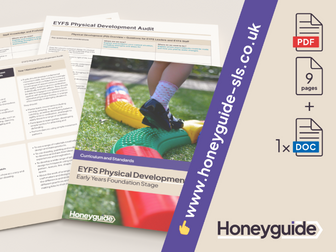
If you’re looking to explore your school’s provision and curriculum for physical development for your early years children, this audit pack gives you the perfect starting point. Aimed at primary school settings, the audit can be used by both EYFS leads, year 1 leaders & teachers, and curriculum leaders to explore how effectively your school gives children broad and exciting physical development learning opportunities in order to develop their gross and fine motor skills. Links are also made between the EYFS and the National Curriculum subjects in Year 1 to provide support for that crucial transition, and is ideal if you’re looking to provide a cohesive curriculum offer. Further EYFS leadership resources can be found on our website.
Physical Development AuditQuick View
Honeyguide

Physical Development Audit

(0)
Physical Development audit for Reception and EYFS provisions. Physical Development audit only. The comprehensive EYFS deep dive and audit pack can be found on our website Honeyguide SLS for £17.50.
Development Physical FactorsQuick View
TheGeographyShopOriginal

Development Physical Factors

(0)
Development Geography L5: What Physical Factors Can Affect Development? FREE - Whole SoW https://www.tes.com/teaching-resource/resource-12899440 This SoW is designed in detail and is both differentiated and engaging, and allows you to move pupils through content efficiently. Made to the highest standard and constructed using current research, both dual coding and retrieval practices are at the heart of this unit. A colour scheme also runs throughout to ease both your delivery and students comprehension. SoW: Can the World Ever Become Fully Developed? Intro: L1: What is Global Inequality? L2: How is Development Measured? Causes: L3: How Do Countries Develop? (Rostow) L4: How Do Countries Develop? (Frank) L5: What Physical Factors Can Affect Development? L6: What Human Barriers can Stop a Country Developing? L7: How can the Resource Curse Impact Development? L8: Is Debt a Cause of Low Levels of Development? Effects: L9: What Threat does HIV Present? L10: How is female education changing in Ghana? L11: How Does the Development Gap Impact Migration? Responses: L12: How can Fair Trade Increase Levels of Development? L13: Can Free Trade be a Solution to Global Inequality? L14: Can Aid Bring About Global Development? L15: How can Anti-Corruption Movements Increase Development? L16: Can Foreign Direct Investment Create Global Development? Debate: L17: What is the Most Effective Way to Increase Global Development? If you leave a review of any of our resources, you can claim any FREE single resource from our ever growing library. Simply message the above email, which is monitored daily. thegeographyshoporiginal@gmail.com Best FREE Resources (The Geography Shop) https://www.tes.com/teaching-resource/-12899088 (Climate Change SoW) https://www.tes.com/teaching-resource/-12899440 (Development SoW) https://www.tes.com/teaching-resource/-12638984 (Waste SoW) https://www.tes.com/teaching-resource/-12451443 (Britain Globalisation SoW) https://www.tes.com/teaching-resource/-12741793 (Local Area Investigation SoW) https://www.tes.com/teaching-resources/bundler/12949461 (Cambridge International) https://www.tes.com/teaching-resource/-12922653 (Israel & Palestine) https://www.tes.com/teaching-resource/resource-12485457 (What is Geography?) I hope you find this SoW useful. If you have, I have created a series of resources. You can check them out here. https://www.tes.com/teaching-resources/shop/TheGeographyShopOriginal