Teach Punjabi using these 7 essaysQuick View
sekhon1976

Teach Punjabi using these 7 essays

(0)
These 7 essays could be used a scheme of learning for KS3 or GCSE - i.e. writing simple and complex sentences in Punjabi. Excellent ideas on how to improve writing skills using topics like Relationships with family and friends, Leisure free time, life style, Holidays, Environment pollution, Current and Future jobs etc.
Punjabi Alphabet ChartQuick View
SundeepKaur

Punjabi Alphabet Chart

(0)
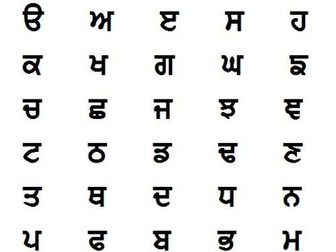
This vibrant and easy-to-follow Punjabi Alphabet Chart introduces learners to the Gurmukhi script, the foundation of written Punjabi. Perfect for kids and beginners, the chart features all 35 original letters (Painti Akhar), with clear pronunciation guides and colorful illustrations to aid recognition and memory. Whether for classrooms, home learning, or cultural enrichment, this chart is a valuable tool to start reading and writing in Punjabi with confidence. Send me a message and I shall send it through by email!
Speak, Write and Play In Punjabi - Learning Punjabi The Fun Way!Quick View
peterfogarty

Speak, Write and Play In Punjabi - Learning Punjabi The Fun Way!

(0)
Unlocking Potential: The Benefits of 114 Wordless Pictures for Teachers Investing in a set of 114 wordless pictures is an exceptional opportunity for educators aiming to spark conversations and improve descriptive skills among students. These visual tools serve as a powerful medium for engagement, creativity, and critical thinking, providing teachers with a versatile resource. Here’s why educators should consider purchasing these conversation-starting pictures and how they can be effectively utilized in various classroom activities. Stimulating Creativity: With no words to guide them, students are encouraged to develop their own narratives and interpretations based on the images. This fosters creativity and imaginative thinking, essential for personal expression and storytelling. Enhancing Descriptive Language: Teachers can utilize these pictures to prompt students to describe what they observe, encouraging the use of rich vocabulary and detailed descriptions. This practice not only boosts language skills but also builds confidence in speaking. Encouraging Critical Thinking: The open-ended nature of wordless images invites students to analyze and discuss different perspectives. This promotes critical thinking as they evaluate visual cues and articulate their thoughts, enhancing their analytical skills. Facilitating Collaboration: Using these pictures in group settings encourages collaboration. Students can work together to create stories or explore various interpretations, fostering teamwork and communication skills. Diverse Applications: These cards can be integrated across subjects—literature, art, social studies—allowing for interdisciplinary learning. Educators can tailor discussions to fit any curriculum, making them an adaptable tool for various lessons. Icebreaker Activities: The wordless nature of the pictures makes them ideal for icebreakers at the start of the school year or during group projects, helping students connect and engage with one another. In summary, a set of 114 wordless pictures is an invaluable resource that enhances conversation, descriptive skills, and critical thinking in the classroom. These images inspire creativity and collaboration, making them essential for creating an engaging and dynamic learning environment.
Learn Punjabi The Fun Way! BundleQuick View
peterfogarty

Learn Punjabi The Fun Way! Bundle

3 Resources
Are you learning Punjabi? Are you wanting to learn in a more fun way? I have adapted teaching resources I made to teach ESL to teach Punjabi. While the worksheets are still in English, the students translate the 57 settings and 114 pages of worksheets into Punjabi and learn them with a Punjabi teacher. The worksheets encourage the students to speak in Punjabi and recall the words they have used in each lesson.
114 Punjabi Bingo Game CardsQuick View
peterfogarty

114 Punjabi Bingo Game Cards

(1)
Welcome to the Punjabi Bingo pack. This is a simple starter game for students. There are 114 different pictures to choose from. Select a single picture and project the image on the wall or share it with the class as a handout. Talk about the picture and then ask your students to select and write down 5 items from the picture. Then look at the picture and pick out all the key vocabulary you want them to talk about. The first student to have all their items read out is the winner. With 57 different settings and 114 different game cards, there are plenty chances for great vocabulary. ***** Please note - these resources provide visual prompts and support to the students, not direct language instruction **************
Bilingual Sight Words, Punjabi and English Flash CardsQuick View
EverythingELL

Bilingual Sight Words, Punjabi and English Flash Cards

(0)
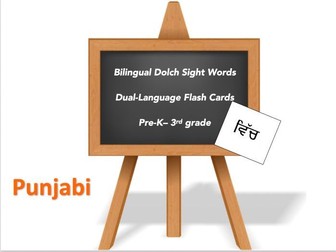
When printed double sided, these flashcards of dolch sight words have English on one side, and the Punjabi translation on the back. It is helpful if you are trying to give meaning to sight words to students who are learning to read English while simultaneously beginning to learn English.
Fact Sheet – Punjabi - Conversation Starters - Key InformationQuick View
natalielonglegs

Fact Sheet – Punjabi - Conversation Starters - Key Information

(0)
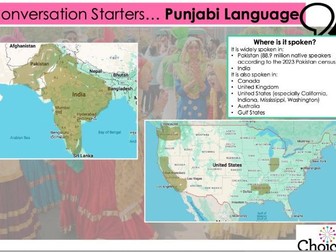
I work for the Leeds Youth Justice Service and I have created a series of fact sheets called ‘Conversation Starters’ to help other staff in the service with key information about religions, countries, cultures and languages. They are designed to be quick guides and allow staff to read up on various topics prior to meeting with / working with families and young people. The aim is to help with any misconceptions and to also know of any special etiquette, etc. that should be adhered to. Plus to help with topics of conversation! The countries series are also aimed to help staff understand reasons why families may choose to move over to England from their home countries. The current LANGUAGES sheets are: Arabic Persian Punjabi (this sheet) Swahili Urdu Though I will keep creating these as and when they are requested, so this list may not include all of them and it would be best to check my TES page as well! Please note - I have added the PDF and PowerPoint files. The documents contain some references to Leeds links which can easily be modified or removed. The Leeds YJS logo is also on the document so this can be replaced / removed. As well as selling each individually I will sell them all as a bundle at a discounted rate, once I have chance to upload them all!
57 Punjabi Setting Cards For Conversation PracticeQuick View
peterfogarty

57 Punjabi Setting Cards For Conversation Practice

(1)
Welcome to the 'Let’s Talk in Punjabi!' pack. This set of cards looks at 57 different settings. The teacher describes something in the top card. The students then use this to model a sentence using the bottom set of pictures. There are lots of things to see and describe in every picture. When the students have completed this task, they can repeat it by working in pairs to discuss each picture. There are lots of different ways you could use this pack. You could laminate them into two cards and get each student to talk about what they had seen in their picture. ***** Please note - these resources provide visual prompts and support to the students, not direct language instruction **************
114 Punjabi Writing Worksheets For Writing Practice + 31 Different Ways Of Using Flashcards In ClassQuick View
peterfogarty

114 Punjabi Writing Worksheets For Writing Practice + 31 Different Ways Of Using Flashcards In Class

(1)
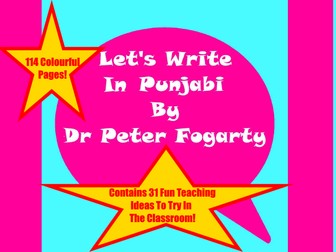
Lots of my users have asked if I can suggest ways they can use these language flashcards effectively in the classroom, and so I have added an additional 31 page teaching guide on using them. I hope you like them. ***** Please note - these resources provide visual prompts and support to the students, not direct language instruction ************** Welcome to the 'Let’s Write in Punjabi!' pack. There are lots of ways of using this teaching pack. It could be used as writing assessment for students learning Punjabi. The students could write about a topic in Punjabi before starting a unit, and then write again about the topic, using the second worksheet at the end of the topic to see how much they have progressed. It could also be used as an introduction to guided writing. Students can write sentences as a class and share the sentences together and they can then write them on their own. Alternatively, students could work in pairs - one student dictates to the other what to write down about what they see in the picture. These pages could also be used to write different stories, using the pictures as a stimulus.
Colours in Community Languages for classroom display ad a teaching aidQuick View
Hdin786

Colours in Community Languages for classroom display ad a teaching aid

(0)
Pack 1 set of colours in English, Urdu, Arabic and Punjabi. Can be used as a classroom display or it can also be a useful tool to teach children the names of colours who may have English as an additional language. Pack 2 is in English, Pashto (Pushto), Farsi (Persian) and Bangali (Bengali)
EDUQAS GCSE MUSIC - Area of Study 4 Practice QuestionsQuick View
rhianjenkins1966

EDUQAS GCSE MUSIC - Area of Study 4 Practice Questions

(0)
Please email misscreativecurriculum@gmail.com for any queries/issues Comprehensive resource, featuring all of the different musical styles in Area of Study 4. The following pieces are examined: With or Without You – U2 Looking For Somebody – Fleetwood Mac Fallin’ – Alicia Keys Heard it Through The Grapevine – Marvin Gaye Light My Fire – The Doors/UB40 Praise You – Fatboy Slim Don’t Bring Me Down – ELO Dock of the Bay – Otis Redding Punjabi MC – Mundian to Bach Ke Wiz Khalifa – See You Again Tears in Heaven – Eric Clapton All pieces are marked out of 12, following typical exam questions and layout. A useful vocabulary summary is included at the start
Sikhism - The 5 K'sQuick View
Teach4Uresources

Sikhism - The 5 K's

(0)
Sikhism - The 5 K’s The attached PowerPoint teaches the 5k’s of Khalsa. Every man and woman who belongs to Khalsa must wear five symbols which show that they are Sikhs. The symbols are usually called the Five K’s because in Punjabi their names all begin with the letter ‘K’. 10-slide PowerPoint. Fully editable.
Jesus in 33 individual languages DisplayQuick View
eric_t_viking

Jesus in 33 individual languages Display

(0)
Simple display showing the language, country, flag and the name for Jesus in that language ideal for RE displays, lessons and promoting multi-cultural work languages include: Urdu, Somali, Slovak, Hausa, Lingala, Czech, Tigrinya, Punjabi, Gaelic, Welsh, Kurdish, Italian, Nyanja, Igbo, Yoruba, Filipino, Polish, Wolof, Akan, Bengali, Chinese, French, Tamil, Greek, Farsi, Swahili, Mongolian, Romanian, Maori,Portugese, Spanish, Romanian, English
Top down Offender profiling AQA PsychQuick View
theesocteacher

Top down Offender profiling AQA Psych

(0)
This lesson is approximately designed for 1 hour and 30 minutes. It covers both the AO1/AO3 of the topic. Features of the lesson includes Application task Exam practice MWB task AFL This lesson is designed to assess students understanding frequently and can be easily scaffolded down or adapted to be more challenging Please check the notes section for additional answers
Group work strategies with example from SikhismQuick View
durgamata

Group work strategies with example from Sikhism

(1)
thoughts about Groupwork with a nice example on the Guru Granth Sahib. The power point is in process - but offers some good visual material. You can save any slide you like. Just put save as jpeg and then current slide for the ones you want. You can then insert them on a publisher file and arrange to print out as resources for the group-work exercise - I've done a few. + info about Gurmurki and Shabad Guru (spiritual sound in the writings and songs of the Guru Granth.) Thanks to ballykl (TES)and the Oadby Punjabi School for added files on Mool Mantra
Forensic Psychology AQA UnitQuick View
theesocteacher

Forensic Psychology AQA Unit

11 Resources
Lessons include: Top down offender profiling Bottom up offender profiling Atavistic explanation Genetic and Neural explanation Eysenck explanation Cognitive explanation Psychodynamic explanation Differential association theory Custodial sentencing Behaviour modification Anger management Restorative justice Features of the lesson includes Retrieval task Exam practice MWB task Student examiner task AFL This lesson is designed to assess students understanding frequently and can be easily scaffolded down or adapted to be more challenging Please check the notes section for additional answers
Language Flashcards: Key greetings from 26 languages.Quick View
Reading_for_Success

Language Flashcards: Key greetings from 26 languages.

(1)
This set of language flashcards explores key greetings in the 26 most commonly spoken languages in the world. The greetings that they teach are: Hello Goodbye Thank you Please Sorry Yes No Including on the flashcards are flags of countries where each language is spoken and facts about that language. The languages are: English Spanish Portuguese German French Mandarin Hindi Bengali Punjabi Urdu Persian Marathi Vietnamese Cantonese Korean Malay Swahili Japanese Javanese Russian Tamil Turkish Arabic Italian Hausa Telugu There are many uses for this with your students. My students enjoy taking a card each week and answering the register with a greeting in their chosen tongue. They could also be used as a class ‘language of the week’; as a multi-cultural display; or as part of a geography project. I hope you find them helpful!
ELL Bilingual Sight Word Cards-41 LanguagesQuick View
EverythingELL

ELL Bilingual Sight Word Cards-41 Languages

(0)
When printed double sided, these flashcards of dolch sight words have English on one side, and a translation on the back in sets of various languages. It is helpful if you are trying to give meaning to sight words to students who are learning to read English while simultaneously beginning to learn English. Language sets Include: Albanian Amharic Arabic Bengali (Bangla) Burmese (Myanmar) Chinese (Simplified) Czech English only Farsi (Persian, Dari) French German Greek Gujarati Haitian Creole Hebrew Hindi Hmong Indonesian Italian Japanese Khmer (Cambodian) Korean Lao Nepali Pashto Polish Portuguese Punjabi Romanian Russian Somali Spanish Swahili Tagalog (Filipino) Tamil Telugu Thai Turkish Ukrainian Urdu Vietnamese Yoruba