Rainforest Layers Worksheet
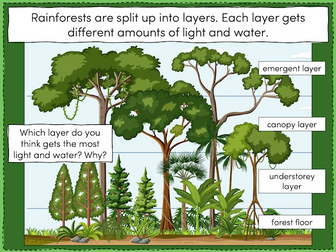
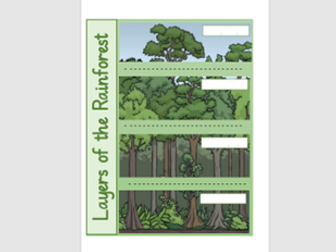
Easy to use activity on rainforests and their main layers - emergent, canopy, understory, forest floor. The students can either colour in the main picture of the layers (page one), then cut along the dotted lines and write information under each flap or cut and stick the animal pictures (page two) and match them to the correct layer.
Possible answers for the animals and layers matching included (page three).
Thank you for your interest
HoppyTimes
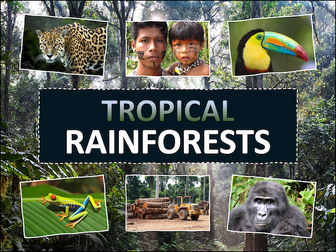
Tropical Rainforests is a Geography unit designed for students in KS2 (Y3-6).
The planning overview, topic title page and a knowledge organiser can be downloaded for free here. Lessons include:
L1 – Locating tropical rainforests on a world map
L2 – Identifying tropical rainforest animals
L3 – Investigating the layers of a tropical rainforest
L4 – Exploring the Amazon rainforest
L5 – Understanding the impact of deforestation on the Amazon
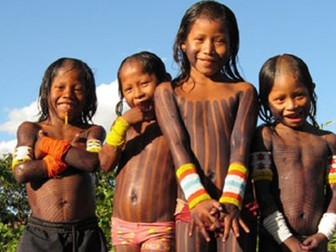
L6 – Investigating how deforestation affects an Amazon tribe
L7 - Thinking of ways to help save tropical rainforests
Each lesson includes a presentation and differentiated activities/worksheets. A knowledge organiser is also included. All resources are compatible with both Microsoft Office and Google Workspace.
If you like this resource, we would appreciate a review! We will happily send you a free resource in return for a review or useful suggestions/feedback. Contact us at ed@teachitforward.co.uk.
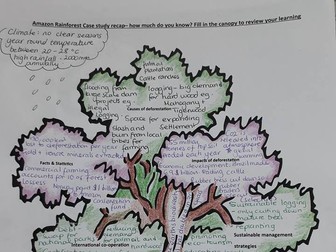
Complete Tropical Rainforests sequence of lessons for Unit 1, Section B of the AQA GCSE. The case study is Brazil.
The lessons included are detailed below.
Physical Characteristics of Rainforests
Adaptation and Biodiversity in Rainforests
Deforestation in Brazil: Introduction
Deforestation in Brazil: Causes
Deforestation in Brazil: Impacts
The Value of Tropical Rainforests
Sustainable Management of Tropical Rainforests
Hope this saves you some valuable planning time.
https://www.tes.com/teaching-resources/shop/markthegeographer
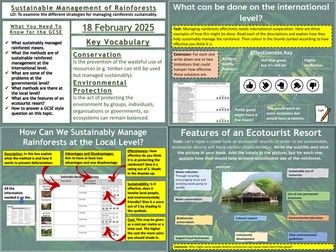
AQA GCSE Geography lesson for the 2016 specification Unit 1B: In this lesson we look at how rainforests can be managed sustainably at different levels.
We start with a retrieval practice multiple-choice task based around the content already learned in the rainforest section of the unit. We establish the definition of sustainable management before then looking at management at the international level. Students explain and rate the three types of action. We then look at some of the problems associated at the government level, students explain why these are problems and offer some solutions. We then look at the local level. Students undertake some guided reading with questions for the text, the students then complete a worksheet that asks them to rate these actions according to several criteria. We then look at the typical features and characteristics of an ecotourist resort and finish with a 4-mark GCSE style question on ecotourism and there is some tips for students who need it on how to answer it.
Hope this saves you some valuable planning time.
https://www.tes.com/teaching-resources/shop/markthegeographer
This resource is part of Tropical Rainforests, a Geography unit designed for students in KS2, but can also be taught as a stand alone lesson. All resources are compatible with both Microsoft Office and Google Workspace.
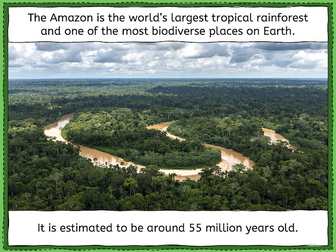
This lesson is a great introduction to the world’s largest rainforest, the Amazon. First, the presentation introduces students to the Amazon and its incredibly biodiverse flora and fauna. It then goes on to look at the geography of the Amazon in more detail, specifically its location within the continent of South America.
The activity challenges students to identify a range of human and physical geographical features within South America, including the nine countries in which the Amazon rainforest is located.
In follow up extension activities, students identify the capitals of those countries and then complete a cloze-procedure paragraph about the Amazon.
If you like this resource, we would appreciate a review! We will happily send you a free resource in return for a review or useful suggestions/feedback. Contact us at ed@teachitforward.co.uk.
This lesson is part of Tropical Rainforests, a Geography unit designed for students in KS2, but can also be taught as a stand alone lesson. All resources are compatible with both Microsoft Office and Google Workspace.
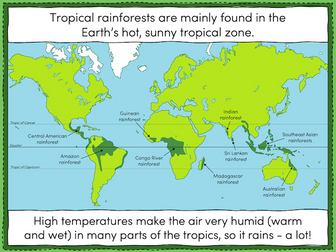
The presentation introduces students to tropical rainforests, including some of the flora and fauna that live in them. Students then learn about the Earth’s tropical belt and the location of the various rainforests within it.
The activity challenges students to label features of a world map including the Equator, the Tropic of Cancer and the Tropic of Capricorn. Students then locate 8 of the world’s tropical rainforests.
Easier - Students use a prompt map and have activity clues.
Harder - Students use a prompt map but have no activity clues.
Extension - Students fill in the missing words in a paragraph about tropical rainforests.
If you like this resource, we would appreciate a review! We will happily send you a free resource in return for a review or useful suggestions/feedback. Contact us at ed@teachitforward.co.uk.
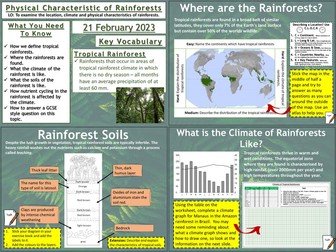
AQA GCSE Geography lesson for the new specification Unit 1B: In this lesson we look at what the physical characteristics of tropical rainforests are.
The lesson has a retrieval practice starter quiz on rivers to begin with. We then look at what it is like to be in the rainforest with a short video clip of walking through the forest. We then look at the location of tropical rainforests and the students have a map with some questions of differing difficulty to answer. The students are provided with a worksheet to draw a climate graph of the rainforest with some additional skills questions to answer (works well with a visualiser). The students complete an annotated profile of the rainforest latosol soil, describing and explaining its characteristics. We then look at the nutrient cycle and the students annotate a diagram making sure they eliminate the incorrect word from the annotation. We finish with a GCSE-style practice question with some guidance and structure provided for the students.
Hope this saves you some valuable planning time.
https://www.tes.com/teaching-resources/shop/markthegeographer
This lesson is part of Tropical Rainforests, a Geography unit designed for students in KS2, but can also be taught as a stand alone lesson. All resources are compatible with both Microsoft Office and Google Workspace.
First, the presentation introduces students to the different layers of the rainforest and some of the animals that live in each layer.
Students then complete a range of activities:
Activity 1:
In pairs, students match the layers of a tropical rainforest to descriptions.
Easier - Students have multicoloured descriptions. They match each layer to one green, blue and purple description.
Harder - Students have plain black descriptions. They match each layer to three other descriptions.
Activity 2:
Students identify and label the four layers of a tropical rainforest.
Easier - Students write one word for each layer.
Harder - Students write two words for each layer.
Extension:
Students cut out pictures of tropical rainforest animals and stick them in the layer in which they live.
If you like this resource, we would appreciate a review! We will happily send you a free resource in return for a review or useful suggestions/feedback. Contact us at ed@teachitforward.co.uk.
AQA GCSE Geography lesson for the new specification Unit 1B: In this lesson we look at what valuable commodities and services the rainforest provides.
The lesson has a rainforest themed retrieval practice starter. We look at what value the rainforest has to indigenous peoples and why these people may be at threat. Focusing on the Achua tribe we look at a video and complete some guided reading with the students completing some questions relating to the text. We then look at the valuable medicines that come from the rainforest, the students have to complete an annotated ‘rainforest cabinet’ using information from the slide. We then look at essential services. The students read the information on the various services the rainforest provides and rate them according to how important they are and explain why they think this. We finish with a GCSE-style practice question with some guidance and structure provided for the students.
Hope this saves you some valuable planning time.
https://www.tes.com/teaching-resources/shop/markthegeographer
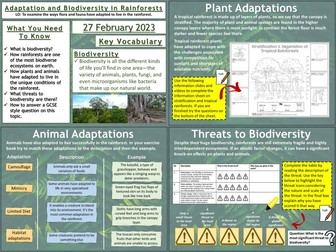
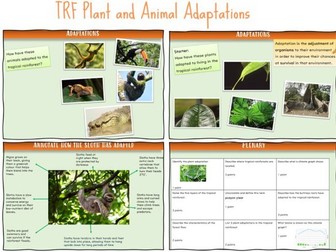
AQA GCSE Geography lesson for the new specification Unit 1B: In this lesson we look at what how plants and animals have adapted to the environmental conditions in the rainforest.
The lesson has a retrieval practice starter to begin with. We then look at what biodiversity is and why the rainforests are particularly diverse. We then look at rainforest stratification and plant adaptations. The students have a sheet to complete and some information slides to use to complete the sheet. This could be used as a carousel or group work task. The sheet can even be coloured in! Then the students complete a mix and match up task on the most common types of animal adaptations. The students then complete a rating task with explanation as to how significant are threats to biodiversity in the rainforest. We finish with a GCSE-style practice question with some guidance and structure provided for the students.
Hope this saves you some valuable planning time.
https://www.tes.com/teaching-resources/shop/markthegeographer
Rainforest Habitats | Differentiated Reading & Activities
Engage your pupils with this differentiated rainforest reading comprehension pack, designed to support science, geography, and literacy lessons. Perfect for exploring ecosystems, adaptations, biodiversity, and environmental challenges, this resource provides two levels of carefully scaffolded texts and activities to ensure accessibility for all learners.
Two Differentiated Reading Levels:
Lower Level (600L–700L, Years 3–4)
Uses clear, accessible language and simple sentence structures to introduce key concepts. Pupils will explore rainforest layers, climates, locations, plant and animal adaptations, the role of rainforests in the water cycle, biodiversity, and conservation challenges—all while building confidence in reading comprehension.
Higher Level (900L–1000L, Years 5–7)
Covers the same content with richer vocabulary and more complex sentence structures, encouraging higher-order thinking. Ideal for advanced readers ready to deepen their understanding of rainforest ecosystems, climate impact, and the role of rainforests in global sustainability.
Both versions help pupils master key concepts about rainforest habitats, the importance of biodiversity, and the adaptations that allow life to thrive in these vital ecosystems.
What’s Included?
8 Differentiated Activities for Each Text (16 in Total!):
Mixed-Style Comprehension Sheets – Vocabulary matching, sequencing, cloze passages, true/false, and written responses
True or False Activities – Assess understanding of key facts
Multiple-Choice Quizzes – SATs-style practice for comprehension and test prep
Cloze Summary Activities – Reinforce main ideas and strengthen vocabulary retention
2 Crossword Puzzles – Expand rainforest-related vocabulary in a fun way
Differentiated Word Searches – Support spelling and key term recognition
Traditional Written Comprehension Sheets – Double-sided worksheets encouraging deeper text engagement
Answer Keys – Complete solutions for all activities
This engaging, cross-curricular resource supports science, geography, and English learning, making it ideal for whole-class instruction, guided reading, independent tasks, or home learning.
Looking for more habitat resources?
Check out my:
Desert Habitat Reading Comprehension Pack
Polar Habitats Reading Comprehension
Grassland Habitat Reading Comprehension
Ocean Habitat Reading & Activities
Temperate Forest Ecosystems Habitat Biome Reading
Freshwater Habitats Comprehension
For AQA GCSE Geography. You need the Oxford AQA GCSE Geography Textbook for the new specification
The lesson includes.
Photo interpretation starter.
Questioning activity
Video clips
Large A3 worksheet with a variety of different activities covering the required content.
Plenary activity.
All worksheets for photocopying included. Hope this helps.
https://www.tes.com/teaching-resources/shop/markthegeographer
Amazon Rainforest activities and posters. This product could be just what you need if you are teaching children about the animals that live in the Amazon Rainforest. It includes fun, hands on activities that keep children engaged and motivated, whilst learning at the same time. These print and go activities include a scavenger hunt and matching activity. Children can also make a bookmark and create their own fact poster of their chosen animal. Word cards, real life photos and colorful fact posters of 15 Amazon Rainforest animals are included. Suitable for years 3 and 4.
**Included in this product: **
15 colourful fact posters on the following animals:
leopard
panther
scarlet macaw
hummingbird
blue morph butterfly
anaconda
boa constrictor
green iguana
poison dart frog
piranha
toco toucan
sloth
howler monkey
capybara
armadillo
Scavenger hunt activity for use with the posters - questions have 3 levels of difficulty
Pictures and descriptions for matching - 2 choices of activities - instructions included
Blank fact posters for children to complete with an animal of their choice
15 bookmarks - children to make one of their own choice
Word cards and real life photos for display
Colouring for early finishers
Transport your students around the world our Rainforests Class Assembly Script! This engaging assembly pack features 32 speaking parts, making it ideal for the whole class to get involved in a fun, educational performance.
Benefits:
32 Speaking Parts: Every student gets a role to play, ensuring full participation and engagement.
Easy to Perform: Clear stage directions and simple dialogue make it easy for teachers and students alike to prepare.
Creative Add-ons: Includes prop ideas and a catchy song to enhance the performance and make it even more memorable.
Educational & Fun: Students will learn key facts about the rainforests while developing confidence and teamwork through performance.
Sample Excerpt:
Introduction
(The stage is set with a green rainforest backdrop showing trees, vines, and animals like monkeys, parrots, and jaguars. Children stand in a semi-circle, holding props like leaves, flowers, and animal cutouts. Child 1 and Child 2 step forward to speak.)
Child 1:
Good morning, everyone, and welcome to our class assembly!
Child 2:
Today, we’re taking you on an exciting journey to one of the most amazing places on Earth—the rainforest!
(Children 3 and 4 step forward, holding a globe and a cutout of a rainforest map.)
Child 3:
Rainforests are found near the equator, in places like South America, Africa, and Asia.
Child 4:
They’re full of incredible plants, animals, and people, and they play a big role in keeping our planet healthy.
Child 5 (stepping forward):
But rainforests are in danger. Deforestation, farming, and mining are destroying them every day.
Child 6 (raising a hand dramatically):
Join us as we explore the wonders of the rainforest and find out how we can all help to protect them!
(Class cheers and waves their props, shouting together, “Let’s save the rainforests!”)
Perfect for school events, this script makes learning about the past an exciting adventure!
Full unit of work for tropical rainforests. All lesson are suitable for 50 minutes to 1 hour of teaching time. Includes supporting worksheets for lessons - no additional resources are required.
All lessons have a starter and lesson objectives. All PowerPoints in the same signature style.
Lesson sequence:
1 - Rainforest introduction
2 - Exploring the wilderness
3 - Layers of the rainforest
4 - Life in the rainforest
5 - Climate of the Amazon
6 - Deforestation
7 - What does deforestation contribute to climate change?
8 - Deforestation mystery
9 - Can we save the rainforests?
10 - ICT research project
11 - Student presentations
12 - Produce from the rainforest
13 - Sustainability
14 - Sustainable tourism
15 - How to survive in the rainforest
16 - End of unit test
Also includes Geography Literacy mat and Geography Numeracy/Map Skills mat.
Rainforests graphic organizer and vocabulary activities. Help your students learn and remember the important facts about rainforests and the associated vocabulary with these fun, interactive activities.
Print out and laminate the graphic organizers for students to keep and use throughout your topic work. Use the vocabulary cut and stick activity at the beginning of the topic as an introduction/guide to their existing knowledge OR as an end of topic assessment.
Topic word cards for display and word search.
This product includes:
Graphic organizer - colour and black and white version
Vocabulary activity - cut and stick match words/pictures/definitions - colour and b/w
20 topic word cards for display
Word search
This set of resources include a four week planning sequence and power point of the dioramas that the children made. When all put together they made a vibrate display on a wall, and create an atmosphere evocative of the rainforest environment.
Display lettering and posters for rainforest as well as writing frames for children to make their own booklet about the rainforest.
Original writing frames made in publisher - I have added these so they can be edited to suit your class.
3 worksheets; one looking at the environments, one looking at two animals from the environment and another looking at the Human Impact on the environment.