Sentence stems for oracy discussions and debatesQuick View
MadebyMrsWilson

Sentence stems for oracy discussions and debates

(0)
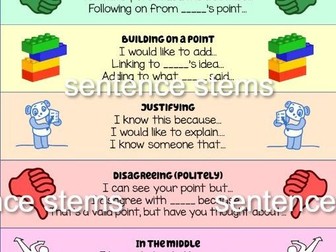
Thank you for looking at this resource! Print this as a large poster for your classroom or use them as a paired or individual resource to structure debates. Give your students a helping hand when contributing in class with sentence stems that help them to think from different perspectives and put their points across clearly and politely. Available as a PDF, PNG and JPEG using my fonts and as an editable PowerPoint slide where you can add in your own fonts and change any pharses. Please note that the PowerPoint version is in Arial font and not the fonts I used in the posters for copyright reasons.
STEM-Paper Plane ChallengeQuick View
ninki1

STEM-Paper Plane Challenge

(0)
Looking for a fun STEM challenge for your students? Easy prep and loads of fun!! Kids just love to make and throw paper planes! Did you know that National Paper Plane Day is celebrated each year on MAY 26TH?? A great way to get some sneaky fitness in as your kids run around retrieving their planes Relaxation- origami is a proven relaxation technique with hidden health benefits Bonding and healthy competition Design challenges- encourage your students to test their designs and search the internet for different plans and models. What improvements worked? Great to use as a research tool and introduction to the topic of flight. What is included in this resource? -This resource comes with a powerpoint presentation to share with your students with clickable links to take you to some fabulous YouTube demonstrations of varying levels of difficulty, to encourage and challenge your students -The worksheets use informal, metric and imperial measurement depending on which country you are in or which age group you are working with. -A versatile resource which can be used for both math and science lessons -View preview for complete information! What people are saying about this resource "My students loved using these resources to learn about scientific methods. I had students learn about the steps of the scientific method and make their hypotheses before creating and flying the airplanes. " “This was a great end of the year activity that I was able to easily adapt for use with my 7th grade students. They loved it!” “Turn their hobby into a learning opportunity!!” “Great resource, easy to implement and engaging!” This is for use by one teacher in one classroom. If you would like to share with your colleagues, PLEASE purchase a multiple license. Thank you :)
STEM club Practical Challenges CollectionQuick View
marissa03

STEM club Practical Challenges Collection

(0)
A collection of STEM themed practical based challenges that can be used in STEM/Science clubs or for fun science lessons. Each activity includes a lesson plan with equipment list and instructions and a colourful student sheet. Activities include Army men launchers Labyrinth Game Bungee Barbie/Bungee Action Man Foosball Table Challenge Jacks Golden Egg Delivery Service Marble Runs Newspaper Shoes
STEM Club/STEM lessons Dunking BiscuitsQuick View
rfitzsimon

STEM Club/STEM lessons Dunking Biscuits

(0)
This powerpoint (and the others I have uploaded) is amazing for a STEM club or a standalone STEM lesson. We used to run a full STEM curriculum for KS3, so have a look at the bundles for sale - our pupils loved STEM lessons!
Bloom's taxonomy question stemsQuick View
emmalljones99

Bloom's taxonomy question stems

(0)
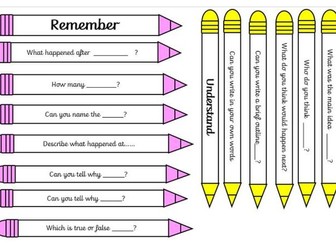
Pencil shape question stems that can be used by children and by staff. Great for display in classrooms and as an activity for children to complete in order to reflect on their learning.
Fortnite STEM Parachute ChallengeQuick View
Kiwilander

Fortnite STEM Parachute Challenge

(0)
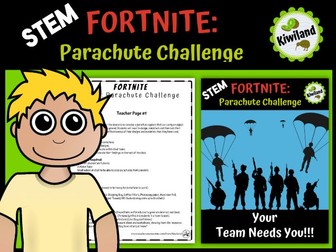
This STEM activity is a great group activity for your students. The challenge in this activity is to design a more efficient parachute to jump out of the Battle Bus. The students need to work together to complete the challenge and experiment given. This Fortnite activity is perfect for a back to school activity or all year around. You do not need to know what Fortnite is (your students will) to do this challenge, but this will earn you your kids respect and you will be that “cool” teacher. Included in this resource are teachers notes, student questions, the experiment, a PowerPoint on the history of flight and comprehension questions to go with the presentation. Everything you need to make a fun filled activity with your students. SCIENCE: Students will use skills in the scientific method: observing, communicating, comparing, organizing, and relating. TECHNOLOGY: Students can document learning through the use of digital technology. ENGINEERING: Students will devise and implement a strategy to construct Marble Roller Device. MATH: Students will explore measurement, graphing, statistics, patterns, and build mathematical knowledge through problem solving
Primary Spaghetti Tower STEM ChallengeQuick View
brightmindstudios

Primary Spaghetti Tower STEM Challenge

(0)
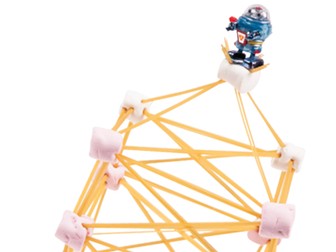
Primary Spaghetti Tower STEM Challenge A hands‑on STEM challenge where learners design, build, test, and improve a spaghetti tower while exploring balance, height, stability, and simple engineering principles. Learners build a tower using spaghetti and connectors, then test how tall and stable they can make it. This low‑prep activity is ideal for primary classrooms, home learning, STEM tubs, or small‑group centres. WHAT’S INCLUDED: • 3‑page STEM Challenge set: Cover Page, Instructions Page, Activity Page • 9‑Point Engineering Graph for comparing two tower designs • Clear directions for classrooms • Kid‑friendly layout for independent exploration • Printable PDF (A4/Letter compatible) SKILLS DEVELOPED: • Engineering design process • Planning and sketching a tower • Testing height and stability • Comparing performance after design changes • Recording results using a structured 9‑point graph HOW IT WORKS: Learners build one version of their spaghetti tower, test its height and stability, and record the results. Then they change one part of the design—such as the base shape, support angles, or connector placement—and test again. They sketch both versions, note the change, and compare results using the 9‑Point Engineering Graph. The open layout supports drawings, notes, and observations. The challenge scales naturally: younger learners build simple upright towers, while older learners experiment with stronger bases, wider supports, and improved stability. LEARNING CONCEPTS: • Balance, height, and stability • Force and load distribution • Testing and comparing designs • Improving designs based on results Curriculum Links: Supports early engineering, structure, balance, and investigations involving height and stability. STEM Vocabulary: balance, base, support, height, stability, design, test, improve Differentiation: Works well for KS1 learners and naturally extends for KS2. TEACHER BENEFITS: • Clear instructions • Minimal prep with easy‑to‑source materials • Works for small groups, centres, early finishers, or whole‑class use • Flexible materials allow easy adaptation • Clear routines support independent work PRINTING & PREP: • Print pages single‑sided • Provide spaghetti, tape, and small connectors (e.g., marshmallows or clay) • Adult supervision recommended when using small materials • Test towers in open areas away from breakables AGE RANGE: Suitable for ages 5–11 (Primary). Younger learners can participate with support. Aligned for KS1 learners, with extension options for KS2. Supports ESL learners with simple language and hands‑on tasks. PERFECT FOR: • STEM centres • Classroom STEM tubs • Early finishers • Makerspace stations • Home learning • After‑school clubs • Family STEM nights FILE DETAILS: • PDF format (non‑editable) • Instant digital download • No physical item shipped TERMS OF USE: For personal and single‑classroom use only. Not for resale, redistribution, or commercial use.
Hindenburg Disaster STEM Case StudyQuick View
InnovativeMiddleSchoolSTEM

Hindenburg Disaster STEM Case Study

(0)
Investigate the 1937 Hindenburg fire with this 6-page STEM packet covering buoyancy physics, static electricity, hydrogen chemistry, and safety ethics. Engage your middle and high school students with a comprehensive, hands-on deep dive into one of the most iconic turning points in aviation history. This complete printable unit bridges aerospace physics, chemistry, and international trade ethics to teach buoyancy physics, hydrogen flammability limits, electrostatic spark discharge, doped cotton fabric combustion, and aviation safety protocols. What’s Included in this 6-Page Unit Packet: Page 1: Historical Case Study & Technical Breakdown – Full narrative of the May 6, 1937 docking disaster at Lakehurst, New Jersey, rigid duralumin airship architecture, helium versus hydrogen lift politics, static charge buildup during thunderstorm approaches, wet landing line ground loops, and comprehension check questions. Page 2: Day in the Life Scenario Challenge – Roleplay assignment where students step into the shoes of a Chief Airship Electrical Inspector at Naval Air Station Lakehurst on May 6, 1937, analyzing atmospheric voltage potential gradients, fabric skin resistance, and gas cell leakage diagnostics. Page 3: Hands-On Unplugged Simulation & Applied Math – Step-by-step math calculations comparing hydrogen versus helium buoyant payload capacities in pounds, electrostatic voltage potential discharge thresholds in volts per meter, and rapid fire combustion expansion rates. Page 4: Engineering Ethics & Workplace Dilemma – Critical thinking exercise exploring geopolitical trade embargoes versus passenger risk, analyzing the US Helium Act of 1925, designing giant passenger airships around explosive hydrogen gas due to export bans, publicity pressures, and aviation safety reforms. Page 5: Redesign Brief & Innovation Lab – Creative blueprinting assignment where students design “LZ-129 Hindenburg V-2,” incorporating an inert non-flammable helium lifting gas system, conductive carbon-mesh anti-static skin coatings, automated gas cell pressure valves, and fire-retardant structural framing. Page 6: Teacher Answer Key & Scoring Rubric – Complete answer key for all analytical questions and math calculations, along with a 10-point grading rubric for evaluating student blueprints on Page 5. Teacher Benefits: 100% Print-Friendly Format: Clean text layout with zero dark background boxes or awkward formatting for easy editing and printing. Multi-Day Classroom Value: Designed to cover 3 to 5 full class periods. Perfect for Physics, Physical Science, Chemistry, Materials Science, Aerospace Engineering, History electives, or emergency sub plans. High-Interest Real-World Content: Combines buoyant force math, static electricity chemistry, airship flight diagnostics, trade embargo ethics, and aerospace redesign!
STEM Challenge: Windmill STEM ChallengeQuick View
Jonmayhew1234

STEM Challenge: Windmill STEM Challenge

(1)
Students will design and create a windmill to see which team has the most efficient windmill. This is a fun an simple activity. Here is what is in the packet: 1. Teacher Guide 2. Prototype Worksheets 3. Results/Review Worksheet
Problem Solving STEM Activity Cards | 20 Printable STEM Challenge Cards for KS1 & KS2Quick View
brightmindstudios

Problem Solving STEM Activity Cards | 20 Printable STEM Challenge Cards for KS1 & KS2

(0)
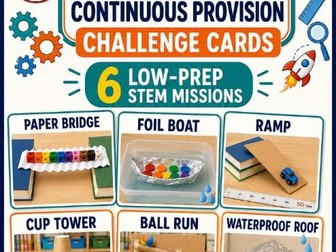
Problem Solving STEM Activity Cards are a set of 20 printable STEM challenge cards designed for KS1 and KS2 pupils. These hands-on STEM activities encourage children to investigate, predict, compare, build and solve problems using everyday classroom materials. Perfect for STEM activities, STEM challenge stations, STEM clubs, practical science lessons, enrichment activities, continuous provision, independent learning, early finishers and home education. These low-prep STEM challenge cards give children opportunities to explore, experiment and think critically through a variety of engaging problem-solving tasks. Activities encourage investigation, creativity and curiosity while requiring only simple materials commonly found in classrooms or at home. What’s Included • Cover page • 20 printable Problem Solving STEM Activity Cards • Activities using simple, easy-to-find classroom or household materials STEM Skills Explored Children will: • Build and design solutions • Make predictions and test ideas • Compare materials and results • Explore cause and effect • Investigate questions through hands-on learning • Develop creative problem-solving skills • Strengthen critical thinking through STEM activities Ideal For • STEM challenge stations • STEM clubs • STEM centres • Continuous provision • Early finishers • Enrichment activities • Independent learning • Partner activities • Small-group work • Practical science lessons • Home education • Indoor rainy-day activities Why Teachers Like These Cards • Low-prep and easy to implement • Uses everyday classroom materials • Encourages independent thinking and exploration • Supports hands-on STEM learning • Flexible for a variety of classroom settings • Suitable for a range of ages and abilities • Easy to print, organise and reuse Challenge Types Included Activities encourage children to investigate, predict, test, compare, build and solve problems through practical STEM experiences. The challenges cover a range of STEM concepts and provide engaging opportunities for children to think creatively while exploring how things work. Printing & Preparation • Print on paper or card • Cut out the cards • Optional: laminate for durability • Store on a ring, in a STEM tub, or in a storage box for repeated use File Information • PDF format • Standard 8.5 × 11 pages • 20 activity cards (4 cards per page) Terms of Use For personal classroom use or single-household use only. Not for commercial redistribution.
STEM Club: Activity- STEM of the living dead- Zombie Apocalypse Survival Scheme of WorkQuick View
marissa03

STEM Club: Activity- STEM of the living dead- Zombie Apocalypse Survival Scheme of Work

(0)
STEM of the Living Dead A zombie apocalypse Survival Scheme of Work that can be done over a number of weeks in a STEM club or fun science practical lesson A variety of science and STEM related activities for students teaching them survival skills. For each activity there is a lesson plan detailing the equipment needed, how to set up and method and student instruction sheets. As well as zombie warning posters that can be displayed around the classroom and corridors to add effect Activities include Water Purification Growing Food Shopping for Food Making a battery Zombie alarm Morse Code Communication Making Nylon Building a shelter Growing the zombie virus Scavenger Hunt Catapult for zombie cure
2D Shape STEM Challenge CardsQuick View
clevermonkey

2D Shape STEM Challenge Cards

(0)
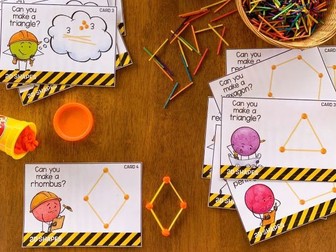
Spark creativity and critical thinking with this Pack of 2D Shape STEM Challenge Cards! These hands-on activity cards invite students to build a variety of 2D shapes using balls, sticks, or other creative materials. With accompanying recording sheets, students reflect on their designs, identify key attributes, and strengthen their understanding of shapes. Perfect for STEM centers, small group work, or independent exploration, this resource combines geometry with problem-solving in a fun, interactive way. Shapes included – square, triangle, rhombus, rectangle, trapezoid, pentagon, hexagon, octagon, kite, trapezium and parallelogram. What’s Included - 2D Shape STEM Challenge Cards (2 different types of cards): Each card features a specific shape (e.g., triangle, square, hexagon) for students to construct with tactile materials. 2D Shape STEM Slides: Suitable for classroom display on your electronic whiteboard (PowerPoint + Google Slides versions) Recording Sheets: Students document their creations, noting shape attributes like sides and vertices. Poster prompts: Two different larger format posters to prompt your students. Print Ready + Editable Versions: Choose from a ready to print PDF or choose your own language or fonts and edit in PowerPoint or Google Slides. Key Features - Hands-On STEM Learning: Encourages students to explore geometry through building and problem-solving. **Reinforces Shape Recognition: **Helps students internalize 2D shape properties by constructing and recording them. Develops Fine Motor Skills: Manipulating small parts like toothpicks and playdough enhances hand-eye coordination. Versatile Use: Perfect for STEM centers, math lessons, small group challenges, or early finisher activities. This 2D Shape STEM Challenge Pack helps students connect math concepts to real-world problem-solving, making geometry engaging and meaningful. Why You’ll Love It - Encourages Creativity and Collaboration: Students can work independently or in pairs to complete the challenges. Supports Multiple Learning Styles: Combines hands-on activities with visual and written components. **Teacher-Friendly: **Easy to prep and perfect for reuse—just print and go! Make geometry exciting with these 2D Shape STEM Challenge Cards! File type – Ready to print PDF + editable PowerPoint and Google Slides versions IMPORTANT THINGS TO KNOW BEFORE YOU PURCHASE THIS RESOURCE… All of our resources are downloadable digital files that you will be able to access immediately after purchase. What programs do I need to open and use this product? I recommend using Adobe Acrobat Reader to open any PDF files. Adobe Acrobat Reader is a free program and can be downloaded here. Ensuring your software is up to date can help to avoid any compatibility issues.
Spaghetti Challenge: STEM activityQuick View
ScienceMuseumLearning

Spaghetti Challenge: STEM activity

(33)
In this race against the clock students work as a team to build the highest tower possible out of dried spaghetti and marshmallows. The objective of this lesson is to explore structures and investigate what methods of building can make the tallest and strongest structure. By testing their prototype buildings, students will also have the opportunity to rebuild and alter their designs to improve them, giving an insight into the real-life processes of testing, redevelopment and prototyping that engineers and scientists use.
KS1 and 2 - Reading question and answer stemsQuick View
sml12

KS1 and 2 - Reading question and answer stems

(1)
Perfect for planning and teaching whole class guided reading - comprehension skills. The question stems are based around the KS1 and 2 SATs and are broken down into the different skills that children need to learn and different question types that appear in comprehensions. They are perfect for helping teachers to plan questions in reading and they include greater depth question stems. The reading answer stems give children sentence starters for answering the questions and are split into the different types of questions such as inference, retrieval, vocabulary etc.
STEM Activity Series/Wind Direction IndicatorQuick View
tinytriumphs

STEM Activity Series/Wind Direction Indicator

(0)
The Wind Direction Indicator This activity is a practical, engaging way to introduce young learners to the invisible forces of nature. By building their own Wind Direction Indicator (also known as a weather vane), children move from observing the weather to actively measuring it. This project bridges the gap between creative arts and STEM, encouraging curiosity about the environment. Key Features Tactile Learning: Children work with various textures, from soft modeling clay and smooth plastic straws to sturdy cardstock. Visual Reinforcement: The hand-drawn weather illustrations serve as a visual cue for different atmospheric conditions, helping kids associate symbols with real-world weather. Interactive Science: Unlike a static drawing, this tool responds to the environment, allowing children to see the immediate impact of a breeze. What This Teaches SkillConceptMeteorologyUnderstanding that wind isn’t just “air” but has a specific path and force. Spatial Awareness Learning to orient themselves using the cardinal directions ($N, S, E, W$). Physics Discovering the “balance point” (center of gravity) required for the straw to spin evenly. Engineering Following a multi-step assembly process to create a functional mechanical device. Instructional Context This activity is designed to be scaffolded. Phase 1 (Creative): Focuses on the artistic decoration of the base plate, allowing for personal expression. Phase 2 (Technical): Focuses on the precision of cutting the arrow and finding the balance point. Phase 3 (Application): Moving the tool outside to observe and record data. Note for Facilitators: This project is an excellent companion to lessons on seasons, local geography, or community helpers (like meteorologists). It transforms a simple paper plate into a scientific instrument, proving that you don’t need expensive equipment to explore the world. 15+Pdf Included
Bubbles investigation - STEMQuick View
sdeamer

Bubbles investigation - STEM

(0)
A fun and exciting experiment for KS3/4 students to practice investigation skills, looking at how glycerine affects how long bubbles last. Focusing on STEM Careers - looking why a company might employ you to conduct this investigation Included is a Ppt and an investigation sheet to help students learn how to plan and write out an investigation. (Best to be printed on A3 if going to print out). Ppt, Word & PDF version avaliable If you are happy with this resource, please leave a review. Thank you
Building Bridges STEM Activity STEM ChallengeQuick View
missotech3

Building Bridges STEM Activity STEM Challenge

(0)
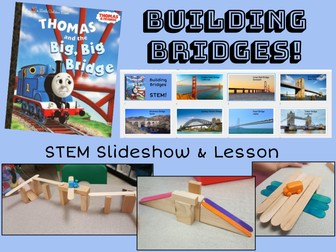
STEM Building Bridges lesson - Great for Kindergarten & elementary. This pack contains: Teacher directions & guide Slideshow in PDF & Powerpoint - can also be used as task cards Two drawing extension sheets in PDF This slideshow contains various photos of bridges from around the world. Show these bridges to your students along with the examples, then let creativity take over. Great read aloud lesson - Thomas & The Big Big Bridge. Need basic materials to start.
Winter Olympics STEM Activity WorksheetsQuick View
kstrick92

Winter Olympics STEM Activity Worksheets

(0)
Bring the excitement of the Winter Olympics into your classroom with this engaging set of STEM activity worksheets, designed to help students explore real-world science and maths through sport. This resource includes five Winter Olympic sports, each carefully linked to key STEM concepts such as forces, motion, angles, data analysis, and human biology. Perfect for STEM lessons, enrichment activities, cover work, or Olympic-themed weeks. Each sport topic contains 3 differentiated tasks plus full model answers, making planning quick and easy. 1. Ice Friction & Speed Skating Investigates friction, surface texture, and speed Students compare motion on different ice conditions Links physics to athlete performance 2. Bobsled Aerodynamics & Drag Explores air resistance and streamlined design Students analyse how shape affects speed Includes engineering-style thinking and design features 3. Ski Jumping: Angles & Motion Focuses on launch angle, speed, and jump distance Encourages mathematical reasoning without complex formulas Ideal for teaching forces and projectile motion concepts 4. Biathlon: Heart Rate & Accuracy Connects biology and physics through real Olympic data Students examine how heart rate affects shooting accuracy Strong links to data interpretation and cause-and-effect reasoning 5. Curling: Friction & Motion Explores how sweeping changes friction Includes data analysis tasks similar to graph interpretation Encourages prediction, pattern spotting, and real-world decision making What’s Included 5 sport-based STEM worksheet sets 15 structured student tasks (3 per sport) Full model answers for every activity Clear data tables and real-world scenarios Print-friendly PDF format Perfect For Upper KS2 / Lower KS3 (Grades 5–7) STEM lessons and cross-curricular teaching Olympic or sports-themed units Extension, enrichment, or fast-finisher activities
Bridge Building STEM club/ STEM lessonQuick View
rfitzsimon

Bridge Building STEM club/ STEM lesson

(0)
This powerpoint (and the others I have uploaded) is amazing for a STEM club or a standalone STEM lesson. We used to run a full STEM curriculum for KS3, so have a look at the bundles for sale - our pupils loved STEM lessons!
The Egg Drop - STEM ActivityQuick View
adamjharvey245

The Egg Drop - STEM Activity

(0)
The Egg Drop STEM Challenge is a nice variation on the commonly used egg parachute challenge. Your class will work together in small teams, thinking about the best way to protect an egg from being dropped using natural materials. They will be encouraged to think about the properties of different materials, considering which one will work best. The whole activity is based around a story of an explorer who is trapped in the North Pole and needs food supplies, and of course, his favourite food is egg! Read the instructions to your class before putting them into groups of 2 or 3. Encourage them to hunt out different natural materials that they think will protect them egg from breaking. Once they have padded out the tubs, give them the egg and see if it works by dropping it from a good height! To save on money and waste, if an egg does not break, it can be re-used by the following team. Once the challenge is complete each student can fill in an evaluation sheet. Resources needed: Supply of natural materials in an outdoor space Activity sheets Small tubs (big 500ml or similar) Somewhere high to drop the eggs from (first floor or second floor) Please don’t forget to rate this resource to let us know what you think. Also, be sure to visit my store and FOLLOW ME to see my new products and hear about upcoming sales!