A lesson introducing Year 12 students to the Feminist perspective
Activities include:
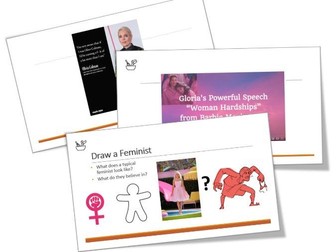
Draw a feminist
Discussion of book extracts from ‘Invisible Women’
Film clip from the ‘Barbie’ movie
‘Star rating’ final evaluation
Essay questions at the end, as well as an example paragraph and suggested sentence starters
Follows a ‘Be more chef’ model - the lesson takes cooking as an analogy for the starter, main and plenary. The ‘Be more chef’ concept pushes students to go beyond the recipe at the end of the lesson, and strive towards additional independent study
Powerpoint and student workbook included
Additional articles relating to ‘Barbie’ and gender
AQA A-Level Sociology: Feminism and the Family – Complete Lesson & Resources
This is a fully resourced and challenging A-Level Sociology lesson on Feminist Perspectives of the Family, designed specifically for the AQA Paper 2 Families & Households unit.
Perfect for both first-teach and revision, this bundle is structured to stretch the most able while supporting students who need more scaffolding. It is ideal for 50–90 minutes of teaching.
What’s Included?
-Fully editable PowerPoint (Feminism and the Family)
Clear explanations, debate prompts, AO1/AO2/AO3 integration, and scenario-based application tasks.
-High-level hinge questions (MCQ style)
Designed to check for understanding after teacher-led explanation, with plausible distractors for desirable difficulty.
-Concept sorting task (worksheet and task slides)
Engaging, challenging retrieval activity where students categorise quotes, policies, and theorists by feminist type — includes false clues to stretch thinking.
-Structured consolidation worksheet
Allows students to apply knowledge, justify answers, and revisit key theorists and ideas across all four feminist strands.
-Embedded case studies & debates
Realistic family scenarios to apply feminist perspectives and encourage critical thought. Each theory includes a debate question for stretch and evaluation.
Feminist perspectives covered in depth:
Liberal Feminism (Oakley, Young & Wilmott)
Marxist Feminism (Fran Ansley)
Radical Feminism (Greer, Delphy & Leonard)
Difference/Black Feminism (hooks, Mirza, intersectionality)
It has:
Balanced blend of AO1 knowledge, AO2 application, and AO3 evaluation
Easily adapted for 1 hour or double lessons
Promotes discussion, critical thinking, and high challenge
Visually clear and student-friendly without oversimplifying the theory
If you like it, please consider leaving a review!
AQA A-Level Sociology: Functionalism and the Family (Families & Households)
Perfect for early Year 12 | Fully resourced | Application-rich and evaluative
This lesson introduces students to the Functionalist perspective on the family within the Families and Households unit of AQA A-Level Sociology (Paper 2). It provides a clear foundation in Murdock’s and Parsons’ theories, while encouraging students to question whether these views still apply in contemporary society.
Included in this comprehensive pack:
Detailed PowerPoint with retrieval starters, visual tasks, interactive questioning, knowledge checks, and theory evaluation
Murdock summary sheet to consolidate the four functions of the family with definitions and clear examples
Parsons sheet to support understanding of Functional Fit Theory and key concepts like primary socialisation and stabilisation of adult personalities
Application worksheet featuring a real-life family case study (The Ali Family) with structured AO2 and AO3 prompts
Discussion task prompts for evaluating the relevance of Functionalist theory, supported by feminist, Marxist, and postmodernist alternatives
Key content covered:
Murdock’s four functions of the family
Parsons’ Functional Fit theory and two key functions
Shifts from extended to nuclear family
Social and geographical mobility
Evaluation using contrasting sociological perspectives
Learning aims:
Understand the key Functionalist explanations of the family’s role in society
Apply theories to real-life examples through structured case study tasks
Evaluate whether Functionalism is outdated or still relevant today
Build confidence in AO1, AO2, and AO3 responses
This resource is ideal for setting a strong theoretical foundation and encouraging analytical, evaluative thinking right from the start of the Families & Households topic.
This lesson explores the Personal Life Perspective, a contemporary approach within AQA A Level Sociology – Families and Households.
Students examine how individuals experience family life, focusing on the importance of meanings, relationships and personal connections, rather than broad structural explanations. The lesson also considers key sociologists such as Carol Smart.
Lesson Objectives:
Define the Personal Life Perspective
Explain how individuals experience and interpret family relationships
Analyse the importance of meanings and personal connections
Evaluate strengths and limitations of this approach
What’s included:
Clear, ready-to-teach PowerPoint with teaching notes
Student-friendly activities and discussion tasks
Printable worksheets
Stretch and challenge activities
Focus on key terminology and literacy
Exam-style question with structured writing support
Designed for the AQA Sociology specification (Families and Households), but easily adaptable for other exam boards.
References included to Rob Webb et al. A Level Sociology textbooks.
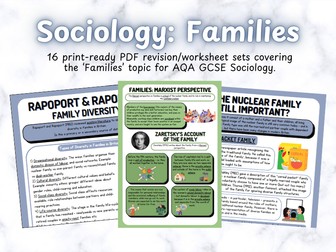
This is a large pack of resources for learning and revision of the “Families” section of AQA Sociology GCSE. The pack includes:
The Functionalist Perspective
The Marxist Perspective
The Feminist Perspective
Different Families
Rapoport & Rapoport
Conjugal Role Relationships
Changing Families
Changing Households
Wider Family Relationships
Marriage and Divorce
Theories of Divorce
Criticisms of Families
Is the Nuclear Family Still Important?
Knowledge Organisers
Practice Exam Questions
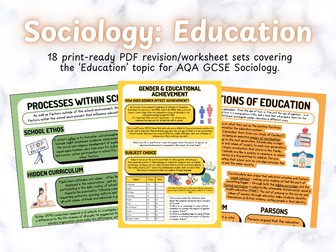
This is a large pack of resources for learning and revision of the “Education” section of AQA Sociology GCSE. The pack includes:
Functions of Education
Education & Capitalism
Feminist Perspective
Types of Schools
Independent vs State Education
Alternative Education
External Factors on Educational Achievement
Education Policies
Processes Within Schools
Social Class & Education
Social Class & Education - Explanations
Gender & Educational Achievement
Gender & Education - Explanations
Perspectives on School Processes
Ethnicity & Educational Achievement
Ethnicity & Education - Explanations
Practice exam questions
Knowledge organisers
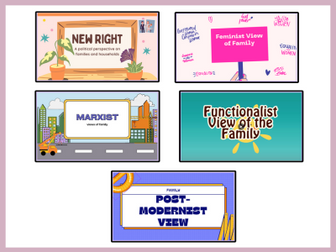
A booklet effectively summarising Functionalist, Marxist, Neo-Marxist, Feminist, Social Action and Postmodern theories.
Can be used as flipped learning stimulus or support for students revision!
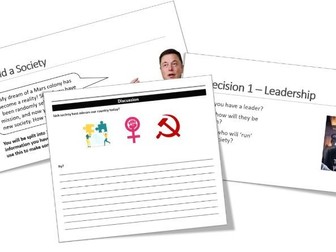
A lesson designed to introduce students to sociological perspectives (Marxism, Functionalism, Feminism) through a ‘design your own society’ game
Students make key decisions about a new colony on Mars through the lens of a given perspective, with a discussion to follow
Powerpoint and student workbook included
Instructions and resources to play a game of UNO to solidify understanding of sociological perspectives
Linked to AQA A-level Sociology
Resources include:
Game instructions
Powerpoint
Intended for use with a standard pack of UNO cards
A booklet to help students revise - this booklet supports different sociological perspectives and their attitudes towards education.
Good for both AS and A2 students.
Comprehensive vocabulary list for Unit 10 Sociological Perspectives in Health and Social Care. Contains key words for Level 3 students with meanings in simple language that students will find easy to understand. Great for a handout for the first lesson on the unit or as a classroom poster.
A lesson introducing Year 12 students to Marxism
Activities include:
‘StarPower game’ - trading strategy game
Marxism in the news
‘Star rating’ final evaluation
Exam questions at the end, as well as an example paragraph and suggested sentence starters
Follows a ‘Be more chef’ model - the lesson takes cooking as an analogy for the starter, main and plenary. The ‘Be more chef’ concept pushes students to go beyond the recipe at the end of the lesson, and strive towards additional independent study
Powerpoint and student workbook included
‘StarPower game’ requires additional resources - coloured counters and envelopes
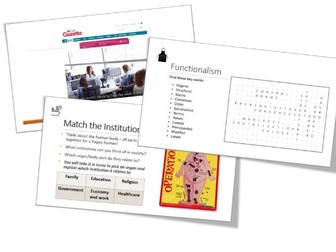
A lesson introducing Year 12 students to the concept of ‘Functionalism’
Activities include:
Group work looking at news stories
‘Operation’ board game and the organic analogy
‘Star rating’ final evaluation
Essay questions at the end, as well as an example paragraph and suggested sentence starters
Follows a ‘Be more chef’ model - the lesson takes cooking as an analogy for the starter, main and plenary. The ‘Be more chef’ concept pushes students to go beyond the recipe at the end of the lesson, and strive towards additional independent study
Powerpoint and student workbook included
PowerPoints devised for level 3 learners.
Covers Functionalism, Marxism, Interactionism and some feminism.
Devised to be delievered online but can be easily converted to classrom delivery.
Uploading on here as I am having a clear out and resetting my PC.
Enjoy
This resource contains 30 minutes of teaching time
This lesson includes;
Retrieval practice
Exam practice
MWB exercises
Writing tasks
Discussion tasks
Please check notes for teacher notes and video links
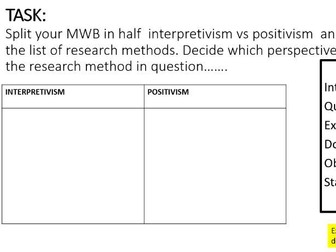
Three lesson plans taken from Michael Haralambos and Martin Holborn's classic textbook &'Sociology: Themes and Perspectives.&'; The aims of these lessons are to compare quantitative and qualitative methods, to understand basic sociological methods and to apply the concepts of validity and reliability.


 Quick View