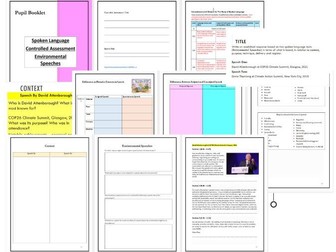
A student booklet and accompanying PowerPoint to facilitate the preparation for the CCEA GCSE Spoken Language CAT on Speeches About Environmental Issues. The speeches by David Attenborough and Greta Thunberg are included in full. They are also divided up into sections for students to annotate language and prosodic features.
Along with this are pages on context and activities to introduce students to the features or spoken language, formal/informal and scripted/spontaneous speech.
The PowerPoint and booklet both have links to the videos of the speeches; time codes accompany the speeches in the booklet.
The PowerPoint also includes an example paragraph and PEEL structure scaffold.
Help students plan and deliver powerful, persuasive speeches with this clear and structured planning sheet, designed specifically for AQA GCSE English Language Paper 2.
This resource breaks down the speech-writing process into manageable steps, supporting students in organising ideas, refining their tone, and using effective persuasive techniques.
What’s included:
A step-by-step planning framework covering:
Purpose and audience awareness
Generating ideas and key points
Structuring a speech (opening, main body, ending)
A dedicated section on tone and persuasive approach, helping students consider:
Emotional appeal, facts, anecdotes, and rhetorical questions
Audience engagement and intended impact
A detailed language features checklist, including:
Emotive language, repetition, rule of three
Inclusive language and powerful verbs
Statistics, contrast, and short impactful sentences
A vocabulary and phrases bank to encourage ambitious writing
A delivery section to support spoken performance skills (voice, body language, audience engagement)
A clear pre-writing checklist to ensure exam success
Why this resource works:
Tailored to AQA exam requirements
Encourages thoughtful planning and purposeful writing
Supports both written and spoken communication skills
Ideal for lessons, revision, homework, or intervention
Perfect for helping students produce confident, well-structured speeches that meet the demands of GCSE English Language.
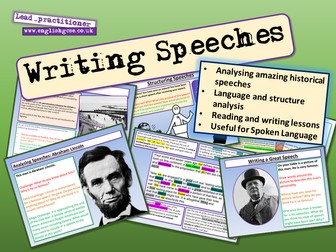
SEVEN very detailed lessons on writing speeches, which include lessons on speech openers, structuring speeches and analysing famous speeches from Winston Churchill and Abraham Lincoln and more recent examples like Barack Obama and Greta Thunberg.
Check out our English Shop for loads more free and inexpensive KS3, KS4, KS5, Literacy and whole school resources.
AQA English Language Paper 1 and Paper 2 Knowledge Organisers
AQA English Language Paper 1 Section A package
AQA English Language Paper 1 Sections A and B package
AQA English Language Paper 1 package
AQA English Language Paper 2 Question 5 package
AQA English Language Paper 1 Question 5 package
AQA English Language Paper 2 Section A package
AQA English Language and English Literature revision package
An Inspector Calls whole scheme package
An Inspector Calls revision package
Macbeth whole scheme package
Macbeth revision package
A Christmas Carol whole scheme package
A Christmas Carol revision package
Jekyll and Hyde whole scheme package
Jekyll and Hyde revision package
Romeo and Juliet whole scheme package
Power and Conflict poetry comparing poems package
Power and Conflict poetry whole scheme package
Love and Relationships poetry whole scheme package
Unseen Poetry whole scheme package
Or check out some Citizenship GCSE, RE, PSHE + RSE resources at EC Resources
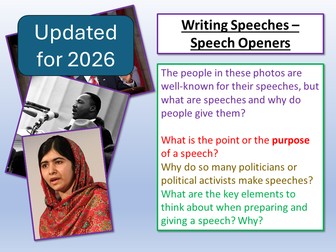
We focus on the opening sentences to speeches and think about the most effective ways of beginning speeches depending on the purpose and audience of the speech being written. Students are given topics and audiences and are challenged to write their own speech openings using modelled examples. Excellent preparation for GCSE students working on non-fiction writing and English Language Paper 1 Section B or Question 5. Fully differentiated throughout.
Updated for the 2026 papers.
Query or question? Get in touch at info@englishgcse.co.uk
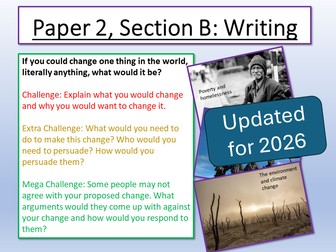
This is a fully resourced lesson that supports students in writing a persuasive speech for GCSE English Language. The focus is on audience, voice and purpose, with clear modelling and scaffolded tasks to help students write confidently.
The lesson teaches students how speeches are written to be heard rather than read. It covers direct address, inclusive language, rhetorical questions, repetition and how to end with a clear call to action. Students then plan and write their own persuasive speech.
The resource includes a PowerPoint, student worksheet, planning grid, a full WAGOLL speech (400–500 words) and clear success criteria. It is suitable for KS4 mixed-ability classes and can be used as a standalone lesson or as part of a transactional writing unit.
A 47-slide PowerPoint & Microsoft Word examples on the SPEECH for the paper 2 transactional writing exam. The following areas are covered:
Structure
Planning
Example question
Model answers
Examiner tips
Topic sentences
Stylistic features
Writing an introduction
Model paragraphs
A clear, student-friendly guide designed to help Junior Cycle students write confident, engaging, and effective speeches for exams and classroom tasks.
This resource breaks speech writing down into manageable, exam-focused steps, with a strong emphasis on audience awareness, spoken language, and persuasive techniques. It is ideal for mixed-ability classes and particularly supportive of students who struggle to move beyond “essay-style” writing.
What’s included:
Clear explanations of what makes a powerful speech, written in accessible language
A focused section on speech-specific language techniques, including:
Direct address
Rhetorical questions
Repetition
Anecdotes
Imagery
Tone and vocabulary
A real-world example of persuasive techniques taken from a public address, analysed in a clear table format
Step-by-step guidance on planning and structuring a speech, using an exam-style question
Scaffolded tasks that help students:
Identify techniques in sample openings
Improve weak openings
Write their own strong openings
Three full sample speeches on relevant Junior Cycle topics:
Global warming
Social media and wellbeing
Bullying and responsibility
Each sample includes comprehension-style questions focusing on technique and effectiveness
A final exam-style speech writing task, with clear audience, purpose, and success criteria
Planning space and a final checklist to support independent writing and self-assessment
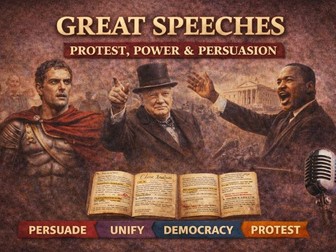
A complete Great Speeches scheme exploring protest, power and persuasion through Julius Caesar, Churchill and Martin Luther King, with structured analysis and writing.
This fully resourced Great Speeches scheme of work is designed to broaden students’ horizons by exploring how powerful speakers use language to incite change, challenge injustice and unify audiences. Across a carefully sequenced series of lessons, students develop a secure understanding of speech writing as a form of social and political protest, while building strong analytical and writing skills that transfer directly to KS3 and GCSE English.
The scheme begins by establishing what speeches are, why they are delivered and how they function within social and political contexts, with a particular focus on protest, persuasion and the incitement of change. Students are explicitly taught key rhetorical and persuasive devices and learn to identify how speakers manipulate language, structure and delivery to influence an audience. This understanding is then applied through close study of influential speeches, including Mark Antony’s speech from Shakespeare’s Julius Caesar, Winston Churchill’s wartime speeches and Martin Luther King Jr’s I Have a Dream.
Contextual understanding is woven throughout the unit, ensuring students appreciate the historical, political and moral significance of each speech. Lessons on Churchill explore leadership, democracy and national unity during the Second World War, while the Martin Luther King sequence focuses on discrimination, persecution, civil rights and non-violent protest. Students are supported to engage critically with these ideas, developing empathy, cultural awareness and a deeper understanding of how language shapes society.
A consistent WHAT–HOW–WHY paragraph structure underpins the scheme, enabling students to analyse language choices with confidence, embed quotations accurately and explain the impact of rhetorical techniques using increasingly sophisticated vocabulary such as unify, democracy, persecution, discrimination, prosperity and inauguration. Scaffolded model responses, guided annotation tasks and regular opportunities for discussion ensure accessibility for mixed-ability classes while still offering challenge.
The unit culminates in extended analytical writing, where students independently respond to the question of how speakers present ideas about social and political protest, followed by opportunities to plan, write and present their own speeches. A final presentation lesson supports students in developing oracy skills, focusing on delivery, tone, gesture and audience engagement.
All lessons are provided as ready to teach PowerPoint presentations with clear starters, structured activities, vocabulary development, model answers and assessment opportunities. This scheme is ideal for Key Stage 3 English, supports progression towards GCSE English Language and Literature, and offers an engaging, purposeful exploration of language.
AQA English Language Paper 1 lesson that looks at a famous speech from Barack Obama and helps students to see how they can adapt language devices for their own speeches. A fully differentiated and resourced lesson to help KS3 and KS4 students prepare for Section B of AQA English Language Paper 2. Students analyse a speech for language and structure before being guided to write their own.
Updated for the 2026 papers.
Query or question? Get in touch at info@englishgcse.co.uk
Check out our English Shop for loads more free and inexpensive KS3, KS4, KS5, Literacy and whole school resources.
AQA English Language Paper 1 and Paper 2 Knowledge Organisers
AQA English Language Paper 1 Section A package
AQA English Language Paper 1 Sections A and B package
AQA English Language Paper 1 package
AQA English Language Paper 2 Question 5 package
AQA English Language Paper 1 Question 5 package
AQA English Language Paper 2 Section A package
AQA English Language and English Literature revision package
An Inspector Calls whole scheme package
An Inspector Calls revision package
Macbeth whole scheme package
Macbeth revision package
A Christmas Carol whole scheme package
A Christmas Carol revision package
Jekyll and Hyde whole scheme package
Jekyll and Hyde revision package
Romeo and Juliet whole scheme package
Power and Conflict poetry comparing poems package
Power and Conflict poetry whole scheme package
Love and Relationships poetry whole scheme package
Unseen Poetry whole scheme package
This resource contains four well-known recent speeches by famous women (Angelina Jolie, Emma Watson, Michelle Obama and Theresa May) which are excellent for linguistic and rhetorical analysis.
This is a useful exercise for pupils studying persuasive writing and effective rhetoric. Not only do these speeches allow students to analyse how famous orators have used language, but they also inspire and teach how pupils can use language in their own persuasive writing too.
Each speech is transcribed here and some contain designated space for analysis and answers to questions based on common GCSE exam tasks.
This resource bundle is ideal for those studying English Language at GCSE, but is equally useful for KS3 language analysis or any other unit on rhetorical or persuasive writing.
A 9 lesson unit comprising a 69 slide PowerPoint and 9 different worksheets exploring the Language Investigation NEA for AQA English Language A Level.
Each lesson includes a starting discussion prompt which acts as a learning objective, detailed guidance on the skills and ideas listed below, a worksheet and activities, worked questions and exemplar responses, and a homework task. The following skills are covered:
Concepts and terminology
NEA Investigation overview and components
Choosing a topic
How to generate a title
Collecting data (with ethical and data protection considerations)
Selecting and analysing data (including eliminating variables)
How to write the introduction
How to write the methodology
How to write the analysis
Quantitative and qualitative analysis
How to write the conclusion
How to organise referencing, the bibliography and appendices
Check out my other English Language resources:
NEA Original Writing
Language and Gender
Language and Region
Language and Power and Occupation
Language and Global and World Englishes
Language Change
Language and Technology
Language and Ethnicity
Language and Social Groups
Analysing Spoken Language
Child Language Acquisition - Speech
Child Language Acquisition - Reading and Writing
Language Discourses - Section B, Question 3
Language Discourses - Opinion Writing - Section B Question 4
Language Levels
AQA Paper 2 Revision
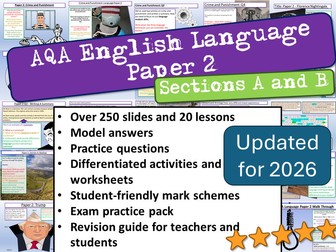
AQA English Language Paper 2 bundle that has recently been revamped and updated. Every lesson took around 7-10 hours to make and include modelled answers, scaffolds, differentiated activities, sources, engaging activities to open up challenging Q1, Q2, Q3, Q4 and Q5 (Non-fiction writing) tasks to all students.
The bundle contains 20 resources that cover both Section A (Nonfiction reading) and Section B (Nonfiction writing) so you know you'll be looking at the whole exam.
The lessons contained are:
1) Introduction lesson that looks at travel writing (Q1, Q2, Q4) - Armitage and Dickens
2) Lesson on Donald Trump article that covers Q1 and Q3
3) Lesson on travel writing (Rory Stewart, Dorothy Wordsworth) that covers Q1, Q2 and Q3.
4) Summary writing lesson that looks at Dickens and a Unicef speech
5) Crime and Punishment lesson on Q1 and Q2
6) Crime and Punishment lesson on Q2
7) Crime and Punishment lesson on Q3
8) Crime and Punishment lesson on Q4
9) Paper 2 walking, talking mock that uses the theme of crime and punishment
10) Section B opening and ending articles
11) Newspaper article writing / writing to explain
12) Magazine article writing / writing to argue
13) Speech writing (Winston Churchill)
14) Speech writing (Barack Obama)
15) Paper 2 exam preparation lesson
16) Paper 2 revision lesson
17) Escape room revision lesson
18) Paper 2 Section A knowledge organiser
19) Paper 2 Section A exam practice pack
20) Florence Nightingale themed Q1-Q4 lessons
Bundle (20x 1hr PP, differentiated tasks throughout using new GCSE numbering system)
All tasks differentiated according to new GCSE numbering system, this bundle is designed for the New Spec AQA Language Paper 2.
Complete 1 hour, well differentiated lessons, with worksheets where applicable.
Suitable for KS4 or adaptable for KS3
Different level tasks for MA,LA or Core
Designed to fit Ofsted criteria for' Good' or above.
Many more inexpensive, high quality English resources are available at my shop:
EnglishGCSEcouk
We also have new complete packs for the 2026 papers:
Paper 1 Section A: Click here
Paper 1 Q5: Click here
Paper 2 Section A: Click here
Paper 2 Q5: Click here
One Year Complete AQA 2026 pack:
Click here
A student booklet and accompanying PowerPoint to facilitate the preparation for the CCEA GCSE Spoken Language CAT on Resignation/Farewell Speeches. The speeches by Jurgen Klopp and Barack Obama are included in full. They are also divided up into sections for students to annotate language and prosodic features.
Along with this are pages on context and activities to introduce students to the features or spoken language, formal/informal and scripted/spontaneous speech.
The PowerPoint and booklet both have links to the videos of the speeches; time codes accompany the speeches in the booklet.
The PowerPoint also includes an example paragraph whilst the resources also include a whole essay and PEEL structure scaffold.
These are booklets to support students when studying about children's speech and language- Understand how to support positive speech, language and communication development for children and young people with behavioural, emotional and social difficulties
This unit of work includes all the elements and linguistic devices essential to a political speech. Pupils are asked to read different speeches, identify techniques and evaluate their effects.
Pupils are also asked to write a political speech as a response to a national catastrophe, ensuring that they follow a specific structure and include elements discussed in lessons. Pupils must also complete an evaluation of their own work.
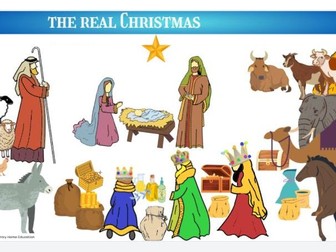
The Real Christmas is a free resource that I’ve created as an easy way to work Speech and Language, reading, logical thinking, memory, pre-writing and writing, fine motor skills, history while giving you the opportunity to teach them why we celebrate Christmas from the Christian faith.
This resource although can be used really for every child was created thinking mostly for Special Needs Education like Down Syndrome, Autism, etc
Parents can use it at home or therapists, I would say this can be for different ages depending where the child is in his development.
I created this from scratch drawing the main characters myself and enjoyed it as I will use it too, and is not easy to find resources that are made to support the SEN in particular and, from a Christian perspective.
I hope it meets the needs of your children and that you both enjoy.
Marry Christmas!!
Norma
There’s lots of research into S&L, and I’ve found most of this is squirreled away with S&LT, which can be costly to schools.
I’ve created a single sound & consonant blend intervention pack to assist with these sorts of targets.
An assessment tool to be used on all new arrivals to the school, to all initial concerns/low achievers and also across all SEN pupils.
The SLCN screen helps to focus on the needs of the individual (if any). To be used in conjunction with the Leicester City Meeting Individual Needs SLCN manual.
This is a leaflet you can download to help educators and parents research, look up and find ways to support children’s speech and language in the Early Years.
A 2 page PDF with links to websites and videos for many different speech and language support.
*Images for illustrative purposes only. Images belong to original sources


 Quick View