A 1.5 hour, fully resourced lesson providing a comprehensive introduction to Christian denominations and beliefs about The Problem of Evil and Suffering.
Written for 9-1 AQA GCSE RS Christian Beliefs and Teachings to complement the Oxford text book.
All of my AQA GCSE lessons include (as appropriate):
a fully editable powerpoint designed to last a double lesson
three levels of challenge
independent study/starter task
embedded video links
fully resourced activities/worksheets
exam practice questions
This resource has been designed to be engaging, detailed and easy to follow.
You will find many more inexpensive and free resources at my shop: PinkWatermelonTeach
Updated for 2025!
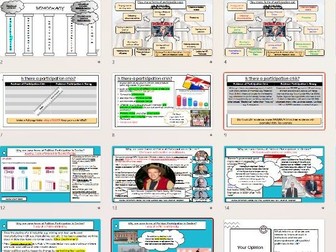
This is a 2 hour Politics Alevel lesson for Edexcel or AQA (although I teach Edexcel Component 1 UK Politics)
Lesson examining Political Participation in the UK and the changes to rates of voting in elections, referendums and membership of parties and pressure groups.
Includes fully editable powerpoint resource, evidence sheet with stats up to date as of 2025
Begins with retrieval of previous lesson knowledge on participation and levels of participation from inactive to active… also looks at riots of 2024 and why they happened/ discussion task linking to dangers of people feeling politically isolated/ forgotten.
Examples of corruption / MPs breaking rules since 2019
Also examines arguments on WHY there is a shift/ drop in political participation looking at apathy, disillusionment/ disenchantment, lack of belief in systems e.g. FPTP and partisan dealignment / rise of populism.
Word document with evidence to support/ oppose the argument that there is a participation crisis evidence and infographics updated in 2025.
Article on How UK has become one of most corrupt nations in the world
Debate sheet/ thinking quilt colour code and above article for homework.
This lesson explores Buddhist beliefs towards evil and suffering, helping students understand that in Buddhism, humans are not seen as evil, but as imperfect beings who are capable of growth. Students will learn that suffering (dukkha) is an inevitable part of life, and explore the causes of suffering, focusing on the Second Noble Truth, which teaches that suffering is caused by craving and attachment. Through engaging activities and discussion, students will explore how suffering also arises from impermanence (anicca) and ignorance (avidya). The lesson will explain how the Three Poisons—greed, anger, and ignorance—lead to suffering in everyday life. Finally, students will consider how Buddhists aim to overcome suffering through following the Eightfold Path, a practical guide to living a life of mindfulness, wisdom, and ethical conduct.
This lesson includes a range of engaging and structured activities to support student learning.
A ** PowerPoint presentation** that outlines the key content and learning objectives.
A starter activity recaps prior knowledge from the scheme of work (SOW), helping students to connect new learning to what they already know.
Throughout the lesson, questioning activities are used to promote discussion, check understanding, and encourage participation.
Students will complete an exam/ deliberate practice question to develop their assessment skills and apply their knowledge.
A student worksheet is provided with a variety of tasks to reinforce learning.
The lesson concludes with a final activity that allows students to consolidate their understanding and reflect on what they have learned.
Ideal For:
• KS3 & KS4 RE departments
• New or non-specialist teachers
• Schools introducing world religions and philosophy to younger learners
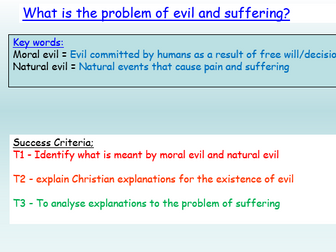
A complete lesson on The different types of evil, Moral and natural and Christian responses to suffering.
this lesson includes: class statements, statement sorting, keywords, hyperlinked images and Christian responses, structured writing grid, word fill, ASL activities including an end of Unit summary of all keywords which can be used separately. This lesson also includes a structured worksheet which is ideal for weaker students.
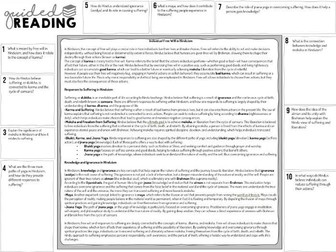
This is a guided reading sheet on Hindu Beliefs:Individual free will and responses to suffering; knowledge and ignorance. This is useful for GCSE AQA Religious Studies spec on Hindu Beliefs, where students need to know about Individual free will and responses to suffering; knowledge and ignorance.
Useful for a summary, revision, introduction, consolidation, independent task or homework on Individual free will and responses to suffering; knowledge and ignorance.
It links specifically to the AQA specification, however could be used for any spec which covers Individual free will and responses to suffering; knowledge and ignorance.
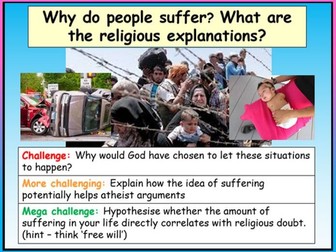
A fully-resourced, detailed and differentiated 1 hour lesson which introduces students to religious and non-religious ideas to explain suffering. Students will examine the concepts of free will, original sin, karma, dualism and much more, comparing and contrasting reigious ideas and completing a GCSE style literacy task at the end. Best suited to upper KS3.
The lesson is well-differentiated with three-level challenges for each task, contains a variety of activities, an hour long PowerPoint, a 2 page information pack, detailed worksheets, clips with differentiated questions, clear measurable LOs, new key-term introductions and other activities.
It is fully editable, engaging and very easy to follow.
Who are EC Resources?
EC Resources are the top TES PSHE providers and are a group of teachers who work together to create easy to use, high quality and editable lessons and units of work. We have created lessons for The Bank of England, The Children’s Commissioner, MACS Charity, Tes, LikeToBe Careers, the Criminal Cases Review Commission (UK Gov) and have also completed PSHE and Citizenship commissions for schools across the UK.
Check out our RE and PSHE Packages here:
Complete KS3 PSHE and RSE
Complete KS4 PSHE and RSE
One Year of KS5 PSHE and RSE
One Year of Citizenship and British Values
Complete Year 7 and 8 RE
Complete Careers and Employability
AQA Citizenship GCSE Mega Pack
We also run the EC Publishing website and you can contact us at info@ecpublishing.co.uk
Teaching PSHE, RE or Citizenship GCSE next year? Why not join our Citizenship and PSHE teachers Facebook group, with 8000 other teachers, for guidance, advice and resource sharing.
This is a complete unit of work reaching to teach!
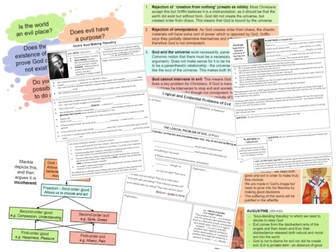
This covers the evil and suffering / problem of evil unit for RS A-level following the AQA specification. It explores differences between natural and moral evil; the logical and evidential problems of evil; and the responses to the problem of evil, including the Augustinian theodicy, Soul-Making theodicies offered by Irenaeus and Hick, and Process theodicy explored by Griffin, as well as strengths and weakness of each response.
Included in the bundle is a PowerPoint and a workbook to match. They have been made together to match exactly!
This helps to support teaching and more independent student-led learning.
If you like this resource, please leave a review!
KS3 Philosophy and Ethics - Lesson 4 of the ‘What Big Questions are there?’ Scheme of Work.
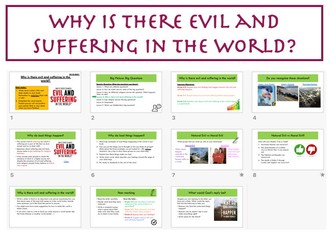
This lesson looks at ‘Why is there evil and suffering in the world’?
This lesson is an introduction to understanding why there is evil and suffering, looking at the differences between moral and natural evil with examples.
By the end of the lesson, students will be able to:
Express your own feelings and suggest reasons why evil and suffering happens.
Explain about how evil and suffering affects many people.
Question why there is evil and suffering in the world if there is a good God.
No worksheets needed - ready to download and teach straight away!
Feedback is welcome, please check out the rest of my lessons in the ‘What Big Questions are there?’
KS3 Philosophy and Ethics - Unit 1- Evil and Suffering
Students will be able to:
To identify the different between moral and natural evil
To explore to explore the problem of evil and suffering
To evaluate attitudes towards the existence of evil and suffering
Feedback is welcome, please check out the rest of my lessons in the Science and Religion Scheme of Work!
This resource helps students explore the biblical story of Job as a way of understanding Christian responses to suffering. Students will learn to retell Job’s story, highlighting his faithfulness through extreme personal loss and physical pain. The resource encourages learners to explain what Christians might learn from Job’s experiences, such as trusting in God during hardship, the value of patience, and the mystery of divine justice. Through discussion and reflection, students will also consider the challenging question: Can God still be just in a world with suffering?, allowing them to engage with both theological ideas and personal perspectives.
This lesson includes a range of engaging and structured activities to support student learning.
It includes a** PowerPoint presentation** that outlines the key content and learning objectives.
A starter activity recaps prior knowledge from the scheme of work (SOW), helping students to connect new learning to what they already know.
Throughout the lesson, questioning activities are used to promote discussion, check understanding, and encourage participation.
Students will complete an exam/ deliberate practice question to develop their assessment skills and apply their knowledge.
A student worksheet is provided with a variety of tasks to reinforce learning.
The lesson concludes with a final activity that allows students to consolidate their understanding and reflect on what they have learned.
Ideal For:
• KS3 & KS4 RE departments
• New or non-specialist teachers
• Schools introducing world religions and philosophy to younger learners
AQA GCSE Religious Studies – Suffering and Causing Suffering
This reflective and engaging lesson supports the AQA GCSE Religious Studies specification and focuses on the complex topic of suffering, both natural and human-made. Students will explore the types and causes of suffering, religious attitudes towards it, and what faith teaches about the responsibility of those who cause others to suffer. Drawing on the beliefs and teachings of Christianity and Islam, this lesson encourages students to think critically about moral responsibility, forgiveness, and justice—key themes within the Crime and Punishment unit.
Learning Outcomes:
Identify different types of evil and suffering (e.g., moral evil and natural evil)
Explain Christian and Islamic responses to suffering, including its purpose and meaning
Analyse what religious believers should do if they cause suffering, using ethical and theological reasoning
It includes a **** PowerPoint presentation**** that outlines the key content and learning objectives.
A starter activity recaps prior knowledge from the scheme of work (SOW), helping students to connect new learning to what they already know.
Throughout the lesson, **questioning activities **are used to promote discussion, check understanding, and encourage participation.
Students will complete an exam/ deliberate practice question to develop their assessment skills and apply their knowledge.
A student worksheet is provided with a variety of tasks to reinforce learning.
The lesson concludes with a final activity that allows students to consolidate their understanding and reflect on what they have learned.
Ideal For:
• Schools introducing/covering AQA GCSE Religious Studies
• KS4 RE departments
• New or non-specialist teachers
Why Choose This Resource?
Fully aligned with AQA GCSE RS (Paper 2: Thematic Studies)
Clear links to Christianity and Islam throughout
Encourages critical thinking and application of religious beliefs
Easily adaptable for in-class, homework use or remote learning
Clearly structured to support students in building high-level evaluative answers
Suitable for mixed-ability classes, with scaffolding provided to support all learners.
Evil and Suffering: Personal Suffering
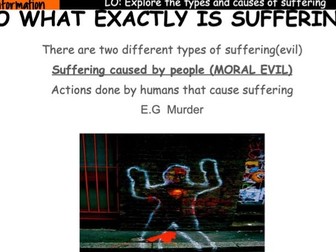
Explores the idea of personal suffering and relating own experiences to suffering in the world. Also looks into the different types of suffering - human/moral and natural and differentiating between the two.
Starter retrieval from previous lessons
Youtube clips and animations to help KS3 to understand the topic
Extension activities for all abilities
Scaffolding and Modeling
Individual and Group activities
Full powerpoint lesson
This is a fully resourced grab and go no prep lesson on suffering.
Included in this resource is:
Clear Aims & Objectives
Interactive activities
Discussion Points
Interactive plenary
Rate this resource and get another one of the same value for FREE-message us with your choice!
We hope that you enjoy this resource! We would love your feedback, if you like what you see, please follow us: on Tes TeachElite’s Shop click the’Follow this Author button’ . We will keep you updated on any sales we throw or FREEBIES we upload.
You can find us on Twitter: https://twitter.com/TeachEliteRE
and Facebook: https://www.facebook.com/TeachElite/
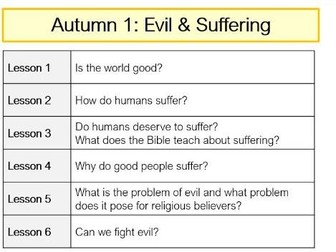
This is a fulll scheme / unit of work for KS3 Religious Studies on the topic of Evil and Suffering. It consists of six 1-hour lessons designed to be taught over a half term. It is an enquiry based approach to Religious Studies and is centred around the question, ‘can Godl love us in an evil world?’ The planning is detailed and contains all links needed. It clearly outlines how each lesson meets the ‘learning about’ and ‘learning from’ strands of religious education teaching.
Unit Overview: Pupils will build on their prior knowledge of major world religions by exploring different religious approaches to evil and suffering. Pupils will explore one of the biggest questions in religion and philosophy: Why is there evil and suffering in the world? They will focus on how Christians understand and respond to this problem, using key stories and teachings from the Bible. Pupils will critically examine the problem of evil; if God is all-powerful and loving, why does he allow suffering? They will read the Genesis story of The Fall and decide whether human disobedience warrants their suffering. Pupils will also read the Old Testament story of Job, a man who suffers greatly despite being faithful to God and what his story teaches Christians about trust, patience and divine wisdom. Finally, pupils will explore how Christians make sense of suffering – through prayer, helping others and believing in a greater purpose to life. This will conclude with a case study of Desmond Tutu, examining how his faith allowed him to stand up against injustice in the world.
The download includes:
Full detailed planning for a six-lesson unit
Clear and well presented PPT slides to accompany each lesson
Unit title page with an overview of how the unit coverage meets National Curriculum guidance for the subject
All resources needed to go along with the lessons
Having found the quote from John Stott that suffering represents the greatest challenge to the Christian faith, this worksheet is designed to compare and contrast different responses to the existence of evil and suffering.
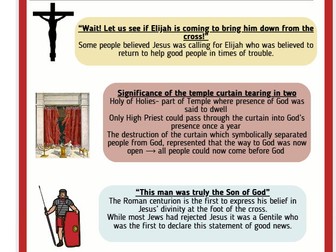
Mark’s Gospel- suffering death and resurrection revision sheets
14 pages of revision notes
Used for CCEA Mark’s Gospel Unit 5
Each story summarised with key points as well as possible questions
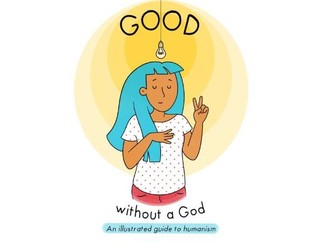
In this lesson, students will learn what it means to be a Humanist, including core beliefs such as relying on reason, empathy, and scientific understanding rather than religious teachings. The lesson explores how Humanists respond to the existence of evil and suffering, recognising that suffering is a part of the human experience but not part of any divine plan. Students will consider how Humanists seek to minimise suffering through human action, such as promoting human rights, compassion, and ethical living. The lesson also invites students to explore Humanist ways of coping with suffering, such as supporting others, building strong communities, and finding meaning through relationships and making a positive difference in the world.
This lesson includes a range of engaging and structured activities to support student learning.
A ** PowerPoint presentation** that outlines the key content and learning objectives.
A starter activity recaps prior knowledge from the scheme of work (SOW), helping students to connect new learning to what they already know.
Throughout the lesson, questioning activities are used to promote discussion, check understanding, and encourage participation.
Students will complete an exam/ deliberate practice question to develop their assessment skills and apply their knowledge.
A student worksheet is provided with a variety of tasks to reinforce learning.
The lesson concludes with a final activity that allows students to consolidate their understanding and reflect on what they have learned.
A powerpoint with activities/discussion about the problem of evil and suffering. The textbook activity it is referring to is from the folens 'Religion and Life&' book. In this activity pupils have to summarise the key Christian beliefs and then order them according to which solution to the problem they agree with most.
Used Watton's religion and life for Believing in God unit. This was put together for a group that had behavioural problems - so tasks are spread out in short bursts. can obviously be adapted to suit. Thanks to the person who provided the starter image from wealth and poverty and to the person who provided moral and evil image sequence. If you use you tube there are some empathy provoking imbed links on the 9/11 and tsunami pitures later in the lesson.


 Quick View