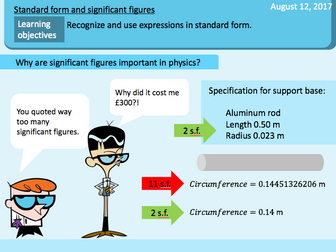
Topic: Standard form, significant figure, rounding
Level: GCSE, key stage 4
I am following the AQA science (physics) syllabus but this resource is suitable for anyone teaching KS3 or KS4 science (specifically physics). I will use this lesson to teach a class of year 9, beginning their GCSE course.
Resources:
1. Powerpoint slides: powerpoint slides, compatible with a worksheet/handout. Slides contain information and tasks for pupils.
2. Notes (editable documents) for pupils: Use this as worksheet or handout. Pupils can take notes during lesson or complete tasks in this editable document.
Hope this resource is helpful for you. Please do let me know if there's any suggestions for improvement. I aim to upload more lessons following this topic.
Enjoy!
Example of write up and the evidence I used to show I had met each teaching standard while completing my teacher training.
Great to use for ideas while for your teacher training or performance management targets.
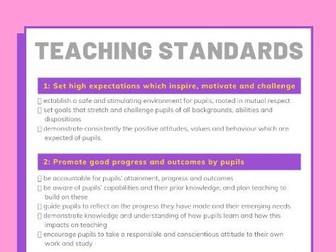
Teaching standards have been outlined to support evidence during teacher training. Each standard has been sub-categorized to make it easier to reference when submitting evidence.
Also included is a checklist to support when completing evidence. These files can both be edited.
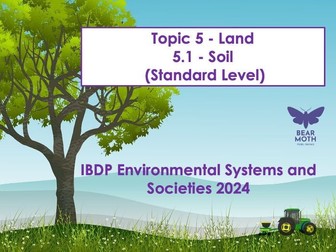
A fully resourced set of teaching materials for ESS Land Unit 5.1 – Soil. A subtopic for the new IB Diploma Environmental Systems and Societies course, first assessment 2026, which is first taught in 2024.
Created by an IB curriculum developer, examiner & workshop facilitator, this Standard Level sub-topic is part of the Land topic that is the fifth unit of the ESS course.
This unit contains three lessons with PowerPoint presentations and worksheets that can be used both in-person and for online learning, added to your Google Classroom, or opened using Google Slides.
Save yourself time, all resources are ready to click and go! All my resources are informed by over 15 years of IB DP ESS teaching and examiner experience, so you can be sure you are getting a quality resource with everything you need to teach the IB ESS content.
Features:
• Lesson 1 – What is soil?
• Lesson 2 – Investigating soil’s lab (experiment)
• Lesson 3 – Soil systems and biogeochemical cycles
• Worksheets to support learning tasks
• Clear lesson aims to meet the 2024 syllabus strands (SL)
• Key ESS terminology highlighted
• Engaging classroom activities
• Knowledge review questions
• Home learning tasks
• Starter and plenary activities
The resource is completely developed by me as an author with no use of Artificial Intelligence tools.
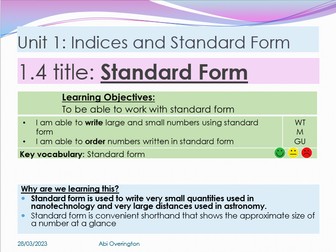
Year 9 consists mainly of three sections: number, shape and data handling. This PowerPoint includes everything you need to teach this unit for up to 4 weeks!
This topic covers a variety of skills essential for the year 9 syllabus, and is suitable and differentiated for everyone; for mainstream students and SEN students.
Including key words, plenaries and learning objectives, this module covers:
Indices
Calculations and Estimates
More Indices work
Standard Form
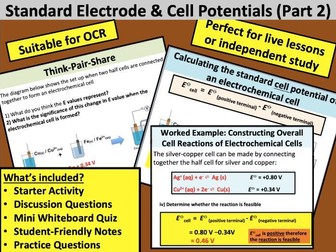
A structured KS5 lesson including starter activity, AfL work tasks and practice questions on Standard Electrode & Cell Potentials (Part 2).
By the end of this lesson KS5 students should be able to:
LO1: To use the term standard electrode potential E⦵ including its measurement using a hydrogen electrode
LO2: To calculate a standard cell potential by combining two standard electrode potentials
LO3: To predict the feasibility of electrode potentials to modern storage cells
The teacher will be able to check students have met these learning objectives through mini AfL tasks for students to complete
All tasks have worked out answers, which will allow students to self assess their work during the lesson
If you teach the AQA Specification, then purchase this lesson instead:
https://www.tes.com/teaching-resource/resource-13550668
Declaimer: Please refrain from purchasing this popular resource for an interview lesson or a formal observation. This is because planning your own lessons, including using your own lesson PowerPoints, is a fundamental skill of a qualified/unqualified teacher that will be assessed during the scenarios outlined above
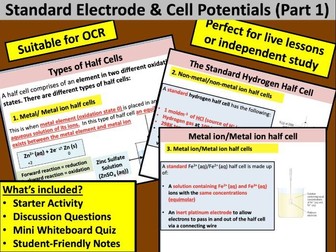
A structured KS5 lesson including starter activity and AfL work tasks with answers included on Standard Electrode & Cell Potentials (Part 1 of 2)
By the end of this lesson KS5 students should be able:
**To describe techniques and procedures used for the measurement of :
**i) Cell potentials of metals or non-metals in contact with their ions in aqueous solution
**ii) Ions of the same element in different oxidation states in contact with a Pt electrode
The teacher will be able to check students have met these learning objectives through mini AfL tasks for students to complete
If you teach the AQA Specification, then purchase this lesson instead:
https://www.tes.com/teaching-resource/resource-13550656
Declaimer: Please refrain from purchasing this popular resource for an interview lesson or a formal observation. This is because planning your own lessons, including using your own lesson PowerPoints, is a fundamental skill of a qualified/unqualified teacher that will be assessed during the scenarios outlined above
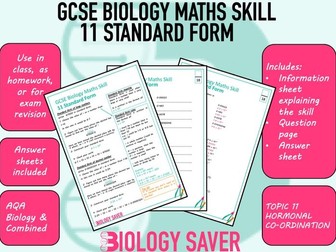
This resource covers a key maths skill for GCSE Biology. The skill covered is Standard Form which is used in Topic 11 Hormonal Coordination.
Included:
Maths skills summary checklist
Information page explaining the maths skill
Worksheet of questions
Answer sheet
This resource can be printed as a double sided A4 sheet perfect for in class activity or a homework. Recommended for year 9/10 to learn the skill during the topic or for year 11 as recap of skills as exam preparation.
Skill is required for AQA GCSE Biology and Combined Science. Skill is also applicable in other exam boards such as Edexcel and OCR.
There is a bundle containing all maths skills here:
https://www.tes.com/teaching-resource/gcse-biology-maths-skills-bundle-13097376
All individual Biology Maths skills for GCSE Biology can be found below:
1.1 Units and Magnification
1.2 Surface area to Volume ratio
2 Cell Cycle Length
3 Rate of Reaction
4 Orders of Magnitude
5 Bacterial Populations
6 Percentage Change
7 Significant Figures and Decimal Places
8 Inverse Square Law
9 Averages
10 Tables
11 Standard Form
12 Ratio, Percentage, Probability, Fraction
13 Punnett Squares
14 Frequency Density
15 Areas of Shapes
16 Population size
17 Equations and Symbols
18 Biomass Transfers
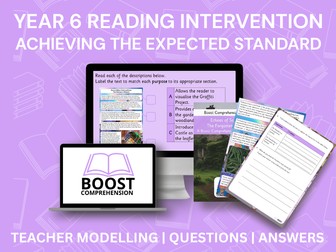
Year 6 reading SATs intervention designed to help pupils achieve the expected standard, using targeted SATs-style comprehension lessons focused on key reading skills.
Ideal for small-group intervention and support for borderline readers, this pack provides nine short, structured lessons that help pupils secure marks through accuracy, confidence, and familiarity with SATs-style questioning.
✔ Each pack contains three texts, with three lessons per text
✔ Lessons focus on retrieval, vocabulary in context, and key comprehension skills
✔ Carefully pitched to move pupils towards the expected standard
✔ Includes structured input slides (PowerPoint) with guided questioning and live modelling
✔ Independent tasks (pdf)
✔ Full answer book included for quick marking and clear guidance
✔ Ready-to-use intervention sessions with no extra preparation
✔ Supports confidence, stamina, and consistency under test conditions
✔ Taken from the Boost Comprehension scheme
✔ Suitable for pupils working towards the expected standard (EXS)
Texts included
Echoes of Solitude (Fiction)
Retrieving information
Understanding vocabulary in context
Sequencing events
Keep on Running (Interview)
Retrieving information
Understanding vocabulary in context
Making inferences
Kelburn Castle (Persuasive leaflet)
Retrieving information
Understanding vocabulary in context
Summarising key ideas
Extra practice
Twenty Minute Text – Mixed Practice: Packing Up the Past
Ideal for building stamina and applying skills independently in a SATs-style format.
Search ‘Boost Primary’ to explore the full range of Boost Primary resources, created by experienced school leaders and used by schools nationwide.
Continue the SATs Reading Journey with our ready-to-teach packs:
Reading SATs Preparation Pack 1 (3 Texts / 9 Lessons)
Reading SATs Preparation Pack 2 (3 Texts / 9 Lessons
Reading SATs Preparation Pack 3 (3 Texts / 9 Lessons)
Complete Year 6 Reading SATs Bundle (27 Lessons / 9 Texts)
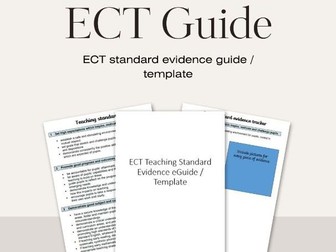
Are you an Early Career Teacher (ECT) looking to stay organised and confidently showcase your progress? Our comprehensive ECT Standards Evidence eGuide and Template is designed specifically for you! This resource provides clear examples and tips on gathering and presenting evidence aligned with teaching standards.
You’ll get:
Structured Template: Easily track and organise your evidence with our ready-made template.
Detailed Examples: Discover what types of evidence to include for each standard, such as classroom setups, lesson plans, observation feedback, and pupil progress.
Visual Guidance: Learn how to use pictures and color coding effectively to present your evidence clearly.
Proven Strategies: Find practical advice on gathering evidence from real-life scenarios—like parent feedback, behavior tracking, and CPD activities.
This guide is your go-to companion to make your ECT journey smoother, ensuring you’re prepared when it’s time to demonstrate your growth and meet the required teaching standards.
Are you looking for a resource that aids your children in understanding ‘Standard English’? Well this teaching pack is full of teaching PowerPoints, posters and worksheets to help.
Was and were - PPt, and worksheet
A or an - PPt and worksheet
The verb ‘do’ - Poster, PPt and worksheet
Standard English proof reading activities
Standard English and the use of slang PPt
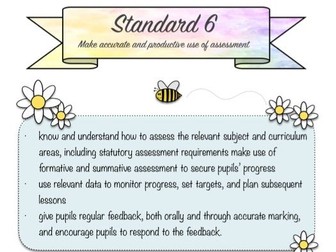
This resource is ideal for trainee teachers completing their PGCE/SCITT/similar courses or their NQT/ECT folder. Each page has the teacher standard outlined along with ideas for evidence! These can be inserted into plastic dividers that have a cover sleeve and used as covers/dividers within evidence standards folders.
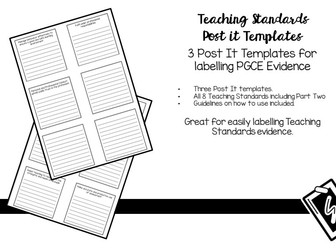
Here’s a template in made to help me label and organise all my evidence for the teaching standards.
A simple template to use for printing on Post It Notes that can then be attached to evidence and ready to file!
This download includes 1 blank template for placing Post Its, 2 sheets with the Standards and lines for making notes and guidelines for using the templates.
This resource is perfect for student placement, PGCE or NQT folders. Each standard and the expectation is stated on the cover. I suggest placing these into your folder just before your evidence, keeping track of each standard and making it easier to find and refer to specific standards.
This is a checklist for trainee teachers. Most teacher training providers require students to provide three clear pieces of evidence for each standard. This can be used to ensure you have three quality pieces of evidence. On the checklist there is a grid below each standard for the trainee teacher to write a description of their evidence. This allows the trainee to see clearly if their evidence matches up to the standard.
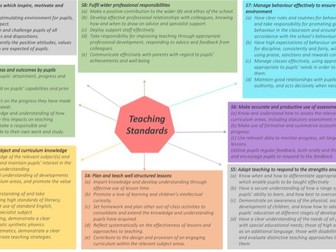
I have created a Teaching Standards Spider Diagram in order to have quick access to all the Teaching Standards throughout lessons, observations and the general teaching day.
All teaching standards come with sections, a, b, c… therefore all the requirements are included in the diagram.
There is a white coloured text version as well as a black coloured version.
This diagram is great for printing and laminating in order to have direct access to the standards.
Teaching Standards Evidence Bank – Professional Portfolio Resource for Educators - Perfect for your file!
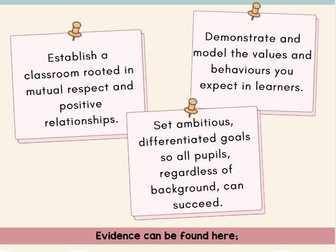
This clear, comprehensive, and attractively designed resource breaks down each of the 8 Teachers’ Standards into digestible expectations and real-world, evidenced practices. Ideal for trainee teachers, ECTs, and experienced educators alike, this document:
Translates each teaching standard into practical actions
Provides a ready-made list of real, verifiable evidence for portfolios and appraisals
Saves time when preparing for observations, performance reviews, and interviews
Supports professional reflection and goal-setting across all areas of teaching
practice
Whether you’re building a professional development folder or mentoring new staff, this document helps articulate and evidence your impact in the classroom and beyond.


 Quick View