7 fully resourced lessons suitable for KS3 Geography. A wide range of activities included e.g. crosswords, odd one out tasks, exam questions, worksheets etc. Main activities are differentiated.
Lessons include:
What is weather and climate?
How do we measure weather?
How can weather data be presented?
What are clouds and why does it rain?
What are depressions and anticyclones?
What is the climate of the UK?
How does climate vary across the world?
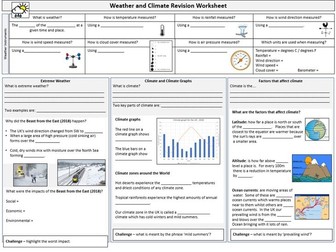
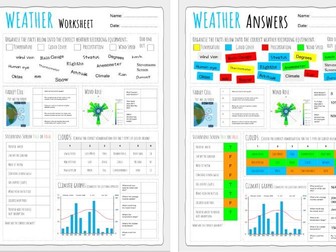
A revision worksheet on weather and climate.
Includes sections on:
weather instruments
extreme weather inc. Beast from the East
climate and climate graphs
factors affecting climate
Could be printed on A4 or enlarged easily to A3.
10 Fully resourced lessons forming a weather and climate scheme of work.
PowerPoints are engaging and interactive.
A resource booklet of over 30 pages is included along with a short end of unit assessment.
Topic includes; Differences between weather and climate, measuring the weather, cloud types, types of rainfall, air masses and the British Isles, Low pressure weather, high pressure weather, interpreting synoptic charts, factors influencing climate, drawing and interpreting climate graphs, assessment.
Please leave a review :)
2 lessons: measuring the weather, climate zones, factors affecting climate. Instructions for making a wind sock to use outside and calculating sunshine hours (to cover Numeracy framework). Couple of references to Wales (to cover Curriculum Cymreig)
A full resourced weather and climate unit made for year 8 but could be taught to any KS3 class. This unit consists of 12, 1hr lessons and includes lessons and resources for a microclimate investigation/fieldwork to be conducted around your school site.
Two seperate assessment points - one peer assessment, one teacher marked. Lessons contain fieldwork investigation including extended writing and graph creation and analysis, map analysis (TEA), creative weather report group task, creative writing tasks, research tasks, carousel tasks, QR code tasks, interactive timers and news reports, video tasks, drawing tasks, colouring tasks and more.
Lessons are as follows:
1 - What is weather and climate?
2 - How do we measure weather?
3 - Why does it rain?
4 - Climate graphs
5 - Climate zones
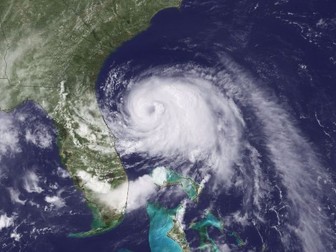
6 - Extreme Weather: Hurricanes
7 - Extreme Weather: Wildfires
8 - Extreme Weather and Climate Change
9 - What is a Microclimate?
10 - Microclimate Investigation
11 - Fieldwork Analysis
12 - Fieldwork Write-Up (Extended Writing)
All resources requiring printing are as hidden slides on the PowerPoint. Links to any videos are in the notes section of the slide.
All information is as of May 2023.
Assessment and detailed mark scheme for an end of topic test on weather and climate.
28 marks, should take approximately 40 minutes for students to complete.
Aimed at KS3 students.
In Microsoft Word Format so it can be adapted as required.
This lesson is part of Exploring Brazil, a Geography unit designed for students in KS2 (Y4-6), but can also be taught as a stand alone lesson.
The presentation first locates Brazil in the world’s climate zones and asks children to infer what the country’s weather and climate might be like.
Next, students look at three areas of Brazil in more detail – Manaus in the Amazon, Teresina in the caatinga desert region and Porto Alegre in the south of the country – and investigate a climate graph.
There are two activities:
Activity 1:
Students first investigate three climate graphs, looking at temperature and rainfall. Their challenge is to match each graph to an area of Brazil, explaining their reasoning for their choices. It is differentiated 2 ways:
Easier – Students match two statements to each climate graph, then match each graph to one of the three cities/regions.
Harder – Students write sentence describing the temperature and rainfall patterns in each climate graph, then match each graph to one of the three cities/regions.
Activity 2:
Students create their own Brazil climate graphs in Microsoft Excel using step-by-step instructions.
If you like this resource, we would appreciate a review! We will happily send you a free resource in return for a review or useful suggestions/feedback. Contact us at ed@teachitforward.co.uk.
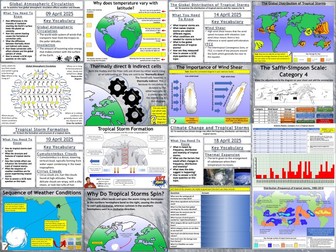
Complete Weather Hazards sequence of lessons for Unit 1, Section A of the AQA GCSE. Cyclone Idai is the case study tropical storm and Somerset Levels is the example of extreme weather in the UK.
The lessons included are detailed below.
Global Atmospheric Circulation
The Global Distribution of Tropical Storms
The Formation of Tropical Storms
Climate Change and Tropical Storms
Cyclone Idai: A Tropical storm
Reducing the Effects of Tropical Storms
Extreme Weather In The UK
The Somerset Levels Floods: 2014
Hope this saves you some valuable planning time.
https://www.tes.com/teaching-resources/shop/markthegeographer
This is a lesson, aimed to get students to think about the difference between weather and climate. In addition to thinking about how weather affects people.
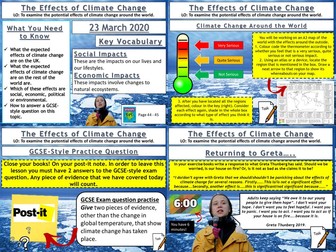
AQA GCSE Geography lesson for the new specification Unit 1A: In this fourth lesson in the section we look at the effects of climate change around the world.
We start with a quote from Great Thunberg and the pupils discuss whether they think she is right that we should be panicking about climate change and its impacts.
We then look briefly at climate change impacts in the UK where the pupils will annotate a map of the UK using information from a video clip. We then look at the impacts worldwide, the pupils will be given an A3 sheet with a map surrounded by the impacts, they first locate the region the where the impact will be felt, rate the seriousness of the impact and then categorise each one as either social, economic, environmental or political.
Using the information they have now gathered they write a response to Greta Thunberg’s quote using evidence from the lesson. We finish with a post-it plenary using a 2-mark question from the 2019 exam.
In a nutshell lesson includes:
Discussion starter over Greta Thunberg Quote
Annotated diagram of the impacts on the UK
A3 map task on the effects of climate change worldwide
Video clips where appropriate
GCSE-style question plenary
Hope this saves you some valuable planning time.
https://www.tes.com/teaching-resources/shop/markthegeographer
All resources required for lesson are attached.
The lesson provides scope for AFL and is fully differentiated.
Objectives for lesson:
- Describe weather maps
- Create your own weather map
Complete lesson in line with new English curriculum
All resources required for lesson attached, including video links in PowerPoint notes section.
PowerPoint self explanatory, accessible for any non geography specialist.
LOs
Outline the difference between weather and climate.
Categorise weather and climate processes.
Create a weather map.
This resource is part of Exploring Australia, a Geography unit designed for students in upper KS1 and lower KS2 (Y2-Y4). All resources are compatible with both Microsoft Office and Google Workspace.
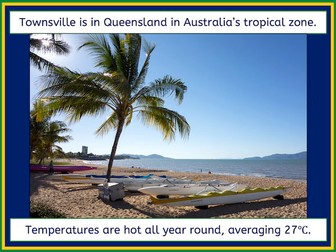
First the presentation investigates how Australia’s position closer to the Equator impacts its climate. Next, students are introduced to Australia’s three climate zones (tropical, arid and temperate) and find out how this effects weather in different parts of the country.
The activity challenges students to identify the climate zones of different Australian towns and cities:
Easier - Students identify the climate zones of 12 towns/cities.
Harder - Students identify the state and climate zones of 12 towns/cities.
Extension - Students investigate which climate zone has the most towns/cities and what this indicates about Australia’s population.
If you like this resource, we would appreciate a review! We will happily send you a free resource in return for a review or useful suggestions/feedback. Contact us at ed@teachitforward.co.uk.
This is a complete unit of work for Geography at KS3 on the topic of weather, climate and climate change for mixed ability students. It is fully contained with work book, whiteboard resources, homework and tests.
Full unit of work for Weather & Climate. This unit explores the physical and human geography of the UK with a central focus on the weather and climate of the UK. All lesson are suitable for 50 minutes to 1 hour of teaching time. Includes supporting worksheets for lessons - no additional resources are required. Most suitable for KS3 or high ability KS2.
All lessons have a starter and lesson aim. All PowerPoints in the same signature style.
Lesson sequence:
1 - Weather and climate in the UK
2 - Climate graphs
3 - Measuring the weather
4 - The water cycle
5 - Clouds
6 - Rainfall
7 - Microclimates
Module also available with 6 extra lessons as part of the UK, Weather and Climate series on the This is Geography shop.
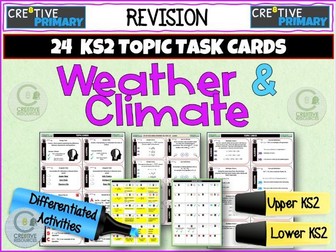
24 Weather and Climate KS2 task cards are perfect for your lesson plans and topic. They are suitable for KS2 students. They feature different activities including knowledge retrieval practice, multiple choice and spot the mistakes amongst other Fun related activities.
Contents of Knowledge Retrieval Topic Task Card bundle
✄ 1 x Set of 24 Different topic Task Cards with a range of activities and styles in a PDF versions (Q and A’s Included) - We sell the editable version if you would like it (search our store)
✄ 1 x Teacher Answer Sheet - All answers covered
✄ 2 x Student Fill in Activity Sheets that can be used with the cards (Optional)
Each Topic Task card is matched to the theme of the set and includes numbering and answers designed by our Primary Specialist . The cards can be printed in colour or black and white.
How to use Knowledge Retrieval Topic Task Cards?
These cards are perfect as an extension task, starter or plenary and as a means of testing knowledge upon completion of a unit. For a short task (extension/starter/plenary), you can simply give them one or two cards and differentiate which cards are given according to the students level or their areas needing improvement. For an end of unit, you could hand the cards out to different groups and have them switch the cards after a certain period of time (e.g. one group gets multiple choice, one group gets spot the mistakes, one group gets photocards, etc.).
Benefits of using this new style of KS2 T&L activity
Set of retrieval activities
Motivating for students
Bitesize tasks
Fun way to revise a topic
Allow for differentiation
Copy, cut and laminate – use over and over again
Versatile and can be used in many different ways
leave a nice review on TES and email us at thecre8tiveresources@gmail.com for a KS2 treat for your students.