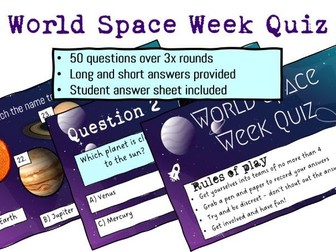
Celebrate World Space Week this October (UK) with your classes or tutor groups with this 50 question quiz themed around the event complete with answers. This resource is a 50 question World Space Week quiz created on Microsoft Powerpoint suitable for KS3 and KS4 secondary students.
There are 50 multiple choice questions in this quiz covering facts and knowledge about space and the solar system, picture matching with keywords, spacial ‘firsts’ and astro achievements as well as space in music, tv and film!
The answers are then to be shared as a class either by going through each question (ensure you are in present mode for the correct answer to colour green) for students to peer or self mark. You could alternatively use the quick answer quiz sheet variation of this quiz if you would prefer to speed things up!
I would recommend for this quiz students get into groups of no more than 4 and the activity should take no longer than 50 minutes to complete.
Check out my World Space Week crossword and wordsearch activity pack here
Please keep an eye out for my weekly tutor time quizzes which are 20 question quizzes created in a similar fashion and please review/leave feedback if you enjoyed this resource and where you have time!
Weekly tutor time quiz -October 1
Weekly tutor time quiz - October 2
Black History Month Quiz
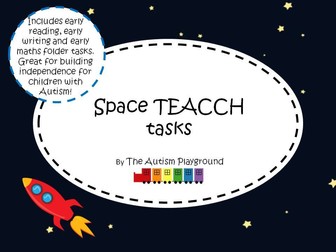
A brilliant Space themed TEACCH pack to add to your file folders. A brilliant addition to your teaching on World Space Week. Great for your pupils with Autism. A selection of early Maths, early Reading and early Writing tasks.
The tasks included are:
Colour sorting
Sorting by size (big and small) (big, medium and small)
Letter matching
Number sequencing to 5 (2 levels included)
Pencil control
Matching picture to picture
Matching picture to word
When creating this resource, you will need to print it and cut out the instructed parts. Laminate, cut and add velcro. You can then add this into a folder or put it into a tray.
TEACCH is an effective system for pupils with Autism. The structure allows pupils to work independently and master a skill.
When using TEACCH the task to be completed is to be placed on the left hand-side - the pupil then completes the task and then places this into a finished box on the right-hand side.
I would recommend using the same tasks for the specific session for around 4 - 6 weeks depending on level of the pupil. It is important to remember that when completing TEACCH it is about building independence and success at the task, you do not want to provide too much challenge. If the pupil can complete the task, this then means they can concentrate on working independently and can complete several tasks without the need for staff support. If the tasks are too tricky, the pupils will not be independent, may get up and wander or refuse to participate.
I hope this resource is useful, if you have any questions about how to use it, please just ask!
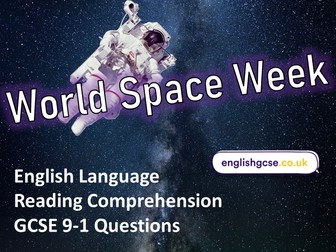
World Space Week reading comprehension pack. A detailed 2 page article that provides an overview of World Space Week and includes differentiated comprehension questions that focus on reading skills and language and structure analysis.
It can be used in form time as part of literacy focus, or in an English lesson for KS3/4 GCSE comprehension training. It is interesting, useful, very easy to use and good way to combine Citizenship and English.
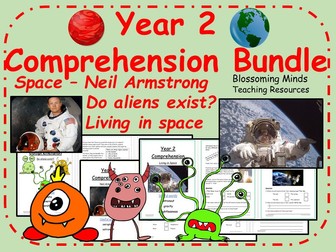
A bundle of 3 comprehension booklets based on the questioning and layout of the KS1 SATS reading papers and differentiated three ways.
The three booklets included are:
Neil Armstrong
Do aliens exist?
Living in space
PDF file format and editable Microsoft Word format included in the price.
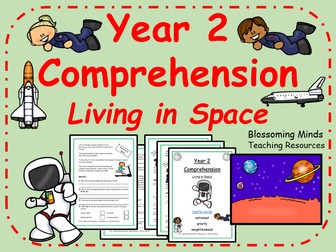
This resource is a non-fiction comprehension activity for year 2. The theme of the comprehension is ‘living in space’ and the booklet covers what it is like for astronauts living in space stations, including what they eat, how they sleep, how they exercise and what they do in their spare time. It would be perfect for using during ‘World Space Week’ in October, during a space topic or during ‘Science Week.’
The booklets are based on the KS1 SATs reading paper. I have included 3 differentiated levels. There are a range of ‘what,’ ‘where,’ ‘how’ and ‘who’ questions, some multiple choice tick questions and some that require more detailed answers. The activity is also laid out in a similar way to the SATs booklets. There is a title page with helpful words followed by four pages of pictures and short written extracts to read and 4 questions per page. Each differentiated level contains 16 questions in total.
There is a colour and black white PDF version of the booklet for each level and answers are also included.
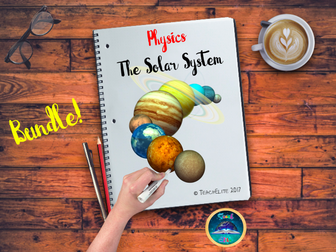
World Space Week Bundle.
Here are 10 of our resources that will be perfect to use when teaching space!
Included in this is:
Space AFL Activity: Pull the udder one!
A completely customisable true or False activity. This particular one is based on space. Pupils love the interaction shouting moo (true) or quacking for false statements. This can be used as a starter, plenary or an AFL checkpoint activity throughout the lesson.
Space Investigation: This is an independent learning investigation about our solar system. Pupils are asked to research the planets and find relevant information about them. This includes extension tasks whereby pupils research the origins of the universe and current theories (Big Bang and Red Shift).
Abstract Planet Timers: For a free sample of this resource please click here
This is a fun countdown timer resource that can be used as a time management tool in any lesson. You have a choice between various abstract planets. The timers are set to 1, 2, 3 or 4 minutes, but you can easily alter the timing between in the animation pane. Each abstract planet can be added to your own slides and displayed in the right hand corner if you so wish!
Picture Reveal - Solar System: A lovely PowerPoint that consists of clouds clearing to reveal the Solar Systems. A great little classroom tool- the pupils will love this addition to your lessons! As you press the right arrow key a cloud is removed. The aim of the activity is to clear the codes to reveal the Scene of the Solar System. There are 16 clouds in total-perfect for an activity involving Q&A.
Solar System - Conveyor Belt: This is based on the Generation Game activity and is centred around the planets in our solar system. Useful for Starter, Plenaries and mini AFL activities throughout the lesson-Pupils love this activity!
Solar System Timer: This is fun countdown timer that can be used as a time management tool in any lesson. Includes 3minutes, 2 minutes, 90 seconds, 40 seconds & 20 seconds countdowns. You can easily be altered in the animation pane to make the timer shorter or longer. The slides can all be selected, copied from this presentation and pasted and inserted into your own PPT.
Space Week Quiz: Don’t miss out on this fun Space Quiz. This PowerPoint is fully interactive with 20 questions based on the topic of space.
Each question slide is linked to an interactive score slide where you can keep a tally of each groups scores. This is a great resource for space week!
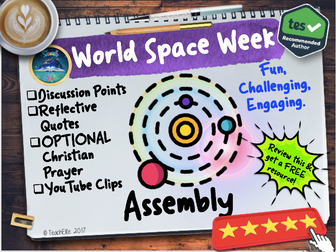
World Space Week Assembly pack contains a PPT (14 Slides) and a handout for you to make notes on each slide should you so wish.
The assembly introduces pupils to World Space Week . It includes links to YouTube clips educating them on this. This resource includes inspirational quote and an OPTIONAL Christian prayer.<br />
<br />
We hope that you enjoy this resource! We would love your feedback, if you like what you see, please follow us: on Tes <a href=“https://www.tes.com/teaching-resources/shop/TeachElite”>TeachElite’s Shop</a> click the’Follow this Author button’ . We will keep you updated on any sales we throw or FREEBIES we upload. <br />
<br />
You can find us on Twitter: https://twitter.com/TeachEliteRE<br />
<br />
and Facebook: https://www.facebook.com/TeachElite/
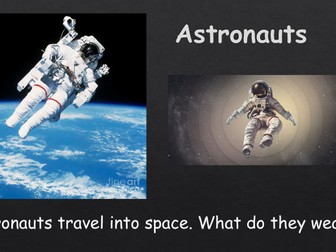
A short PPT to discuss space. Lots of opportunity for talk and to discuss the different space pictures. The PPT looks at planet Earth, rockets, astronauts and day/night.
Challenge: What will you take if you went to the moon?
You can link it to the story, ‘Whatever Next’.
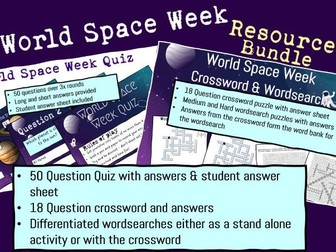
Celebrate World Space Week this October (UK) with your classes or tutor groups with this resource bundle which is a combination of my 50x question quiz, Crossword puzzle (much of the content is covered in the quiz) and Wordsearch. These resources are themed around the event and all three resources come complete with answers.
This resource for World Space Week quiz created on Microsoft Powerpoint suitable for KS3 and KS4 secondary students.
Quiz
There are 50 multiple choice questions in this quiz covering facts and knowledge about space and the solar system, picture matching with keywords, spacial ‘firsts’ and astro achievements as well as space in music, tv and film! The answers are then to be shared as a class either by going through each question (ensure you are in present mode for the correct answer to colour green) for students to peer or self mark. You could alternatively use the quick answer quiz sheet variation of this quiz if you would prefer to speed things up!
Crossword
Also included is an 18x question crossword complete with answers. Most of the answers to questions within the crossword worksheet are covered in the Quiz so I would recommend the quiz is completed first! The answers to the crossword make up the wordbank students will need to complete the wordsearch activity!
Wordsearch
Finally, there are 3x worksheets included in this resource - all have the same words to find. 2 wordsearches do not have a wordbank as students need to first complete the crossword puzzle and use the answers from the crossword to discover which words to find in the wordsearch. These are differentiated as Medium and Hard in the files. There is an additional wordsearch with a wordbank if you wish for students to complete the wordsearch as a standalone activity.
Please keep an eye out for my weekly tutor time quizzes which are 20 question quizzes created in a similar fashion. Also check out some of my other events based resources (including Black History Month) and please review/leave feedback if you enjoyed this resource and where you have time!
Black History month Quiz
Black History month crossword
Black History month Lesson
Black History month bundle
Weekly tutortime quiz October 1
Weekly tutortime quiz October 2
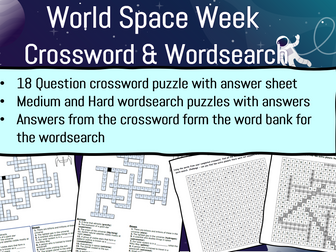
A 18 question World Space Week crossword puzzle and wordsearch designed for KS3 and KS4 secondary students. This is a stand alone activity that can be used to support a lesson or as a tutor time activity to celebrate World Space Week (4th - 10th October).
**Task: Students need to first complete the crossword puzzle to build the wordbank for the words they will then need to search in the wordsearches. **
Within this resource is:
1x 18 Question crossword puzzle with space related questions + Answers
1x Wordsearch (Hard) + Answers
1x Wordsearch (Medium + Answers
1x Wordsearch (Medium) with wordbank (so no need to complete the crossword puzzle first
Many of the answers for the crossword puzzle is covered in my World Space Week Quiz which can be downloaded here.
Teachers are provided with an answer sheet which is a completed version of the crossword puzzle.
Fancy all 3 resources at a discounted price? Download my World Space Week quiz, Crossword and wordsearches here.
A long assembly (or 2/3 short ones). starts by looking at what space is, moves onto the planets in our solar system. then asteroids and comets. looking at alien life and what it could look like. Then onto the international space station and how it was built. Next a little look at Tim Peake, finishes with the you tube video of when the ISS does Bowie
This powerpoint involves pupils thinking about what they would need if they were to find another planet for humans to survive on. It takes pupils through a series of demonstrations (videos links available if you don’t have the equipment) and practicals that they are able to do to get them thinking about what they would need for finding and surviving on a different planet. The slides have some pictures and minimum words on. The majority of the work in the notes section of the slides, which goes through what you can discuss with the pupils and any video links you can show them linked to this. This is adaptable, to use as a ‘science show’/assembly or as a series of lessons. With the practical side, it would take more than one lesson. I have used this style for a few demonstrations for later primary school years and also early high school years and they have all really enjoyed the mix of demos and practicals that they can take part int.
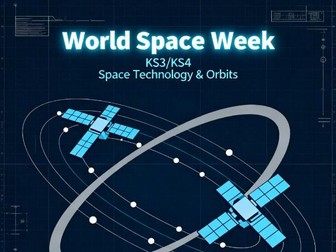
**KS3/KS4 World Space Week PowerPoint – Gravity, Orbits, Satellites, and Space Technology
**
Overview
A detailed PowerPoint presentation for KS3 and KS4 science lessons to celebrate World Space Week. Covers core physics and astronomy concepts including gravity, orbits, artificial satellites, and space technology, with interactive elements and classroom experiments.
What’s Included
Explanation of gravity with Newton’s law in simple terms
How gravity keeps planets and moons in orbit
Circular and elliptical orbits explained with diagrams
Natural vs. artificial satellites and their uses
Real-world impact of space technology on daily life
Timeline of space exploration and technology milestones
Classroom gravity demonstration and vacuum experiment discussion
Orbital mechanics and escape velocity explained
Interactive quiz and reflection on the future of space exploration
Learning Objectives
Define gravity and explain its role in the solar system
Describe how orbits work and apply the concept to satellites
Identify the difference between natural and artificial satellites
Understand the impact of space technology on Earth
Recognise key milestones in the history of space exploration
Apply scientific knowledge through class experiments and discussion
Who Is It For?
KS3 and KS4 science teachers
Physics and astronomy lessons
Cross-curricular use during World Space Week (4–10 October)
Whole-class teaching, revision, or assemblies
Why Choose This Resource?
Curriculum-linked content aligned with KS3/KS4 physics
Ready-to-use with engaging visuals and activities
Combines theory, history, and practical experiments
Saves teachers planning and research time
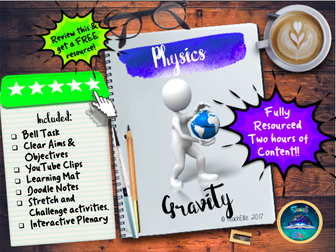
This is a 2 hour ‘Grab & Go’ lesson on the concept of gravity and the Space Race. perfect for Space Week
Included in this lesson is:
Bell Task
Clear Aims & Objectives
YouTube Clips
Learning Mat
Doodle Notes
Stretch and Challenge activities.
Interactive Plenary
If you review this resource we will give you another resource for FREE.
We hope that you enjoy this resource! We would love your feedback, if you like what you see, please follow us: on Tes <a href=“https://www.tes.com/teaching-resources/shop/TeachElite”>TeachElite’s Shop</a> click the’Follow this Author button’ . We will keep you updated on any sales we throw or FREEBIES we upload. <br />
<br />
You can find us on Twitter: https://twitter.com/TeachEliteRE<br />
and Facebook: https://www.facebook.com/TeachElite/
This mind-blowing and educational 22 slide assembly looks into some interesting facts about the Universe. Can be used as a part of World Space Week or any other time of the year. The assembly includes video’s pictures and key information to amaze and engage your KS3 or KS4 students.
The assembly includes:
What is the Universe
How old is the Universe?
How big is the Universe?
5 informative and engaging videos
What is: a light year, a black hole
Comparisons in size
Interesting facts about the Universe
Personal reflection question
Please also visit my TES Assembly Store where over 100 assemblies are available on a huge range of topics.
A ready-to-use assembly on World Space Week, suitable for EYFS and KS1 classes.
Designed to save teachers valuable planning time, this resource provides an engaging, age-appropriate presentation that is ready to use with your children – simply open and deliver!
Perfect for class, year-group or whole-school assemblies, without the time-consuming planning and slide creation.
 Quick View

 Quick View
 Quick View
 Quick View
 Quick View
 Quick View
 Quick View
 Quick View
 Quick View
 Quick View
 Quick View
 Quick View
 Quick View
 Quick View
 Quick View
 Quick View
 Quick View