

 Quick View
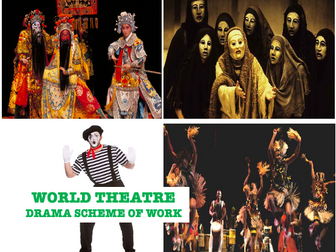
World Theatre Drama Scheme of Work
This is a 6 lesson scheme of work exploring different theatrical traditions and styles around the world.
The download includes 6 fully prepared power-point lessons and all additional worksheets and resources. This also includes and assessment lesson.
All lessons are easily adaptable to suit the needs of classes.
Lesson 1 - Ancient Greek Theatre and Chorus
Lesson 2 - African Theatre
Lesson 3 - Chinese Theatre/Peking Opera
Lesson 4 - French Mime Theatre
Lesson 5 - Recap and assessment preperation
Lesson 6 - Assessment Lesson
Bundle Sale
 Quick View
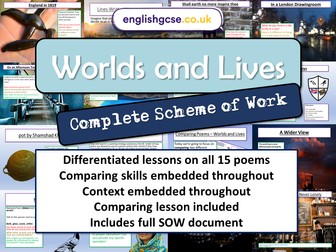
Worlds and Lives
Worlds and Lives pack for the new AQA poetry anthology. Currently includes:
Lines Written in Early Spring - William Wordsworth
England in 1819 - Percy Bysshe Shelley
Shall earth no more inspire thee - Emily Bronte
In a London Drawingroom - George Eliot
On an Afternoon Train from Purley to Victoria, 1955 - James Berry
Name Journeys by Raman Mundair
pot by Shamshad Khan
A Wider View - Seni Seneviratne
Homing - Liz Berry
A Century Later - Imtiaz Dharker
The Jewellery Maker Louisa Adjoa Parker
With Birds You’re Never Lonely - Raymond Antrobus
A Portable Paradise - Roger Robinson
Like an Heiress - Grace Nichols
Thirteen - Caleb Femi
Comparing poems lesson
Scheme of Work document
 Quick View
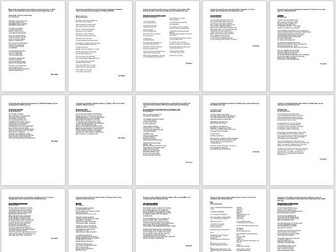
Worlds & Lives Practice Questions
Fifteen practice questions for the Worlds & Lives anthology poems.
There are 15 fully formatted questions, one for each of the poems. Printable as singular sheets for in-class practise or as a booklet for student revision.
** Get these as part of a bundle with full scheme of work and 15 lessons**
Sale
 Quick View
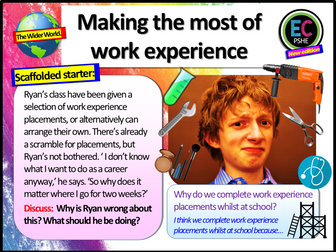
Work Experience
NEW DfE 2026 GUIDELINES COMPLIANT (see lesson plan included for details). An updated, 2026 version of our popular work experience lesson. Covers why we do work experience, the Dos and Dont’s, top tips for making it successful, how to make the most of your time and much more. Includes case study tasks, analysis tasks, clip tasks, creative tasks - everything you need to cover the subject in an hour and perfect for non-specialists!
This lesson is taken from the new EC Publishing Complete 2026 PSHE Package which can be found at the EC Publishing website. Everything is editable and easy to pick up and run with and includes future DfE updates too.
This has been written to cover the 2026 PSHE guidance from the DfE and PSHE Association for Careers / PSHE. Includes detailed lesson plan.
We are confident you’ll be pleased with this resource – however, if you have any issues at all, contact us at info@ecpublishing.co.uk and we’ll help you straight away. If you try to contact us through Tes we may not for be alerted for days so may not be able to help you on time.
Who are EC Resources?
EC Resources are the top TES PSHE providers and are a group of teachers who work together to create easy to use, high quality and editable lessons and units of work. We have created lessons for The Children’s Commissioner, The Bank of England, The British Legion, MACS Charity, Tes, LikeToBe Careers, the Criminal Cases Review Commission (UK Gov) and have also completed PSHE and Citizenship commissions for schools across the UK.
Please visit our Tes store https://www.tes.com/teaching-resources/shop/EC_Resources for everything PSHE, RSE, RE and Citizenship.
email info@ecpublishing.co.uk
Check out our PSHE Packages on Tes here:
Complete KS3 PSHE and RSE
Complete KS4 PSHE and RSE
Complete KS5 PSHE and RSE
One Year of Citizenship and British Values
Complete KS3 RE
Complete Careers and Employability
AQA Citizenship GCSE Mega Pack
Teaching PSHE, RE or Citizenship GCSE next year? Why not join our Citizenship and PSHE teachers Facebook group, with 12,000 other teachers, for guidance, advice and resource sharing.
Bundle
 Quick View
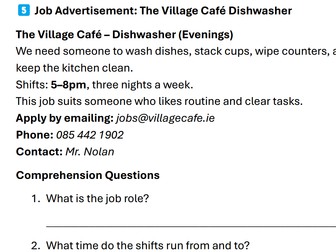
World of Work
A set of comprehensions, social stories and activities to get students ready for a real world working environment. Items covered include: Reading job advertisements, filling in forms, interview techniques and more.
undefined
 Quick View
World Cup Art Project
art lessons where the pupils will design their own football team including Kit, Badge, poster for the world cup, a ball design and a design for a new world cup trophy.
includes a Power Point presentation and a booklet for the pupils to work from.
 Quick View
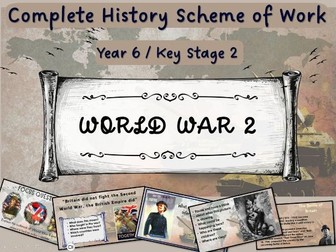
World War 2 - Complete History Scheme of Work KS2.
This is a complete 5-week scheme of work, based on the history of the World War 2 . Written for Key Stage 2, but easily adapted
Objectives covered:
To understand why Britain had to go to war in 1939
• To understand the role of the British Empire in WW2
To understand the impact of the Blitz.
• To understand the impact of the war on the lives of women.
• To understand the impact of evacuation on children
There is a free sample available of lesson 1 here: https://www.tes.com/teaching-resource/-13303187
Each lesson comes with all resources and an editable powerpoint. There is also a medium term plan for all 5 lessons.
 Quick View
World of Work
An A5 booklet and corresponding PowerPoint presentation introducing students to the world of work and employability skills. The Powerpoint is easy to follow and students complete activities in their booklets as they go. Can take up to 2 lessons and can be adapted and extended as you wish.
Booklet introduces students to linking their interests and achievements to transferable skills, followed by guidance on how to write a CV and tackle difficult interview questions.
Great to linking in the Gatsby Benchmarks and works with multiple year groups but would target yr9 onwards.
Bundle
 Quick View
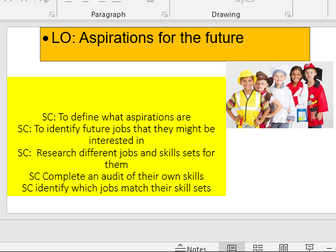
The world of work
This bundle pack is designed for SEN or lower level learners. The pack consists of ‘What is enterprise’?
What is unemployment and ‘aspirations for the future’. There are multiple differentiated tasks and video clips to aid understanding which can be used for discussion.
 Quick View
World of Work
We had a themed week in school where pupils had to think about the world of work. A variety of activities, from thinking about different jobs, general ideas about what they want to be and a detailed for to include research on their chosen job. We rewarded throughout the week with WOWW tokens. The most collected won a prize.
 Quick View
World Cup 2026 English Lesson
Make the most of this year’s World Cup with these fun and engaging football focused creative writing resources, based around and inspired by the World Cup in the US, Mexico and Canada!
25 slides jam packed with content, this lesson is sure to get your students excited about this major sporting event, whilst helping them improve their creative writing skills. Complete with a printable worksheet, this lesson has the following structure:
Starter - Quiz (general knowledge/picture round/English based World Cup Questions) with peer-assessed answer slides
Differentiated lesson aims with a big question
Background and context to the World Cup
Using sensory description to envisage a stadium
Video stimulus of England’s trip to the Euro 2024 final to generate ideas about thoughts and feelings of being in that moment
Image based stimulus for independent creative writing task
Exemplars of good and bad responses for students to evaluate
Self-assessment activity in which students edit and improve their own work based on the exemplars
The lesson has lots of differentiation opportunities with scaffolding and stretch and challenge opportunities throughout; full teacher notes are provided underneath the slides to ensure that the lesson is ‘ready to roll’ with no adaptation required.
This lesson is recommended for students from year 6 up to year 10 - so top of Key Stage 2, Key Stage 3 and the bottom of Key Stage 4.
Feedback and reviews very much welcomed and appreciated.
Bundle
 Quick View
An introduction to the world at work
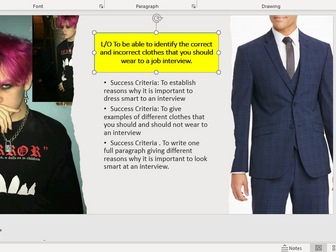
This bundle pack covers, responding successfully to a job advertisment, an introduction to possible interview questions, do’s and dont’s at a interview and what to wear at an interview. There are video clips and multiple resources for each lesson.
 Quick View
The changing world of work
Previously part of The Preparation of Working Life qualification although cross-curricular. Presentation covers the Learning Objectives; To be able to describe the changes in the world of work and how the changes will affect us. Includes starter activity, links, discussion points and interactive Black Hole plenary which can be used time and time again.
 Quick View
KS3 Travel Writing Complete Scheme of Work
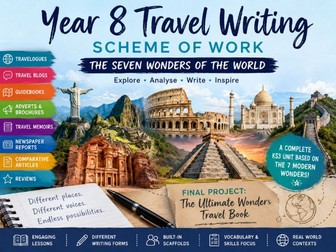
Travel Writing Scheme of Work | Seven Wonders of the World | Full KS3 SOW
A complete and engaging Year 8 Travel Writing Scheme of Work based around the Seven Modern Wonders of the World. This fully resourced KS3 English unit takes students on a journey across some of the world’s most iconic landmarks while developing their ability to write for different audiences, purposes and forms.
Students explore locations including Petra, Machu Picchu, Christ the Redeemer, Chichén Itzá, the Colosseum, the Taj Mahal and the Great Wall of China, using each wonder as a springboard for a different style of travel writing.
Across the scheme, students learn how to write:
• Travelogues
• Travel blogs
• Guidebook entries
• Travel adverts and brochures
• Travel memoirs
• Newspaper reports
• Comparative travel articles
• Reviews
• A final travel writing project booklet
The lessons are designed to build confidence with both creative and transactional writing, making the unit ideal preparation for later GCSE English Language skills. Students are encouraged to adapt their voice, tone, structure and vocabulary depending on the form they are writing in.
What is included?
• A full sequence of visually engaging PowerPoint lessons
• Do Now retrieval activities
• Clear learning objectives
• Contextual information on each wonder
• Model texts for students to analyse
• Vocabulary development, including Tier 2 word banks
• Explicit teaching of form, audience and purpose
• Writing scaffolds and sentence starters
• Success criteria for each writing task
• Peer assessment and self assessment opportunities
• Comparative writing tasks
• A final extended project: The Ultimate Wonders Travel Book
Key writing skills covered include:
• Sensory description
• Show, don’t tell
• First person narrative voice
• Informal blog voice
• Formal guidebook tone
• Journalistic structure and the 5 Ws
• The inverted pyramid structure
• Persuasive writing using AFOREST
• Comparative connectives
• Topic sentences
• Parenthesis
• Personification
• Similes and metaphors
• Pathos and emotional appeal
• Adapting tone for different audiences
This scheme is ideal for Year 8, but could also be adapted for Year 7 or Year 9, especially as a creative non-fiction or transactional writing unit. It works particularly well as a high-interest KS3 unit because students are exposed to real-world places, rich vocabulary, varied forms and purposeful writing tasks.
The final project asks students to create their own Ultimate Wonders Travel Book, bringing together multiple travel writing styles into one polished publication. This makes the unit perfect for display work, assessment, homework projects or an end-of-term writing showcase.
This resource is suitable for:
 Quick View
Primary Meta-Skills Progression (SDS Aligned) & World of Work Connections
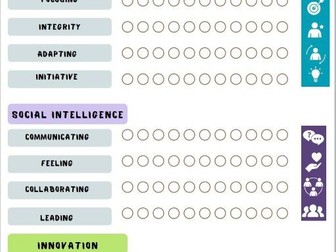
This resource is my whole-school skills framework (P1-P7) that directly links to the Skills Development Scotland (SDS) meta-skills. It comes with all the supporting materials you’ll need, plus clear connections to the world of work to help pupils see the ‘why’ behind their learning.
We’ve implemented this across our whole school, and the feedback from staff has been amazing! It’s made a real difference to pupil engagement, how they develop essential skills, and their overall learning.
I really hope this helps your school foster those crucial meta-skills and boost curriculum coherence across your primary stages!
 Quick View
La Coupe du Monde - World Cup 2026
This resource includes a PPt, workbook and worksheet built around the upcoming 2026 World Cup. It introduces the host countries, with a focus on Canada as a francophone country and includes a link to watch and hear more about the range of stadia. A straightforward colour by numbers of the flags is included. It also looks at the mascots and language work around qualities associated with them, so useful vocabulary for role models, backed up by links to Wordwalls. There are several reading texts and tasks arranged to reinforce reciprocal reading skills: what are the issues around tickets (a chance to revise numbers in a different context), the technology of the 2026 football and the history of the competition. There is also a chance to find out more about the countries participating and work on the grammar around being ‘in’ or going ‘to’ a country.
Languages and the world of work
A powerpoint featuring facts and figures, a video and a quiz on how useful languages can be when entering the world of work. No prior knowledge required. Facts and figures from CILT website.
World of Work and Job interviews
A presentation and a couple of worksheets used to prepare Y11 for a spoken controlled assessment. This set concentrates on dream jobs and interviews.
The way I used the parallel text was to initially practice pronunciation, then for the students to highlight key phrases that they would consider useful for speaking on both sides of the text, before finally manipulating them to give them their own meaning.
keywords: Traumberuf, Jobs, dream job, Bewerbung, application, interview