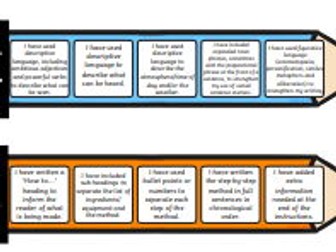
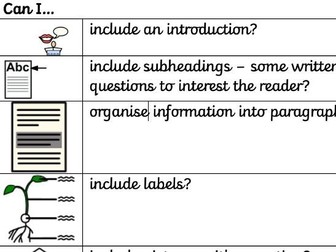
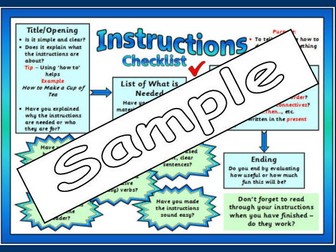
Designed to help the children whilst they are writing instructions in Literacy, the Instruction Checklist Mat is a useful tool for the children to ensure that they address all the features of this particular genre in their own work. By making the Instruction Checklist Mat available on classroom tables, the children have instant access to ideas and, therefore, are more equipped to work independently. The Instruction Genre Checklist Mat can be re-used, especially if laminated for durability and has been produced in full colour using the Sassoon Primary font. Topics included: instructional/procedural texts.
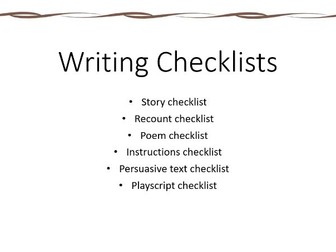
A wide collection of fictional and non-fictional genres of writing ‘checklist’ pencils. These are detailed and informative pencils, outlining the Structural Features and Language Features of the following genres of writing:
Non-Fiction:
Formal Letter
Informal Letter
Diary Entry
Newspaper Report
Non-Chronological Report
Instructional Writing
Discursive Writing
Persuasive Writing
Fiction:
Narrative Writing
Character Description
Setting Description
Can be laminated as a full set for children to lay in front of them during the writing process. Downloadable as a PDF.
Use these in class for children to guide their instructional, descriptive and report writing.
Children can use these as a self assessment tool/success criteria.
Very useful to guide teacher’s planning and teaching episodes too.
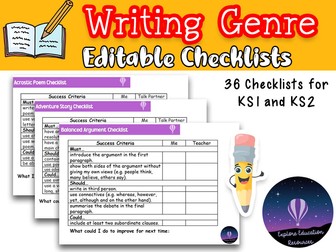
This resource provides 36 writing checklists tailored for KS1 and KS2. Each checklist focuses on a different genre or text type, offering clear criteria to help teachers assess, plan, and guide writing development.
What’s Included:
✔ 36 genre-specific writing checklists
✔ Checklists for a range of writing styles, from acrostic poems to traditional tales
✔ Editable format for easy use and customisation
Lesson Overview / Structure:
★ Writing Checklist Framework
- Each checklist includes "Must," "Should," and "Could" statements to guide assessment.
★ Versatile Use
- Ideal for planning lessons, guiding self-assessment, and providing peer and teacher feedback.
★ Time-saving Assessment Tool
- Streamline the process of assessing writing with clear, concise criteria that help students focus on areas for improvement.
Why It’s Useful:
✔ Covers a wide range of writing genres for KS1 and KS2
✔ Differentiated assessment to support all learners
✔ Editable for ease of use and adaptability
✔ Saves time while providing targeted feedback
Suggested Use Cases:
Perfect for KS1 and KS2 teachers, writing assessments, lesson planning, and supporting self-assessment and peer feedback.
Search Tags:
KS1 writing checklists | KS2 writing assessment | Writing genre checklists | Writing success criteria | KS1 literacy | KS2 writing planning | Outstanding writing resources
Writing for different genres – SEND is a downloadable set of lesson plans that can be used to support students with special educational needs and disabilities at key stage 3. It has been adapted specifically for SEND students and reluctant writers, and is designed to work in targeted intervention sessions.
It features seven comic strips as prompts to engage neurodiverse students, such as those with dyspraxia, dyslexia or ADD/ADHD. The images, alongside simplified definitions of key terms, vocabulary exercises, word banks and writing prompts will also help to support EAL learners (students who speak English as an additional language) and INA students (International New Arrivals).
Seven genres of writing
It includes lesson plans, teaching notes, exemplars, scaffolded writing templates and worksheets to help students to learn about the language, structure and form of seven different writing styles. By understanding the writing process, they will learn how to produce a range of text types, some of which might be new genres for students.
The writing activities are based on themes to appeal to young adults, such as music, football, aliens and pets, and cover a range of different genres:
a fictional diary
a formal letter
a playscript
a fictional recount
a list
a poem
a comic strip.
Each lesson includes suggestions for starters, as well as a range of differentiated activities to develop students’ vocabulary and writing skills. Students will feel more confident developing their own writing style and writing in specific genres. They will also understand the differences between writing fiction and non-fiction texts.
Key features:
It is accompanied by a PowerPoint for use in class, which contains useful checklists of the language features and structure of each writing genre.
Includes a lesson plan and teaching notes for each of the seven different writing genres.
Includes seven original comic strips as writing prompts.
Includes a PowerPoint with 22 slides of checklists and activities, summarising the language features and structures of each text type.
Includes a range of carefully scaffolded activities to take students step-by-step through the process of writing for each particular genre, including vocab exercises and word banks, sentence starters and frames, and planning and writing templates.
What’s included?
There are 57 pages of classroom activities:
‘A Week’s Excuses’ – writing a diary
‘Something Odd Out There’ – writing a formal letter
‘Alien Arrival’ – writing a playscript
‘Jennifer Jones’ – writing a recount
‘Sad I Ams’ – writing a bulleted list
‘StereoHead’– writing poetry
‘The Dark Avenger’ – writing a comic strip
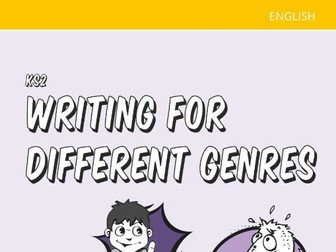
Writing for different genres is a downloadable key stage 2 English pack featuring seven original comic strips as prompts to engage and inspire reluctant writers.
The pack includes lesson plans, scaffolded writing templates and worksheets to support children in writing for different text types: a fictional diary, a formal letter, a playscript, a fictional recount, a list, a poem and their own comic strip. It also includes additional teaching ideas to develop children’s own writing skills, including an activity to develop their understanding of metaphor and simile.
The pack comes with a PowerPoint which features a starter activity for each session and useful checklists of the language features and structure of each writing genre.
What’s included?
Includes lesson plans and scaffolded writing templates for each writing genre
Features seven original comic strips as writing prompts
Includes a PowerPoint with starter activities and checklists for the language features and structures of each text type
The sessions can be taught in any order and adapted for different year groups. Perfect for your key stage 2 English lessons to develop children’s skills in writing for a range of purposes.
What’s inside?
‘A Week’s Excuses’ – writing a diary (pages 4-11)
Teaching notes
Comic strip
Diary writing template
Sentence starters
Using direct speech
‘Something Odd Out There’ – writing a formal letter (pages 12-19)
Teaching notes
Comic strip
Letter template with prompts
Letter template without prompts
Blank-bubbled version of ‘Something Odd Out There’
‘Alien Arrival’ – writing a playscript (pages 20-14)
Teaching notes
Comic strip
Playscript template
Blank-bubbled version of ‘Alien Arrival’
‘Jennifer Jones’ – writing a recount (pages 25-28)
Teaching notes
Comic strip
Match report planning template
‘Jennifer Jones’ – all of a muddle
‘Sad I Ams’ – writing a bulleted list (pages 29-32)
Teaching notes
Comic strip
‘Happy I Ams’ – metaphors
‘Happy I Ams’ – list template
‘StereoHead’ – writing poetry (pages 33-36)
Teaching notes
Comic strip
A sense poem planning template
A sense poem writing template
‘The Dark Avenger’ – writing a comic strip (pages 37-42)
Teaching notes
Comic strip
Blank comic strip template and checklist
Blank-bubbled version of ‘The Dark Avenger’
22 SUCCESS CRITERIA WRITING GENRE PROMPT CARDS CHECKLISTS
A great resource for Key Stage 2 children to use to help them with their writing.
Each writing prompt card explains the structure, the features and when the type of genre can be used.
There are 22 Publisher resources, each one a different genre.
These resources are editable and are currently created on an A4 Publisher page.
The prompt cards can be printed, reduced in size and placed in child's book to enable self assessment or peer assessment.
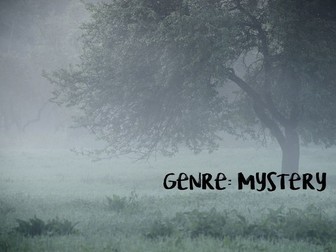
Three brilliant story starts for upper KS2/3 focussing on the 'Mystery' genre.
Each includes an evocative image to stir students' imaginations, encouraging discussion and writing.
All three are easily differentiated by outcome or support.
Included in the pack is a 'Writer's Checklist' - a resource designed for students to self-assess or peer-assess their work.
Please leave feedback if you've enjoyed using my resources.
Thanks!
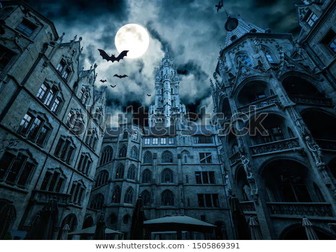
Gothic genre including starter, conventions, tasks, lists, questions, popular culture, creative writing.
At least 3 lessons worth.
Main Content:
Matching picture starter
Gothic conventions checklist
Gothic picture conversation activity
Related vocab activity
Questions based on The Gothic
Snap activity
Creative task A (2 activities – students pick 1)
Woman in Black extract and related questions
Write your own definition
Creative writing task B with planning and scaffolding
Peer marking checklist criteria
This table of detail can be used as a checklist to ensure that writing is consistent with the genre and does not fall into the trap of becoming a story.
The criteria is in line with assessment guidelines and is structured to make it easier for both students and teachers to identify secure and creatively perceptive content.
Suitable as a skills tool for Writing-to-Inform and Writing-to-Entertain.
This bundle comprises:
- A checklist of Fantasy Genre titles for Year 5
- 9 book quizzes with answers
- A book review sheet
- A certificate
I have made these resources for use in my school. We wanted to widen the genres that our children were reading. For each genre, the children read three titles from the booklist. They then complete the quiz and a book review for each title they have read. After this, they work on a creative piece for each book, such as: a picture of their favourite character; a new book cover or a story map. When all of the tasks are complete, the children receive their genre certificate. These can be printed and laminated.
This bundle comprises:
- A checklist of Fantasy titles for Year 3
- 9 book quizzes with answers
- A book review sheet
- A certificate
I have made these resources for use in my school. We wanted to widen the genres that our pupils chose to read.
For each genre, the children read three titles from the list. After this, they complete the quiz and a book review for each title. Finally, they work on a creative piece, such as: a picture of their favourite character; a new book cover or a story map.
When all of the tasks are complete, they receive their genre certificate.
This bundle comprises:
- A checklist of Fantasy Genre titles for Year 4
- 9 book quizzes with answers
- A book review sheet
- A certificate
I have made these resources for use in my school. We wanted to widen the genres that our children chose to read.
For each genre, the children read three titles from the list. They then complete the quiz and book review for each title they have read. Finally, they produce a creative piece such as: a picture of their favourite character; a new book cover or a story map.
When all of the tasks are complete, the children receive their genre certificate. These can be printed and laminated.
This bundle comprises:
- A checklist of Fantasy Genre titles for Year 6
- 9 book quizzes with answers
- A book review sheet
- A certificate
I have made these resources for use in my school. We wanted to widen the genres that our children were reading. For each genre, the children read three titles from the booklist. They then complete the quiz and a book review for each title they have read. After this, they work on a creative piece for each book, such as: a picture of their favourite character; a new book cover or a story map. When all of the tasks are complete, the children receive their genre certificate. These can be printed and laminated.
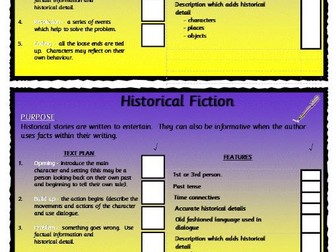
Beginning your Genre Study of Historical Fiction? This is a great supplemental resource for teaching a Historical Fiction unit in Reading Workshop. You will find resources for whole class genre lessons, read aloud, or mini-lessons, as well as graphic organizers and resources for small groups, literature circles, book clubs, or as independent projects!
Inside you will find:
Historical fiction definition printable poster
What is Historical Fiction? Graphic Organizer
Historical Fiction Characteristic/Example from Text Graphic Organizer (Filled out and blank for flexibility)
Characteristics of Historical Fiction printable poster
Historical Fiction Characteristics Checklist
Characteristics of Historical Fiction: Characters/Setting/Plot Graphic Organizer
What I Noticed About Historical Fiction Chart
Why do we read Historical Fiction? Brainstorming Graphic Organizer
Perspective- what is it and how does it affect our Historical Fiction story?
Historical Fiction Texts I've Already Read Graphic Organizer
*The rest of these resources can be used with a specific book. You can use them with a whole-class read aloud, or in small groups!
Exploring a Historical Fiction Text Cover Page
My Background Knowledge: What I Already Know About the Time Period/What I Want to Find Out About the Time Period Graphic Organizer
Getting Ready to Read: What I Already Know About the Time Period/ What I Learned from the Author's Note/What I Learned from a Non-Fiction Text Graphic Organizer
Language from the Time Period Graphic Organizer
Text-to-Text Connections with Historical Fiction Graphic Organizer/Chart
Text-to-Self Connections with Historical Fiction Graphic Organizer/Chart
Text-to-World Connections with Historical Fiction Organizer/Chart
Character/Character Traits Graphic Organizer
Character/How the Setting (Time and Place) Influences the Character's Actions Graphic Organizer
Character/Protagonist/Antagonist with Evidence Graphic Organizer
Character's Perspective/Influence on Story Graphic Organizer
Setting: Describe the Time and Place Graphic Organizer
Comparing Life Back Then to Life Today Graphic Organizer
What I Notice About the Setting Graphic Organizer
Sensory Images in the Setting Graphic Organizer
Plot: Problem/Conflict and Solution Graphic Organizer
Plot: How Does the Setting Influence the Plot? Graphic Organizer
Fact vs. Fiction: What was fact in the story? What was fiction? Graphic Organizer
Asking Questions Before/During/After Reading Historical Fiction Graphic Organizer
Using Characteristics of Historical Fiction: What makes this story Historical Fiction?
Lesson/Theme of Story Response Page
Author's Purpose Response Page
After I've Read (3 Questions I Still Have, 2 Lessons in the Story, 1 Topic I Want to Know More About)
In this package the teacher benefits from a comprehensive arsenal of narrative writing tools to help teach narrative writing more effectively. It is not a simple checklist that aids the teaching of the genre but is a ready reference to create effective writers in his or her class. In addition to entrench these concepts, students are given a host of exercises ranging from story starts to techniques like Show and Tell.
What is the breakdown on this package?
• A 14 slide PPT jam packed with features of and techniques for narrative writing
• Students are provided with story starter types and complete exercises on them.
• Students are taught to create descriptive settings.
• Students are taught to develop characters better.
• Students are taught to use stronger nouns and verbs in their writing through exercises.
• Students are taught to use sensory words for better descriptions of scenes and characters in the story through a number of exercises.
• Students are taught to understand conflict in a story better with a number of exercises.
• Students are given ideas to embellish concepts of character development in a story.
• Students are given ideas to pace the story better.
• Students are shown how to vary the length of sentences to create tension and captivate reader. These ideas are affirmed through a number of sentence restructures.
• Students are given tips on ending stories better and supported with exercises to affirm the resolution of a problem.
Help your students to independently edit and proofread their own explanation writing pieces or explanatory essays with these engaging checklists and rubric.
There are three age variations in the bundle for Junior (Ages 5 - 7), Middle (7 - 11) and Senior (11 - 15). Each bundle contains both a student checklist for independent assessment and a student / teacher rubric for conferencing. Check the preview for a visual example.
The version you are looking at is the free PDF version. If you are looking for an editable version you can find it here
Editable Writing Checklists
These editable checklists are specifically for narratives and explanation writing at the moment. However we will are currently creating more for other writing genres in the coming weeks which will be added.
Each age group has been stylised and written to appeal to different age groups.
With six to a page you can easily print these out and distribute to students an re use them over and over.
Best of all they are completely editable if you wish to change any element of it.
Give your students the tools they need for great writing.
Suitable for upper KS2. These checklists show a variety of writing genres. Some have examples/starts of examples of what the text may look like. Can be adapted to suit particular aims.


 Quick View