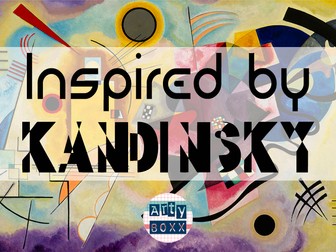
Year 7 Kandinsky powerpoint - introductory lesson, starting Shapes piece and working in the style of Kandinsky.
Homework - Kandinsky research sheet with 3 areas: artist facts, artwork analysis and artist copy.
A cover lesson designed to be fully self explanatory with an accompanying PowerPoint and worksheets to support a range of students in creating their own piece of kooky art inspired by Kandinsky himself. Rather than produce a copy, students are introduced to the artist, his methods and ways of working before being asked to create their own compositions with these key ideas in mind. A step-by-step slide is included to guide and structure the activity and another showing example shapes and designs. 3 different worksheets are also included, one blank and two with shapes to get students started. Can be a self-contained activity or used as a larger project or scheme of work.
A fantastic PowerPoint to challenge students abstract perception of Art. Through this activity, students embrace the style of his work whilst being introduced to watercolour and collage.
Powerpoint on Wassily Kandinsky - looking at his development with colour emotion theory, followed by a student task for them to create their own interpretations of colour.
Artist research and research links to Synesthesia- a condition which Wassily Kandinsky is believed to have had due to his paintings inspired by music - and his quotes on which he could ‘see colours’ when he listens to sounds or music.
The main task is for students to complete a Kandinsky inspired artwork based on their current feelings - this is all about self expression and how colour and shape can be used to display emotions. With significant links back to colour emotion theory - and what colours mean to you.
Presentation demonstrating the development of Abstract Art. This powerpoint looks at work by several different artists, including Kandinsky, Mondrian, Bomberg, Pollock and Rothko.
A 10 week project that looks at three different artists.
Wassily Kandinsky, Roy Lichtenstein and Friedrich Hunterwasser.
Pupils will identify the visual characteristics of each artist and then apply then to their own design.
The final part of the project looks at the pupils interpreting a chosen artists characteristics to create a portrait in their style.
Pack includes
powerpoint for each artist
resource sheets
game ideas
independent research
levelled examples
step by steps
additional artists to expand project.
Ideal for Year 7 and Year 8.
Lesson by lesson term PowerPoint on the artist Wassily Kandinsky.
Students are to listen to music and produce a final outcome in the style of Kandinsky.
The powerpoint consists of the following:
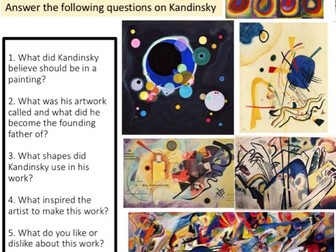
Students will learn about Wassily Kandinsky and his abstract Art and be able to make their own version of Kandinsky while listening to four pieces of music.
Task 1: Describing artwork tasks (slide2)
Task 2: Answer questions on Kandinsky (slide 3)
Task 3: Listening to music and interpreting this (slide 4)
Divide your paper into 4 blocks as seen in the example and in your blocks you need to draw what you interpret while listening to the four pieces of music.
Listen to the You Tube tracks of music - one at a time. While listening to the music in each block while you listen to the music you need to draw what the music makes you feel. (Copy the http address into search to hear music)
That is, you need to Interpret the music by drawing shapes, colours, textures, lines, forms, images and what you feel the music represents.
A PowerPoint showing the work of Robert and Sonia Delaunay and Wassily Kandinsky.
Used as an introduction to discuss and identify 2D shapes in art, before the children created their own shape artwork.
A distinction grade resource showcasing 5 different artists and designers part of art movements: surrealism, Pop art, Abstract art, Art Nouveau, Art deco. Plus detailed design/art analysis.
FORMAT
The resource is provided for you in both PDF and pptx powerpoint format. Easy to use.
INCLUDED
A very detailed powerpoint for Art UAL, but could also be used for art GSCE, A level, I recieved a grade Distinction - the top grade on my course.
Designer Romain de Tirtoff (Erte) information and art analysis - Art Deco.
Artist Alphonse Maria Mucha information and art analysis - Art Nouveau
Artist Wassily Kandinsky information and art analysis - Abstract art
Artist David Hockney information and art analysis - Pop art
Artist Salvador Dali information and art analysis - Surrealism
I would be very grateful if you could leave a honest review after using this resource. Thank you.
Powerpoint introduction lesson - shapes, geometric and organic. Introducing a shape project for Kandinsky and Matisse, with compare and contrast analysis work.
This has always been a great lesson that can build into a larger project. Whatever the age the students always love the idea of having a “secret formula” for creating the work, even the older ones enjoy the joke here because it really is essential guidance on composition rules. The 11 page powerpoint provides the starter and instructions for the lesson along with contextual information on Kandinsky, and again all students love the story about his revelation on his work in the dark. There is also a lesson plan with AFL questioning and the handout sheet for the responses to Kandinsky with suggested word bank to use.
Resources developed for stand alone textiles taster lesson for year 6 pupils.
Powerpoint includes - learning objectives, images of the work of the artist Kandinsky, key words and design brief with design illustration.
Worksheet designed to accompany ppt. for pupils to fill in and attack sample of work to
Resources are aimed at year 6 pupils to be used in 1 hr lesson, however they could be used for first introduction to fabric crayoning or as design task focusing on shape and colour.
The resources only focus on design for fabric crayoned card and not the fabric crayoning process.
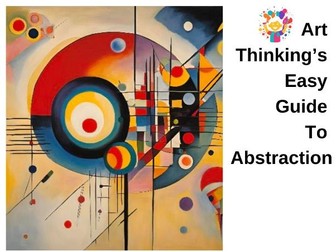
A fun and easy to understand powerpoint suitable for KS2 & 3 pupils, that explains how artists like Kandinsky used abstract art to depict emotions and music. As well as art making activity - it contains easy to use literacy templates for pupils to write about their art works, and sound clips to get the pupils listening, thinking, - and painting!
Lesson objectives, starter, review and PLTS prompts are in the powerpoint slides, so its an easy and practical resource to use without adaptation.
Suitable for non specialists and art teachers alike - who want to teach pupils about abstraction, and how colour can be used to explain emotions.
This can be used as a cover lesson or a lesson within a SOW relating to Abstract Art.
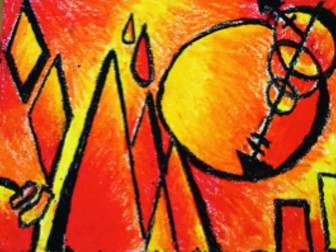
Learning Objective: Develop colour blending skills and understanding of colour theory through the use of oil pastel
Colour examples of the expected outcome and step by step instructions. Also a keyword box to describe harmonic and monochromatic colours.
Links to colour theory and Wassily Kandinsky underpin this lesson which is presented on 1 Powerpoint slide. This can either be projected or printed as a help sheet.
You will need a class set of oil pastels for this cover.
Please leave a review!
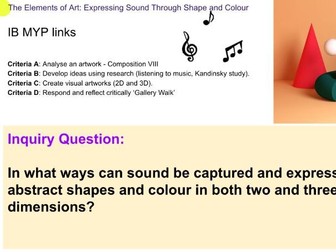
Engaging 1-hour IB MYP art lesson exploring how sound can be expressed through shape and colour in 2D and 3D, perfect for interviews or core teaching.
The Elements of Art: Expressing Sound Through Shape and Colour
Key Concept (IB MYP): Personal and Cultural Expression
Related Learner Profiles: Inquirers, Risk-Takers, Open-Minded
This inspiring, creative 1-hour lesson explores how students can express sound through abstract shape and colour using both two- and three-dimensional media. It can be delivered as a stand-alone interview lesson for IB MYP roles or embedded within a broader unit of work on the Elements of Art.
Inquiry Question:
In what ways can sound be captured and expressed through abstract shapes and colour in both two and three dimensions?
Lesson Highlights:
Engaging starter activity with a colour wheel reference and prior knowledge check.
Uses music as a stimulus (Composition VIII inspired Kandinsky activity).
Ideal for Years 7–9 or MYP Year 1–3, depending on prior experience.
Cross-disciplinary links to music, personal expression, and abstract art.
Vocabulary and literacy support embedded throughout.
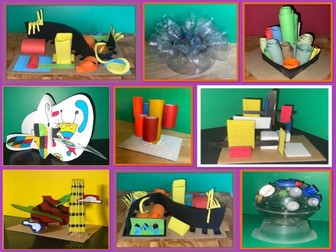
Flexible final outcomes: either a 3D collage using paper or a small 3D sculpture using clay/plasticine.
Includes opportunity to listen to a musical piece and analyse visual responses.
Assessment Criteria (IB MYP Arts):
Criteria A: Analyse an artwork – e.g., Kandinsky’s Composition VIII
Criteria B: Develop ideas using research (listening, reflection, artist study)
Criteria C: Create a visual response – either 2D or 3D
Criteria D: Respond and reflect through a student-led ‘Gallery Walk’ activity
What’s included in the resource:
Fully editable PowerPoint with slides for all activities
Student worksheet/response sheet
Printable vocabulary sheet
Suggested soundtracks for stimulus
Visual examples of possible outcomes
This is a versatile and imaginative lesson that allows students to explore the connection between sound and visual expression in a fun, thought-provoking way. It fosters creativity, critical thinking, and communication—ideal for developing the IB MYP learner profile and for showcasing high-quality teaching practice.
Recommended resources:
Music player/speakers
Access to abstract musical compositions (free suggestions included)
Drawing materials, coloured paper, scissors, glue, or modelling materials
You will find PowerPoints for each lesson, resources and the lesson plans.
The lessons entail:
Children will be looking at different tones and will complete a tonal ladder.
Drawing lines of different sizes and thickness.
Using a view finder to draw in detail in one part of an image. Some to be drawn using sketching pencils and some with colouring pencils. Children to remember to show tone, line and texture in their drawings.
Observational drawing involving fruit and vegetables.
Using different brushes and experimenting with these. What effect does this give? Children will also be looking at the colour wheel, primary and secondary colours. Look at the work of Kandinsky and create artwork inspired by him.
Add white to colours to make tints and black to colours to make tones.
Create their own painting which demonstrates the skills previously learnt.
Distance Learning: This has everything for the distance learning experience, including:
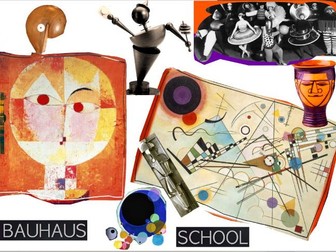
a) complete presentation on The Bauhaus in powerpoint.
b) Google student searches
c) Flash-Discussion Cards
c) making artist card–(to share with class)
d) making enhanced visual based question–(to share with class)
e) visually enhanced multiple choice test
These parts are shown in the Preview (where it is a lot easier to understand since there are actual slides). There are plenty of sample slides in your preview to ascertain if this material suits you. Go to the preview now to review those materials!
EXCERPT:
The Bauhaus was founded in 1919 in Weimar, Germany by architect Walter Gropius. Gropius’s Proclamation of the Bauhaus (1919) stated: reimagine the material world to reflect the unity of all the arts. Bauhaus combined fine arts and design education.
The curriculum began with a course in the study of materials, color theory, and formal relationships. It was taught by Paul Klee, Vasily Kandinsky, and/or Josef Albers. After learning theory, students entered specialized workshops, which included metalworking, cabinetmaking, weaving, pottery, typography, and wall painting.
In 1923, Gropius stressed the importance of designing for mass production. The school’s slogan became, “Art into Industry.”
Abstract Sculpture is an Art and Design unit of work aimed primarily at children aged 7-9. The unit consolidates and deepens children’s understanding of sculpture and in particular, assemblage sculpture. Learning is delivered through an in-depth look at abstract art and some iconic artists and artwork that feature in this art movement.
The package provides the medium-term plan, six lessons (each lesson has a MS Powerpoint presentation) and a knowledge organiser. An additional presentation focuses on What is Sculpture?
Strands of Learning:
Sculpture
Painting
Children learn about some of the key artists and art works associated with abstract art. They study the work of Kandinsky, Piet Mondrian, Pablo Picasso and Joan Miro and interpret their work through authentic assemblage sculpture. The unit completes with them creating their own abstract sculpture designed to highlight the problem of plastic waste. This is used to deepen children’s understanding of how contemporary artists use their artwork to express their feelings and thought and to convey important messages,
This unit of work is part of the Art Academy Scheme of Work for children aged 5-11 being developed on behalf of Carousel Education.
Powerpoint teaching slides with teacher’s notes, WALTS, images and key questions. Unit of work- art- artist studies x 2- primary and secondary colours based on animals. Planned for KS1
Based on Animal Kingdom
PAINTING- Kandinsky/ Mondrian (Elmer)
Key learning intentions: Know the primary colours (red, yellow and blue) Explore what happens when white, black and grey are added to primary colours. Know the primary colours and secondary colours Know what happens when grey, black and white are added to primary and secondary colours Name different types of paint and their properties (watercolour, poster paint )
Skills Explore paintbrushes Choose correct sized paintbrush Explore with watercolours Can create an image using only straight lines. Explore with watercolours and poster paint Mix colours to match a picture Choose correct sized paintbrush Use correct consistency of paint Explore different types of paint
Understanding/application Explain paintbrush choice Make observations on what happens when white, black and grey are added to primary colours Compare success of primary colours vs. tints/tones Can use vocabulary – horizontal and vertical, diagonal. Explore with watercolours and poster paint Mix colours to match a picture Choose correct sized paintbrush Use correct consistency of paint Explore different types of paint
POWERPOINT SHOWING IMAGES AND IDEAS ON THE DEVELOPMENT OF MODERN ART. A SHORT(ISH) SUMMARY OF THE DEVELOPMENT/ HISTORY OF THE MODERN ERA AND MODERN ART.


 Quick View
 Quick View
 Quick View
 Quick View
 Quick View
 Quick View
 Quick View