“Article & Questions” Assignment
Assignment:
Students read the Article.
Students answer the Questions.
*Note: This purchase includes both a PDF and WORD version of the assignment
PDF: Best used in class or for homework
WORD: Best for online, remote learning or uploading to Google Classroom
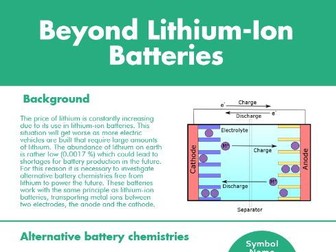
This infographic for A-level chemistries students briefly explains how lithium-ion batteries and related battery chemistries like sodium-ion and magnesium-ion batteries work. Due to the low abundance of lithium on Earth, lithium-ion batteries will have to be replaced by these other chemistries in the future. They do, however, work on the same principle as lithium-ion batteries, only the ions are exchanged by sodium or magnesium ions. Sodium-ion batteries are infact already used, for example in electric bikes made by the company Faradion.
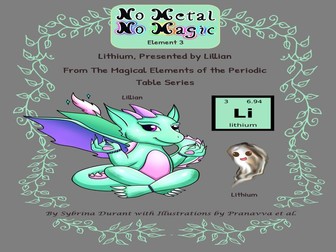
Join Lillian, a vibrant and grounded Elemental Dragon, whose fabulous tail is charged with the whimsical powers of Lithium, the third element in the marvelous periodic table. Lillian is not just a character; she embodies the essence of exploration and curiosity. As you embark on this magical journey with her, get ready for a whirlwind of playful facts and enchanting tales that showcase the incredible realms of Lithium and its captivating wonders. Each page offers a unique blend of educational content and narrative, making complex scientific concepts accessible and fun for young readers.
This book is truly a treasure trove of knowledge, offering a variety of fun activities designed to engage and inspire young minds. Whether it’s interactive experiments or creative puzzles, these activities make diving into the world of chemistry an absolute blast! Lillian’s adventures not only entertain but also encourage readers to think critically and nurture their natural curiosity about the scientific world.
Lillian isn’t alone in her thrilling quest; she is just one of many extraordinary elemental friends waiting to be discovered in the other No Magic No Metal books. Readers will be introduced to an entire cast of magical creatures and fantastical characters, each brimming with personality and their own unique brand of magic. From majestic unicorns and fearsome wizards to brave knights and quirky goblins, the diverse ensemble is designed to resonate with every child’s imagination. Together, they will ignite curiosity and inspire every young reader eager to explore the enchanting world of the Magical Elements of the Periodic Table.
With Lillian as your guide, each chapter unfolds like a new adventure, overflowing with excitement and knowledge. Readers will find themselves eagerly flipping through the pages, anxious to explore each new mystical element and its real-world applications. By integrating chemistry with a delightful narrative, this book makes science feel less like a subject to be learned and more like an adventure waiting to unfold.
So, get ready to sprinkle a little magic on your learning journey; it’s bound to be an unforgettable ride! Filled with whimsical illustrations and engaging storytelling, this book promises to enchant young readers, making science a captivating subject rather than a daunting one. It’s destined to become a favorite addition to school libraries and cozy home bookshelves alike, cherished by all who venture into its pages.
In summary, this delightful tale is not just a story; it’s an invitation to explore, learn, and dream. Dive in with Lillian and her elemental friends, and unlock the magical secrets of science in a way that’s never been done before. Let the adventure begin, as the worlds of magic and chemistry unite for a sensational experience that educates and entertains!
This PowerPoint presentation with worked examples and student questions covers:
Flame tests for lithium, sodium, potassium, calcium, and copper.
Electron energy levels and emitting radiation.
Precipitate tests for iron(II)), iron(III), copper(II), calcium, and zinc.
This PowerPoint resource is a complete and engaging lesson on “Using the Earth’s Resources and Sustainable Development” for the AQA GCSE Combined Science Chemistry specification. It introduces students to the concepts of finite and renewable resources, how humans use the Earth’s natural materials, and how sustainable development can ensure these resources are available for future generations. The lesson also explores how chemistry contributes to sustainability by developing synthetic alternatives and cleaner technologies.
The resource begins with a clear starter activity that revises key prior knowledge, including carbon footprints, fossil fuels, and changes in Earth’s atmosphere. It then moves into detailed explanations and tasks focused on natural resource use, the distinction between renewable and finite resources, and the role of chemistry in creating sustainable solutions. Students are encouraged to categorise resources, analyse graphs, and work with real-world data, including orders of magnitude calculations based on lithium reserve statistics—developing both subject knowledge and numeracy skills.
The PowerPoint includes multiple discussion prompts, structured tasks, and challenge questions that are ideal for classwork, homework, or assessment preparation. Real-world contexts like fossil fuel use, synthetic fibres, and global demand for lithium make the topic relevant and up to date. This resource was last updated in June 2025 to ensure alignment with current examples and the most recent AQA specification.
Designed specifically for the AQA GCSE Combined Science Chemistry, this PowerPoint file (.pptx) is ready to use in class or to support blended learning and revision. Key terms include sustainability, finite resources, renewable energy, fossil fuels, synthetic materials, and carbon footprint.
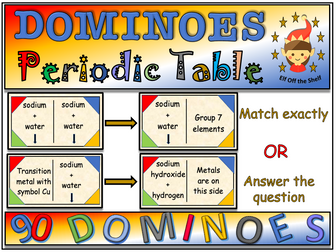
A dominoes game for middle with questions and statements on the Periodic Table of elements instead of numbers to consolidate learning at the end of the topic or for revision.
The game can be played with or without the students being given a copy of the enclosed periodic table.
Prior Knowledge
Elements are arranged in the periodic table in order of atomic number.
Metals are on the left of the table and non – metals on the right with a zig – zag line dividing the two.
Some of the metals touching the zig – zag are semi – metals or metalloids which means they have some properties of metals and of non – metals.
Vertical columns are called groups and horizontal rows are called periods.
Each period starts with metals on the left and end with non – metals on the right.
The elements within each group have similar physical and chemical properties.
Group 1 are the alkali metals. Group 2 are the alkaline earth metals. Group 7 are the halogens. Group 0 are the rare or noble gases. The central block are the transition metals.
On the left – hand side of the table, reactivity increases as you go down a group and on the right – hand side of the table reactivity increases as you go up a group.
Group 1: can be cut with a knife; must be stored under oil; low density – lithium, sodium and potassium float on water; form compounds which are solid at room temperature; form compounds with similar formulae – LiCl. NaCl. Group 7; are all colored; react with hydrogen to form acids; react with metals to form salts.
Alkali metal + water --> alkali metal hydroxide + hydrogen
lithium + water --> lithium hydroxide + hydrogen
Group 0 are all inert gases – they do not react with other elements
Transition metals; except for mercury, which is a liquid, these are harder than group 1 metals; have high melting points; react slowly with atmospheric oxygen.
What You Get
90 dominos
Animated PowerPoint explaining the rules and how to play.
Periodic table
Rules of the Game
Each player selects seven dominos from the top of the face-down pile and holds them in their hand like playing cards.
The player whose surname begins with a letter closest to the letter A starts and play proceed in a clockwise direction.
Dominos can be matched exactly, or a name can be matched with a symbol or descriptions, sketches and circuit diagrams can be matched.
If a player thinks a match is wrong, they can challenge. If the challenger is correct, they give a card from their own hand to the challenged player. If the challenged player is correct, they give a card from their hand to the challenger. Pupils are encouraged to check their books for the correct answer and consult their teacher if a consensus is not reached.
If a player cannot play a domino, they pick up from the face down pile and can play if possible or add it to their hand.
The structure patterns and trends of the periodic table of elements and the names and properties of the alkali metals (groups1), halogens (group 7) and the rare or noble gases (group 0) are all explained in this action-packed and enjoyable fully resourced distance learning or home school lesson for middle school science.
What’s Covered
Elements are arranged in the periodic table in order of atomic number.
Metals are on the left of the table and non – metals on the right with a zig – zag line dividing the two.
Some of the metals touching the zig – zag are semi – metals or metalloids which means they have some properties of metals and of non – metals.
Vertical columns are called groups and horizontal rows are called periods.
Each period starts with metals on the left and end with non – metals on the right.
The elements within each group have similar physical and chemical properties.
Group 1 are the alkali metals. Group 2 are the alkaline earth metals. Group 7 are the halogens. Group 0 are the rare or noble gases. The central block are the transition metals.
On the left – hand side of the table, reactivity increases as you go down a group and on the right – hand side of the table reactivity increases as you go up a group.
Group 1: can be cut with a knife; must be stored under oil; low density – lithium, sodium and potassium float on water; form compounds which are solid at room temperature; form compounds with similar formulae – LiCl. NaCl. Group 7;are all colored; react with hydrogen to form acids; react with metals to form salts.
Alkali metal + water alkali metal hydroxide + hydrogen
lithium + water lithium hydroxide + hydrogen
Group 0 are all inert gases – they do not react with other elements
Transition metals; except for mercury, which is a liquid, are harder than group 1 metals; have high melting points; react slowly with atmospheric oxygen.
What’s Included
Animated PowerPoint for teaching with exit ticket quiz and all answers to classwork and homework)
Flip it (pupil writes questions to given answers)
Anticipation Guides (combined starter and plenary)
Guided notes to support the PowerPoint
Fact sheet
Homework (x2) plus answers
Fact share worksheet
12 Taboo cards
Pupil progress self-assessment checklist
Exit Ticket
Suggested lesson plan showing choices possible between resources
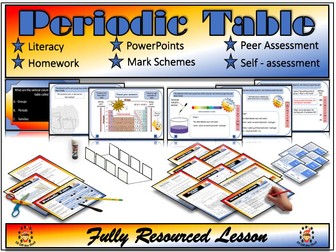
This pack contains 18 printable resources and it is intended that the teacher uses them to build their own unique lesson to take account of student ability and time available. Literacy, oracy, self-assessment and peer assessment are all built in to the resources. These features are clearly marked on the comprehensive one-page flow chart lesson plan which shows where the logical choices between resources can be made.
Geography Case Study
Lithium is key to green technologies.
The “Lithium Triangle” of Argentina, Bolivia and Chile, holds most of the world’s lithium reserves.
Chinese businesses face allegations of the violation of the rights of local communities, damage to ecosystems and unsafe working conditions.
Argentinian lithium miners surrounded their Chinese managers’ compound and blockaded the entrance with flaming tyres.
This resource includes a variety of lesson activities to pick and choose:
Which Geography keyword is the ODD ONE OUT?
5Ws &1H about Tesla Motors and Elon Musk
5Ws &1H about a photo of lithium salt mounds
In which photo would you be most likely to … meet a worker whose health is at risk?
Critical Thinking: write THREE sentences to LINK these four images (technology: manufacturing, sales, use, waste)
Worksheet and data to construct a dot distribution map of China’s lithium mines around the World
PQE: China’s Lithium Mines - worksheet to analyse the dot distribution map using critical thinking (Patterns, Quantify, Exceptions)
Several slides for screen projection: encourages class evaluation of the positives vs negatives of dot distribution
Slide showing annotated map of Global North vs Global South - encourages analysis of correlation between lithium mining and socio-economic development
Link to video: “Argentina indigenous groups
protest against lithium mining”
Concept Map: The Lithium Triangle (35 snippets of info, to be colour-coded according to Locations, Causes, Effects, Management, Supporting Data)
The concept map info can then be used for:
Thought Chains: The Lithium Triangle - complete the scaffolding to complete six pieces of analysis…
“Chinese firms have been buying lithium mines in South America because…”
“The lithium mining industry in South America is SOCIALLY unsustainable because…”
“The lithium mining industry in South America is ECONOMICALLY unsustainable because…”
“The lithium mining industry in South America is ENVIRONMENTALLY unsustainable because…”
“Electric car makers buy Chinese lithium-ion batteries because…”
“Electric cars are not yet completely sustainable because…”
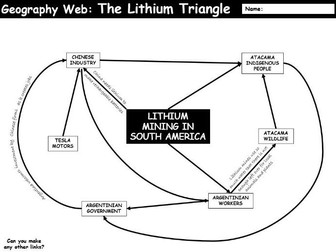
Geography Web: The Lithium Triangle
Pupils link feature and analyse the connections between the Lithium Triangle and China, Argentina’s government, indigenous people, Tesla Motors
TEACHERS’ BACKGROUND INFORMATION sheets (x3) with links to relevant articles and original BBC News story
This worksheet is intended for use during or after a teacher demonstrates (or shows a video) of the reaction of lithium, sodium and potassium with water.
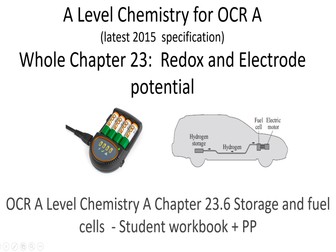
Student workbook and teacher PP.
The following concepts are being covered:
Pollutants from using fossil fuels- review.
Primary cells – description, examples – Zinc cells, deducing the overall cell reaction.
Secondary cells -description, examples- lithium ion and lithium -ion polymer cell, deducing the overall cell reaction when the cell is discharging and when being charged.
Fuel cells – description, structure and reactions for an alkali hydrogen cell and an acid hydrogen cell.
Teacher PP supports the workbook and contains answers to all questions. The answers are revealed in steps. There are many activites to allow the students to achieve the learning outcomes for this topic.
The resource was prepared with the use of A Level Chemistry for OCR A textbooks.
Some diagrams and some questions were taken from this book.
This resource includes a presentation and a worksheet on demonstration of reaction between alkali metals (lithium, sodium and potassium) and water.
This also contains starter and some follow up questions with answers.
Revision cards for the AQA specification. Covers flame tests (sodium, calcium, lithium, potassium and copper), precipitates (iron(II), iron(III), copper(II), magnesium, calcium, aluminium, sulfates, halides) and tests for gases (hydrogen, oxygen, carbon dioxide and chlorine). Print double-sided to get flash cards.
Sheet for students to fill in the reactivity series for notes. Includes carbon and hydrogen, and spaces for potassium, sodium, lithium, calcium, magnesium, aluminium, zinc, iron, copper, silver, gold.
Could also be annotated with extra information about methods of extracting metals, reactions etc in a summary activity.
This is a set of questions about the bonding in lithium fluoride. For a bit of fun it treats the process as a date between two elements on an internet dating site. It was inspired by the fabulous Kate and Anna McGarrigle's NaCl song which can be found on You Tube. Lots of other free resources are available at the Rocket Resources web site.
A great way to help teach and learn important terminology. This 20 word crossword will challenge pupils on their knowledge of chemical symbols. These are some of the most commonly used elements that come up in secondary/high school so are important for students to know. Included is the crossword with pictures, crossword without pictures and the solution.
Words used are as follows:
BERYLLIUM
BORON
CARBON
CHLORINE
COPPER
GOLD
HELIUM
HYDROGEN
IODINE
IRON
LEAD
LITHIUM
MAGNESIUM
NEON
NITROGEN
POTASSIUM
SILVER
SODIUM
SULPHUR
ZINC
Enjoy!
Word searches are great activities to help students memorise key terms. I personally like to start every new topic with one of these so students can start identifying key words they need to be aware of. Worksheet with pictures, worksheet without pictures and solution are provided.
Words used are as follows:
BERYLLIUM
BORON
CARBON
CHLORINE
COPPER
GOLD
HELIUM
HYDROGEN
IODINE
IRON
LEAD
LITHIUM
MAGNESIUM
NEON
NITROGEN
POTASSIUM
SILVER
SODIUM
SULPHUR
ZINC
Enjoy!
This detailed PowerPoint presentation on Ionic Bonding is an ideal teaching resource for secondary school chemistry lessons. It provides a clear explanation of how ionic bonds form, alongside interactive and engaging activities to help students consolidate their understanding. The resource includes learning objectives, step-by-step examples, and practice exercises designed to develop students’ skills in drawing dot-and-cross diagrams for ionic compounds.
Key topics covered include the definition of ionic bonding, the formation of positive and negative ions through electron transfer, and the role of electrostatic forces of attraction. The presentation explores common examples such as sodium chloride, magnesium oxide, and potassium oxide, and provides detailed instructions on working out ion charges for elements in Groups 1, 2, 6, and 7. Students are encouraged to practice constructing ionic bonding diagrams for compounds like lithium fluoride, calcium chloride, and sodium oxide, with extension tasks to deepen their understanding.
This PowerPoint (.pptx file) is fully editable, making it easy for teachers to adapt the content to their specific curriculum requirements. Updated recently for improved clarity and functionality, the resource is suitable for classroom use, homework assignments, or independent study. Its structured approach and clear visuals make complex concepts accessible and engaging for learners.
Whether you’re teaching bonding for the first time or revising for exams, this resource provides everything you need to support your students’ mastery of ionic bonding.


 Quick View
 Quick View
 Quick View
 Quick View
 Quick View
 Quick View