Analysis and persuasive writing activities ideal for a KS3/ KS4 homework task for a non-fiction unit/ AQA Language Paper 2 revision with full instructions, paragraph structures, success criteria and WAGOLL modelled examples.
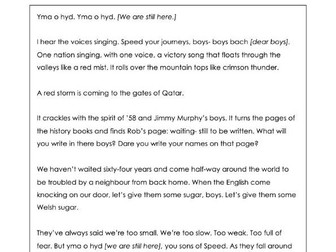
This project focuses on Michael Sheen’s persuasive speech in support of the Welsh football team in the 2022 World Cup.
Resource tasks:
Read the speech. Highlight and annotate any persuasive techniques on the sheet.
Select one quotation from the speech and write a short analytical paragraph to answer the question: How does Michael Sheen use language to persuade and motivate his national team? There are structures and a modelled example on the sheet to follow.
Write a short persuasive speech to rally support for a team for the 2022 World Cup from a country of your choice.
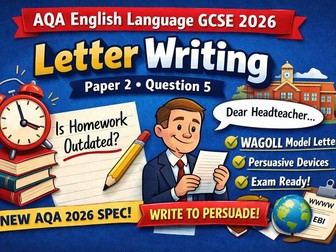
Engage your students with a ready-to-teach, full lesson on AQA GCSE English Language Paper 2, Question 5! Perfectly aligned with the 2026 AQA curriculum, this lesson focuses on writing a persuasive letter to a headteacher debating whether homework is outdated in the 21st century.
This lesson is ideal for teachers looking to boost student engagement, build writing skills, and prepare for the new exam-style questions. It is fully scaffolded for KS4 / Year 10–11 students and includes everything you need to deliver a high-impact lesson.
What’s included:
Exam-style Question 5 task: AQA 2026-approved wording for a letter-writing question
WAGOLL (What a Good One Looks Like): Model letter demonstrating persuasive techniques and formal letter conventions
Sentence starters and writing frames: Scaffolded for students to structure their letters confidently
Persuasive devices table: Countdown, rule of three, rhetorical questions, call to action and more – with examples tailored to the homework topic
Vocabulary focus: Includes the Grade 9 word draconian, linked to both the letter task and An Inspector Calls
Starter activities: Fun, interactive ways to hook students (including “Homework in the Headlines” and thought-provoking questions)
Video link & discussion: Students watch a short clip on the homework debate and discuss their views
Formal letter formatting guide: Step-by-step teaching of addresses, date, greeting, and sign-off
WWW / EBI feedback prompts: To help students reflect on their writing and self-assess
Why this lesson works:
Fully aligned with AQA 2026 GCSE English Language Paper 2
Focuses specifically on Question 5: writing a persuasive letter
Supports differentiation – easy to adapt for higher or lower ability groups
Encourages critical thinking, cultural capital, and persuasive writing skills
Ready-to-use: no preparation needed
Perfect for:
Year 10 and 11 English Language classes
Revision lessons and exam practice
Embedding persuasive writing skills for Paper 2 Question 5
This lesson teaches children about persuasive writing and different persuasive strategies they can use. It then gives different targets (success criteria) that learners need to achieve in order to successfully produce a good persuasive letter.
It also includes two different example texts (one good and one that requires improvement)
A teacher-created PowerPoint lesson introducing and explaining the DAFOREST framework for narrative and transactional/persuasive writing. This resource supports students to identify, interpret, and apply key language techniques used in prose and speech writing, making it ideal for secondary English lessons, GCSE preparation, and literacy intervention.
The lesson includes clearly modelled definitions, memorable examples, and an extended labelling/identification task using a full speech extract, enabling students to analyse a real text like an expert reader and transfer these skills into their own writing.
Techniques Taught and Modelled:
Direct address (audience/reader positioning)
Example reference: Mark Antony’s speech in Julius Caesar
Alliteration and sound patterning
Fact vs Opinion (writer viewpoint awareness)
Repetition (language for emphasis and learning)
Rhetorical question (reader engagement and reflection)
Emotive language (crafting reader response)
Statistics as evidence to support viewpoints
Triple / list of three (rhythmic structural device)
Core Learning Activities:
‘What does DAFOREST stand for?’ gap-fill task
Explanation boxes defining each technique in student-friendly language
Multiple concrete, high-interest examples that aid memorisation
Speech annotation/modelling activity, including a full 272-word extract by Abraham Lincoln delivered at the battlefield near Gettysburg, Pennsylvania, US.
Students highlight and label techniques, supporting AO2 analysis and reading-to-writing skill transfer
Teacher notes clarify the purpose of this extract as a model text for technique spotting (not presented as novel content)
Skills Developed:
Recognising and naming figurative and structural methods
Explaining the intended effect on reader or audience
Distinguishing fact from viewpoint
Analysing semantic fields and tone
Applying language techniques in original writing
Transferring method analysis into GCSE English Language responses
Building cohesion, emphasis, and reader engagement in non-fiction writing
Best For:
KS3 Secondary English lessons
GCSE English Language method analysis and transactional writing
Functional Skills
Literacy intervention and skills reinforcement
Guided annotation modelling
Homework or revision planning
Reading strategy and evidence tagging before writing
5 lesson sheets which can be used as cover or homework to help students learn about creating and marketing a product centered around chocolate.
Perfect for KS3 or KS4
Lessons are structured with tasks that involve looking at data and explaining ideas, persuasive writing, analysing language used in adverts, and writing a pitch (Dragons’ Den)
This resource contains 4 different, independent tasks which culminate in pupils writing a persuasive speech to be delivered to their peers. Each activity has been designed to complete at home, thus giving you 4 weeks worth of homework and one more if you add a week for rehearsal or making a PPT to go with their speech.
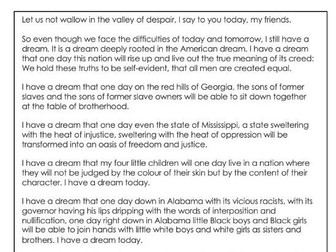
The first homework looks at Martin Luther King's 'I have a dream' speech and asks pupils to identify persuasive features. Self-assessment is also included.
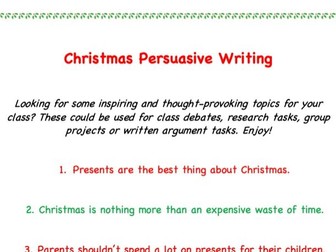
List of 10 topics for persuasive writing/debate with a Christmas theme.
Could be used for class debates, written classwork or homework, research tasks or group projects at the end of the term!
Suitable for KS2 or KS3 primarily, although could be used with older students too.
Also includes worksheets to help students structure their ideas.
A great way to reinforce a persuasive writing unit. This project is creative and allows students to enjoy doing their homework, whilst learning valuable skills. The project includes a detailed outline of the task, what they can and can't do and how it will be assessed (class assessed through S&L presenting to the class - also useful for a S&L grade).
Persuasive writing KS4. Originally used for IGCSE though skills are transferable to other exam boards.
Covers
'Take Me Out'- Ethics
Persuasive devices
Animal Rights
Euthanasia
Facebook
For or against school bell
Travel writing
Could also be used with KS3
Rhetoric analysis activity ideal for a KS3/ KS4 homework task for a non-fiction unit/ AQA Language Paper 2 revision with full instructions, paragraph structures, success criteria and WAGOLL modelled example.
This project focuses on Martin Luther King Jr’s infamous ‘I Have A Dream’ speech.
Resource tasks:
Read the speech. Highlight and annotate any persuasive techniques on the sheet.
Select one quotation from the speech and write a short analytical paragraph to answer the question: How does Martin Luther King Jr. use rhetoric to gain support from his audience? There are structures and a modelled example on the sheet to follow.
The premise of this lesson is that a new policy is being considered that will triple the amount of English homework students receive in a week. They have to a write a letter to the Principle persuading them that this is not a good idea. The lesson focuses on 3 devices: rhetorical questions, hyperbole and flattery.
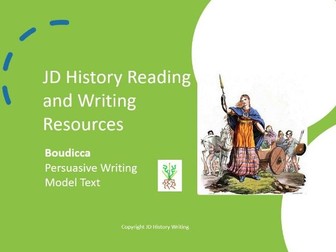
Show students an example of persuasive writing, while they learn about Boudicca! The model text is a speech by Boudicca persuading her people to fight the Romans.
The model text comes in two versions for differentiation. One version has more challenging questions and asks the students to work more independently. One is colour-coded to help students identify the features of persuasive writing and includes a wordsearch.
A great class, homework or guided reading activity.
Persuasive Writing Techniques
This resource includes:
Clear definitions and simple examples of a range of persuasive writing techniques (12 different techniques included) on PowerPoint slides.
3 different persuasive writing tasks for example: Should homework be compulsory? Write a letter to your head teacher in which you argue your point of view on whether homework should be banned.
Each persuasive writing task includes a model paragraph which uses a range of persuasive techniques for students to identify and explore.
Ready to use but also fully editable (PowerPoint)
This Unit includes four PowerPoint Presentations (The Writing Process, Rhetorical Devices, Logical Fallacies, and the Mini-Research Project), note-taking guides, Logical Fallacy Activity, and a Unit Overview. This resource is aligned with the Common Core and is intended for High School Students.
Here is a persuasive writing lesson for KS3/KS4 which will enable your students to use essential language techniques (alliteration, rhetorical questions, lists of three, hyperbole, emotive language etc.) for persuasive and argumentative writing tasks.
Contains a vivid and engaging 17 slide PowerPoint , a worked writing example with comments plus task, an extension worksheet/homework task and a persuasive writing poster for the classroom
This is a fully-resourced 3 week scheme of work with lesson PowerPoints, supporting resources, scheme of work and homework menu. Students will develop their persuasive writing skills, learn how to structure and deliver a speech. Models are provided and tasks are differentiated. This can be used for KS3 and it could also be adapted for preparing KS4 students for the GCSE/IGCSE speaking and listening endorsement.


 Quick View