A comprehensive pack of resources - non-chronological report writing
These resources include a:
1st presentation that introduces the general features of report writing in a colourful, child friendly format that clearly leads the learners through the signposts of the genre.
2nd presentation that continues with the assessment of reports including online link and differentiated checklists - peer and self editing.
Additional resources provide:
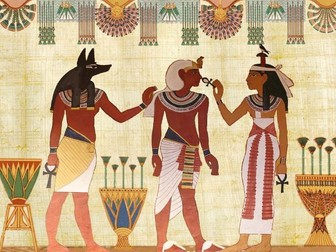
A clear concise and interesting model report on Egypt for learners to read, discuss, analyse, highlight and ‘pull apart’ - active learning.
An annotated report to provide the teacher with the main teaching points of the model report.
A colourful word mat with sentence starts and vocabulary to support report writing.
A mind map for the planning stage which is partially completed to support learners ( can be easily edited to provide less support).
Word strips with facts about Egypt - ideal for ‘cut and stick’ activities ( learners can categorise facts under headings in a carousel type activity)
This detailed pack of resources will support the learners thoroughly from the initial lesson on the structure of a report through assessment ,the analysis of models and finally to a finished piece that can be assessed and celebrated.
This resource contains work for a whole lesson (or two) based on writing a report - aimed at KS4 students.
Activities include:
- reminder of assessment objectives (new spec) and mark schemes;
- Discussion of reports, their purpose and who writes/reads them;
- Labelling activity for how to format a report;
- Correctional exercise (starter) for improving punctuation and formality of sentences;
- Mind-mapping class ideas to structure their own writing;
- Model paragraphs;
-Peer and self-assessment grids.
- An additional task has been included at the end for either homework, revision or a in-class timed response that could be peer or teacher-marked.
This is tailored to the WJEC/Eduqas mark scheme, assessment objectives could easily be replaced to suit your exam board.
Support your children’s work on report writing with our handy guide. It’s a wonderful teaching resource and can also be used as part of your classroom display boards.
The guide includes information about:
* What are non-chronological reports?
* Types of reports,
* Organisation of reports,
* Thinking about your audience,
* Researching the topic,
* Planning your report,
* Writing your report,
* Facts and opinions,
* Present and past tense,
* Formal writing,
* Vocabulary,
* Top tips for writing a report.
Visit Teaching Packs for more fantastic resources!
This scaffold is a complete guide on how to write a scientific report. The scaffold is differentiated using colors and a guide on the side to aid students in their report writing skills.
The scaffold will take students through the scientific method.
A Creative Writing resource to be used with a story or text for KS2 and KS3 Literacy.
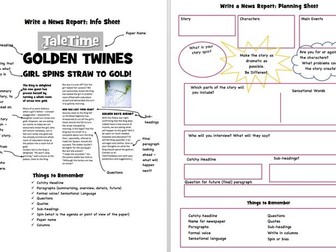
I wrote a News Report gives you all the elements you need to run a successful Newspaper writing lesson. With an example based on a fairy tale, a breakdown with success criteria and a planning sheet as well as two differentiated writing frames and a self assessment.
This resource was designed to be used with Tale Time’s Audio collections - but can be used for any story or text.
Included:
Example Text - News Report for Fairy Tale Rumpelstiltskin
Info Sheet - Breakdown of features of News Report from example and success criteria
Planning Sheet - Broken down planning for creating a News Report from a story
2 Writing Frames (differentiated)
Assessment Criteria - Included on Info sheet and Planning Sheet
Self/ peer assessment form
This resource will work well within a Newspaper Writing unit.
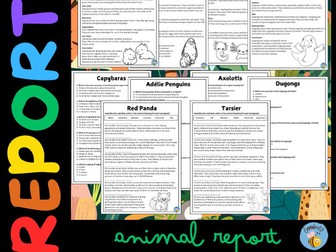
Introduce your students to report writing with these engaging and educational Animal-Themed Report Writing Activities! Featuring six unique animal reports, this resource is designed to make report writing both fun and accessible for students as they learn key skills such as structuring information, choosing subheadings, and identifying effective report language.
Product Features:
4 Animal Reports with Multiple-Choice Questions: Reports on Axolotls, Capybaras, Adélie Penguins, and Dugongs come with 6 multiple-choice questions each. These questions reinforce report comprehension, animal facts, and the structure of report writing, helping students identify key elements in high-quality reports.
2 Animal Reports with Subheading Activities: Reports on Red Foxes and Tarsiers prompt students to apply their understanding by selecting appropriate subheadings for each of the 6 paragraphs, reinforcing the importance of clear organization and topic relevance in reports.
Why Teachers Love This Resource: These activities provide an ideal introduction to report writing, combining fascinating animal topics with essential writing skills. They help students:
Recognize what a well-structured report looks like.
Understand the purpose of subheadings and clear structure.
Explore language that is informative and engaging.
With animals like axolotls and capybaras to spark curiosity, this set of activities will captivate students while guiding them through the report-writing process.
Follow my new Instagram for updates and teaching tips: EmmaBee89 on Instagram
“Writing for a Purpose: Non-Chronological Report” is a learning resource designed to assist Key Stage 1 children in understanding the basics of writing and structuring non-chronological reports.
The resource provides a clear explanation of the features of non-chronological reports are and how they are used to provide information about a specific topic. Non-chronological reports are a form of writing that presents information about a subject without following a time sequence.
The resource includes an example of a non-chronological report and demonstrates how to organise information using headings and subheadings. It also provides tips on how to use descriptive language and facts to engage the reader.
This resource can be used in English lessons to introduce children to the concept of non-chronological reports and provide guidance on how to structure one. Teachers can use this resource to explain the purpose of non-chronological reports, provide examples of how to organise information, and encourage children to create their own reports.
In addition, this resource can be used to encourage cross-curricular writing. For example, children can apply their knowledge of non-chronological reports to research and report on topics in science, history, or geography.
Are you preparing for the Cambridge IGCSE English First Language exam and feeling uncertain about how to write a compelling newspaper report? This PowerPoint Presentation is your ultimate guide to mastering the art of Newspaper Report Writing, aligned with the Cambridge IGCSE curriculum requirements.
What You’ll Learn in This Lesson:
Introduction to Newspaper Report Writing
Understand the purpose, style and audience for newspaper reports.
Learn the NEWSPAPER acronym to identify key features.
Breaking Down the Writing Prompt
Conduct a SPAG analysis.
Use the “4Ws” to understand task requirements: Style, Purpose, Audience and Genre.
Analyse the 5W1H framework (Who, What, When, Where, Why and How) to construct a powerful lead paragraph.
Scaffolded Writing Process
Annotate the reading text with clear bullet points using colour coding.
Organise your report into 9 structured paragraphs: headline, subline, byline, dateline, lead paragraph, three body paragraphs and a conclusion.
Develop detailed, well-supported ideas for each bullet point using clues from the text and marking scheme.
Key Writing Tips
Maintain a consistent and convincing tone suitable for national news readers.
Use clear, engaging language with flawless spelling, punctuation and grammar.
Stay within the word limit of 250–350 words.
Evaluation Criteria
Understand the assessment framework:
15 marks for content, focusing on comprehensive and well-supported ideas.
10 marks for writing, emphasising structure, style, and technical accuracy.
Practice and Apply
Hands-on exercise: Read, annotate, and write a newspaper report based on the given reading text.
Learn to develop each paragraph with relevant transitions and support.
What You’ll Achieve by the End:
Write a professional, well-organised newspaper report that meets all IGCSE standards.
Gain confidence in analysing prompts and structuring your response.
Enhance your reading and writing skills to excel in your exams.
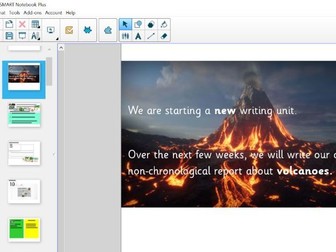
This download includes all slides and resources for a 12-lesson writing sequence, inspired where children write their own non-chronological report about volcanoes, using the Talk for Writing process. It produced very successful writing outcomes for a Year 3 cohort but could be tailored for other year groups.
Using Talk for Writing strategies, children recite and write a report about earthquakes. Then, they innovate by researching, planning, editing and publishing their own report about volcanoes.
The download includes:
• Ready-to-go lesson slides (Both SMART Notebook & Microsoft PPT format) that are user friendly and take the teacher through the writing sequence step-by-step
• Clearly organised and user-friendly resources for 12 lessons including a starter for every lesson, activities, some differentiated versions and word mats
• A book cover page to go into writing books
Lesson sequence:
L1 – I can explore and discuss non-chronological reports
L2 – I can identify the features of a non-chronological report
L3 & 4 – I can use actions and symbols to recite a non-chronological report
L5 & 6 – I can write a non-chronological report
L7 – I can explore and define subject-specific vocabulary
L8 – I can interpret and sort factual information
L9 & 10 – I can develop sentences for a non-chronological report
L11 – I can revise and edit my writing
L12 – I can publish a non-chronological report using subject-specific vocabulary
If you enjoy or have any feedback when delivering this lesson sequence, a review or comment would be appreciated!
This resource is really handy and helpful for students and teachers alike. It has a sample answer for report writing for CIE IGCSE 0500 English Language Paper 1
It also has tops and techniques, steps to write a report, some useful newspaper vocabulary idioms and phrases and other helpful exam tips and techniques
This stimulating and informative lesson develops students’ skill in creating non-chronological reports that precisely meet the content, language and structural features of the form. In particular, they gain an in-depth understanding of how non-chronological reports are ordinarily set out on the page, what information should be included within them, and what style they should be written in, in order to meet form and purpose. These resources contain 3 example non-chronological reports, differentiated by the accessibility of their language.
Students follow a clear and logical learning journey, in which they:
-Define what non-chronological letters are and clarify their purpose;
Establish the structural features of non-chronological letters;
-Work collaboratively to identify and analyse the content and language features in further model examples of non-chronological reports;
-Create a success criteria for effective non-chronological reports;
-Write their own non-chronological reports, using a planning sheet (if needed) and the techniques that they have learnt;
-Peer/self-assess their writing attempts.
There are enough resources here really for two lessons, including:
-Visually engaging whole-lesson PowerPoint;
-Non-chronological reports x 3 (based on tennis, great white sharks, and Dubai)
-Non-chronological reports structure worksheet;
-Non chronological reports planning sheet;
-Step-by-step lesson plan.
All images are licensed for commercial use, and are cited on the final page of the slide.
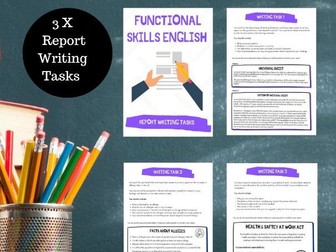
This lesson has been designed for anyone studying level one or level two Functional Skills English. The lesson helps learners understand how to approach a report writing question and includes a modelled response.
If you liked this lesson, then please check out our shop for more lessons and resources.
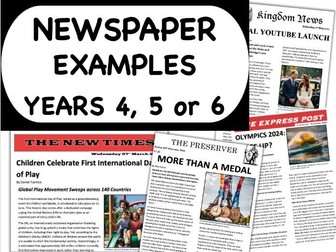
Need quality examples of newspaper reports for KS2? These newspaper articles are based on true stories but have been modified for children in KS2 - most suitable for Years 4, 5 or 6.
There are 4 articles and each one has a different newspaper name, date and focus. Each report uses the features of a newspaper article (as expected for KS2 children in the UK).
A powerpoint presentation that highlights the important points when writing a newspaper report. It uses a scenario where the students imagine they have been rescued after being stranded on a deserted island and contains information on newspaper structure, language devises and techniques in non-fiction writing designed to inform.
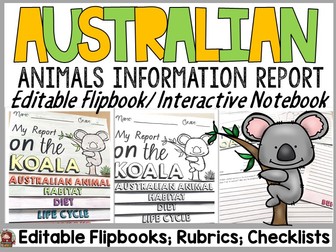
Use these flipbooks to scaffold the writing of Information Reports on Australian Animals. Students have a choice of 24 Australian Animals to research on. This resource can be used as a stand-alone flipbook or in an interactive notebook.
What’s Included:
24 EDITABLE cover templates in blackline to print. Images not editable.
EDITABLE Flipbook templates (2-7), in blackline to print.
*Self-editing checklist
*Peer-editing checklist
*Teacher Marking Rubric x 3 formats
*24 Vocabulary Display Cards
*Writing sheets x 3 styles
PARTS OF THE FLIPBOOK
COVER: 24 cover (images not editable) options featuring Australian animals. Students can pick the cover depending on what Australian animal is under study.
The following Australian animals are featured:
Bandicoot, Black Swan, Cockatoo, Dingo, Echidna, Emu, Kangaroo, Kiwi, Koala, Kookaburra, Platypus, Possum, Tasmanian Devil, Wombat, Bilby, Brown Snake, Crocodile, Frilled Neck, Lizard, Green Tree Snake, Quoll, Red Belly Snake, Cassowary, Sugar Glider, Thorny Devil
TEMPLATE 2: AUSTRALIAN ANIMAL
weight, length, family, and group of Australian animal. Students may also write a brief description.
TEMPLATE 3: HABITAT
location in Australia. A map of Australia is included to mark the location.
TEMPLATE 4: DIET
food the Australian animal eats to survive. There is place for illustration.
TEMPLATE 5: LIFE CYCLE
the breeding seasons and habits.
TEMPLATE 6: BEHAVIOUR
the physical and behavioural adaptations that enable the Australian animal to survive in its environment.
TEMPLATE 7: INTERESTING FACTS
any other interesting facts about the Australian animal that would sum up the information report.
HOW TO ASSEMBLE:
You can choose either of the options.
Print out the templates in blackline. Cut around each template and assemble from smallest template to largest template. Have students colour in cover page. Staple at top tab for flipbook or glue descending order in notebook.
Print out the templates on cardstock (different colours). Cut around each template and assemble. Attach at top.
** Have students refer to books, websites, and videos on the specific Australian animal to record information.
SUGGESTED USE:
Have students collect information in their flipbook on the Australian animal under study. This could also serve as their draft where they could use the self-editing and peer-editing checklists to edit. Finally have students publish on given writing sheets or type out content from draft observing corrections. The sections pertaining to habitat, diet, life-cycle, and behaviour can make-up the Body of the Report and 1-2 interesting facts to conclude the Information Report.
** These Australian Animal flipbooks are sure to make an interesting bulletin board display.
PRINTER SETTINGS: file >print > scale to fit paper
There are three resources that will help students to understand how to write a report effectively.
Resource One contains a report written by a student. There are also analytical questions that will help students to understand how the candidate constructed their report and whether their report is effective or not.
Resource Two is a PowerPoint, which contains a series of questions that focuses on students giving their opinions on school dinners. The students will then be encouraged to write their own report about their school canteen.
Resource Three is to be used after the students have completed their own reports, as it contains a series of self-reflective questions that will allow students to evaluate the effectiveness of their own report.
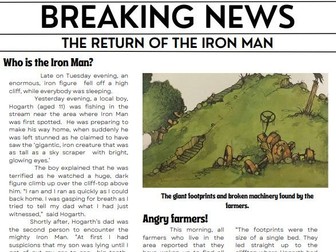
This resource includes an example of a newspaper report based on the events in the 2nd chapter ‘The Return of the Iron Man’.
It can be used as a WAGOLL and to explore the features of a newspaper. A useful starting point when revising newspaper reports and will save you from having to write your own!


 Quick View