A modelled introduction to persuasive writing for low ability pupils. This covers Pros/Cons and the first two paragraphs. Some modelled starters for less able pupils to get going and ideas for finishing off the first two paragraphs. I have used this with SEN/low ability Year 9 pupils and it really helps them to begin to understand the processes behind structuring a piece of persuasive writing.
Powerpoint to examine the good and bad sides of chewing gum - used uniform think pair share to stimulate ideas to begin with. Was used for a PSHE lesson with my form group. Kids loved it. Then again - I have the best form in the world!!
The following topics are covered:
describing your school
describing a normal school day
saying what subjects you study and giving your opinion
describing school uniform
talking about the good and bad things about school
discussing school rules
describing changes you would like to make at school
describing your ideal teacher.
3 lessons on a power point about school uniform in Spanish. Includes starter tasks, written task, peer assessment success criteria with graded outcomes A* -D and an AQA higher and foundation exam question. Please leave feedback.
Sentence builder
Activities such as gap fill, bad translation, jumbled sentence to re-order, templates for Conti sentence stealer, delayed dictation and mind reader and then tangled translation that touches upon earlier school uniform and location
Good revision task for school
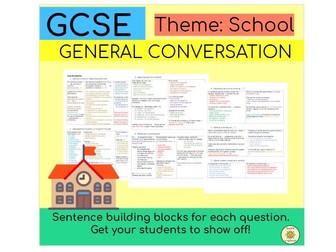
School Sentence building blocksScaffolded sentence building blocks designed to provide students with the necessary grammar and range of vocabulary to give detailed and complex answers in their speaking and writing GCSE Spanish exams. The questions match those of our Speaking Booklet (https://www.tes.com/teaching-resource/gcse-spanish-speaking-booklet-edexcel-and-aqa-roleplay-photo-card-general-conversation-practise-12069685) and are organised by modules 1-8, following the structure of the Viva! Edexcel Spanish GCSE book. Each question is answered with a colour coded multiple choice word bank that includes higher structures, different tenses, idioms and a variety of vocabulary. The perfect resource to boost their confidence when developing their productive skills and when preparing them for the General Conversation part of the Speaking GCSE.
Easy to adapt and modify to suit your classes and curriculum.
The questions included in this document are as follow:
¿Cómo es tu instituto? ¿Qué instalaciones tiene? What is your school like? What facilities does it have?
¿Qué asignaturas te gustan y no te gustan? ¿Por qué? What subjects do you like and not like? Why?
Háblame de tu uniforme escolar. Talk to me about your school uniform.
¿Qué piensas de las otras normas de tu instituto? What do you think about the other rules in your school?
¿Cómo es un día típico en tu insti? What is a typical day like in your school?
¿Qué es lo bueno y lo malo de tu instituto? What’s good and bad about your school?
¿Qué hiciste ayer en tu instituto? What did you do yesterday in school?
¿Qué planes tienes para este trimestre? What plans do you have for this term?
¿Puedes describir un viaje escolar que hiciste en el pasado? Can you describe a school trip that you have done in the past?
This resource is based on a typical GCSE French writing task, to write about a bad school day / une mauvaise journée à l'école. (The resource is based on an example response.)
The resource is split into 4 sections:
- Part 1: A good start to the day?
- Part 2: Late!
- Part 3: Trouble at school...
- The Full Essay.
Each section contains a pdf based on the text (with 11 activities to choose from), and a pdf based on the vocab (with 7 activities to choose from). (Over 100 pages in total!)
The text resources in each section include 3 jigsaw reading activities, a multiple choice rebuild activity, 4 different types of gap-fill activities, and a find-the-French resource including the text plus all of the vocab that features in the vocab activities.
The vocab resources in each section include: matching; multiple choice matching; writing the French based on word shapes; cut-out-and-play pairs cards for things like pelmanism or kinaesthetic matching; and dominoes.
The Home Front provides an up to date understanding of the
pressures and influences on parents, and makes recommendations
to policy makers for where to go from here in developing
parent-focused policy.
Year 10 and 11 - writing an article. (Edexcel and AQA)
I have exhausted the typical article question such as write an article on why ‘homework should be banned’ and ‘school uniform is good’ etc etc… and my classes wanted something new and different. So, I picked something controversial such as whether cycle lanes were good or bad and my classes was surprisingly upbeat and very engaged! They had some really excellent ideas, I was proud of them all!
The PowerPoint went down well and they really enjoyed it.
Enjoy!
Here are 5 lesson plans, a Powerpoint to aid delivery of each lesson and a Publisher document with relevant worksheets.Just added a Word document for resources for those who are struggling opening the publisher format Please comment and rate -thanks.
This is a resource we use to prepare KS2 year 6 children for school transition. We work through the booklet with the children on a 1:1 basis but this can be a self driven document.
This is enough to cover a few lessons on modals and school rules. The worksheet assumes knowledge of wenn, daß, weil etc and word order in producing good opinions and reasons. The mash up doc needs to be chopped up into strips. The notebook file contains the Grange Hill and Mash themetunes and there are real German pix of signs: watch out for the ones towards the end!
This lesson is written for the Module 1: Communication section and will help you prepare your students to undertake:
Section A Task 4
‘Prepare for and then take part in, a group discussion and make notes on the main points raised.’
Please note that the ASDAN CoPE course also needs a number of skills sheets and assessment paperwork that sit alongside each module. This is not included in this lesson resource. They can be found in the official student book.
The ppt will scaffold the lesson for your students, breaking it down into easy step by step instructions.
It includes:
objectives
a discussion focus (school uniform - good/bad)
a planning worksheet
success criteria
extension tasks
Looking for a project or activity for a group of students, a form or a class?
This ppt will help you launch a a project activity for them to do.
The title is ‘a topical discussion’.
The ppt will scaffold the project activity for your students, breaking it down into easy step by step instructions.
It includes:
objectives
a discussion focus (school uniform - good/bad)
a planning worksheet
success criteria
extension tasks
Making Sustainable Education Simpler
We've now proven beyond a doubt that a school can offer students a transformative high quality education and cover their own costs through school-run businesses.
The SCHOOL IN A BOX Guide Series aims to make starting such a school easy, and reduce the risks involved to a manageable level.
This series draws together the collective experiences of Teach a Man to Fish, our sister organization Fundacion Paraguaya, and the many school partners we work with across the developing world into nine easy-to-read self-help manuals.
This is my account of what happened when we moved to London and my son (then aged 9) suffered some bullying. (He is now 31 and a professional actor. You may have seen him in the photos and video referred to on Siddhartha becomes the Buddha.)
I wrote this years ago and found it when doing a computer search for Krishna - in relation to my recent Hinduism Day. I think it could encourage some good discussion on many aspects of RE, PSHE and Citizenship.
I have now also uploaded the 'parent' file - Sunlight and Shadow parts 2 and 3
Writing frame that sums up the whole of the topic school. It contains a few useful sentences to help pupils describe their school or add a few structures that may be more complex.
'The Business of School Councils' is the report of research into the factors that contribute to effective school councils. It can be used to help schools set up effective school councils and other methods of listening to pupil voice.