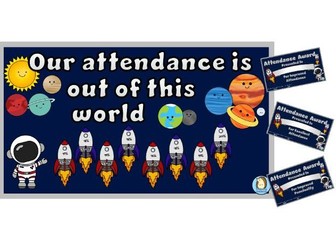
This “Our Attendance is Out of This World” display pack, featuring a vibrant space theme with rockets, astronauts, and planets, is designed to inspire and improve whole-school attendance in your primary school. The pack includes engaging display materials that bring the theme to life, making it easy to create a visually striking attendance board. Also included are matching certificates to reward students for excellent attendance, improved attendance, and punctuality. Perfect for setting a school-wide focus on attendance, this display pack makes an impactful, year-round addition to your corridor or school hall.
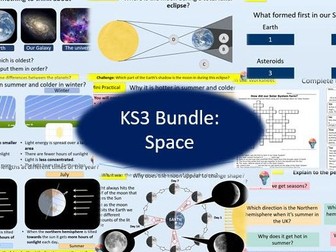
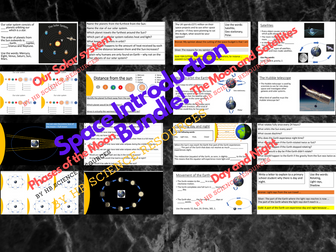
This bundle contains all the lessons you need to cover the KS3 English National Curriculum on Space.
These lessons are designed to be easy to teach (especially for non-specialists), interactive, student-led, and AfL filled/driven.
These lessons contain video links, various online simulations for students to use to aid their understanding and sense of wonder, PDF worksheets, complete PDF answer sheets, answers to all powerpoint questions (either incorperated into the powerpoint slides or in the notes sections), teacher delivery notes/tips in the “notes” sections of the powerpoints, stretch and challenge tasks for higher ability students throughout each lesson, various AfL tasks (e.g. finger voting/mini-whiteboards/true-false quizzes), and plenary tasks for each lesson.
This bundle contains the following lessons:
The Night Sky
The Solar System
Formation of the Solar System
Why we get Seasons
Phases of the Moon
Eclipses
Let’s learn about Space!
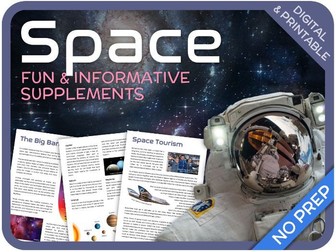
This worksheet includes 24 pages with a large variety of activities and exercises about Space. The materials have informative exercises about many different kinds of topics such as the big bang, black holes, the solar system, the Sun and many other things! Crosswords, word searches, puzzles and other kinds of activities are included to make it a fun and interesting class. The answers and an answer sheet is included.
GOOGLE SLIDES WITH PREMADE TEXTBOXES INCLUDED!
Overview:
Page 1-3: The Big Bang Theory
Page 4-6: The Solar System
Page 7-9: The Sun
Page 10-11: Meteors, Comets, and Asteroids
Page 12: Black Holes
Page 13-14: Neil Armstrong
Page 15-16: The International Space Station
Page 17-18: Space Rubbish
Page 19-20: Space Tourism
Page 21-22: Fun Facts
Page 23-24: Reflection
The following questions are just a few examples of the aspects addressed in this unit:
What are the planets in our Solar System?
What are black holes?
Why is there an International Space Station?
What is Space Rubbish and how dangerous is it?
Why do planets orbit the Sun?
Who was the first person in space?
What is the big bang?
What causes the tides?
Why is there no sound in space?
What is the difference between meteors, asteroids and comets?
Keywords:
Space, satellite, galaxy, comet, asteroid, planet, sun, earth, NASA, alien, shooting star, space station, astronaut, saturn, mars, jupiter, venus, neptune, mercury, uranus, gravity, orbit, milky way, black hole, Neil Armstrong, Yuri Gagarin, big bang, stars.
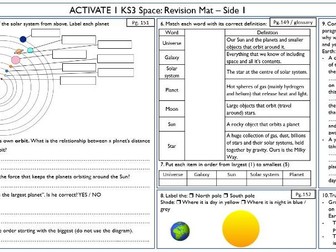
A double sided revision mat worksheet with answers. Page number references given for Collins Activate 1 Textbook.
Suitable for mixed ability groups - a variety of tasks including short answers, gap-fills and match-up activities.
Includes questions about:
Planets: Order, size and orbits
Key vocab definitions about objects in space
Days, years and seasons
Eclipses
Phases of the moon
Satellites
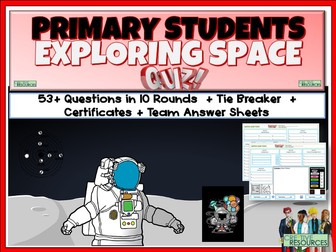
Space Science Quiz and answers for KS2 or KS3 Students. Versatile, editable science resource for either an Online virtual science lesson or a more traditional classroom based science lesson. The topic of the quiz is space
This science quiz includes a wide variety of different rounds including: matching rounds, photo rounds, linking rounds , number round, multiple choice round , designing round, word search, anagrams and much more…
**Just added for ONLINE LEARNING - NEW DIGITAL ANSWER SHEET - Student can fill in their editable PDF answer sheet and can also self mark with built in tick boxes and score counter.
Contents of Quiz
☞ 1 x Professionally Designed PowerPoint Quiz ( Containing 10 Different Rounds and over 50+ Questions)
☞1 x Set of certificates for winning students (Gold, Silver and Bronze)
☞ 1 x Full set of Answers (Animated at the end of the Quiz)
☞ 1 x Student Answer Sheets they can fill in during the quiz
☞ 1 x FULLY DIGITAL STUDENT ANSWER SHEET
☞ Quiz can be done as an individual task or in small teams.
✰✰✰✰✰✰✰✰✰✰✰✰✰✰✰✰✰✰✰✰✰✰✰✰✰✰✰✰✰✰✰✰✰✰✰✰✰
How could you use it for science?
Use for a Live Zoom / Teams Lesson
Assess Prior knowledge or introduce a new topic
As a class based activity / Lesson
An educational ’ Treat Lesson ’ For your students.
✰✰✰✰✰✰✰✰✰✰✰✰✰✰✰✰✰✰✰✰✰✰✰✰✰✰✰✰✰✰✰✰✰✰✰✰✰
Who are Cre8tive Resources?
We are a not-for profit Community interest social enterprise made up of Teachers. We invest in developing more free and paid resources for students.
Product Code: C8/QZ/263
✰✰✰✰✰✰✰✰✰✰✰✰✰✰✰✰✰✰✰✰✰✰✰✰✰✰✰✰✰✰✰✰✰✰✰✰✰
You may also want to check out these other popular Science resources for your students
⇨ Women in Science
⇨ Scientific Discoveries
⇨ The Heart Revision Task Cards
⇨ Science End of Year Escape Rooms Bundle
⇨ How to Draw Graphs in Science
⇨ Organic Chemistry
⇨ Genetics - Biology
⇨Electricity Science Escape Room
⇨ Careers in STEM
⇨ Exploring SPACE
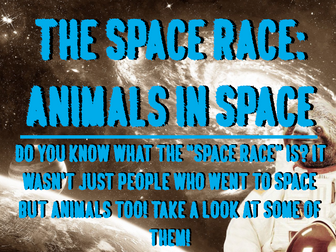
Contains a PowerPoint which looks at the Space Race with a focus on the first animals to be sent into space by the USA, USSR & France. Each slide looks at a different animal, in order of their missions and gives basic info. Some slides include links to videos that can help engage children and give them extra information.
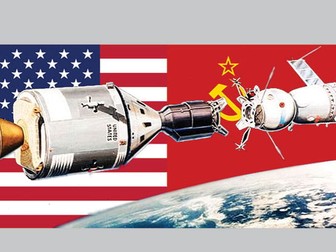
This is an introductory lesson to the history of space travel used with Year 5. It details the main events and gives the children a sense of chronology. The children have to reach their own conclusion as to who ‘won’ the space race by justifying their decision. The resource includes:
PowerPoint presentation,
Differentiated worksheets,
Lesson plan.
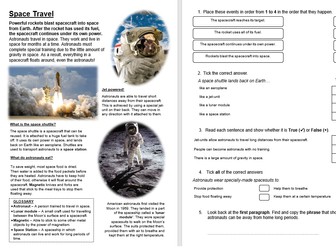
This space-themed comprehension is aimed at KS2 primary school learners. It contains an information page of text about ‘Space Travel’, sharing lots of useful information and facts.
A set of National Test style questions have been written to work alongside the information sheet including questions such as:
Order events 1-4
Tick the correct answer
True or False
Find and copy
There are 5 questions in total with an answer sheet provided :)
We are hoping to produce more of these comprehensions so keep your eyes on our resource page!
All images taken from copyright free image sources.
ENJOY!
A booklet about Space, planets, galaxies and technology using the Widgit symbols. I designed it to be an easy read for students with poor literacy and non-confident readers. There are some worksheets to access comprehension, but these are not with symbols.
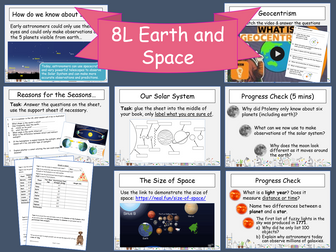
5 Lesson BUNDLE for 8L Earth and Space (Exploring Science 8)
Lesson 1: 8La Gathering Evidence
Lesson 2: 8Lb Seasons
Lesson 3: 8Lc Magnetic Earth
Lesson 4: 8Ld Gravity in Space
Lesson 5: 8Le Beyong the Solar System Pt.1
Beyond the Solar System Pt. 2
All worksheets included in individual lessons.
Other Year 8 Bundles:
8A Nutrients: https://www.tes.com/teaching-resource/8a-food-and-nutrition-bundle-exploring-science-12736670
8B Plants: https://www.tes.com/teaching-resource/8b-plants-and-their-reproduction-bundle-5-6-lessons-12678036
8I Fluids https://www.tes.com/teaching-resource/8a-food-and-nutrition-bundle-exploring-science-12747933
Classroom Displays:
Cells - https://www.tes.com/teaching-resource/cell-biology-and-division-board-display-12581330
Genetics - https://www.tes.com/teaching-resource/genetics-science-display-board-genetic-engineering-clones-chromosomes-12728955
Chemistry - https://www.tes.com/teaching-resource/atomic-structure-and-compounds-science-board-display-materials-chemistry-classroom-display-12679637
Embark on an interstellar journey with " Forces and Space - Earth and Space," the ultimate class assembly script resource designed to propel students and the school audience into the vast expanse of our universe. This script is an educational launchpad for teachers to illustrate the wonders of space and the forces that govern it.
Key Features:
Comprehensive Script: Our script navigates through the cosmos, providing a detailed narrative about Earth’s place in space, gravity, planetary motion, and more. It’s written to captivate and educate, making the vast concepts of space science accessible and engaging.
Character List: With characters ranging from the mighty Sun to the smallest Asteroid, each student will have the opportunity to represent an element of our solar system or a force that operates within it. The character list is designed to encourage participation and ensure that every student can be a star in the performance.
Recommended Props: To enhance the visual spectacle of the assembly, we’ve included a list of suggested props that can be easily created or found. These props are not only fun to make and use but also serve as tangible representations of the celestial bodies and forces at play.
Adaptations for Varied Educational Needs: The resource comes with a guide on how to adjust the script to fit different year groups or school types, making it a versatile tool for any educational setting.
Educational Impact: This assembly script goes beyond the performance, serving as a dynamic educational resource that encourages students to explore and understand the fundamentals of forces and space.
Additional Information:
Editable PDF: Flexibility is key, and that’s why our script is provided in an editable PDF format. Upload it to Google Docs, and you can easily make edits to tailor the script to your class’s unique talents and curriculum requirements.
More Teaching Resources: If “Galactic Explorers: Forces and Space - Earth and Space” helps your class’s interest in science take flight, be sure to explore the wide range of educational materials we offer on the TES website. Our resources are crafted to enhance teaching and learning across various subjects and grade levels.
Bring the wonders of the universe into your hall with this ready-to-use Space Week / Astronomy Assembly PowerPoint – perfect for KS1 and KS2.
This engaging assembly includes:
A fully scripted set of notes in the presenter’s section, written in easy-to-read paragraphs so you know exactly what to say.
Striking slides covering big questions, amazing space facts, astronauts, and the famous Earthrise image.
Opportunities for pupil participation through astronaut role play and reflection questions.
A closing thought that links curiosity about the stars with caring for our planet Earth.
In this lesson, students will work towards the objective: To understand how space travel has progressed and how rockets work.
They will look at how space travel has progressed over time through the timeline slides and will be quizzed on what they have learnt. Following this, they will learn how rockets are made and how they work in great detail through videos and text. Finally, they will be supported in creating their own rockets from film containers to practically see the science in action!
The engaging presentation- with links to online video clips and an experiment sheet are all provided. A knowledge organiser for Earth & Space is also included.
This lesson is intended for Year 5 students but can easily be modified for all KS2 and KS3 students.
This lesson is 1/6 lessons on Earth & Space. To view the other lessons, please visit: https://www.tes.com/teaching-resources/shop/ResourcesForYou/Primary science
Leave a review for this resource and send a copy of your receipt to resourcesforyou100@outlook.com to receive a FREE single resource of your choice!
The presentation looks at the theories of Aristotle, Copernicus and Galileo to show how these theories led to modern day ideas about the solar system.
The first activity asks children to fill in diagrams to show the difference between heliocentric and geocentric models.
The second activity asks children to write or match facts about early astronomers and is differentiated 3 ways.
Higher ability write own sentences
Middle ability match stickers and fill in missing words
Lower ability match stickers
Please note I do not own any of the pictures or videos used in these resources.
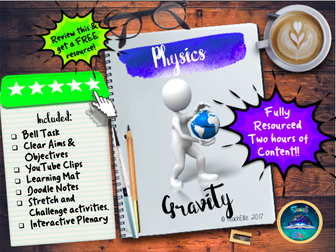
This is a 2 hour ‘Grab & Go’ lesson on the concept of gravity and the Space Race. perfect for Space Week
Included in this lesson is:
Bell Task
Clear Aims & Objectives
YouTube Clips
Learning Mat
Doodle Notes
Stretch and Challenge activities.
Interactive Plenary
If you review this resource we will give you another resource for FREE.
We hope that you enjoy this resource! We would love your feedback, if you like what you see, please follow us: on Tes <a href=“https://www.tes.com/teaching-resources/shop/TeachElite”>TeachElite’s Shop</a> click the’Follow this Author button’ . We will keep you updated on any sales we throw or FREEBIES we upload. <br />
<br />
You can find us on Twitter: https://twitter.com/TeachEliteRE<br />
and Facebook: https://www.facebook.com/TeachElite/
5 space writing activities and support resources: funny rhymes, acrostics, slotting words into a space picture, space rhyme bank, and a simile poem to write - IN a planet! Guide notes provided where handy. Approx. Y3-6.
This bundle includes everything you need to teach about the topic of the Space. Perfect for covering all areas of Space including the planets, astronauts and Neil Armstrong!
Included in this pack:
Presentations for each lesson, with interactive activities and links to videos.
Worksheets for different lessons and accompanying activities.
Opportunities for cross-curricular links as well as class projects.
Workbooks for children to work through during the entire topic.


 Quick View