This Netflix documentary will change how students think about their clothing purchases and consumption habits overall. Great for Social Studies or Family and Consumer Science, this 95 minute documentary examines the origins of where our clothing is produced, and its cost to the people who make it, our environment and the planet as a whole. Suitable for any level of middle or high school where you are discussing economy, global trade, environment this film will open up much to discuss. Lesson down load includes a brief survey for students prior to watching in a think/pair/share, 25 chronologically ordered questions, three experiments for students to complete at home after the first night of viewing and space for personal reflection at the end. Lesson takes as least two days to complete and could really use a third to help students process what they learned. Answer key to movie questions is also included. Film is available on NETFLIX.
Bring real-world issues into your classroom with this engaging, ready-to-use worksheet based on the eye-opening documentary The True Cost (2015). Perfect for citizenship, ethics, or social studies classes, this resource helps students explore the hidden impacts of the global fashion industry—including environmental damage, labor exploitation, and consumer responsibility.
This comprehensive and student-friendly pack includes:
A guided introduction with pre-watching questions
“While watching” activities to focus student attention
Critical thinking questions with an answer key
A creative storytelling assignment
A mini research task on ethical fashion
Optional group discussion prompts
Designed to spark meaningful classroom conversations and critical reflection, this resource is ideal for secondary students (ages 14–18) and requires no prep from the teacher!
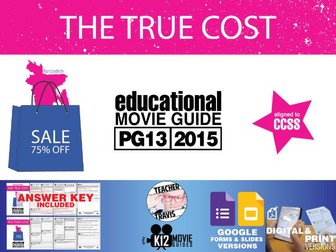
The True Cost Documentary Movie Guide | Questions | Google Formats (PG13 - 2015) challenges your students to put themselves in the shoes of garment workers in India and Bangladesh and connect their experiences to the fast fashion industry. Explore the idea of advertisement and consumptionism. Analyze the argument that sweatshops might help poorer countries. Finally, explore what we can do as individuals to help reform the clothing industry.
This resource consists of 11 high-level, short answer and essay questions that will do more than just ask your students to regurgitate information.
This product .zip file includes:
A student movie guide, PDF print version (4 pages)
A student movie guide, PDF digital fillable form version (4 pages)
*An answer key is included with this movie guide, however many answers will vary as students are encouraged to construct their own meaning from the characters’ dialogue and behavior. See the preview for samples.
*A Google Forms & Slides Version of the Movie Guide
*CCSS alignment indicating standards met, PDF (1 page - see also preview image)
**CCSS Note: I’ve taken the liberty of aligning certain reading standards with the act of consuming content via the movie instead. Although students aren’t reading they are asked to perform the same cognitive functions on the content that they consumed from the movie.
**Distance Learning Tips:
Distribute the digital PDF file or the google forms version to each student
Use the screen sharing tool on your group call software to play the movie
Pause the movie at each question to give students time to write/discuss
Is this movie guide worth it? Download two of my movie guides for free below:
Trolls World Tour (PG - 2020)
Onward by Disney (PG - 2020)
The Lightning Thief
Kung Fu Panda 3
Teach The True Cost of Auto Leases with expert-level confidence—even if your degree isn’t in Finance or Maths.
Stop spending your evenings and weekends prepping complex financial concepts. This “Zero-Prep” resource is designed to teach itself, providing a high-rigor, visually stunning lesson that allows any teacher or cover supervisor to step in and deliver master-level instruction instantly while eliminating maths anxiety for both teacher and student.
What’s Included
The Concept Blueprint: A comprehensive independent study guide featuring the Teacher’s Briefing, a scripted “Anchor Analogy” narrative, and visual logic diagrams to cement foundational understanding.
The Guided Mastery Suite: High-rigor worked examples that bridge the gap between theory and calculation, utilising a step-by-step mathematical modelling approach.
The ‘No-Fail’ Mark Scheme: A fully transparent, isolated answer key that replicates every logical step and equation, ensuring students receive immediate, accurate feedback.
Premium “Non-Specialist” Features
Teacher Briefing: A “Why This Matters” high-level overview to get you up to speed in under 60 seconds.
Teacher’s Script: A 2-paragraph narrative script that explains complex financial logic using relatable, real-world analogies.
Misconception Radar: Integrated “Pitfall Warning” callout boxes that identify and correct common student errors before they happen.
Financial Literacy, Maths Cover Work, Ready-to-Teach, KS4/Secondary Finance, The True Cost of Auto Leases, Anchor Analogies, Emergency Cover Lessons, Business Maths, Life Skills, Guided Practice
Resource;
Algebraic statements - True or False
Contains;
1. 20 algebraic statements.
2.Cross Curricular link encourages literacy with the pupils (this is a massive focus in our school).
3. 20 solutions provided.
4. Set of instructions to ensure the task runs smoothly.
5. Printable version – white version instead of yellow to save on ink.
Printing Tip: This resource has been designed to display on a board. If you wish to print I would shrink 4 to a page and click on 'two sided' to save on cost. If you are printing on a different size, select ‘shrink’ or ‘print to fit page’ (or fit to page option on your print settings) in order for it to print correctly on A4.
File Type;
PDF
Idea behind task;
To develop pupils thinking/reasoning skills. To encourage pupils to think about what a term or expression actually means. To encourage mathematical discussion within the classroom.
Check the preview!
If you do purchase my resource, please do rate and review my resources. I really appreciate reviews and feedback, I aim to develop constantly and love to ensure my resources are up to date and differentiated to all ability levels but please do try to be constructive!
@ shacostello@gmail.com
This is a good way of developing pupils reasoning skills.
Terms of use;
Please use only by the customer paying for this resource.
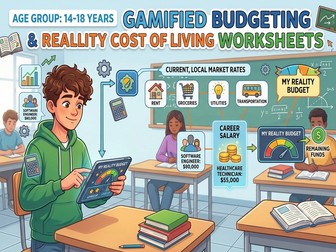
Are you tired of abstract financial literacy lessons that fail to connect with your students? Bridge the gap between textbook theory and real-world survival with this immersive, Gamified Budgeting & Cost of Living Project-Based Learning (PBL) Curriculum.
This isn’t just another worksheet. It’s an unforgettable, multi-day “reality check” that forces students to confront the true cost of independent living. By choosing a career and using real-time, localized data from their own communities, students will build a comprehensive monthly budget from the ground up. They will experience the financial shock of taxes, the challenge of finding an affordable apartment on Zillow, the pain of calculating local grocery and utility bills, and the weight of debt and savings.
This complete, no-prep curriculum is designed to generate powerful “aha!” moments and foster critical thinking, resilience, and true financial understanding.
What’s Included in this 42-Page All-in-One PDF:
Part 1: In-Depth Theoretical Guide (9 Pages): A professional overview for educators on the pedagogical approach, covering concepts like The Income Illusion, The Housing Heavyweight, The Convenience Tax, and Subscription Creep, all supported by case studies.
Part 2: The 10-Worksheet Student Project (20 Pages): A step-by-step workbook that guides students through:
Worksheet 1: Career Selection, Gross vs. Net Income, and Taxes
Worksheet 2: Housing Market Reality (researching real local rent)
Worksheet 3: Utilities and Connectivity (real costs of electricity, internet, etc.)
Worksheet 4: Groceries & Dining Out (pricing a real grocery cart)
Worksheet 5: Transportation Economics (car payments vs. public transit)
Worksheet 6: Healthcare and Emergency Funds
Worksheet 7: The Lifestyle Audit (discretionary spending)
Worksheet 8: Debt & Obligations (student loans, credit cards)
Worksheet 9: The Monthly Ledger (reconciling the final budget)
Worksheet 10: The Pivot (navigating simulated financial shocks like rent increases or car trouble)
Part 3: Comprehensive Teacher Resources (13 Pages):
Conceptual Visuals: Three powerful diagrams to simplify complex ideas.
Fully Worked Exemplar Answer Key: A complete, step-by-step walkthrough of the entire project using an example profile (Dental Hygienist in Austin, TX).
5-Day Teacher Implementation Guide: A pedagogical roadmap for rolling out the project, complete with gamified elements and tips for managing classroom discussion.
Assessment & Grading Rubric: A clear, 4-point rubric to make grading meaningful and simple.
Equip your students with the critical financial survival skills they desperately need for life after graduation. Download this impactful project today!
Keywords: Financial Literacy, Project-Based Learning (PBL), Budgeting, Real World Math, Cost of Living Project, Life Skills, Economics, High School Math, Personal Finance, Career Exploration, Adulting 101, Gamified Learning, No-Prep, Curriculum.
Analysing the costs of new learning technologies within the educational sector is currently a neglected area, yet the issue of how to spend money effectively in this context is a question that must be answered. This question is made especially pertinent with the current expansion of information technology into higher and further education. To know the costeffectiveness of these initiatives, it is first necessary to gain some comprehension of the costs involved. This must be done in a way that is comprehensible to everyone in academia.
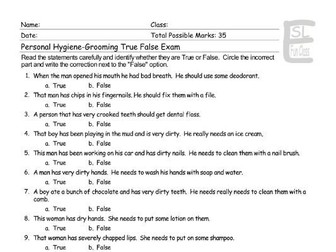
Personal Hygiene-Grooming True False Exam-ESL Fun Games
Try out our Personal Hygiene-Grooming True False Exam.
Description:
This is a two page true false exam. Each exam has a total of thirty-five true or false statements.
How to Use It:
Students will read the statements and identify whether they are true or false.
These exams can be printed and handed out to students in class. They also work great for extra homework practice.
Save on printing costs by projecting the exam and having students write down the answers in their notebooks.
Notes:
Each exam includes an Answer Key, Scoring Sheet and Scoring Solution on separate pages.
Use our board and card games or other worksheets and exams as complimentary activities for this exam.
Don’t forget to download our free “Telling Time True False Exam” sample to try one out.
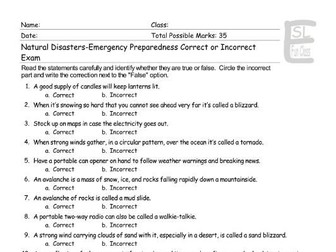
Natural Disasters-Emergency Preparedness True-False Exam-ESL Fun Games
Try out our Natural Disasters-Emergency Preparedness True-False Exam.
Description:
This is a two page true false exam. Each exam has a total of thirty-five true or false statements.
How to Use It:
Students will read the statements and identify whether they are true or false.
These exams can be printed and handed out to students in class. They also work great for extra homework practice.
Save on printing costs by projecting the exam and having students write down the answers in their notebooks.
Notes:
Each exam includes an Answer Key, Scoring Sheet and Scoring Solution on separate pages.
Use our board and card games or other worksheets and exams as complimentary activities for this exam.
Don’t forget to download our free “Telling Time True False Exam” sample to try one out.
**Lesson 2 of 4 - Is this true
**
Our media literacy resources have been carefully designed to give you a comprehensive understanding of media literacy, providing practical tools to integrate the subject into your teaching and empowering your students to distinguish fake news from reliable information. The resources are designed to be used in the classroom straightaway, and include worksheets, classroom presentations and lesson plans.
Developed by The PSHE Association, The Student View and Bellingcat, our Media Literacy curriculum has been awarded Level 4 Impact accreditation by Skills Builder Partnership which means that all of our resources not only develop Media Literacy skills, but also their essential skills of Listening, Speaking, Problem-solving and Staying Positive.
FREE Training for Teachers
We have a limited number of places available on our Media Literacy CPD for Secondary School Teachers between October 2023 and January 2024. Find out more and guarantee your place (at no cost to you or your school) https://thestudentview.org/teacher-training/.
Funded by The European Media and Information Fund.
In Issue 11.2, Nicol and Coen (2003) argue for developing a cost-benefit analysis model for learning technology. However, there are three substantive issues with this approach. First, it is problematic because it involves comparing different things; second, because by understanding the purpose of the analysis, it may be possible to justify the necessary simplifications for special cases and limited applications while being explicit about the limitations; and third (and conversely), this can expose errors and omissions in the analysis even after accepting its general principles.
This is a lesson which meets specification points within the WJEC GCSE ‘The Sciences’ Double Award (2026) spec, specifically from Unit 3.2 - Energy Resources & Efficiency (Biology)
The lesson starts with an overview of the key vocabulary which students will be learning and using this lesson. Students can stick their key word lists into their books before the lesson begins.
The lesson starts off with a true or false activity to recap on the previous lesson content, on the topic of energy and power.
After this, students will be introduced to the idea of kilowatt hours as a measure of electrical energy used by appliances, and therefore homes/industry. Students will then be asked a few short questions to assess their understanding of what they have learned so far.
Students will then be shown the calculation to work out the total cost of using an appliance, and be shown an example electrical bill and worked example.
After this, students will be given a worksheet which contains information about various electrical appliances and how much they have been used for. Students will have to use the price of electricity provided to work out the family’s overall running costs of the house. The mark scheme for this task is included in the resources, for students to assess their work once complete.
The next task is a progress check, which the students can either self-assess or peer-assess using the answers provided.
The last task is a set of questions graded from easy to hard, students are to start at the easy questions and answer as many of them in their books as they can, working their way over to the harder questions.
The plenary task is an exit card for students to summarise what they have learned during the lesson, this can be handed into the teacher at the end of the lesson.
Thanks for purchasing, please let me know if you have any feedback :).
Significant investments are being made in the application of new information and communications technologies (ICT) to teaching and learning in higher education. However, until recently, there has been little progress in devising an integrated costbenefit model that decision-makers can use to appraise ICT investment options from the wider institutional perspective. This paper describes and illustrates a model that has been developed to enable evaluations of the costs and benefits of the use of ICT.
Significant investments are being made in the application of new information and communications technologies (ICT) to teaching and learning in higher education. However, until recently, there has been little progress in devising an integrated costbenefit model that decision-makers can use to appraise ICT investment options from the wider institutional perspective. This paper describes and illustrates a model that has been developed to enable evaluations of the costs and benefits of the use of ICT.
The need for more cost-effective and pedagogically acceptable combinations of teaching and learning methods to sustain increasing student numbers means that the use of innovative methods, using technology, is accelerating. There is an expectation that economies of scale might provide greater cost-effectiveness whilst also enhancing student learning. The difficulties and complexities of these expectations are considered in this paper, which explores the challenges faced by those wishing to evaluate the costeffectiveness of computer-based assessment (CBA).
The aim of this unit is to focus on how business objectives are to be achieved once they have been decided. This unit focuses on the methods that businesses can use in order to meet their objectives. It breaks these methods down into functional areas: marketing, finance, human resources and operations management (including purchasing and stock control). For more materials relating to this resource, please visit the NGfL site, linked below.
My friend's two sons call me Grandma and I have known them for more than ten years, This is an account of the way the older son got into big trouble a few years ago.
He is now in prison as a result.
Get your students to work out all the different places where he made choices - which could have changed the course of that very sad evening, in which he was responsible for the death of his friend.
I have now added another 'chapter&' three years on.
I hope that by reflecting on this true story, they may be able to make wisher choices themselves. It might even save someone&';s life.
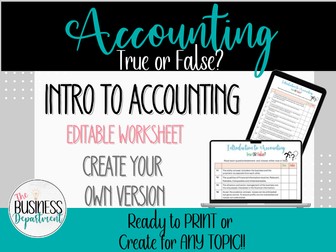
Introduction to Accounting: Concepts, Bases and Policies.
True or False? Two page worksheet to revise Introduction to Accounting: Concepts, Bases and Policies.
Students will need to analyse the information and form their own conclusions.
They are also asked to explain their choices.
Answer key included.
Can be PRINTED or used as DIGITAL versions.
Both Colour/BW versions available.
EDITABLE by clicking into the table and adding your own text.
These are very popular with my senior / Leaving Certificate students.
You may also be interested in:
Intro to Accounting | Complete Unit |Theory of concepts, bases & policies
Introduction to Accounting | Key definition worksheet | EDITABLE
Economics Revision | Strand 1 BUNDLE | Intro, Scarcity & Choice, Sustainability
Intro to Economics | Complete Unit | Scarcity, choice, opportunity cost | Basic Economic Problem
Economics | Complete Unit Market Equilibrium | Supply and Demand
Economics | Complete Unit |Consumer | Diminishing Marginal Utility | Equi-Marginal Principle |
Economics | Student experiment | Law of Diminishing Marginal Utility | Consumer
Business Revision | Unit 1 BUNDLE | People in Business, Contracts and Conflict |
Business Revision | Contract Law |
Business Revision | Industrial / Workplace Conflict | Industrial Relations |
Other Economics, Business and Accounting resources available in my store.
The critique by Draper raises some interesting points that we did not have space to discuss in our published paper. As he points out, taking a purely quantitative approach to the evaluation of ICT investments in teaching and learning is wholly inappropriate. However, in this transitional period, where ICT applications are new and the effects on operational processes within higher education institutions are unknown, it is not only qualitative issues that need to be investigated but also the potential changes to the scope and nature of the costs incurred by institutions.