AQA GCSE Science skills and metacognition - how to approach exam questions using thinking skillsQuick View
Professor_Bunsen

AQA GCSE Science skills and metacognition - how to approach exam questions using thinking skills

(2)
Huge pack of resources to teach a module on thinking skills and metacognitive approaches to science exam questions. Aimed at year 10/11 double or triple scientists. The resources focus on skills and contain examples from biology, chemistry and physics. The questions selected can usually be answered from the information in the question meaning this work can be incorporated into teaching without worrying too much about where you are in the syllabus. Mark schemes are included. Metacognition, which includes ideas such as learning to learn and developing thinking skills, can be applied to the way students tackle examination questions. This scheme of learning and accompanying lessons and resources,for science skills, breaks down the different types of questions that students meet and supports them to find learned strategies that work for them in how to tackle those questions. Each skill comes complete with a PowerPoint, worksheet and mark scheme. The resources are based on AQA materials but the skills are transferable across other exam boards. All three sciences: biology, chemistry and physics, are covered. Connections and tick boxes Data in tables Graphs Data in bar and pie charts Comprehension and application Command words Complicated diagrams Extended response questions Professor Bunsen resources are tested in school and make GCSE science engaging and exciting. Most importantly it could save you and your school time! The accompanying worksheet allows students to practice and for you to give feedback and help them to improve. The answers are included to help the busy teacher or non-specialist.
Computational Thinking Escape RoomQuick View
nwilkin

Computational Thinking Escape Room

(7)
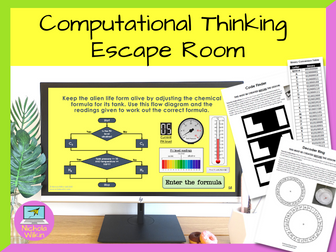
This highly interactive lesson that requires the pupils to work in teams and use computational thinking skills to solve a range of puzzles. This activity perfect for pupils about to learn Python programming and you want to show the importance of computational thinking skills. **This resource was shortlisted for the Teach Secondary Awards, a very rare honor for an independent resource creator. ** Your class need to work together to escape a locked laboratory in a spaceship and start the engines to avoid being sucked into a black hole by completing different challenges which will use a variety of computational thinking skills. They are given most of the lesson to work together and at the end of the lesson, time is dedicated to discuss the computational thinking skills they used during the activity. This gives them a practical application for the computational thinking theory rather than using the tired old “making a jam sandwich” or “getting up in the morning” scenarios which are commonly used. This activity is not a handout driven escape room, it involves using an interactive PowerPoint presentation and physical tasks that moves away from pupils filling in yet another worksheet, to working together in a team to solve interesting and challenging puzzles. Pupils enjoy the lesson and are fully engaged whilst developing the key computational thinking skills of decomposition, pattern recognition, abstraction and algorithms. Please note: This lesson does require teachers to prepare some props beforehand and it is highly recommended the teacher reads through the teacher’s instructions and creates the props well before they want to use the lesson. Also please note that this resource does not work with Google Slides. Written primarily for key stage 3, this activity can be used in a variety of situations: Introducing pupils to computational thinking skills before they are introduced to a text-based programming language Used as an end of term fun lesson which still has an education element A fun activity to use on a year 6 transition day Allow your new year 7s to get to know their new classmates and grow team sprit Helping a reluctant class see the benefits of learning programming skills . What are you waiting for? Download this interactive escape room NOW, to help students learn about computational thinking skills in a fun and memorable lesson they will love and remember. You may also be interested in my Computational Thinking Worksheets which you can buy from here.
Strategy Board Games for Critical ThinkingQuick View
swelch_resources

Strategy Board Games for Critical Thinking

(3)
This is a set of 10 board games that work on STRATEGY rather than CHANCE. The only equipment you need is counters/markers. Provided in both colour and black/white. Easy-to-follow instructions are written on the game boards. All games are for 2 players. These games develop skills such as: ♦ strategic thinking ♦ logical thinking ♦ spatial perception ♦ planning ahead ♦ social interaction (not played on a screen!) Games: ♦ Spiralin’ ♦ Slide it! ♦ Sandwich ♦ Choices ♦ Pretwa ♦ Block ♦ Len Choa ♦ Nine Holes ♦ Tapatan ♦ Nine Field Kono Designed on A4 size paper. ********************************************************************** © Suzanne Welch Teaching Resources
Thinking skillsQuick View
bgjwh06

Thinking skills

(0)
creative questions - a power point of questions set to make children think creatively (What would life be like if cars were never invented)- 10 questions with pictures to match. Creative thinking - more questions which are more specific to encourage creative thinking skills. (e.g. You walk into class and instead of your teacher you find ?Goldilocks sitting in her chair. She tells you, that you can ask ?three questions which would you pick and why?) 15 questions with pictures. Litercy starter pictures - These are a set of pictures collected from the national geographic website which are great for discussion ( a shadow lurking in the water - a fish surrounded by other fish - men backpacking and carting sleds in the snow)
Revision Study Skills 1Quick View
NikkiFabs

Revision Study Skills 1

(0)
Powerpoint and activities for study skills. used post 16+ but also useful for Year 11. Covers different techniques and why revision is important. Why its important, thinking positive and who can help with some simple case studies. 15 slides fully editable. Activities are separate.
High Order Thinking Skills ActivitiesQuick View
misscarter2023

High Order Thinking Skills Activities

(0)
The following resource provides both display tiles and information slides for High Order Thinking skills, Critical thinking, Inferencing thinking, Problem solving based activities. These are based on Bloom’s taxonomy. You will receive 23 different ideas that can be used throughout your lessons in addition to plenary ideas. The resource is fully editable so you can re-arrange the display tiles to reflect your personal style. The activities aim to develop your pupils understanding of learning styles, critical thinking, inference thinking, problem solving skills and high order thinking skills. These are activities that can be used in upper primary to secondary classrooms.
Thinking Skills PowerpointQuick View
wardy2

Thinking Skills Powerpoint

(15)
60+ slides each with a new thinking skill/discussion point. Eg: What is lurking in the middle of this maze? (with picture) Why is this man upset? (with picture) Who would you rather be friends with? (with pictures) Why did this cat eat? (pic of fat cat) Perfect for thinking time while you take the register - then you can discuss it for a few minutes after. I have tried to make them appeal to girls and boys, as well as including some emotional questions, practical and just fun things. There are what if's, hows, whys, whens, who.... Hope you find them useful.
Strategic Thinking Skills BuildingQuick View
Cre8tive_Resources

Strategic Thinking Skills Building

(0)
Strategic Thinking Skills Building Escape Room - Virtual Escape Room run through PowerPoint by Cre8tive Resources! This lasts an hour or under depending on how quick the teams can solve each puzzle! Students love this style of lesson, great as an educational treat for your middle school or even high school class. Will your students be able to escape before time runs out? The escape room puzzles content will be tailored to the topic of this escape room. Escape Room Product Contents: ☞ Escape Room Interactive Tracker PowerPoint - Keeps the competitive nature on display ☞ Escape Room Puzzle Keys (Six Sets for Six Teams) ☞ Escape Room Team sheet - Record codes, answers clues as they progress through the 7 rooms ☞ Escape Room Puzzles (7 Rooms = 7 Different styles of Puzzles involving numeracy, literacy and lateral thinking) ☞ Bonus Riddles with every puzzle. ☞ Teacher Answer Sheet - Quickly confirm to teams they have solved the puzzle correctly ☞ Teacher instructions of how to set up the escape room and what to print and top tips and shortcuts. ☞ Successful Escape Certificates for those that complete the entire challenge (There is a difficult bonus escape too :) for any quick teams ✿ The 7 Rooms include: The Classroom, The Fair, The Interview, The Website, Job Interview, Boss’s Office, and the Extra Secret Escape Room location. It is suitable for Middle School and High School students. JUST PRINT AND GO! They can also be used to encourage a flipped learning environment.
REVISION SKILLS THINKING SKILLS PUPILS WORKBOOK and PPTQuick View
lesley1264

REVISION SKILLS THINKING SKILLS PUPILS WORKBOOK and PPT

(0)
A 10+ page pupil workbook which allows pupils to look at how their memory works, techniques such as scanning and skimming, creating mind maps and revision timetables. Uses some clips from Youtube to test visual memory and culminates in an activity where pupils create an information sheet giving hints and tips for revision success. Accompanying PPT
Employability Skills: Preparing for an Interview and Interview SkillsQuick View
wilfy

Employability Skills: Preparing for an Interview and Interview Skills

(0)
A 5 or 6 lesson scheme of work that can form part of PSHE, careers-focus days or be completed independently with Key Stage 4 or 5 students. The Powerpoint resource can be used to support delivery and there are two pupil booklets to focus thinking and action planning. The units are: - preparing for interview [with video stimulas] - interview skills [with video stimulas] ** New TES uploader - please review **
My Skills and Careers BookletQuick View
Cre8tive_PSHE

My Skills and Careers Booklet

(1)
My Skills and Careers Booklet contains 20 pages and has been updated for the 2024 academic years. This Careers booklet is packed full of varied activities, worksheets, tasks for students to undertake with regards to exploring their own skills and qualities in line with thinking about their future career opportunities. The booklet also has activities related to Labour MArket Information and exploring employment sectors whilst also considering thing like how Brexit may impact Labour trends. This Careers Booklet also comes with some of our most popular careers resources. I will detail a list below Contents included 1 x 20 Page A4 Careers Booklet of activities 1 x Student Workbooklet in PDF format 1 x Set of Careers Domino Templates 1 x Student Blank Poster Template 1 x Skills and Qualities Card Sort activity with Worksheet ✰✰✰✰✰✰✰✰✰✰✰✰✰✰✰✰✰✰✰✰✰✰✰✰✰✰✰✰✰✰✰✰✰✰✰✰✰✰✰✰✰ Have a look at some of our highly popular specialist careers units: ☞ Year 7 Secondary Careers Unit ☞ Year 8 Secondary Careers Unit ☞ Year 9 Secondary Careers Unit ☞ Year 10 Secondary Careers Unit ☞ Year 11 Gatsby Benchmark Careers in Context Unit ☞ Year 12 Secondary Finance and Careers Unit ☞ Year 13 Secondary Finance and Careers Unit
Jewish Leaders Thinking SkillsQuick View
TeachElite

Jewish Leaders Thinking Skills

(1)
These statements must be cut out and used in conjunction with out Jewish Leaders placemat. They are used to distinguish the varying roles of leaders within the Jewish community.
Thinking Skills Assessment (TSA)Quick View
DrLucyJeffery

Thinking Skills Assessment (TSA)

(0)
This **Thinking Skills Assessment guide **answers all of your TSA questions. It tells you about the TSA, what to expect in both Section 1 and Section 2 papers, and how to prepare and improve your problem solving & critical thinking skills. It also provides you with lots of sample questions taken from past papers (with answers), and gives guidance on how to get the best result. At the end of this document, you’ll find a list of helpful further reading resources. Essential document for teachers, tutors, and students preparing for the TSA. Suitable for Oxford University, Cambridge University, and UCL admissions TSA exams. For Section 1, there are 18 past paper questions with answers For Section 2, there are 16 past paper questions and an additional 2 questions with ‘thinking steps’ and essay writing tips. **This document also provides a breakdown of verbal and numerical reasoning skills. **
Comprehension: Critical Thinking SkillsQuick View
RemediaPub

Comprehension: Critical Thinking Skills

(0)
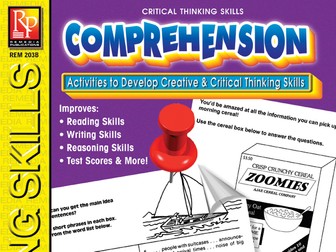
Putting knowledge to work. Comprehension implies the understanding of information and the ability to see basic relationships. The 26 lessons in this unit provide plenty of practice in areas that emphasize comprehension. Students are involved in interpreting verbal and visual communications (A dinosaur “size chart” is provided. “How long was the Tyrannosaurus?”), making comparisons (Using the Table of Contents provided: “Which chapter is shorter?”), and finding relationships with the “big picture” (Using the map of the Lone Star Camp: “Where does the trail from the cabin lead?”). The sequential activities featured here are sure to develop critical thinking skills.
Absurdities: Critical Thinking SkillsQuick View
RemediaPub

Absurdities: Critical Thinking Skills

(0)
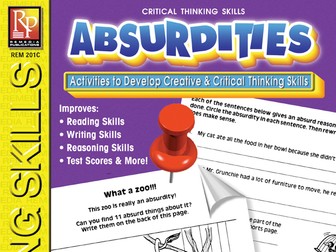
Teaching humor! It’s not at all absurd. In fact, absurdity is at the core of both critical cause-and-effect thinking and basic humor.Example: “We took our dog to training classes so he could learn to chase cars.” The reasoning here is absurd. Can you rewrite the sentence to make a little more sense?From slapstick comedy to abstract puns, absurdity plays a key role. Research now offers evidence of the value of humor as a tool for promoting emotional balance, stimulating intellectual growth, and improving physical well-being. In this learning unit, you’ll find 24 “absurdly” enlightening lessons. The step-by-step exercises are sure to improve thinking and logic skills.
Classification: Critical Thinking SkillsQuick View
RemediaPub

Classification: Critical Thinking Skills

(0)
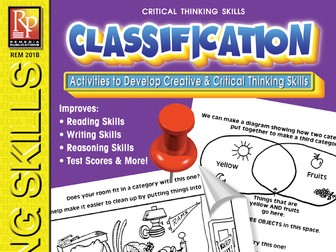
Using object classification activities to exercising important thinking skills! Example: The category is Food. Think of an object in this category that begins with each letter of the alphabet.As students create categories using words and pictures, they develop analysis, discrimination, comparison, and logical thinking skills.The 22 lesson pages featured here pose classification problems - first on a simple, concrete level and then progress to more abstract activities. With these step-by-step exercises, children are sure to give their logic and thinking muscles a good workout.